



Labaron Philon is worth a Top 10 pick in the 2026 NBA Draft. Here’s why.
With the departure of Mark Sears and Chris Youngblood, Philon was due for a bump in his counting stats this season, but it’s been his ability to make such sweeping improvements, particularly surrounding his obvious weakness as a shooter and finisher around the rim, that is indicative of legitimate development, not just inflated stats due to higher usage.
There’s a counterintuitiveness to Philon’s improvement that I find enamoring.
Hypothetically, if a player steps into a heavier-usage, more on-ball role, with a significant uptick in self-creation and playmaking responsibility, while facing more defensive attention, on one of the best teams in the country, you would probably expect his scoring and playmaking efficiency to suffer or, at the very least, plateau...right?
Wrong!
Philon saw a sizable increase in his USG, which actually led to a 7.1% increase in effective field goal percentage and 7.7% increase in true shooting percentage, indicative of an already special offensive talent continuing to make drastic improvements.

PERIMETER SHOOTING
The biggest catalyst for Philon’s jump in efficiency has been his growth as a perimeter shooter, which has helped answer some of the questions that loomed large heading into the season, regarding his ability to consistently stretch the floor.
Given his bump in usage, Philon saw an increase in overall three-point attempts (6.9 att per/100 → 10.3 att per/100), but it’s worth noting that the portion of his shots that came from beyond the arc remained relatively unchanged (3PR .40 → 3PR .42).
The most impressive part of Philon’s shooting development is his ability to improve while simultaneously sustaining a more difficult shot diet than the previous season. Not only did he jump from 31.5% to 39.9% from beyond the arc, but his assisted three-point rate dropped by 29.2 percent, or rather, his self-created three-point share increased by 29.2%. This has allowed Philon to punish defenses off the dribble from beyond the arc, a skill he absolutely had to improve this season.
While his unassisted three-pointers increased, his heaviest volume three-point play type was still no-dribble jumpers, highlighting his ability to toggle between being an on and off-ball threat (36.5%). Given his growth this season, Philon is now much more capable of sliding alongside another lead guard and operating in an off-ball role offensively.
The level of shot difficulty is something I want to harp on again. Philon is extremely comfortable shooting in tight spaces and can now punish defenses that go under screens, something he struggled to do during his freshman season.
RIM PRESSURE
Philon’s improvements from beyond the arc have allowed the most exciting part of his game to flourish: his downhill scoring and rim finishing.
Philon’s somewhat pedestrian 58.1% at the rim last season left plenty to be desired, and he certainly delivered, with a +7.6% increase, jumping up to an elite 65.7% at the rim.
At 6 ‘2.5 (barefoot) and 176.2 lbs, Philon doesn’t overwhelm defenders with his size or speed, so how is he so efficient?....
It breaks down to 4 skills that make Philon such a special driving talent:
Pacing + Ball Handling:
Philon has excellent fluidity, which he pairs with elite start/stop movements, culminating in a herky-jerky pacing that is very difficult for defenders to stay in front of and allows Philon to dictate defenders’ timing.
While he lacks the elite verticality and athleticism that some of his peers possess, his ability to abruptly shift speeds and directions is an elite athletic trait in its own right, and he has enough explosiveness to take advantage of gaps in defensive spacing.
His ability to quickly accelerate, while changing directions, has been critical in allowing Philon to create separation as he gets downhill, but it’s his de-acceleration around the rim that helps create such efficient scoring opportunities, where he is able to mitigate the size and length of defenders by forcing them to mis-time their contest, essentially neutralizing the length Philon faces at the rim.
His handle can only be categorized as “deceptive” and might be the best in the class. When combined with his poise, it allows him to trap defenders on his backside and snake through all areas of the floor.
Stride Lengths + Take-Off Footwork:
Because he is not an above-the-rim finisher, Philon’s skillset is reliant on disrupting defenders’ timing, a large part of which is related to his stride lengths and takeoff footwork on his layups. Despite his lack of positional size, Philon is capable of picking up his dribble from nearly any distance, three-point line, paint, etc, when he pairs that with his array of early take-offs and off-foot/off-hand finishes, Philon is able to remain a dynamic downhill threat, even without a live dribble.
Playing Off of Two Feet:
Once Philon breaches the paint, he is committed to playing off of two feet, which opens up a bevy of scoring opportunities, as defenders are at the mercy of his pumpfakes. From a standstill, Philon has great flexibility and step-through game, allowing him to slide around defenders and create advantages after he’s already generated a paint touch.
Initiating Physicality:
Finally, while he weighed in at 176.2 lbs at the NBA combine earlier this month, Philon plays above his weight, especially around the rim. He is fervently dedicated to initiating physicality and doing so early in his drives downhill. Once around the rim, he is exceedingly comfortable banging with bigger guards and forwards to create space, and doesn’t shy away from contact.
MIDRANGE
Philon’s downhill scoring isn’t limited to finishing at the rim, and he has a beautiful midrange game, both visually and analytically.
As a freshman, he was already efficient from the midrange, shooting an impressive 44.4%, but it came on very low volume, 3.0 att per/100 poss.
As a sophomore, he scaled that part of his game up, increasing his midrange att per/100 poss to 5.6, while maintaining nearly identical efficiency at 44.5%.
Increasing his volume, while maintaining his already impressive efficiency, highlights his elite touch and growth into becoming a true three-level scorer, who has the necessary counters needed for a rim-pressure reliant guard.
PLAYMAKING
I don’t think people understand how smart Philon is.
He stepped into a ball-dominant role this season with a significant boost in offensive and playmaking responsibilities.
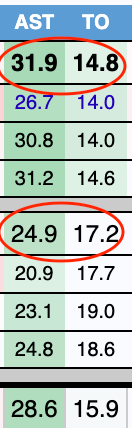
Naturally, his AST% increased, jumping from 24.9 to an elite 31.9, yet his TO% actually dropped from 17.2 down to 14.8. It takes a truly special processor to suppress turnovers while simultaneously creating more for others, especially as his on-ball responsibilities increased.
Visually, Philon’s passing game is simple, which isn’t inherently negative and lends itself to his ability to consistently make the right read. He is more than capable of making flashy and advanced passes when necessary, but he isn’t in an elite tier of playmakers. He thrives passing out of the pick-and-roll, but his lack of size and length can limit the passes he’s capable of completing. His ability to make live dribble dual-handed passes is perhaps his best playmaking trait, and he is very comfortable manipulating defenses with his body language (6th clip).
DEFENSE & REBOUNDING
While I’ve been keen to highlight Philon’s widespread improvement from his freshman season, I would be remiss to not also point out his regression as both a defender and rebounder.
Still, I’m optimistic Philon will be an average defender for his position, mainly given his impressive freshman year defensive profile, with a 1.2 BLK% and 2.9 STL%, solid numbers for a smaller guard, particularly a freshman.
While it certainly isn’t excusable, I do believe that when juxtaposing Philon’s freshman and sophomore year seasons, a large portion of his regression was tied to his jump in usage and hesitancy to pick up fouls, where he had fewer fouls called per/40 this season, 2.0, than last season, 2.7, despite playing 6.2 more minutes.
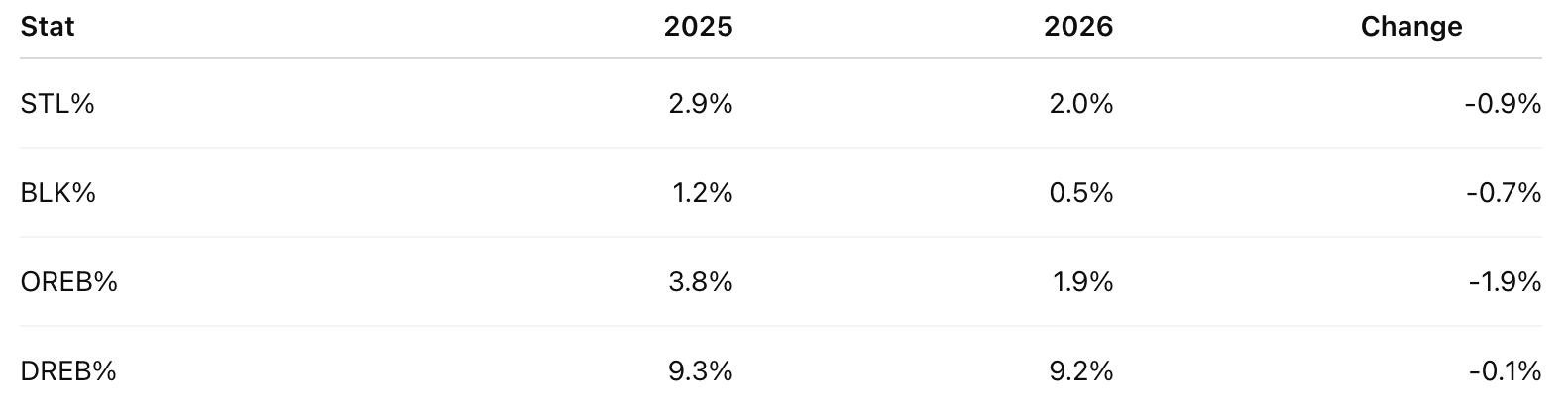
While it may be slightly irresponsible to query Philon’s freshman year numbers, it is this sample size that is likely more reflective of his NBA role, where he can substitute some of his usage for defensive attentiveness.
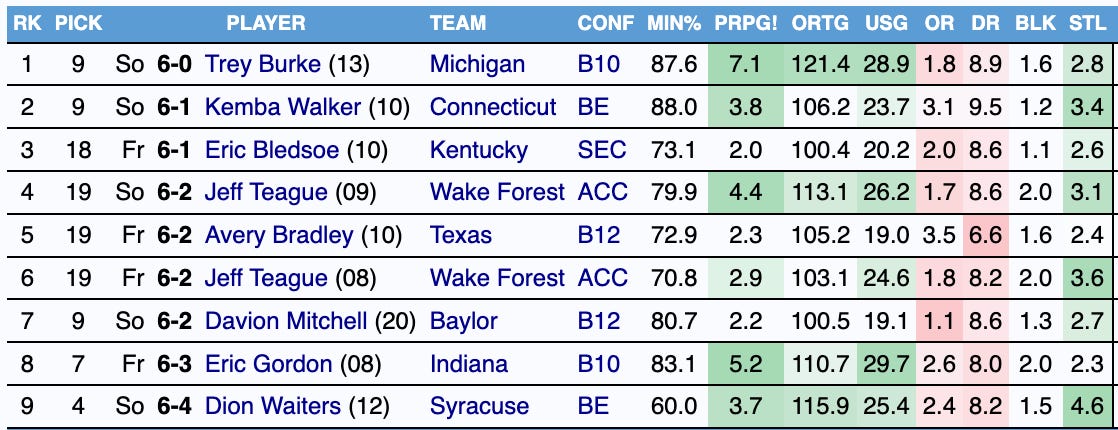
Historically, players at Philon’s size (6 ‘0-6’ 4) with similar rebounding and defensive numbers are able to sustain long NBA careers, although most of them existed in the early 2010s, an era of NBA basketball that favored the small guard more than the modern NBA that Philon is entering.
Still, the overlap of motor and defensive cognition needed to achieve these numbers, at that size, is a combination worth having faith in.
Because he lacks the traditional defensive tools of size and length, Philon relies on being highly engaged and anticipatory to be disruptive. He can be quick enough to stay in front of driving players and has great timing on steals. But especially this season, he struggled to navigate space efficiently and stay close to drivers along the perimeter, giving himself too much space to serve as a buffer between himself and offensive players, allowing opponents ample room to operate. His screen navigation, ball watching, and overall anticipation have significant room to improve, particularly in terms of consistency, because he’s proven he can be impactful when fully engaged.
BODY
I’ve touched on it throughout his profile, but my biggest frustration with Philon is his weight, or rather his inability to gain substantial weight after returning to college for his sophomore year.
2025 NBA Combine
174.6 lbs
2026 NBA Combine
176.2 lbs
Philon needing to add weight has never been a secret, and his struggles to pack on pounds make me dubious he will be capable of adding the necessary size to hit his ceiling, particularly on the defensive end.
For comparison, he is significantly lighter than most of his NBA comps were coming out of college:
Tyrese Maxey - 198lbs (FR)
Andrew Nembhard - 193lbs (JR)
Coby White - 185lbs - (FR)
Still, some players are able to add the needed weight or survive at their current size;
Darius Garland - 175lbs → 192lbs
Dennis Schroder - 175lbs
But realistically, the margin for error for shorter and lighter guards is impossibly slim. To increase his chances of success, Philon must add weight or hope his offense can continue to transcend any physical limitations (not impossible).
OUTLOOK
In my experience, scalability is one of the most underappreciated and underanalyzed traits an NBA prospect can have. I believe Philon embodies it. He can play with or without the ball in his hands, his efficiency improves or stays the same across a variety of usages, and he is a talented playmaker with sought-after turnover suppression.
While he is an older prospect and there are valid concerns about his physical limitations, I feel very comfortable betting on a player with Philon’s overlap of three-level scoring efficiency, competitiveness, IQ, pacing, and solid defensive priors.
In my eyes, he is worth a Top 10 pick and is undoubtedly cemented as a lottery talent.