


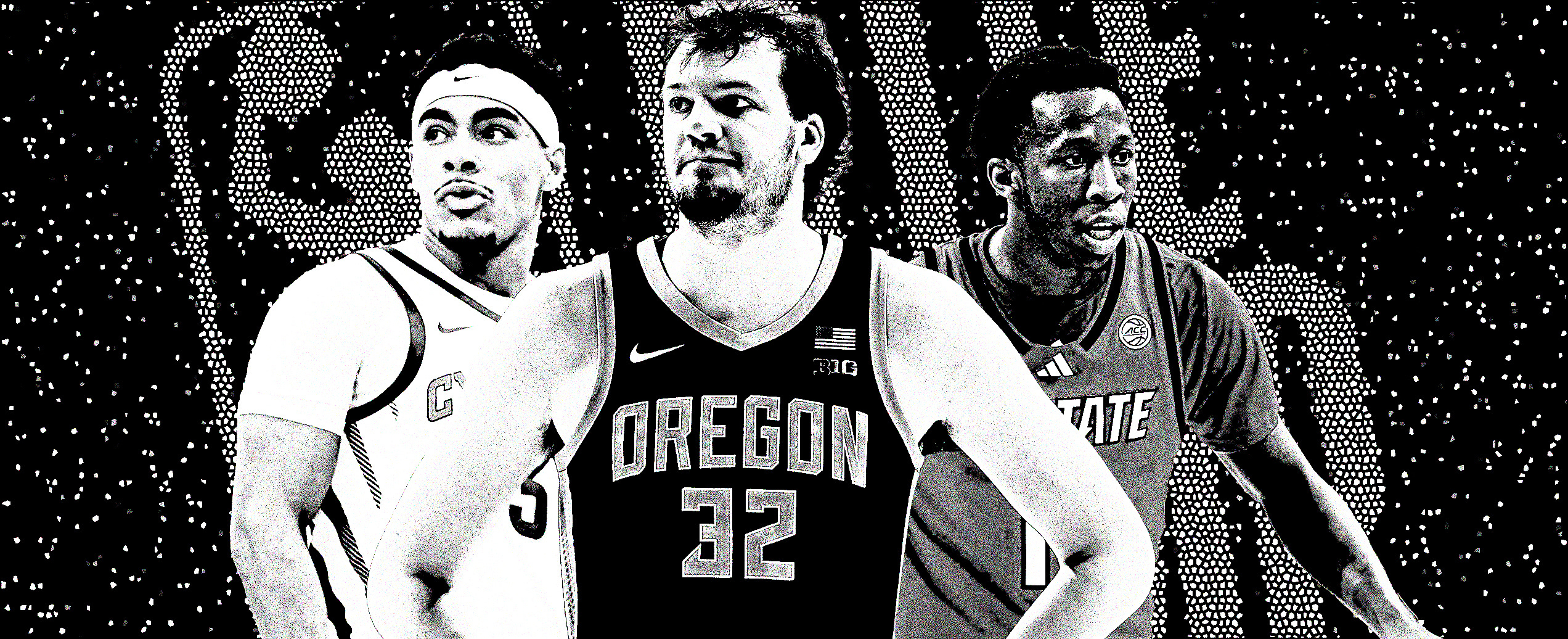
The 2026 AWS G League Combine kicks off on Friday! The stakes are high for these draft sleepers. NBA teams will vote on the best performers in the field, who will subsequently be “called up” to the NBA Draft Combine the following week. Past G League Combine (previously G League Elite Camp) participants include Andrew Nembhard, Max Strus, Jose Alvarado, and Caleb Martin, so this event has routinely produced future starters and high-level rotation players. Today, I’ll be giving my thoughts on every player in the field!
*This field is subject to change*
Michael Ajayi, 6’7”, Butler, Bruising Forward
Michael Ajayi looks and moves like an NBA player. He’s long, strong, athletic, and tougher than a two-dollar steak. The biggest thing that pops with Ajayi, both on tape and on the stat sheet, is his rebounding. He punches way above his size on the glass, constantly battling for position and skying for the ball. He averaged 11.1 RPG with a 9.7 ORB% and a 27.5 DRB% in the ultra-physical Big East this past season. He’s a stifling point-of-attack defender with solid playmaking metrics (1.9 STL%, 2.8 BLK%) and an above-the-rim finisher (31 dunks). The question for Ajayi is whether or not he’s going to space the floor reliably enough to play a wing position, since he’s undersized for a big man role. Ajayi only made 26.1% of his threes on low volume while going 65.3% at the line this past season. He also loves to take tough, low-percentage pull-up twos (15-for-51 on the year per Synergy). His base is a bit inconsistent, and he often has his feet way out wide with knock knees. He’ll likely need a mechanical overhaul in order to find consistency.
DJ Armstrong Jr., 6’3”, UMBC, Sharpshooter
DJ Armstrong Jr. is a dead-eye shooter. He hit 41.9% of his triples on 6.5 attempts per game this past season. His 91.9% mark at the charity stripe further bolsters his case as a high-level sniper. Plus, Armstrong is truly dynamic. Per Synergy, he posted a 47.1 3P% in transition, 44.0 3P% on spot-ups, 43.5 3P% as a pick-and-roll ball-handler, and 37.5 3P% off screens. Plus, he was a reliable playmaker with a two-to-one assist-to-turnover ratio. Still, there are some concerns. Armstrong was primarily a secondary initiator, which is scary given the level of competition he faced. Players of his size who operate more off-ball typically need to stuff the remainder of the stat sheet, but Armstrong’s rebounding and defensive playmaking metrics were all lackluster. Again, given the league he was in, that’s worrisome. Armstrong will want to show he can impact the game in more areas this weekend.
Donovan Atwell, 6’5”, Texas Tech, Sharpshooter
Donovan Atwell is an elite shooter. He hit a ridiculous 45.8% of his threes on 14.2 attempts per 100 possessions this past season. He showed off serious dynamism beyond the arc as well, going 20-for-39 in transition, 9-for-23 on handoff triples, 8-for-18 as a pop man, and 6-for-12 off screens, per Synergy. While he avoids mistakes (4.0 TOV%, 0.8 APG to 0.4 TOV), he didn’t show much juice as a creator (3.9 AST%). His defensive metrics are subpar (2.0 STL%, 0.4 BLK%, 7.9 DRB%), so his two-way equity remains a question. Still, he set the nets on fire at the Portsmouth Invitational, going 40.6% from deep on over ten attempts per contest, so he’s shown he can get the job done on a court loaded with NBA hopefuls. Atwell will need to continue to prove that type of long-range dominance to keep his stock hot in Chicago.
Nate Bittle, 7’0.5”, Oregon, Two-Way Big Man
Nate Bittle has been on the cusp for quite a while now. He’s a massive human being. At last year’s Elite Camp, he came in at 7’0.5” with a 7’5.75” wingspan and a 9’5” standing reach while weighing in at 252 pounds. He has the prototypical size for a drop coverage big man, and he’s actually talented in that capacity. He does a great job of using his length and strength to take away good angles and swallow up opponents inside (career 7.8 BLK%). Offensively, Bittle is a smart passer (19.7 AST%). He likes to shoot threes, taking an exciting 7.1 attempts per 100 possessions over the course of his career, but he’s been inconsistent, with a career 32.8 3P%. Throw in the fact that he’s rather ground-bound (10 dunks last season), and there are serious questions about his athleticism and where he can score efficiently on an NBA floor. Bittle will look to show that his size and smarts are enough to get him over the hump.
Rafael Castro, 6’10”, George Washington, Skilled Rim-Runner/Defensive Playmaker
Rafael Castro is a whirlwind of productive chaos. Offensively, he’s a blur in the open floor. He thrives in transition and has serious bounce (57 dunks). He’s also a hard-charging rebounder (11.8 ORB%, 26.5 DRB%). That said, he’s savvy and skilled enough to produce in the halfcourt. He’s got a great handle for his size, he’s physical, and he reads the floor well, which led to a .762 Free Throw Rate and a 13.1 AST% over the past two seasons. Defensively, he killed it as a roamer this past year, flying into passing lanes and swatting shots at the cup (3.7 STL%, 7.6 BLK%). The issue is that at 226 pounds, he’s on the slender side for a big man, and he’s yet to show he can space the floor. How well Castro matches up against physically larger opponents in the combine setting will be instrumental in how teams view his projection to the next level.
Zach Cleveland, 6’7”, Liberty, Point Forward
A lot of bigger dudes want to call themselves point guards, but Zach Cleveland is the real deal. He was Liberty’s primary offensive hub last season, and he posted a 35.7 AST% that tops what most point guards in this field were able to register. He can attack off the bounce, facilitate from the middle of the floor, or make great reads from the top of the key. Plus, he’s a good athlete who can finish above the rim (21 dunks) and disrupt the opposing offense with his blend of tools and timing (2.2 STL%, 4.0 BLK%). Unfortunately, he’s a non-shooter right now who went a career 4-for-36 from three and 54.5% at the charity stripe. He also struggled to orchestrate in the Portsmouth Invitational Tournament’s less structured environment (1.3 APG to 3.0 TOV), though he made an impact on defense. Cleveland will need to prove he can find a way to provide offensive value on a pro floor.
Jacob Cofie, 6’10”, USC, Defensive Disruptor
Jacob Cofie is a chore to deal with on defense. He has absurd length, and he wants to make plays on the ball all the time. His 5.7 BLK% and 2.4 STL% through two seasons are elite marks for a forward. Cofie can overwhelm opponents with his size at the point of attack; off the ball, he’s constantly seeking out playmaking opportunities. He’ll make his presence felt on the boards, too (8.4 ORB%, 18.3 DRB% in two years at USC). Plus, he has solid feel as a passer, both from a standstill and on the go (12.0 AST%, 1.9 APG to 1.7 TOV). The question is where Cofie can score efficiently enough on offense. His slender frame and contact-averse nature will limit him on the interior at the next level, and his 31.8% mark from deep on low volume makes him someone that NBA defenses can ignore on the perimeter at the moment. Cofie’s non-scoring indicators are all outrageous, so he does have a chance to move the needle if he can hit shots in Chicago. As it stands, he’s one of the more intriguing stay-or-go players remaining.
MJ Collins, 6’4”, Utah State, Walking Bucket
MJ Collins can really score the basketball. He posted 16.5 PPG on 62.0 TS% this past season. Collins is a flamethrower from deep who connected on 36.1% of his threes while taking 12.0 attempts per 100 possessions last year. He has parking lot range and can keep the defense honest off the bounce (40.5% on pull-up threes, per Synergy). He’s also no joke when forced off the line. He has serious lift and tallied an incredible 34 dunks. The issue is that Collins can feel like he’s playing separately from his team at times. He had an assist rate under 10 and doesn’t read the floor particularly well. His defensive effort (1.7 STL%, 0.3 BLK%) can be incredibly frustrating. Collins’s scoring prowess is impressive, but front offices will look to see him impact the game in other areas this weekend.
Quadir Copeland, 6’6”, NC State, Two-Way Wing Creator
Quadir Copeland boasts incredible playmaking prowess for a man his size. He’s big enough to bully smaller guards while still having the craft to break a bigger defender’s ankles and the speed to dice through traffic. Once downhill, he can finish at the rim or make great on-the-go deliveries. Per Synergy, he ranked in the 81st percentile on pick-and-roll possessions including passes last year. His feel and tools enable him to impact the game defensively, too, as shown by his 3.6 STL%. While Copeland went 39.7% from deep last year, his volume was low, and his career mark from long range sits at 28.5%. Still, at the Portsmouth Invitational Tournament, he took four threes per game and made a third of them. Mechanically, his shot looks sound. Copeland’s length, mental processing, skill, and athleticism make him one of the bigger upside propositions in the field. If the shot sticks, he could be a serious needle-mover at the next level. A big outing in Chicago could go a long way in hearing his name called on draft night.
Melvin Council Jr., 6’3.75”, Kansas, Caretaker Guard
Melvin Council Jr. is as steady as it gets. He excels at organizing the offense, as indicated by his 28.8 AST% and 2.7 assist-to-turnover ratio last season. He’s a quick thinker who finds openings in a hurry. Defensively, his long 6’9.5” wingspan gives him more to work with than most true point guards. Throw in his ability to process the game and his speed, and he posted a 2.6 STL% and 1.5 BLK% over the course of his Division-I career. Unfortunately, he’s long struggled to score efficiently. This year, he went 39.2% from the field, and he’s a career 29.1% three-point shooter. Council was one of the best players at the Portsmouth Invitational Tournament, where it was clear that his athleticism and feel were a cut above most of the field. How well Council produces against a higher tier of competition at the G League Combine will be instructive as to how translatable his skill set will be in the pros.
Tucker DeVries, 6’7”, Indiana, Dribble-Pass-Shoot Wing
Tucker DeVries loves to let the long ball fly. While his 35.9% mark from distance throughout his college career seems run-of-the-mill, there’s more to like there the deeper you dig. He took 12.5 attempts per 100 possessions throughout his career, and he was often his team’s clear-cut lead option, so he wasn’t getting easy ones, either. DeVries can bomb deep triples off movement. Still, he’s not just a shooter. He plays low to the ground with his handle and he’s strong, so he can get downhill and read the floor (18.3 AST% last season). Defensively, he’s not fleet of foot or particularly bouncy, but he has great recognition as a team defender. As a result, he’s long posted solid playmaking metrics (career 17.0 DRB%, 2.2 STL%, 1.9 BLK%). DeVries’s injury history and sub-40% mark from the field this past season are both discouraging factors that need to be taken into account. Still, the framework of a valuable role player is here. If he can thrive at the G League Combine, there’s a good chance he could hear his name called on draft night.
Tre Donaldson, 6’1.75”, Miami (FL), Traditional Point Guard
Tre Donaldson thrived in Miami’s high-skill, high-feel environment. He thrives at organizing the offense and registered a gaudy 29.6 AST%. As a career 37.7% shooter from deep, he’s a reliable threat to space the floor. He uses that gravity to get downhill, where he has above-the-rim bounce. Plus, the necessary bailout shot-making chops in the mid-range are here. Donaldson’s speed and savvy made him a standout at the Portsmouth Invitational Tournament, where he routinely got to his spots and averaged 5.0 APG to 2.3 TOV. And while he’s short, his 208-pound weight and a 6’5” wingspan give him some insulation. Donaldson’s lackluster defensive playmaking metrics and the jack-of-all-trades, master-of-none nature of his game leave him in a tough spot given his height. Given the NBA’s lack of appetite for smaller guards, he’ll likely have to blow it out of the water this weekend to overcome that stigma.
Reynan dos Santos, 6’4”, Mexico City Capitanes, Downhill Combo Guard
Reynan dos Santos loves to get to the rack. He uses his blend of rhythm, long strides, and funky movement patterns to collapse the defense time and time again. Per Synergy, he took 43.4% of his halfcourt shots at the cup, and he converted 57.1% of them. He also boasts solid recognition as a passer (1.7 APG to 1.2 TOV). Defensively, his length and quickness enable him to stay in front at the point of attack. He routinely gives a second effort when clipped by screens. There are some hangups. His jumper isn’t consistent, as he went 31.9% on catch-and-shoot threes, per Synergy. Defensively, he has some lapses off the ball and doesn’t always boast the best anticipation on switches. If dos Santos can drill threes and stay engaged defensively, he has a chance to climb.
Malique Ewin, 6’10”, Arkansas, Possession Battle Big
Malique Ewin thrives at generating extra possession for his team. He loves to slither his way into inside position on the offensive glass. His 15.7 ORB% was one of the best marks in the country. Once he grabs the ball, he’s an elite put-back threat (85th percentile, per Synergy) thanks to his bounce and soft touch. If his look isn’t there, though, he has great eyes for spray out passes (11.6 AST% in D-I play). Defensively, he moves his feet well on the perimeter. His lack of strength is an issue, as he’s on the wiry side, doesn’t stay strong through his chest well (5.4 BLK%, 6.0 fouls per 100 possessions), and doesn’t hold up as well on the defensive glass (15.5 DRB%). If Ewin can show defensive refinement and improved physicality, he could be a name to watch given his analytically-friendly play style.
Jamal Fuller, 6’5”, Long Island, Physically Imposing Wing
Jamal Fuller may not have been on everyone’s radar at Long Island, but the man was productive. He led the NEC in BPM this past season. Defensively, his well-developed frame and hounding playstyle helped him to average 1.0 SPG and 1.1 BPG. Offensively, he loves to bully his way to the cup, where he made 59.4% of his halfcourt rim attempts, per Synergy. Add in the fact that he sees the floor well (14.7 AST%) and can knock down a three (43% on 6.0 attempts per 100 possessions), and there’s an interesting blend of strength and well-roundedness here. Fuller’s back-to-the-basket playstyle will need to be adjusted. The fact that he’s a six-year college player who played in a smaller conference doesn’t help his perception, either. Fuller will want to show he can adapt to a more NBA-friendly style while still remaining productive in Chicago.
Jaden Henley, 6’6.75”, Grand Canyon, Versatile Wing
Jaden Henley took the draft world by storm after an incredible string of performances at the Portsmouth Invitational Tournament. There, he averaged 15.3 PPG while dominating opponents on the defensive end (3.3 SPG). Offensively, Henley is best when going downhill. He aggressively seeks contact (.505 FTr), and he’s super bouncy (27 dunks). He also has solid passing feel (20.1 AST%). Defensively, he’s a persistent threat in passing lanes, and he loves to strip unsuspecting ball-handlers (2.9 STL%). The issue for Henley is that he’s long been an inconsistent three-point shooter. His results have varied, and his process can be frustrating; he’ll take exceedingly difficult looks sometimes while occasionally hesitating on open opportunities. Henley’s defensive output, feel, rebounding, and downhill prowess give him ways to withstand cold streaks, but if Henley can’t find consistency from deep, his mileage may vary. If Henley gets hot from three in Chicago, though, watch out.
Bryce Hopkins, 6’6”, St. John’s, Skilled Bruiser
Bryce Hopkins can power his way to his spots and score all over the floor. He has an old-school interior game, where his strength and a bevy of counters allow him to generate space in the mid-range and get clean looks at the cup. Still, his touch extends beyond the arc, where he hit 36.6% of his threes over his past two seasons. He’s also a smart passer who relishes the opportunity to punish double teams. Hopkins also leverages his physicality on the glass (7.3 ORB%, 16.5 DRB%) and at the point-of-attack on defense. The hangup here is that Hopkins lacks quickness and bounce, and he’s also dealt with a series of knee injuries over the years. How well his medicals hold up, paired with his lack of traditional athleticism, could give teams pause. Hopkins will want to move as well as possible while adapting to more of a traditional NBA style this weekend.
Graham Ike, 6’9”, Gonzaga, Skilled Powerhouse
Graham Ike is a physical force. He thrives at carving out space on the boards on both ends of the court (career 10.2 ORB%, 22.7 DRB%). Still, where Ike impressed me most this season was with regard to his skill development. Despite tipping the scales at 245 pounds, he had impressive moments of putting the ball on the floor to shake defenders before pulling up or whipping the ball to an open teammate (13.7 AST%). Ike’s handle, feel, 33.8% mark from deep, and 79.7 FT% give credence to the idea that he could fit in a five-out system. Defensively, things are less clear. He can move his feet well, but his positioning, particularly in ball screen coverage, can be maddening. His 3.3 BLK% this past season was a poor mark for a big man, and particularly scary given his lack of height for a center. If Ike can show greater defensive polish while knocking down jumpers, he could get some real buzz going.
Kasen Jennings, 6’3”, Appalachian State, Scoring Guard
Kasen Jennings can fill it up. He scored 15.2 PPG this past season while earning All-Sun Belt Second-Team honors. He’s comfortable pulling up both from three and in the mid-range, and he made 55.2% of his halfcourt rim attempts. He’s also able to see the floor and hit open teammates (2.1 APG to 1.6 TOV). The issue here is that Jennings isn’t over-the-top great in any given area. He’s a career 33.7% from deep, he’s a run-of-the-mill athlete, he’s not a true initiator, and his defense is just okay. Jennings had to take on a huge usage burden this past season, so the hope here is that when he’s on a floor loaded with more talented players, he can shine in other areas.
Trey Kaufman-Renn, 6’8.25”, Purdue, High-Feel Bruiser
Trey Kaufman-Renn is quite the conundrum. He’s an awesome, physical rebounder (13.2 ORB%, 23.7 DRB%) who rocks at establishing interior position and holding onto it. Then, there are the modern flourishes. He’s a dynamite passer who posted a 17.2 AST% and a 1.8 assist-to-turnover ratio while acting as a short-roll playmaking hub for the Boilermakers. He’s a killer in 4-on-3 settings who can quickly make the right pass or hit his signature push-shot floater at a preposterous clip (47-for-78, per Synergy). The flaws are extremely severe, though. He’s a heavy-footed, ground-bound athlete who rarely finishes above the rim, doesn’t make plays on defense (0.8 STL%, 1.0 BLK%), and can’t space the floor. There are real questions about who he defends and where he scores on an NBA floor. That said, he started to win me over after dominating the Portsmouth Invitational Tournament (17.3 PPG, 5.4 RPG, 3.3 APG, 1.3 SPG). The name I keep coming back to is Tolu Smith, who might not be what NBA teams traditionally look for, but he was so strong, smart, and talented that he still carved out a spot. TKR will want to further that narrative in Chicago.
Keba Keita, 6’7”, BYU, Small Ball Big
Keba Keita’s flaws are extremely obvious. He’s a 6’7” center who never made a three-pointer in college, shot 50% at the free-throw line, and posted a minuscule 2.2 AST% during his senior season. Generally, undersized interior players need to have those types of skills in order to compensate for their lack of length. The good news for Keita, though, is that he’s an awesome athlete with a ridiculous motor. His bounce helped him to post an 8.3 BLK%, far more common among 7’1” dudes than 6’7” players. He’s also fast enough that he can do way more on the perimeter than most centers (2.6 STL%). Plus, he’s still hard to shut down on the glass. His career 14.8 ORB% and 23.0 DRB% are incredible numbers. Keita’s measurements will be extremely important, as will his on-court performances against players with true NBA size.
Jaxon Kohler, 6’9”, Michigan State, Rebounding Stretch Four
Jaxon Kohler brings power and touch to the table. He’s a hard-nosed rebounder (12.8 ORB%, 25.0 DRB%) who uses his physicality to control the glass on both sides of the floor. Unlike most interior bangers, though, the dude can shoot. He took 9.2 threes per 100 possessions and sunk 38.9% of them, an impressive marriage of volume and efficiency for a man his size. Given that spacing and rebounding are hot topics at the moment, that bodes well for Kohler. Still, his ball skills and processing need work. He averaged 1.3 APG to 1.4 TOV last season, and at the Portsmouth Invitational Tournament, he had zero assists and seven turnovers over the course of three games. He’s a hair undersized and not bouncy enough to traditionally anchor a defense, nor is he nimble in space, raising questions about who he guards. Kohler will want to show off his shooting and toughness while also showing that he can defend and reliably make decisions this weekend.
Kobe Knox, 6’5”, South Carolina, Downhill Wing
Kobe Knox wants the smoke. He attacks the rack with great fervor, and he gets great results, too. Per Synergy, 39.4% of his halfcourt rim attempts came at the rim, and he made an impressive 59.5% of them while also displaying the hops to finish above the basket. Throw in a .530 FTr, and if he gets to the line a lot, too. His 4.5 ORB% points to his tenacity on the boards, too. Knox is also a solid passer (13.7 AST%). Defensively, his fundamental stance with long lateral strides, paired with his great frame, makes him tough to beat at the point of attack. Per Synergy, he held opponents to 4-for-13 shooting on isolation possessions last season. The issue here is the shot, as Knox only hit 31.1% of his threes on low volume for a wing this past season. If he can get the shot on track, there could be a path for him, but right now, it’s got him on the outside looking in.
Xaivian Lee, 6’3.5”, Florida, Traditional Point Guard
Xaivian Lee had a down year at the wrong time. He was a hot name coming into the year, but his 42.0/29.2/76.5 shooting splits greatly diminished his buzz. He can launch frustrating, tough shots with plenty of time left on the shot clock. That said, it’s hard to be all the way out. Lee can really move. He has a myriad of ways to collapse defenses, and he’s a capable live-dribble passer who averaged 4.2 APG to only 1.9 TOV for a great Gators team. Defensively, his speed, bounce, and tenacity led to a 16.9 DRB%, 2.2 STL%, and 1.1 BLK% for his career. Plus, Lee is coming off a great outing at the Portsmouth Invitational Tournament, where he continued to play even after a brutal fall onto his wrist. If Lee can reel in his wilder tendencies, he has a lot of the tools and skills required of an NBA guard.
Malique Lewis, 6’8”, SE Melbourne Phoenix, Two-Way Wing
Malique Lewis quietly put together an excellent season in Australia’s NBL. The downside here is that he doesn’t offer much in the way of self-creation. He only took nine twos that were generated off a spot up, and Synergy tracked 22 total driving scoring possessions the whole season. The good news is that he’s an awesome offensive connector. He sunk 39% of his catch-and-shoot threes, he’s an outstanding snap decision maker (2.0 APG to 0.7 TOV), and he knows how to move without the ball. He gets after it on the boards on both sides of the court (6.0 ORB%, 18.1 DRB%). Defensively, his frame, feet, and timing make him a versatile point-of-attack defender and a potent disruptor (2.5 STL%, 2.8 BLK%). Lewis might not have the most mesmerizing highlight tape, but the plug-and-play potential here is extremely intriguing.
Tamin Lipsey, 6’2”, Iowa State, Possession Battle Guard
Tamin Lipsey’s flaws are easy to spot. He’s an iffy shooter who went 31.6% from deep this past season. He’s also coming off a lackluster outing at the Portsmouth Invitational Tournament. There, he averaged 4.3 PPG and shot 37.5% from the field. The measurements portion of the event didn’t go great either, as he came in with a 6’2.5” wingspan and a 7’11” standing reach. That said, I still think he has a real chance to stick at the next level. He has an intriguing blend of strength, speed, and savvy. He’s a shifty driver with excellent playmaking vision (28.0 AST%, 10.9 TOV%). He’s also a physical, sneaky presence on the offensive glass. (5.2 ORB% this season). Defensively, he creates chaos all over the floor, as shown by his career 4.4 STL%. Lipsey thrives at getting into passing lanes and stripping his man at the point of attack. There’s always the possibility that his lack of scoring gravity will be too much to overcome, and scouts will be eager to see if he can put the ball in the bucket in Chicago. Even still, his knack for generating great shots for others, avoiding turnovers, and creating transition opportunities makes him one to watch.
Fletcher Loyer, 6’4”, Purdue, Sharpshooter
Fletcher Loyer has an otherworldly shooting resume. He hit over 43% of his threes during each of his final three college seasons. This past season, he sunk 43.2% of his triples on 12.5 attempts per 100 possessions. There’s not a shot in the book he can’t hit, which is why he ranked out in the 80th percentile and above in Synergy’s efficiency categories for shots out of spot-ups, off screens, in transition, and stemming from handoffs. He’s also a great “keep it moving” passer who averaged 2.1 APG to 1.0 TOV. Loyer’s career 1.3 STL%, 0.2 BLK%, and one total dunk are gigantic athletic red flags. Loyer will be looking to prove he can provide something on the defensive end to stay above board.
Aidan Mahaney, 6’3”, UC Santa Barbara, Scoring Guard
Aidan Mahaney did a great job of filling it up this past year. He posted 14.9 PPG this past year, with his best work being done beyond the arc. Mahaney hit 38.5% of his threes on 6.1 attempts per game despite drawing heaps of defensive attention. Mahaney leveraged his gravity to make his teammates better, too. His 2.7 APG was a career high, and he had the first two-to-one assist to turnover ratio of his career, too. There are serious scalability concerns here, though. Mahaney struggled mightily in his lone high-major season at UConn. His minuscule non-scoring advanced numbers (.215 FTr, 5.9 DRB%, 1.3 STL%, 0.2 BLK%) are scary and point to how quickly his impact can diminish on the nights where he can’t get his shot going. Mahaney will look to prove that his bounce-back senior season was a case of genuine improvement rather than a bump that came from playing lesser competition.
Robert McCray V, 6’4”, Florida State, Athletic Point Guard
Robert McCray V has some incredible highlight tape. He’s thrown down some preposterous dunks over the years, both in transition and in a halfcourt context. His tools show up on defense as well, where he can fly in for help blocks around the basket (2.1 BLK%), or nab pick-six steals in passing lanes (2.5 STL%). On offense, he did it all for the Seminoles, which is made evident by his elite 43.8 AST%. The issue here is that McCray can be ball-dominant and take too long with the ball in his hands, leading to turnovers. During the Portsmouth Invitational Tournament, he averaged 3.0 APG to 5.0 TOV. Simply put, the ball can stick with him, and when he doesn’t make something happen, it gets ugly. Throw in inconsistent results from deep over the years, and McCray can be tough to get a read on. If he can speed up his offensive process, produce steadier results from three, and continue to remain active defensively, he’s got a real chance. Chicago should provide insight as to whether he’s closer to that or more of a long-term G League development project.
Kevin “Boopie” Miller, 6’0.5”, Southern Methodist, Traditional Point Guard
Kevin “Boopie” Miller plays the right way. He’s a true point guard who blends a steady, crafty style with speedy bursts. Regardless of which tempo he’s playing at, he usually gets to where he wants on the floor, and he has no shortage of ways to win wherever he ends up. He’s a lights-out shooter (41.4% from three last season), a tough finisher (.435 FTr, 60% at the rim in the halfcourt per Synergy), and an excellent passer (30.6 AST%). His size is a real issue, though. During the Portsmouth Invitational Tournament, Miller posted a meager 6’0” wingspan while tipping the scales at a paltry 160 pounds. As a result, there are serious concerns about how well he can handle the NBA’s physical play style, and he’s likely to be a frequent mismatch target on defense. Miller will look to show that his skill and savvy are enough to overcome his lack of size.
Mark Mitchell, 6’8.25”, Missouri, Ultra-Physical Forward
Mark Mitchell is big, strong, and smart. He was perhaps the biggest winner of the measurements portion of the Portsmouth Invitational Tournament. There, he came in at 6’8.25” with a 7’2.5” wingspan, an 8’11” standing reach, and a weight of 238 pounds. He is massive. On offense, he likes to bully his way to spots and draw fouls (.713 FTr). Plus, he can pass it when defenders come to help and create openings (21.2 AST%). Defensively, he smothers opponents with his physicality and size. The question is whether or not he’ll be a respectable enough shooter. His 38.8% mark from deep last year seems awesome, but he only took 2.6 of them per 100 possessions, and his career 67.1% mark at the charity stripe leaves a lot to be desired. If he’s not going to shoot it, the rest of his offensive value diminishes pretty quickly. But if he can become a knockdown guy, he could be a valuable rotation piece.
Aaron Nkrumah, 6’6”, Tennessee State, Two-Way Wing
Aaron Nkrumah is one of the most fascinating players in the field. He’s able to put the ball in the bucket at all three levels. He hit 36% of his catch-and-shoot threes on good volume, he showed comfort pulling up both in the mid-range and beyond the arc, and he posted 21 dunks on the season per Synergy. He’s also an absolute menace on defense. His 5.0 STL% is truly an outlier mark. He has ridiculous hand speed at the point of attack. He had some of the most breathtaking point-of-attack takeaways I saw all season when I studied his tape for the NCAA Tournament preview. An opponent will have their dribble super tight and away from Nkrumah, and he still just…gets it away from them somehow. It is mesmerizing to watch. The issue here is that Nkrumah is rail-thin. He’s listed at 175 pounds. Physicality was a problem for him even at the mid-major level, where he only made 53.2% of his halfcourt rim attempts per Synergy because he had a hard time playing through contact. Defensively, bigger players might plow right through him. I do wonder if there’s a Keon Ellis-type outcome in the cards if it all clicks. He’s one of the “mystery” prospects I’m most excited to see in Chicago. The size of other players may be way too much for him, but conversely, he may blow people’s minds with his skill and aggressiveness.
Jaron Pierre Jr., 6’5”, Southern Methodist, Athletic Wing
Jaron Pierre Jr. has a really intriguing blend of shooting and athleticism. Per Synergy, he hit 41.1% of his catch-and-shoot threes. If defenders give him driving lanes, though, Pierre is a terrifying runway athlete who can throw down some nasty jams. He posted 21 dunks on the year and converted a respectable 55.6% of his halfcourt rim attempts on the year, according to Synergy. His end-to-end speed and shot-making prowess profile well to the NBA’s tempo. He also got better as a passer over the past two seasons, registering a 17.2 AST% over that time. Defensively, Pierre leaves something to be desired. His off-ball attention to detail waxes and wanes, which is quite concerning for a player who started college in 2020. If Pierre can make an impact on both ends in Chicago, he could shoot up boards.
Malik Reneau, 6’9”, Miami (FL), Bruising Forward
Malik Reneau is a bullying, crafty player on the interior. He can overwhelm opponents with his physicality or shake them with his old-school post moves. He makes some incredible passes from time to time, too (career 16.2 AST%). Throw in the fact that he’s a great offensive rebounder (career 10.2 ORB%) and a solid three-point shooter (34.7% on nearly five attempts per 100 possessions last year), and there’s enough of a modern framework to his game to buy into his NBA potential. Still, Reneau’s jumper isn’t totally consistent yet, as he went 25% from deep on 1.3 attempts per game at the Portsmouth Invitational Tournament. Also, for every good pass he throws, he throws a bad one (2.8 TOV to 2.1 APG). Defensively, his 6’11” wingspan makes him undersized for a five, and his perimeter engagement isn’t quite up to snuff. If Reneau can hit shots from deep and play good defense, he could get the Combine call-up. If not, teams will see him as more of a developmental project.
Kowacie Reeves Jr., 6’7”, Georgia Tech, Dynamic Wing Scorer
Kowacie Reeves Jr. is coming off a monster outing at the Portsmouth Invitational Tournament. There, he scored 23.0 PPG on 56.8/42.9/76.9 splits. He looked lethal from long range in that context, and his 38.7% mark from deep on high volume this past season further bolsters his shooting resume. He’s a quick mover who can separate off the ball and drill deep triples. Still, he’s good inside. He made 44.4% of his mid-range pull-ups and 67.3% of his halfcourt rim attempts last season, and he threw down some big-time dunks at the PIT. Throw in a 6’10.5” wingspan and solid defensive playmaking metrics (1.7 STL%, 2.5 BLK%), and there’s reason to believe he could impact the game on both sides of the ball. Unfortunately, there are some questions about how he processed the game. He averaged 1.2 APG to 1.4 TOV last season, and he had a negative assist-to-turnover mark in Portsmouth. Reeves is regarded as an intelligent person off the floor, so there’s hope here. Plus, there aren’t that many guys with real-deal athleticism who can shoot like he does. If Reeves can stay a step ahead mentally, his ascent will continue. If not, he should still be able to keep a healthy degree of interest.
Jaylin Sellers, 6’4”, Providence, Bucket Getter
Jaylin Sellers can definitely score the basketball. His 18.3 PPG was the top mark in the Big East, and his 47.3/42.9/85.9 splits show he wasn’t just needlessly chucking it, either. Per Synergy, he went 42% on catch-and-shoot threes, 44.4% on pull-up threes, 44.1% on pull-up twos, and 62.7% at the rim, so he’s good from everywhere. Unfortunately, there’s not much insulation here. He only had a 10.6 AST% despite massive usage. Defensively, he doesn’t put in a lot of effort (1.7 STL%, 0.8 BLK%). At the Portsmouth Invitational Tournament, his efficiency wasn’t where it needed to be (38.7 FG%, 18.8 3 FG%). Sellers will want to show that he can contribute in other areas this weekend.
Markhi Strickland, 6’5”, North Dakota State, Interior Athlete
Markhi Strickland loves to get out and run. He ranked in the 96th percentile of transition frequency, and he dunked 36 times this past season, per Synergy. In the halfcourt, he loves to back his man down before converting inside. He took 8.6 FGA/game, and all of them were twos. His 6.2 ORB% is good for a man his size, too. There are serious questions about how scalable his game will be to the NBA when he’s competing against other high-level athletes, though. He went a career 8-for-36 from three in college and only made 49.3% of his career free throws. His defensive disruption (career 2.3 STL%, 1.0 BLK%) likely isn’t enough to compensate for his lack of a shot, either. Strickland will need to show viability from deep to move the needle.
Aiden Tobiason, 6’5”, Temple, Dribble-Pass-Shoot Athletic Wing
Aiden Tobiason is one of my favorite long-term prospects in the field. He just finished his sophomore year and does have the option to return to school, but I think there’s a chance he could rise and stay in, given the value of his modern skill set. Tobiason is a career 35.8% three-point shooter on 6.8 attempts per 100 possessions, and he’s hit a solid number of triples off movement. That said, he’s best going downhill. He dunked 25 times last year and converted an awesome 65% of his halfcourt rim attempts, per Synergy. Plus, he has a fluid process on the go and slung 2.0 APG to only 1.4 TOV. Defensively, his playmaking metrics (10.8 DRB%, 2.1 STL%, 0.6 BLK%) aren’t anything to write home about, but his lateral footspeed and aggressiveness at the point-of-attack make him tough for opponents to deal with. Tobiason does have the safety net of returning to school. That said, athletic wings who can hit threes, finish, make good decisions, and guard the ball come at a premium. If Tobiason shows out, he could be a serious riser given the lack of wing depth in this class.
Seth Trimble, 6’3”, North Carolina, Absolute Dog
Seth Trimble is a nightmare to deal with on the defensive end. While his stats don’t seem out of this world (2.3 STL%, 0.6 BLK%), he’s a suffocating threat at the point of attack. He took on the toughest assignment every night and had possessions where he shut down everyone from Darryn Peterson to Cameron Boozer. At the Portsmouth Invitational Tournament, Trimble blew the athletic testing out of the water and measured with a 6’8.5” wingspan. Plus, he scored an efficient 14.0 PPG. Offensively, he’s best as an attacker. He took 35% of his halfcourt shots at the rim, which is a high mark for a guard, and his toughness is made clear by his .541 FTr. The flaws are pretty scary. He’s a career 28.6% from deep on low volume and a 68.7% free throw shooter. His passing isn’t awesome, as his career-high assist rate topped out at 16.6%, and he had a negative assist-to-turnover mark at the PIT. His lack of shooting and subpar playmaking may be too much to overcome, but I’m terrified to bet against him.
Cade Tyson, 6’7.5”, Minnesota, Sharpshooting Wing
Cade Tyson has a fantastic shooting resume. He took 507 threes over the course of his college career, and he sunk 42% of them. While he’s best from a standstill (52.8% on spot-up threes per Synergy), he does have some movement dynamism to him. While he only tipped the scales at 198 pounds at the Portsmouth Invitational Tournament, he’s still a tough interior player. He’s able to fight to his spots in the mid-range, he made a jaw-dropping 78.3% of his halfcourt rim attempts according to Synergy, and he posted a .558 FTr, so he has answers when run off the line. He’s also a solid rebounder, and at the PIT, I thought he was one of the better “.5 passers” throughout the course of the event. He’s very limited as a defensive playmaker (1.3 STL%, 0.7 BLK%), but he knows how to play long, use his chest, and contain the ball. Tyson might never bring the two-way impact teams crave, but in Chicago, he’ll have another chance to prove that he can put up enough of a fight on the defensive end for his sharpshooting to sing.
Ernest Udeh Jr., 6’10.75”, Miami (FL), High-Motor Big
Ernest Udeh Jr. immediately stood out from the crop at the Portsmouth Invitational Tournament because he simply looked so much different than everyone else there. At 6’10.75” with a 7’4.5” wingspan, a 9’3” standing reach, and a 262-pound frame, Udeh has the measurements of a true-blue NBA center. Throw in the fact that he is a terrifying mover, and there’s a lot of reason for excitement. He’s a killer rebounder (13.1 ORB%, 25.8 DRB%) and a frightening rim runner (62 dunks last season per Synergy). On defense, he does an exquisite job of sliding his feet when switched onto smaller players, and he’s still big enough to hold his own against true bigs on the block. The concern here is Udeh’s level of feel. He’s never been trusted to do much with the ball, and he had a worrisome 3.0 AST% last season while averaging 0.5 APG to 0.6 TOV. Defensively, his 5.8 BLK% is disappointing for any true five, but particularly for one with his tools. Udeh looks like a great bet to eat innings, but if he can show some ball skills and consistency as a rim protector, it would go a long way as we approach draft night.
Lamar Wilkerson, 6’4”, Indiana, Sharpshooter
Lamar Wilkerson is a serious shotmaker. He hit 41% of his threes on 8.1 attempts per game over the past two seasons. His 37.0 3P% mark coming off screens and 42.6 3P% on pull-up attempts point to his shooting versatility, too. Wilkerson isn’t toast when he’s run off the line, either. Per Synergy, he made 50% of his pull-up twos and 61.2% of his rim attempts in the halfcourt this past year. He improved as a ball mover, too, with his 15.9 AST% and 2.4 APG to 1.6 TOV proving that he’s a reliable decision maker. I do worry about Wilkerson’s two-way impact. He may fall into the troublesome “Not Quite Wing” archetype, as he’s not a dynamic ball-handler and he’s undersized for a 2/3. While he has a strong, bulky frame, his defensive metrics (1.7 STL%, 0.6 BLK%) grade out poorly, which further complicates the matter. Wilkerson’s measurements will be important, as will his defensive output in the scrimmages.
Darrion Williams, 6’6”, NC State, Skilled Wing
Darrion Williams has some concerning athletic limitations. He’s not particularly fast covering ground, he doesn’t get off the floor with the greatest of ease, and he’s on the heavier side. That said, he really, really knows how to play productive basketball. Williams hit 40.4% of his threes on 11.2 attempts per 100 possessions this past season, so he’s a real-deal floor spacer. While he might not be able to explode to the rim when run off the line, he’s one of the best on-the-go decision makers you’ll find anywhere. Williams reads the game at an advanced level and boasts excellent pass placement. He can make impressive deliveries through super-tight windows in heavy traffic. Defensively, he’s always posted solid steal rates (career 2.4 STL%) because he thinks the game at a high level and has outstanding timing. Front offices may worry about his athletic profile, but Williams will look to show that he’s simply too good at basketball to ignore.
Noam Yaacov, 6’1”, Telenet BC Oostende, Traditional Point Guard
Noam Yaacov is an excellent offensive initiator who has been one of the best players in Belgium’s top pro league this season. He’s a mesmerizing pick-and-roll creator who keeps the ball on a string, utilizes ball screens in a variety of ways, and uses speed changes to keep defenses on their toes. He’s able to get to the rim at will and convert once he’s there (62.3% on halfcourt shots at the basket, per Synergy). Still, he can keep defenses honest with the threat of his jumper (36.8% on 136 pull-up threes this year per Synergy). Throw in a penchant for physicality (.548 FTr) and a deceptive, crafty passing game (6.1 APG to 2.7 TOV), and his on-ball equity is off the charts. Plus, his 47.4% mark on catch-and-shoot threes gives him off-ball value, too. Defensively, he’s a great rebounder for his size (16.8 DRB%), but he’s not much of a playmaker (2.2 STL%). His lack of length and tendency to open up his hips too easily are big problems on that side of the ball. Yaacov might be the most underrated player in the field, but the defensive concerns are no joke. It will be fascinating to see how he looks on that end of the ball in Chicago.
Is there a place this is streaming?