


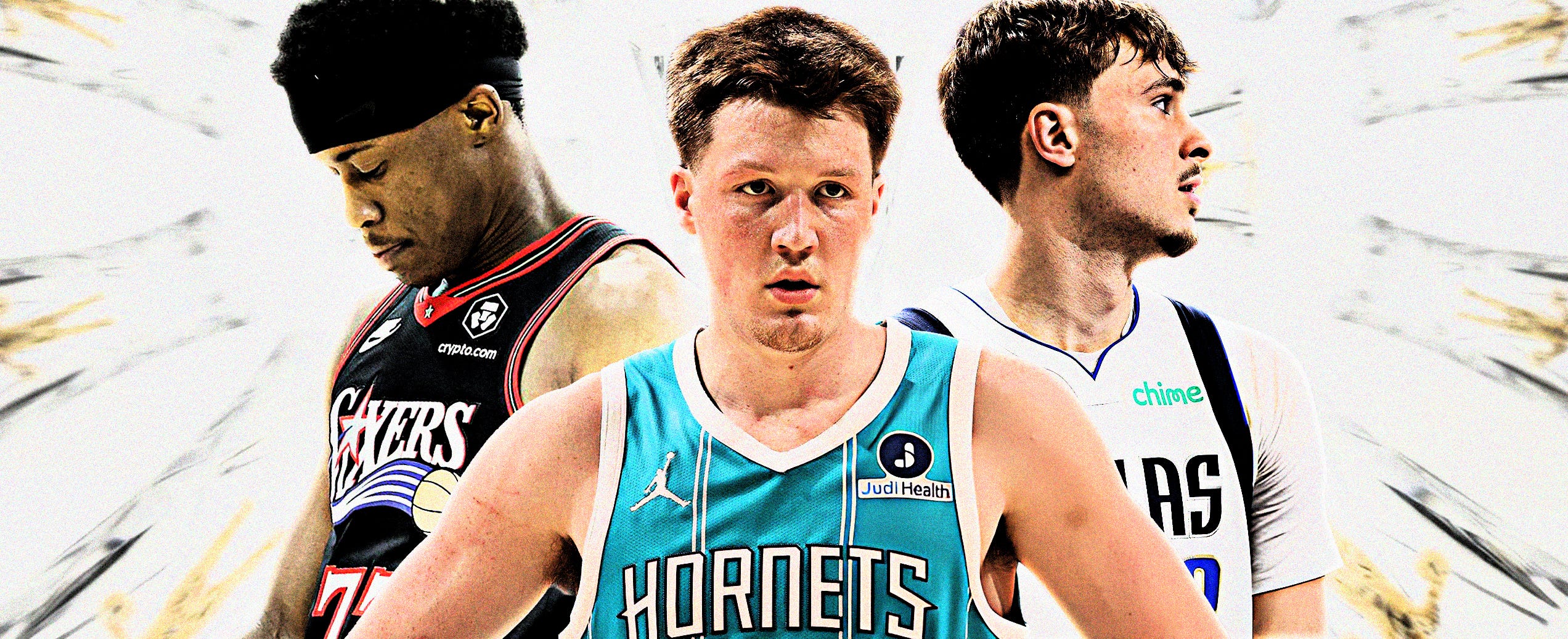
I can’t remember an NBA Rookie of the Year race as divisive as this one has been.
Two players have stood out above the rest: Cooper Flagg of the Dallas Mavericks and Kon Knueppel of the Charlotte Hornets.
Each player has a legitimate case for the award, so much so that I would love nothing more than voting amongst media members to be split right down the middle, and we see a Co-ROTY award issued. That has only happened less than a handful of times in NBA history.
With that unlikely to happen, it’s only fair to decide the award, and not sit dead center on the fence.
To be clear, I DO NOT have an official awards ballot, so all of the selections outlined in this piece are entirely for analysis, reflection, and engagement. What I choose here has no impact on the award selections, but remains one of my favorite things to write about during the basketball season.
Without further ado, let’s go over my selections for NBA Rookie of the Year, as well as the All-Rookie First and Second Teams!
2025-26 NBA Rookie of the Year
Nominations:
Cooper Flagg, Dallas Mavericks
Kon Knueppel, Charlotte Hornets
VJ Edgecombe, Philadelphia 76ers
WINNER: Cooper Flagg, Dallas Mavericks
Anyone who has been following my discourse on social media, as well as listened to the last podcast I recorded for No Ceilings, knows that I have held strong to Kon Knueppel being my choice for NBA Rookie of the Year.
However, I have in fact shifted my position to Cooper Flagg as the choice for me personally. It’s been a roller coaster of a ride trying to decide between both players, as it truly came down to the wire about which player I was going to choose.
I laid out a full case for Knueppel on the Locked On NBA Draft with No Ceilings Podcast about a week ago, and since then, I wanted to do some more digging on film and reflect that stance which was largely analytics-based.
In terms of arguing for Knueppel, the case is strong, but not perfect. He’s put up similar averages across the board to Flagg in terms of points, rebounds, and assists. He’s played for the Charlotte Hornets, which has a chance to get into the Eastern Conference race in the playoffs. There’s little doubt in my mind that Knueppel has been one of the main reasons why the Hornets franchise has seen success this year, even if the largest portion of that credit rightfully deserves to go to LaMelo Ball, as his on/off impact severely outweighs any other player on the roster. When he is efficient and leading the way offensively for the Hornets, their offense is nearly unstoppable. When he isn’t at his best, or in the game altogether, Charlotte struggles to maintain that same pace offensively, even if the defense doesn’t take a significant hit.
Knueppel has been a stabilizing force for the Hornets when he’s been on the floor, even without Ball and Brandon Miller. Despite the team’s record not reflecting similar levels of success when Ball and Miller have both missed games, the on/off data shows that the Hornets are still +4.0 points better per 100 possessions when he’s on the floor and those other two are off, per Cleaning The Glass.
Now, these metrics are imperfect, as they account for minutes where Ball and Miller have still played in the game. But it’s another reason to back Knueppel as a Rookie of the Year choice because he’s been a fantastic shooter regardless of who has been on the court with him. He broke the rookie record for three-pointers made in a season, and has been a top shooter in the league since the season kicked off. His metrics in terms of efficiency as a pick-and-roll ball handler, slip screener, catch-and-shoot threat, driver, and secondary ball-handler are all far beyond where rookies normally check in at, per Synergy Sports.
All of those things are great. But I still would have serious regrets not choosing Flagg for this award, despite the ways in which we can count the numbers for Knueppel.
Flagg has great numbers for a rookie, too. He’s led his team in points, rebounds, assists, and steals this entire season while being only second in blocks to Daniel Gafford. The list of players who have put up 21 PPG, 6 RPG, and 4 APG isn’t long by any means, and that alone is worth praise in itself.
Basketball analysis has moved past the PRA box-score watching elements of stat use. I completely understand that. But Flagg is far more than just a stat stuffer, even if that’s been the image portrayed over the last 10 games or so.
In his last 10 games, Flagg has averaged 27.8 PPG, 6.9 RPG, and 4.7 APG on efficient splits across the board while turning the ball over at a low rate and staying out of foul trouble defensively. Given how impactful he is as a defensive rebounder, weak-side shot blocker, and primary defender on the opposing team’s best perimeter option, carrying that burden is incredible for a 19-year-old.
“But Nathan, he’s having his best stretch of the season in March/April, which we all know isn’t important basketball due to the wave of tanking across the league!” Well, that stance has merit for sure, as I’ve voiced my frustrations with lineup manipulations and other egregious methods utilized by teams over the last few months to bottom out in hopes of landing a great pick in the 2026 NBA Draft.
EIGHT of the 10 teams Flagg has faced over that stretch are playoff or play-in teams in each respective conference for this upcoming postseason, so he hasn’t just fed on the true-blue tankers across the league landscape—not to mention that those teams have thrown their best guys at him, not to mention the entire defense’s attention in general. And yet, he’s been on such an impressive scoring tear that he’s looked like a completely different player than he was at the beginning of the season.
Now, to be clear, I even tried to use an argument regarding consistency for Knueppel when I was pretty firm in my stance on him being the most reliable player night in and night out this season who was impacting winning. But looking back at Flagg’s numbers over the course of this season, he’s been damn good this entire stretch outside of a rough October start when his role with the Mavericks was still being determined by Jason Kidd.
Flagg has averaged close to 20+ PPG in five of seven months during the regular season, which by itself would put him in great company with some of the NBA’s best All-Stars. Not only that, but he’s routinely found himself around 6-7 RPG and 4-5 APG over the entire course of the season as well. Flagg is doing everything for his team, even if that hasn’t led to wins due to the lack of top-tier personnel around him.
Flagg has played ZERO games with Kyrie Irving this season, around or fewer than 20 games with Anthony Davis, and not many with Dereck Lively. For the vast majority of Flagg’s rookie season, he hasn’t spent any time alongside players of the caliber of Ball and Miller for Charlotte for significant stretches of time.
Yet that hasn’t hampered or impacted his individual performance. Outside of efficiency from three-point range (which has significantly improved just before his February injury and certainly in this most recent stretch of games), Flagg has done really well in finding scoring opportunities inside the arc, moving the ball to find his teammates when defenses have pressured him with more than one defender, and he’s done his part to end possessions on the other end of the floor.
Where Flagg stands to level up his game the most, outside of just making more jump shots, is his ball-handling. Flagg is a bit upright in terms of how he can handle the ball, but there’s been real growth in that area as the season has gone on. He’s figured out how to leverage his size at 6’9” to his advantage by keeping the ball high and going to a floater game in the paint rather than trying to get all the way to the basket. He’s even gotten better at drawing contact off of those looks and getting to the line at an improved rate.
Those runners of his require a ton of touch to pull off consistently, but Flagg has seemingly mastered that shot in a very short amount of time. On the season, Flagg is 51% on those runners, and even 38% on pull-up twos, which is another shot Flagg has used against good wing defenders that have sealed off some of his driving lanes.
The types of shots Flagg has become comfortable taking AND making by this point in the season are what really separated his case for me as NBA Rookie of the Year. Anyone saying a few games shouldn’t swing a yearly award stance, they’re absolutely right. But I’m looking past the numbers and evaluating HOW Flagg has been able to do what he’s done.
Whether it’s been in some form of pick-and-roll, isolation, or (most importantly) in transition, Flagg has found ways to put his team on his back and keep some of these games even close. As much as I love Knueppel as a player and adore what he’s been able to do for Charlotte in ways that far exceed his perceived role of catch-and-shoot player, I can’t imagine him doing what Flagg has done on both ends of the floor in the same situation. And that context does matter for an award that historically hasn’t factored in team record outside of a few occasions where the race has been so incredibly tight.
And to be clear, this is one of those instances where the team record could very well factor in. But Charlotte is sitting in a play-in position, not firmly in one of the six top seeds in the East. So the gap between Dallas and Charlotte isn’t AS DRASTIC as some may argue that it is.
I don’t want to look back five years from now when Flagg could be on pace to thrust himself into MVP-level conversations and knock him for a team situation that he did everything in his power to make better, even if it wasn’t enough due to countless reasons at that time. Watching Flagg now, he’s just a much more thoughtful and confident player than he was at the start of the year on both ends of the floor. And that development matters to me.
So yes, everyone, I’ve flip-flopped on my decision more times than I can count this year. But at the end of the day, Flagg just makes the most sense to me as the NBA’s 2025-26 Rookie of the Year.
2025-26 NBA All-Rookie First Team
Cooper Flagg, Dallas Mavericks
Kon Knueppel, Charlotte Hornets
VJ Edgecombe, Philadelphia 76ers
Dylan Harper, San Antonio Spurs
Ace Bailey, Utah Jazz
I just wrote extensively about how the NBA Rookie of the Year race was tight at the top between Cooper Flagg and Kon Knueppel, but another subplot of that ballot for me was this: who would I put third between VJ Edgecombe and Dylan Harper?
Yes, folks, THAT race has also been incredibly close. Ultimately, I gave the nod to Edgecombe, who is among Harper, Flagg, and Knueppel on my All-Rookie First Team, because of his play at the start of the year, combined with how good he’s been in his role for the Philadelphia 76ers of late.
All Edgecombe had to do this season was be a star in his role: play defense on the perimeter, create turnovers, run the floor in transition, and knock down open shots when the ball swung his way on offense. Naturally, Philadelphia found itself in a position without much at the backup point guard spot, so any time that Tyrese Maxey had to miss, a lot of that burden fell on the shoulders of either Edgecombe or Grimes. Edgecombe most certainly had to find his way handling the ball in pick-and-roll, as his ball control on drives into traffic was one of his larger weaknesses coming out of college, which goes hand-in-hand with questionable pull-up jump shooting.
Thankfully, as the season progressed, Edgecombe improved in both of those areas. Very quietly, Edgecombe has become a reliable scorer on pull-up jumpers in the paint and even started to knock down some threes off the bounce and in pick-and-roll play. VJ’s passing has also improved over the course of the season in terms of making those easy reads in front of him as a secondary handler and finding his teammates for easy looks off of the attention that he draws naturally due to his impressive burst and athleticism.
Despite VJ’s lull in the middle of the season, hitting the “rookie wall” after his strong start, I think he showed enough growth and improvement combined with early-season success to maintain his third spot on my ROTY ballot and land on First Team All-Rookie.
But trust me, Harper made it a competition. I wouldn’t fault ANYONE for having Harper as the third guy on a ROTY ballot by any means. He’s missed more time than Edgecombe, but he’s been absolutely electric on the floor for the San Antonio Spurs.
One could put together a legitimate case that Harper has a brighter future as a defender than Edgecombe just based on his frame and physicality alone. Harper can cover more positions effectively at this point in time, as he can switch onto bigger wings and forwards more easily than Edgecombe due to his slight frame. And when Harper has had to take on the challenge of guarding larger matchups, he’s done his part in making sure he’s not just shoved out of the way and beaten on those possessions. Harper competes and can guard away from the ball as much as he can at the point of attack. It helps to have Victor Wembanyama behind you on defense, but both Harper and Stephon Castle have done about as good of a job as a tandem can in limiting penetration from the perimeter.
On offense, Harper has been a walking paint touch who has also improved as the year has gone on as an outside shooter. On the season, Harper is up to 40% on catch-and-shoot threes, which is certainly a much-improved mark from his freshman season at Rutgers, where he was almost exclusively on the ball and needed to be because of some questionable shooting efficiency. Harper showing his dominant play inside the paint, coupled with improvements in ancillary areas, has made him stand out as one of the most promising long-term prospects in the NBA for years to come. Harper looks the part of a future All-NBA talent.
That leaves one last spot on All-Rookie First Team, which came down to three players: Ace Bailey, Maxime Raynaud, and Cedric Coward.
I ultimately chose Bailey because of (similar theme here) growth I saw from him as the season has gone on. Bailey came in playing sparing minutes for the Utah Jazz, primarily asked to catch, shoot, and do little else in the hopes that he would limit mistakes and turnovers.
As the year went on for Bailey, he’s gotten to handle the ball more in pick-and-roll situations and isolate more frequently as the team’s primary offensive option amidst Tankapalooza. To Bailey’s credit, he’s looked good taking on more offensive responsibility.
Passing windows have looked clearer for him with Utah than in college. Bailey’s done better at choosing better shots and limiting the amount of deep pull-up twos he’s taking regularly. Bailey is even drawing contact and getting to the free-throw line more frequently over the last month and a half, which is a big part of him not settling and generating more efficient offense for himself.
In putting those elements together, Bailey has looked like the promising wing he was billed as during the 2025 draft process. Overall, I’ve really enjoyed the tape he’s put together on both ends of the floor, operating within structure under Will Hardy.
That is to take NOTHING away from Raynaud and Coward, who are next on the list of rookies to discuss.
2025-26 NBA All-Rookie Second Team
Maxime Raynaud, Sacramento Kings
Cedric Coward, Memphis Grizzlies
Jeremiah Fears, New Orleans Pelicans
Derik Queen, New Orleans Pelicans
Collin Murray-Boyles, Toronto Raptors
What Maxime Raynaud has done over the last two months is nothing short of awesome for Sacramento Kings fans and the organization alike.
Raynaud has essentially been the player he was last year at Stanford for the Kings right off the bat, which is incredible value for a second round pick.
Time after time during February and March, Raynaud has put up double-doubles, scoring efficiently from two-point range as an excellent play finisher, and has hit his fair share of spot-up threes. There are definitely some questions about Raynaud’s defense, given he’s not a natural rim protector and a bit stiff moving to cover options on the perimeter, but his offense has been so, so good for Sacramento of late.
I ALMOST gave the last All-Rookie First Team spot to Raynaud because of what he’s meant to Kings fans. This season has been a year from hell in Sacramento, given the injuries and lack of clear vision for the future, but there’s no question the Kings struck gold with the drafting of Raynaud and the signing of undrafted rookie Dylan Cardwell to bolster the team’s frontcourt.
Raynaud looks the part of a legitimate rotational center on a good team because of how effective he is at moving without the basketball, rolling to the rim, and even finding some touch shots around the basket off some self-created drives. I haven’t seen the same type of growth in him that I’ve seen from Bailey as the season has gone on, but I have zero qualms with anyone who would vote Raynaud ahead of Bailey on All-Rookie First Team because of how steady he’s been since the calendar turned to February.
That leaves Cedric Coward with a spot on the All-Rookie Second Team as well, despite looking the part of a shoo-in for First Team for a large stretch of the first half of the season.
In that time, Coward was making a winning impact for the Memphis Grizzlies before injuries and other circumstances pushed Memphis into a full-scale rebuild with the trade of Jaren Jackson Jr. None of that is Coward’s fault by any means, and before any of that happened, he was knocking down shots with regularity and stepping up as the team’s best wing defender even ahead of Jaylen Wells, who had that moniker just a season ago.
To Coward’s credit, he still is the team’s best wing option on defense moving forward. He’s consistently taken on the other team’s best assignment and has done his part to slow them down with his massive wingspan and grown man strength.
Coward hasn’t been as consistent offensively as Bailey and Raynaud in later parts of the season, as his shooting efficiency has gone up and down (as expected for any rookie), with most of his best games coming as a play finisher in transition, off cuts, and off second-chance opportunities in the halfcourt. Coward still has plenty of room to grow as a ball handler, and while his passing hasn’t been bad by any means, I’d argue I’ve seen some more bright spots of late from Bailey and Raynaud than Coward. Again, he’s still had a very strong rookie season that deserved consideration for First Team despite landing on Second Team.
This section of my selections was excruciatingly difficult, if I must admit. I knew coming in that those first seven players were the best of this class pretty convincingly up to this point, but this next tier of rookies have all had their time on my All-Rookie Second Team throughout the season. Three spots for what feels like eight total guys is a very tough exercise.
Where I landed with two of the three spots, happened to be in giving appreciation to the two main rookies on the New Orleans Pelicans in Derik Queen and Jeremiah Fears. It’s been another rough season in New Orleans, and James Borrego didn’t make it any easier on the rooks by benching them both mid-way through the season. Now granted, both Queen and Fears have remained productive off the bench, but their defensive shortcomings seemingly weren’t enough to overcome some of the more veteran options on the roster. Given that the Pelicans don’t possess their first round pick for the 2026 NBA Draft, there’s been zero incentive for New Orleans to continue playing its rookies and bottom out like the rest of Tankapalooza.
Still, there was a strong stretch in December and January where both Queen and Fears looked like they had a shot for All-Rookie First Team because of their offensive creativity, leading to some wins for New Orleans. Queen, in particular, has been one of the funkiest offensive talents we’ve seen from the center or power forward position in quite some time. He’s been very comfortable handling the ball and creating in isolation, rating in the 71st percentile per Synergy. He’s had numerous shots at triple-doubles, given how good of a passer he is and the fact a team can run real actions through him both from the top of the floor and out of the post. Queen’s shooting touch from the midrange will go a long way in continuing to help him stand out as a viable option offensively in the NBA, but there’s no doubt his ball handling, pace, and creativity at that position are unique and worth a selection on All-Rookie Second Team.
Fears wasn’t as much of a slam-dunk selection as Queen for Second Team, but he did enough throughout the season as a rookie point guard to keep my attention and remain optimistic about his long-term development. Fears primarily operates at one speed, but has gotten better at mixing in changes of pace to find passing lanes in pick-and-roll sets to get his teammates better looks. When his jumper is falling, it’s extremely difficult to pick up the young guard, as his burst and first step are among some of the best at the position. While he isn’t a positive defender in the backcourt, I did appreciate his effort this season at the point of attack. Teams couldn’t hunt Fears the way they do some other lead guards because of his effort in fighting through screens and contesting drives to the basket. Again, by no means has he been good away from the ball defensively, and even in falling for some cheap moves and pump fakes, but I’ve seen enough games where he’s played with great spirit on both ends of the floor, not just on offense.
One last spot, and I decided to go with Collin Murray-Boyles of the Toronto Raptors over Will Riley and Ryan Kalkbrenner.
Let me be clear: each of the young frontcourt studs in Riley and Kalkbrenner is deserving of All-Rookie Second Team. But Murray-Boyles has stepped up and shown growth in a role that many projected him to be able to play down the road, but he’s already done it in his rookie season.
Murray-Boyles has effectively played center minutes without Jakob Poeltl on the floor, which has been its fair share even when he’s been able to play in games. With Collin at the helm, Toronto’s defense is much more dangerous in terms of switching matchups and containing ball pressure. Murray-Boyles has the mobility to cover more ground than a traditional rim-protecting center, and his long wingspan and excellent hands help him to still make plays on the ball, hence the steal rate that helps to compensate for not having a sky-high block rate equivalent to that of a seven-foot big man.
On offense, Murray-Boyles has shown real signs of life as a shooter that he didn’t show in his two years of college, making more threes at a higher clip than he did at South Carolina. All Murray-Boyles has to be is a threat from the outside, as his ability to handle and take mismatches off the bounce is exceptional for a player his age.
When I watch Murray-Boyles on the Raptors, I can feel his impact even when the box score doesn’t scream like a Riley stat line over the last few weeks. And the fact that Murray-Boyles has seen action for Toronto essentially since day one, I just couldn’t leave him off my list, no matter how much I wanted to give Riley a nod for what he’s done after the All-Star break.
What Riley has been able to accomplish in a short amount of time has put him near the top of any sophomore breakout radar. The 6’9” wing has shown off legitimate ball-handling ability, both on the break and in navigating traffic through pick-and-roll sets. Riley’s dribbling/passing combo at his size stood out in the pick-and-roll numbers last year in college at Illinois, but given his frame, not too many scouts were convinced he’d hit the ground running like this so early in his career.
Yet Riley has shown as much on/off-ball versatility as any prospect in his class up to this point. He can release the ball quickly and lace catch-and-shoot threes, score in the midrange, and even has some touch around the basket. His defensive rebounding and passing vision have him on triple-double alert, which is the type of versatility this Wizards front office has been drafting in the first round, time and time again. Riley has shown so much promise that it’s going to make a decision on a contract extension for Bilal Coulibaly very difficult. Coulibaly hasn’t had consistent time on the court to round out his offensive skill set, but he is a hellacious defender and has been since his first game in the league. Still, Riley’s offensive versatility matches that of Kyshawn George, so having more of those types of guys is a luxury. There will be only so many minutes to go around, especially with another high lottery pick in tow. I love what Washington is building, and Riley was my toughest cut for All-Rookie Second Team.
As for Kalkbrenner, he’s been very effective in what his strengths were coming into the 2025 draft: he sets good screens, rebounds, deters drivers, and finishes everything off lobs and putbacks. Kalkbrenner will have a long and productive career, even if he doesn’t show other signs of growth like becoming an even better post scorer or outside shooter. He’s lost some of his minutes of late to Grant Williams small-ball lineups, but he’s remained in the rotation at center with Moussa Diabate and Williams for a team that’s looking to make some noise in the Eastern Conference Playoffs.
Tre and Egor :(