


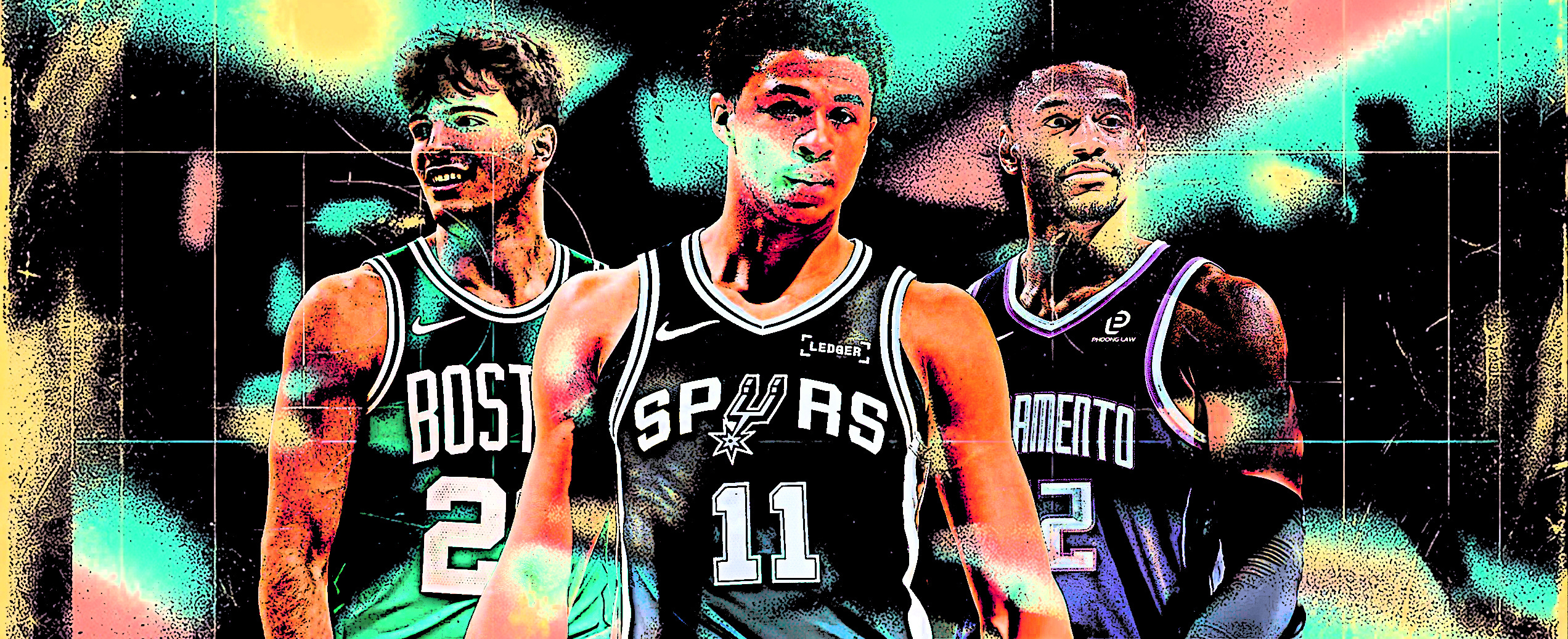
We’re very close to the end of the NBA’s regular season, which means it’s time to wrap up thoughts on this year’s rookie class as a whole.
I’ll have a column coming in the near future outlining my NBA Rookie of the Year, All-Rookie Teams, and some great honorable mentions.
But this exercise in particular is inspired by legendary NBA analyst Zach Lowe.
His yearly “Marc Gasol All-Stars” column/exercise is an excellent read/listen for those who haven’t heard Zach discuss his annual selections at length. To paraphrase the contents of the columns, they’re Lowe’s creative muse for unpacking his favorite non-traditional NBA superstars around the league, most of whom go slightly underappreciated given their value to their teams and who they project to become in the future.
That’s exactly the basis of what I’m doing here with the rookie class. That inspiration, along with the joy in watching the namesake of my annual team, Carter Bryant of the San Antonio Spurs, led me to crafting my own rookie selections for a piece similar to what Lowe has done over the years.
There are a few rules here, but I tried to choose players who are probably not in the running for an All-Rookie squad AND have logged at least 400 minutes played at the time of writing this column. It’s a simple enough exercise to introduce readers to some of the fun young talent around the league that fans may not know much about because they aren’t logging a ton of minutes or at the forefront of awards discussions. I see potential in each of these players to become at least rotational mainstays in the league with upside for true starter-caliber production in key roles for good teams.
Without further ado, let’s kick this off with the namesake of the column, a certain defensive menace currently playing in San Antonio!
Carter Bryant, San Antonio Spurs
When Carter Bryant checks into the game for the San Antonio Spurs, there’s just an energy that flips immediately in terms of defensive intensity.
That’s Bryant’s calling card, after all. Defense, defense, and more defense.
The 6’8” rangy forward can guard every perimeter position on the floor effectively—even some centers, depending on the matchups.
Bryant is best utilized when he’s deployed as a disruptor to the other team’s top perimeter matchup, whether it’s a guard or wing. Bryant WANTS to pick up 94 feet and guard the full length of the floor. His wingspan creates problems both in the halfcourt and in transition because of how he can play passing lanes, pressure ball-handlers, and cover ground in terms of challenging jump shots and looks at the rim.
Now he’s a rookie, so Bryant is susceptible to some off-ball lapses or ball-screen hiccups every now and then, but he is a PEST in one-on-one matchups and makes his opponent’s lives miserable in terms of the quality of shots he lets them take on a nightly basis.
Bryant’s gotten more time of late for the Spurs off the bench, and his impact is felt even without the sure skill offensively just yet. When he’s knocking down corner threes and running the floor in transition, Bryant looks like a ready contributor to what San Antonio wants to accomplish in the postseason. Bryant’s jumper isn’t yet there for him, however, as he’s struggled to maintain efficiency on a low volume of attempts.
When Bryant is asked to just be a forward enforcer, grab rebounds, guard on the other end of the floor, and have as few offensive responsibilities on the perimeter as possible, he’s looked like a stud. The impact he’s had at the power forward position compared to the small forward spot is vast, per Cleaning the Glass. San Antonio is +10.3 points per 100 possessions when he’s played the power forward position, primarily when the Spurs go to the “all defense, no brakes” lineups with Victor Wembanyama, Stephon Castle, and Dylan Harper on the floor with him.
Now, a keen observer would argue the net swing is entirely on the shoulders of Wembanyama because of how much of a difference he makes by himself. To that, I would say: you’re definitely right. But watching the tape, Bryant’s disruption on defense only adds to the frustration of opposing offenses; also, he’s proven there are ways to deploy him even while he’s entirely raw offensively without taking everything off the table for the Spurs in playing winning basketball.
Bryant is an impressive, rangy athlete who clearly thrives on competition because of how he’s wired, and making an impact on defense. It may not be in this postseason, but I’m fully convinced Bryant will have his time in the spotlight in postseason runs to come for the Spurs, along with some of the franchise’s other young cornerstones.
Dylan Cardwell, Sacramento Kings
Dylan Cardwell is close to breaking one of my rules in terms of writing about players who aren’t in consideration for an NBA All-Rookie nod. There’s a legitimate argument to make for Cardwell as an All-Rookie Second Team performer. It’s a close race, as this is a DEEP rookie class, but because of his center counterpart, Maxime Raynaud, making as strong a First Team push as he possibly could, I’m not entirely convinced Cardwell will earn one of those spots on Second Team.
That being said, his case is based around the impact he’s brought off the bench for a team that at one point was trying to win basketball games, but is now in a position to race to the bottom while doing the best it can to evaluate the young pieces on the roster, specifically Raynaud, Cardwell, and wing player Nique Clifford.
When Cardwell is on the floor, the frontline for the Sacramento Kings is without a doubt improved on the glass, on the interior, and from a screen/finishing standpoint. Cardwell looks to rebound everything, dunk even more, and block shots with some of the best big men in the league. If Cardwell were eligible for the Basketball-Reference leaderboards in terms of rate stats, he would rank 19th in total rebounding percentage and 29th in block percentage. This means that when Cardwell is on the floor for the Kings, he is doing everything in his power to make sure he’s the workhorse, accomplishing the dirty work that sparks winning.
It’s admittedly difficult to measure winning impact when said player is in an environment that has done everything BUT win basketball games this season. Go back to Auburn, and you’ll see Cardwell was one of the driving forces in the frontcourt on legitimately GREAT college teams, even if his box-score stats weren’t jumping off the page.
Cardwell does his damage as an offensive rebounder, dunk finisher, screener, and rim protector. All things that won’t necessarily light up highlight reels, but they are important to moving the needle and ensuring the star talents can just be stars.
Most importantly, he’s athletic enough to play alongside another big man who may not be as equipped to do the dirty work, but has offensive capabilities that lift the floor of the rest of the team, Cardwell included. The Kings have plus points per 100 possessions lineup combinations with both Domantas Sabonis and Maxime Raynaud playing next to Cardwell in the frontcourt, and while we just don’t have enough data on those combinations to come to meaningful conclusions one way or the other, it’s still something that I believe is worth exploring next season and beyond given how in vogue double big lineups are across the league.
Kings fans LOVE Cardwell, and I’m fully aware of why. He’s your favorite big man’s favorite big man: come in, do the work that needs to be done, and just continue to show up night after night. Where I’m most curious about Cardwell’s game going next is operating more as a hub for handoffs/passing opportunities around the free-throw line area. I’ve seen some evidence on tape of Cardwell being a good passer, and I would like the Kings to keep tapping into that aspect of his game moving forward.
Hugo Gonzalez, Boston Celtics
Hugo Gonzalez is an absolute maniac on the basketball court.
Being in the Philadelphia area, I tend to watch quite a few 76ers games in my spare time. I was introduced to Gonzalez in the NBA’s regular season when the Boston Celtics took on the Sixers, and boy was his presence LOUD on defense against both Tyrese Maxey and VJ Edgecombe.
There may not be a better player built to just face guard the living hell out of opponents on the perimeter than Gonzalez. I discussed Carter Bryant earlier as the type of player who wants to guard 94 feet. His impact feels different than Gonzalez in terms of HOW he goes about his business. Bryant is long as hell; while Gonzalez isn’t small by any means, it just feels more overwhelming with Carter because of how he extends and uses his wingspan to swallow up opponents and contest shots.
Gonzalez just doesn’t let other players go where they want to on the floor. Period. His lateral mobility, bend, and overall flexibility/foot speed are so impressive for a young wing defender. He matches the cadences of opposing ball handlers so well, and seemingly reads their feet to a tee in terms of shutting off driving lanes and keeping players in front of him. His active hands match the speed of his feet, as he can create deflections and poke balls away, especially against smaller guards.
When Gonzalez is on the floor next to multiple perimeter players who can take on a higher usage of the offense, the Celtics SHINE as a team. When Gonzalez is at the small forward spot, Boston is +27.5 points per 100 (!!) in essentially 600 minutes worth of action, which is no joke in terms of sample size for a rookie player.
What’s most promising is that Gonzalez is up to roughly 35% from three-point range on about 5.4 attempts per 100 possessions, with a healthy three-point rate for a wing in terms of how many of his shots are coming from behind the arc. Shooting was Hugo’s biggest question coming stateside, but he’s really made it a priority to fit into Boston’s style of three-point heavy offense and let them fly when the ball has been swung around to him.
He’s an Energizer Bunny in transition, has gotten more comfortable seeing little passing windows in front of him, and has shot the basketball much better with regularity of late. Put those elements together with Gonzalez’s menacing defensive approach, and Boston has yet another youngster waiting in the wings who can impact winning when called upon.
I’m a bit surprised I don’t see Gonzalez come up much in All-Rookie discussions, given how well he’s played in legitimate minutes for the Celtics, but his box score numbers and overall production don’t match some of the best players from the draft class. Still, I have my eye on Hugo moving forward as an impact player with plenty of room to grow with the Celtics moving forward.
Yanic Konan Niederhauser, LA Clippers
Yanic Konan Niederhauser was a popular riser in the 2025 NBA Draft process as a pogo-stick big man who could jump out of the gym, catch and finish lobs, and block shots into the stands. That’s what he did at Penn State, and it’s the same blueprint for the young center in the NBA with the LA Clippers.
Given the willingness of the Clippers to move on from stalwart Ivica Zubac at the trade deadline to fill in gaps around Kawhi Leonard with younger talent after the departure of James Harden, it’s only fair to assume that Niederhauser has the franchise’s attention as the next starting center in LA.
As advertised, Niederhauser finishes almost everything around the basket. He’s up to 66% on two-point shots, with a true shooting mark of 69.1% on the season. He’s even tried to step out and take some threes, knocking one down out of five attempts so far in limited minutes. I’m not sure that will ever be a real part of Yanic’s game, but it’s nice to see his overall offensive confidence start building as he’s gotten playing time with the Clippers.
In the G League this season, Niederhauser averaged 15 points, 10 rebounds, and 2.4 blocks across nine total games for San Diego. That’s definitely something, given his efficiency in that role has essentially carried over to what he’s doing in the NBA.
Solid rebounding numbers, a block rate even higher than Cardwell’s, and the type of high-level interior finishing one would want out of a rim-running center.
Even if Niederhauser is destined to be a clone of Jaxson Hayes, that’s still a great option at backup center. I think there’s a bit more to unlock with Yanic, though, as a big—particularly as a potential post-up threat down the line. All Niederhauser has been asked to do so far in the league is roll, cut, and catch lobs. But at Penn State, Niederhauser was a solid post player, and he looks as though he’s already started to fill out his frame and get stronger as he’s been in the NBA.
Hayes never quite put on the type of strength or developed his footwork to do more than just be an energy big off the bench, but Niederhauser intrigues me in ways Hayes never did. Niederhauser has already produced in a bit over 400 minutes to prove he’s deserving of time for the Clippers, and the name of the game to develop is get minutes to experience and see more, then take those reps and flesh out next steps off the court to round out one’s skill set. The only way to get better at NBA basketball is to actually play it. Niederhauser is on the right track to develop into more than just a player who catches and dunks.
Mohamed Diawara, New York Knicks
I’m not entirely sure what to make of Mohamed Diawara and his NBA future just yet, but I do know that I’ve enjoyed what I’ve seen from him so far, and his build and offensive approach signal that he has a chance to hang around some good rotations in the league for quite a while.
On the season, the 6’9” forward from France has knocked down 40% of his threes, with all but 17 of his makes coming off the catch per Synergy Sports. He’s not creating much of any offense for himself, but he’s been a reliable corner shooter when the New York Knicks have looked to him on ball reversals and corner kickouts.
And honestly, that’s the name of the game for most rookies and even sophomores in the NBA. Can you handle the simplified role we’ve put in front of you, play with energy, and positively impact the team in the minutes we give you?
So far, Diawara has done that for New York. He’s a legitimate defensive option given his size and length, and while he hasn’t been an incredible defender, he’s had some good moments for the Knicks on that end of the floor. I’m not overly encouraged by his offense outside of shooting spot-up threes, given he’s at 41% finishing on layups this season with not a ton of passing volume to speak of (or unassisted shots created), BUT again, he’s done what’s been asked of him!
That’s the most important thing Diawara could be doing in his career right now: provide effort on defense, rebound the ball, and knock down open threes. Even though I don’t have a mile to write about Diawara’s impact on the Knicks, I’m still left with more positives than negatives. He’s earned the opportunity to continue growing with this franchise, and I’m excited to see if he’s given a green light to further expand his game in Summer League and beyond.
Rasheer Fleming, Phoenix Suns
I couldn’t write about rookies who haven’t exactly played a lion’s share of minutes for their respective team and NOT talk about Rasheer Fleming.
The Saint Joseph’s product at forward hasn’t gotten a ton of time for the Phoenix Suns just yet, and quite frankly, hasn’t been terribly efficient in the minutes he’s gotten.
But watch back some of the tape, and one can see why he was bandied about as a potential lottery pick in the 2025 NBA Draft.
First of all, Fleming is freaking HUGE. His 7’5” wingspan in a 6’9” frame is more than adequate to play the power forward position in today’s NBA. And he lets it be known on defense that he intends to use every single inch of his length to cover ground and swallow up opposing scorers who try to go after him one-on-one.
Fleming is incredibly athletic as well for a player his size, both in terms of verticality and straight-line speed down the floor. He can finish looks in transition, get the best of opposing players on backdoor cuts/lobs, and can just go up and make plays on the ball that few others can because of how physically gifted he is.
In some G League action this season, Fleming’s production was about what anyone would expect after watching him in college. Great spot-up player from distance, dunk threat, rebounder, and defensive playmaker.
His passing numbers aren’t jumping off the page, BUT he does have some underrated vision/delivery from a standstill that’s already come to light in Phoenix. It was one of my favorite aspects of his game in college that few discussed because he wasn’t asked to be a passer. Fleming was on the floor to finish plays, rebound, and defend. But the glimpses are there from Fleming in terms of finding the open man from the middle of the floor.
As a shooter, Fleming has consistently knocked down threes at every level now. He’s becoming more than just a catch-and-shoot threat from a standstill. Fleming can legitimately run towards a shot, catch, stop, and rise up to shoot effectively from deep. Any time a team can take advantage of a 6’9” shooter that can operate off some movement, it opens up so many fun possibilities. As Fleming rounds out the rest of his game and earns minutes from the Suns, he can work in the pick-and-pop game, come off a simple action and step into a shot, or space from the corners and let those kickout looks fly.
There’s plenty of room for Fleming to grow as a player, particularly on offense. His non-dunk finishing at the basket has left something to be desired so far in the NBA, and he has work to do in terms of getting better at covering perimeter matchups defensively while also holding his ground when he’s matched up on true centers.
But because he’s 6’9” and 240 pounds with awesome length and shooting versatility, the sky is almost the limit for Rasheer as he develops. If he ever becomes a more sound ball handler who can routinely attack mismatches off the bounce and punish opposing players, along with some of the defensive improvements I outlined, we could be talking about a potential NBA All-Star. I really don’t think that’s out of reach for Fleming.
Is it more likely that he’s a role player who can contribute in a few key areas over the course of an average 20 MPG role? For sure. But Fleming’s tools would have anyone dreaming a bit bigger, and I’m fascinated to see what type of leash both he and fellow draftee Khaman Maluach get from Phoenix in Summer League this year.
we view basketball in such a similar lens, grateful i found your page🙏🏾