


The 2026 NBA Combine is in the books! We’ve got a full recap going through athletic testing, measurements, and the scrimmages! Everything you need to know about the week’s risers and fallers!
The 2026 NBA Combine is in the books! I was lucky enough to be on the ground in Chicago for the entire course of events. Today, I’ll be walking you through the week’s winners and losers, both from the measurements/testing portion of the event and the scrimmages.
Measurements and Athletic Testing
The Guards
One of the biggest questions coming into the week was how the class’s top guards would stack up next to each other. Between Darius Acuff Jr., Keaton Wagler, Mikel Brown Jr., Kingston Flemings, Brayden Burries, Ebuka Okorie, and Labaron Philon, it feels like there are an overwhelming number of guards who could reasonably be selected in the 5 to 14 range.
Acuff came in at 6’2” barefoot with a 6’6.5” wingspan and a 185.8-pound frame. That said, I thought he appeared bigger than his listed weight in person. He has that prototypical power guard build, and he looks like he could run through a brick wall. While his vertical numbers weren’t anything special, his three-quarter court sprint time was the best of the day, which should come as no shock after watching him routinely push the pace in transition.
Keaton Wagler didn’t have the best week. While his 6’5” height is nice for a guard, his stubby wingspan (6’6.25”) relative to his height was a letdown. His lack of bulk and run-of-the-mill athleticism popped up, too. He tipped the scales at only 188 pounds, and he was toward the lower end of the guard spectrum throughout the athletic testing. This shouldn’t be surprising, as Wagler’s game is more predicated on his exceptional mental processing and use of pace/manipulation than burst or power. Still, these factors could be ceiling inhibitors that also make his floor outcomes scarier. The reason for optimism would be that Wagler likely hasn’t had the same types of resources other prospects have given his late-blooming trajectory, and he’s wider up top, so he may have some room to fill out his frame in the coming years.
Mikel Brown Jr. had a great week. He came in at 6’3.5” with a 6’7.5” wingspan while weighing in at 190.2 pounds, giving him arguably the best positional size in this group. His athletic testing went well, too, as he ranked third in the lane agility drill and had one of the better verticals in the entire class.
Kingston Flemings was a mixed bag. His measurements disappointed, as he stands only 6’2.5” with a 6’3.5” wingspan and weighs only 183.4 pounds. The good news is that his run-jump stuff went well, at least. He ranked second in the shuttle run, sixth in lane agility and three-quarter court sprint, and tenth in the max vertical. If you’re going to be undersized, you’re going to need the tools to compensate for it, and Flemings has them. Additionally, he shot well during drills, which may alleviate concerns about his funky mechanics.
Brayden Burries’ week helped solidify his stock. While he’s still a bit of a positional tweener at 6’3.75” with a 6’6” wingspan, his 215.4-pound weight shows that he should have no problem with physicality at the next level. His athletic testing was comfortably above average, too.
While Ebuka Okorie’s 6’1.25” height may be a letdown, his length (6’7.75” wingspan and 8’2” standing reach) and weight (186 pounds) should help compensate for that. His athletic testing wasn’t anything to write home about, though.
Labaron Philon’s weight remains a concern. While he made meaningful strides on the basketball court after returning for his sophomore season, his 176.2-pound weight, up only 1.6 pounds from a year ago, was quite frustrating. His average athletic testing, paired with that small of a frame, likely hurt his momentum relative to his peers.
Bennett Stirtz quietly had a good week. At 6’2.5” with a 6’6” wingspan and a 186-pound weight and solid athletic testing marks across the board, Stirtz did nothing to lose his spot. He came in second overall in the shooting drills. Scouts also took note of the fact that he didn’t look like he had a drop of sweat on him after the drills, further demonstrating the stamina he showed at Iowa. Plus, he sat in the crowd to watch the scrimmages, so he’s a real basketball sicko, and I love that.
Christian Anderson’s 6’1” height was disappointing, and his skinny 180-pound frame is still troublesome, but he at least showed that he has length (6’6.25” wingspan) and athleticism (40.5” max vertical). Plus, he shot the cover off the ball, which shouldn’t be a surprise to anybody.
The other big story among the guards was this year’s undersized prospects. Each of Ja’Kobi Gillespie (5’11.75”), Tyler Tanner (5’10.75”), and Braden Smith (5’10.25”) came in under the six-foot mark. Last season, only 18 total players listed at 6’0” and below appeared in an NBA game, which creates exceptionally narrow windows for these prospects. Worse yet, Tanner and Smith both weighed in under 170 pounds, something only six NBA players did last season. We’ll get to their scrimmage performances later, but they had to really put on a show to quell the concerns about their size.
Wings and Forwards
A lot of eyes were on the battle between Cameron Boozer and Caleb Wilson in Chicago. I’d say that Cameron Boozer had the better week out of the two, even if Wilson edged him out in certain respects. For starters, Boozer measured better than anticipated. He 6’8.25” barefoot, but his 9’0” standing reach and 7’1.5” wingspan were superior to the rumored marks that had been floating around in draft circles. Plus, at 252.8 pounds, Boozer has some serious bulk to him. Wilson’s 6’9.25” height, 7’0.25” wingspan, and 9’0” standing reach are all prototypical marks for an athletic four man, but his 210.8-pound weigh-in was a reminder that he does need to continue to fill out his frame. Boozer got the best of Wilson in the lane agility drill, which generated a lot of discussion on social media, but Wilson comfortably bested him in every other area of the athletic testing. I’d say both players had a good week. Boozer measured better than anticipated and had above-average athletic marks, which should help silence doubters about his projection, while Wilson showed that he’s every bit as explosive as he looks on tape.
Don’t forget about AJ Dybantsa, either. He looks absolutely massive in person, which makes the things he’s able to do with the ball all the more amazing. His 6’8.5” height, 7’0.5” wingspan, and 8’10” standing reach are outrageous marks for a player with his on-ball scoring ability. Throw in a fourth-place finish in the max vertical, and it’s safe to say Dybantsa didn’t do anything to hurt his stock.
Darryn Peterson did well for himself, but I don’t think the needle moved on him in any respect. He stood 6’4.5” with a 6’9.75” wingspan while weighing 198.8 pounds, which is good for someone who projects to play the two. His athletic testing was solid across the board.
Cameron Carr may be positionally thin at 184.4 pounds, but he’s got everything else you could ask for on a physical level. His 7’0.75” wingspan and 8’8” standing reach are absurd marks for someone who can play at the two spot. He ranked second in lane agility, standing vertical, and max vertical. He also did himself more favors in the scrimmages, but we’ll get to that later.
Forwards who had good marks include Trevon Brazile, Maliq Brown, and Tobi Lawal. Brazile was one of only three players to generate a 100 overall combine score from the awesome Tawny Park Metrics site. He has an uncanny blend of positional size and agility. Maliq Brown’s 3.07 three-quarter court sprint time raised my eyebrows, given his viability as a defense-and-transition action player. Tobi Lawal’s ridiculous 45.5” max vertical was unlike anything I’ve ever seen in person. While Alex Karaban can’t hold a candle to these guys athletically, he was awesome in the shooting drills and improved his athleticism enough to get out of red flag territory.
Milan Momcilovic, Joshua Jefferson, and Allen Graves all left something to be desired. They all have various skill packages that should help overcome those shortcomings, though. On the wing side, Amari Allen came in shockingly short. His strong max vertical helped compensate for that to a degree, but the prevailing assumption that he tanked his standing reach didn’t help. His “real measurements” had been in the rumor mill for a while, but still, a guy who was listed at 6’8” to come in at 6’5.25” barefoot isn’t going to be well received. His skill, talent, and production are intriguing, but now he’s facing a new set of questions.
The two/threes who popped to me were Billy Richmond III and Tounde Yessoufou. Richmond won the lane agility drill, tied for first in the three-quarter court sprint, and had the seventh-best max vertical. Yessoufou was fifth in the shuttle run while measuring with a 6’10” wingspan and boasting a powerful 219.8-pound frame that should help him guard up the lineup.
Bigs
It’s a great year to need a big man. The Michigan Coalition was awesome. Aday Mara stood a comical 7’3” barefoot with a 7’6” wingspan and a 9’9” standing reach, which you don’t exactly find too often from someone who can pass the ball at a high level. Yaxel Lendeborg’s size (6’8.75” with a 7’3.25” wingspan) and fluidity were on display, as he did well in the lane agility and shuttle run for a man his size. Morez Johnson’s 6’9” height was a relief, and his 7’3.5” wingspan and 8’11” standing reach give him viability at the five. Plus, he blew the water out of the other bigs in both the running and jumping categories. Oh, and he shot well this week, too, showing that he could bring potential lineup versatility to the table as well. These three further bolstered their cases in Chicago.
There were lots of other really huge guys who did well. Hannes Steinbach’s vertical and agility marks were better than I anticipated. Chris Cenac Jr.’s speed, bounce, and 7’5” wingspan further raised intrigue around his upside. Tarris Reed Jr.’s massive 263.6-pound frame and uncanny agility scores (88.0 overall per Tawny Park Metrics) showed off his rarity as a giant, versatile defender. Rueben Chineylu’s outrageous 7’7.75” wingspan will always be of note. Luigi Suigo didn’t participate in the athletic testing, but his 7’2.75” height, 7’5.5” wingspan, and 9’6” standing reach are all awesome for a player with some ball skills at his disposal. His 289-pound weight surprised me, and not in a good way, though, as I feel like he’s easier to move for his size than he should be. Still, he’s an interesting stay-or-go name to watch. Zuby Ejiofor performed better than expected in several ways. While his 6’7.5” height is a big concern, his 7’2” wingspan helps, his 38” max vertical was a pleasant surprise, and he shot the ball well from three. For a guy with “where does he score?” concerns, that type of bounce and touch could help teams talk themselves into him. The big that left me wanting more was Malachi Moreno. His 6’11.25” height was nice, but his 7’1.5” wingspan was a bit of a letdown. While he’s always been more fluid than explosive, his leaping and agility marks were still more subpar than I expected. The fact that he thinks the game at a high level and reacts to things quickly helps compensate for that, though. I still like him in guaranteed contract territory, given the value of his modern skill set.
Scrimmages
Coming into the scrimmages, there were four, “oh, hell yeah, it’s awesome that this guy wants to compete” names that stuck out to me—Dailyn Swain, Cameron Carr, Tarris Reed Jr., and Tyler Tanner. Personally, I love it when players who are already in guaranteed contract range want to compete. It shows that they want the smoke and aren’t trying to hide anything. Plus, in most cases, I think there’s only so far you can fall once you’re in that range. You’re there for a reason, and it’s because you’ve already put a great sample of tape and data together. The four players who took that chance this year all had meaningfully different outcomes.
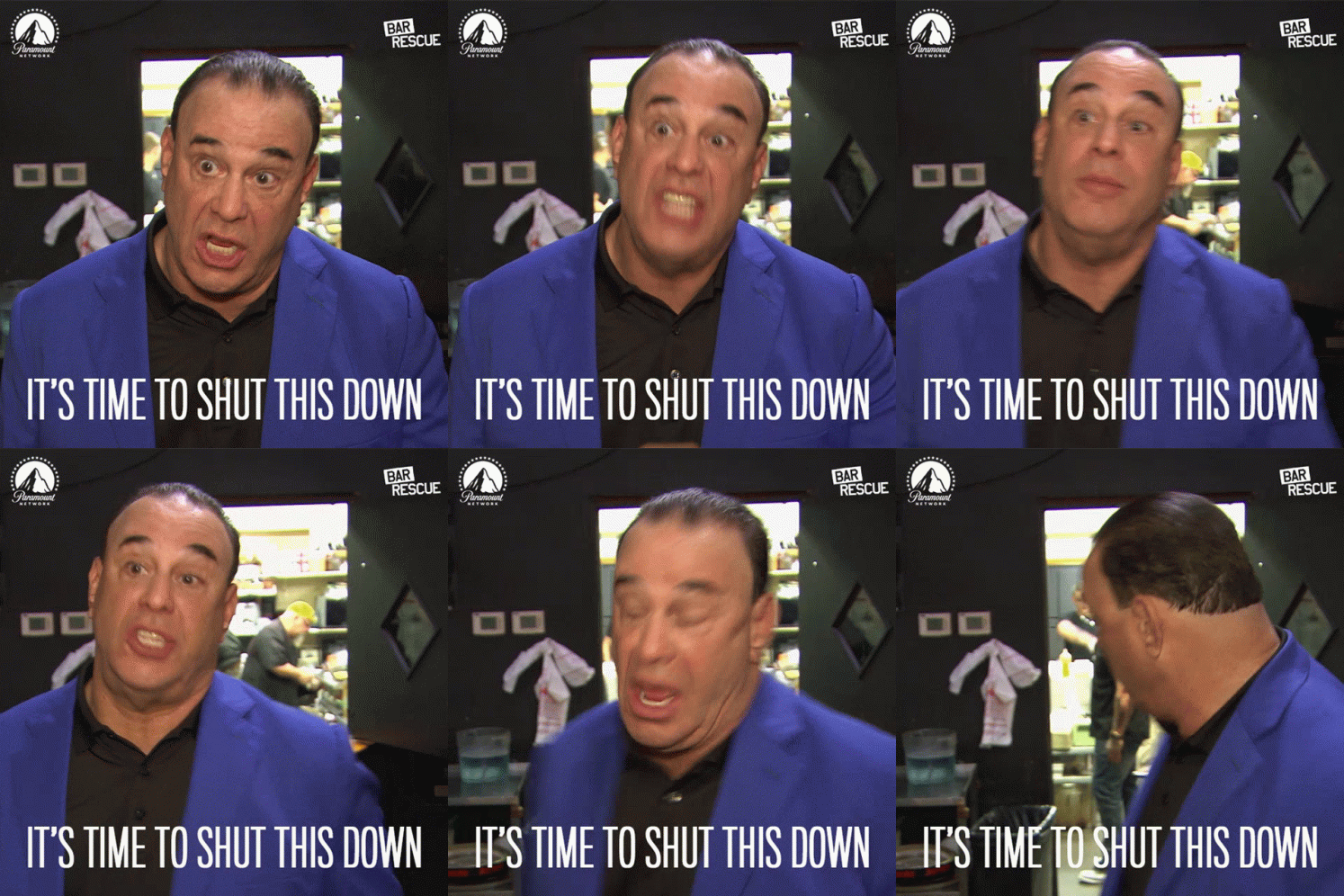
Cameron Carr was the standout and the winner of this year’s Jon Taffer “SHUT IT DOWN!” Award. He immediately set the nets on fire with four early threes. He ended the contest with 30 points on 18 shots. In addition to his three-point barrage, Carr contributed in other ways. He was active on the defensive end, snatching seven rebounds and blocking two shots. One of his rejections came on a perimeter closeout, where the length, quickness, and pop he showed in athletic testing were on full display. Plus, he showed the bounce around the basket that led to his impressive dunk totals on the year, sending home two rim-rocking jams. On his second dunk, Carr hung onto the rim so long that I thought he was attempting to get ejected from the game because he was tired of dominating so much. After one lone contest, Carr and his representation made the wise decision to say…
The next most impressive of the group was Tarris Reed Jr. In his first contest, he and Rueben Chinyelu beat the absolute tar out of each other on the interior, limiting each other on the glass while fighting like mad for position. Reed had some great finishes, made savvy passes, and forced mistakes on the defensive end with his length and timing. In his second scrimmage, Reed was the best player on the floor, posting 17 points on nine shots. His bullying strength and soft touch with both hands were evident. He also blocked two shots and made more advanced deliveries to his teammates. While many bigs in his range opted to sit out, Reed showed exactly who he was and furthered his first-round case.
Dailyn Swain left me wanting more. The good stuff was on full display. He has an unreal blend of bend, shiftiness, and speed for a guy his size, which helped him get into the paint. His awesome recognition and burst in passing lanes showed up on a steal. He got on track toward the end and had a big dunk. But Swain was also pretty quiet out there, which is a concern given worries about how he’ll adapt to more of an off-ball role. He missed some defensive rotations around the basket, which is something we saw a bit of at Texas. Swain also made the decision to shut it down after one game, which, when contrasted with Carr’s decision to shut it down, didn’t sit well with me. There were a lot of rumblings throughout the week about how long it takes his shot to leave his hands off the catch, and I get the feeling that teams may not be as into Swain as the public-facing draft world. That said, I’m still in on Swain, probably more so than team personnel. Again, you can only fall so far in a draft like this one. Swain’s ability to create both paint touches in the halfcourt and transition opportunities through his steals is a valuable skill that shouldn’t be tossed aside.
Tyler Tanner had an up-and-down series of games. Normally, that would be fine, but given the size concerns he’s facing, that’s a bigger deal for him than others. In his first outing, he had 13 points on 11 shots, five assists to only two turnovers, and two steals. In his second, he had only two points on 1-7 shooting, with five assists, three turnovers, and two steals. There were some positives. Tanner made several great passes, and he generated a ton of deflections. His quickness and activity on defense are no joke. However, he rarely got deep into the paint, and he didn’t display enough dribble craft or ball-screen manipulation to really bend the defense. If he were to go into the league right now, he’d be extremely perimeter-oriented on offense, which means that he’ll have to be an excellent, consistent three-point shooter. On the defensive end, opponents were constantly calling for the ball in “mouse in the house” situations against him.
The consensus in the building was that Tanner should go back to school. That said, I still think choosing to play in the scrimmages was the best decision for his long-term future. It’s much better for him financially and for his long-term development to identify exactly where he stands relative to his peers. I’d rather have that information now than go into the draft and find it out on an NBA court after eschewing what I’d imagine is an extremely lucrative NIL offer if he were to return to Vanderbilt. He’s still intriguing as a long-term proposition, but I’d feel a little queasy with him as a “this year” guy.
Baba Miller did wonders for his stock. He had 20 points, six boards, and two assists in the first contest, then 13 points, nine boards, and three assists in the second. He’s a long, bouncy athlete who loves to fly in on the glass before pushing it in transition. While his shot has long been inconsistent, it looks pretty good, and he takes the right ones from deep. There’s a lot of Josh Minott to his game, which is a useful type of player to have on your roster.
Otega Oweh’s team struggled to get things going on offense, but he still stepped up and performed well. He feasted within the flow of the game during the first contest, and in the second, he showed that he has some juice to create his own shot. Shooting consistency will be a question with him, but Oweh’s half-court finishing, solid decision-making, and pick-six playmaking are all traits that I adore.
Matt Able looked solid. He played his role well on offense, hit open shots, and showed off his springiness in transition. He looked more comfortable on the ball in the middle of the floor than I’d anticipated. Still, he lost Dillon Mitchell a few times on defense and let him feast on the glass, which you cannot do with him. I’d still swing in guaranteed range given the three-and-D, plug-and-play nature of his game, though there is a need for refinement.
Billy Richmond was a joy to watch. His motor is ridiculous, and it feels like his presence is inescapable on the defensive end. Plus, he got in on the offensive glass a few times. Richmond’s shot was inconsistent. He hit some great perimeter jumpers but also had an ugly airball in the first contest. He’s a tough stay-or-go call, but he’s the type of competitive athlete with skill that I’d love to roll the dice on.
Ryan Conwell is small for a two-guard, but I thought he played well, and his strength goes a long way toward compensating for his suboptimal length. He bullied people at the point of attack on defense, and rotationally, he got to the right spots time and time again. He also made some passes that I didn’t expect him to have in his bag, and of course, he hit a bevy of impressive threes from distance. The size could create a tricky predicament for him, but I love his power, touch, and low-maintenance play style.
Despite his lack of size, Braden Smith was super impactful. He’s so under control, demonstrating exquisite command over both the ball and the floor, even in extremely heavy traffic. He manipulates the hell out of ball screens to get where he wants on the court. Smith also seemed more eager to pull the trigger from three, which was nice to see, as he’d pass up open looks from deep in favor of the mid-range at times in college. His pass placement is out of this world. Defensively, he tried to pick up 94 feet, which didn’t go well at times. I still ultimately think he’s smart and skilled enough to stick despite his poor measurements and athletic testing.
Ja’Kobi Gillespie went nuts in the first game, scoring 28 points on 17 shots while also grabbing three steals and a block. He looked rockier in the second outing but still posted 15 points. Gillespie’s speed is absurd up close. He’s a nightmare to track off the ball, and he covers ground like a maniac. That type of movement profile is a must for a player like him. He made some nice passes on the move, too. I’ve long been skeptical about the combination of Gillespie’s subpar size and shooting inconsistency, but he had a lot of positive buzz in the building in Chicago. He definitely helped himself in a big way.
Rueben Chinyelu and Felix Okpara had some moments. Chinyelu did a phenomenal job battling against Tarris Reed Jr. in his first contest. In the second, he posted a gaudy 14 points and 15 rebounds, but the process was pretty rocky. He bobbled a number of passes and rebounds while struggling with his touch. Okpara had rough stretches in the first contest, but in the second, his mobility was impossible to miss. He had 15 points on eight shots while grabbing seven rebounds in that one. Both of them have felt limitations, but I could see them on an NBA floor, even if in a more limited capacity. Particularly, I think Chinyelu’s massive size and defensive presence make him a viable year-one option worthy of guaranteed contract consideration. Okpara is more of a two-way target for me.
Jeremy Fears Jr. was a needle mover for me. He’s like a coach on the floor. He was extremely vocal and organized. His speed, power, and craft enabled him to collapse defenses before making stellar passes, finishing with touch, and making perfect passes. I get that the three-ball is a question, but I’m less worried about that swinging his fate than I was before because of how good he was at everything else.
Trevon Brazile was inconsistent, but I still liked what I saw. He’s an awesome mover with a gorgeous stroke for his size and a great athlete. He’s also really refined his game when running off the line. Maliq Brown grew on me throughout the week as a potential gadget player. He knows exactly who he is—a versatile defender with awesome hands who can pass and should only take great shots. Dillon Mitchell falls into a similar boat. He’s probably never going to shoot it, but he’s an elite put-back guy and a potent transition player. Jaden Bradley was up and down, but his poise and toughness remain intriguing. I have no idea what Nick Martinelli’s offensive role would be on an NBA team, but he’s tough as nails on the glass, and his touch in floater range is absurd. Teams that want to buy in on his brand of physicality and motor got a lot more ammo after his great outings. G League Combine call-up Aaron Nkrumah wasn’t out of this world, but he continued to look like he belonged with his shooting and activity in his second contest.
Flory Bidunga was a bit quiet on both ends. He wasn’t bad by any stretch, but I was left wanting more, especially since he measured on the shorter side for a center. John Blackwell felt like a guy who needed to go back to school. His measurements were rough, and he dribbled the ball a lot without creating anything great for his team. Noam Yaacov had a much harder time getting to his spots here than in the G League Combine, which ate into my excitement about his game. Ugonna Onyenso was pretty quiet as a communicator and allowed more offensive rebounds than I would’ve liked to see. Rafael Castro is a favorite of mine, but I thought he was a little lackluster against bigger, better athletes.