


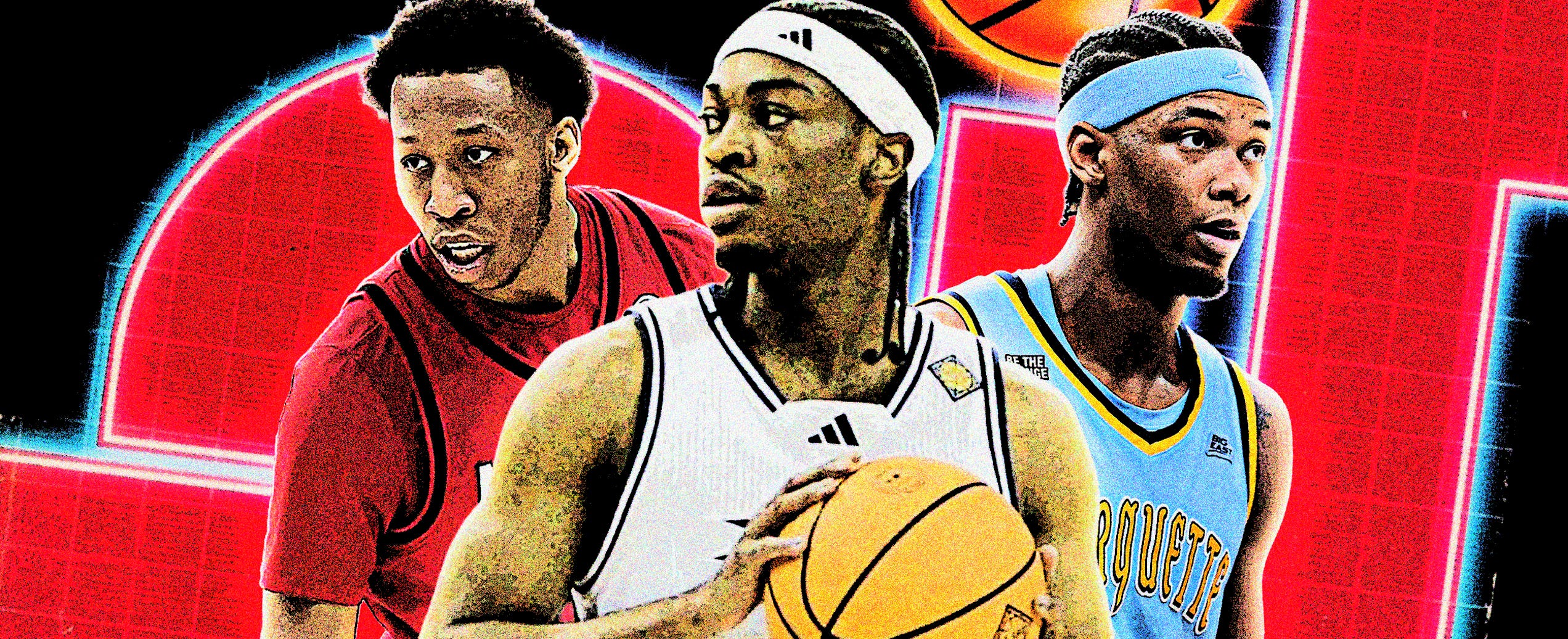
Draft Sickos…it’s combine season!
The first major pre-draft event of the cycle is upon us, and it’s the Portsmouth Invitational Tournament. The event, which is entering its 72nd year, exclusively features seniors from across the world of college basketball. In Portsmouth, they’ll be participating in combine-style testing, measurements, and a series of games in a tournament format. Throughout the process, they’ll hope to impress NBA front offices and continue to build momentum heading into the NBA Draft. Players like Jimmy Butler, Robert Covington, Pat Connaughton, Richaun Holmes, Royce O’Neale, Alex Caruso, Dorian Finney-Smith, Derrick White, Kendrick Nunn, John Konchar, Terance Mann, Craig Porter Jr., Toumani Camara, and Kobe Sanders have come through the event. While older prospects are often overlooked, the PIT provides them with a springboard to launch their draft stock before a long, successful NBA career.
Today, I will be digging into every player in the field. I’ve noted some of my favorite prospects in the field with an asterisk. As always, if you want to support this type of work, please consider subscribing to No Ceilings +, as it helps keep the lights on over here. Also, make sure to follow me on Twitter!
All statistics are courtesy of Synergy Sports, Sports Reference, and BartTorvik.
AJ Storr, 6’5”, Ole Miss, Shot-Creating Forward
AJ Storr gets buckets. He scored 34.6 points per 100 possessions this past season, and he can fill it up in a variety of ways. Storr ranked in the 82nd percentile on spot-ups, so he can slide in as a complementary piece, but he also ranked in the 70th percentile as a pick-and-roll scorer and the 74th percentile as an isolation scorer. He has a physical approach to getting to his shots with the bailout chops to hit tough jumpers off the bounce late in the shot clock. Previously, Storr could suffer from tunnel vision, but this year, he saw the floor much better and posted a 16.0 AST%. Storr has a pro body, but you wouldn’t know that by looking at his rebounding and defensive metrics on the stat sheet. When he’s on, he’s awesome, but his game lacks the requisite insulation to stay valuable when his shot goes cold. That’s the type of stuff scouts will be keeping an eye on with him in the PIT.
Amani Lyles, 6’7”, Akron, Well-Rounded Forward
Amani Lyles checks a ton of boxes. After being an interior player for most of his college career, Lyles sunk 37.3% of his threes on 3.6 attempts per game this past season. Still, he didn’t abandon what brought him to the dance. He’s a bruising interior presence who connected on 66.7% of his twos and owned the glass (10.0 ORB%, 23.1 DRB%). His big body and ability to process the game allowed him to post a career 2.3 STL% and 4.8 BLK%, too. On paper, he does all the things that an NBA team could want out of a role player. The concern, though, is that he could be a jack-of-all-trades, master-of-none who only popped off once many of the best mid-major players transferred up to a higher level. Plus, his handle is limited, and his passing decisions can be frustrating, inhibiting his on-ball equity. For Lyles, the PIT will provide the platform to show that he’s a serious, late-blooming prospect and not a one-year wonder who feasted against lower-level opposition. Personally, I’m a fan of his hard-charging, stat-sheet-stuffing output.
Anthony Roy, 6’5”, Oklahoma State, Sharpshooting Wing
Anthony Roy has hit some of the most breathtaking shots I’ve ever seen on a basketball court. He’s a career 40.6% from three-point range at the Division-I level, which is eye-catching enough as it is, but the way he goes about it is all the more impressive. Roy has a slick handle and impressive footwork, enabling him to shake defenders before lunging backward or moving east-west prior to draining a pull-up three. He’s also able to run into his shot, going 41.8 3P% in transition. The rest of his game can be frustrating. He’s a good rebounder, and he can move, but his defense is inconsistent. Roy also posted a meager 8.6 AST% on a 25.2 USG%, which raises concerns about his feel. He had a much higher assist rate at Green Ba,y but he still turned it over a lot. The shot is so exceptional that Roy is bound to get looks, but at the PIT, it’s his ancillary skills that scouts will be monitoring.
Boopie Miller, 6’0”, SMU, Traditional Point Guard
Boopie Miller has been one of my favorite college point guards to watch in recent years. He’s a real-deal orchestrator who blends his craft and speed to get to his spots. From there, he can drain threes (41.4% from deep this past season), draw contact and finish inside (.435 FTr, 60% at the rim in the halfcourt), or find open teammates after creating advantages (30.6 AST%). Miller ranked in the 83rd percentile on pick-and-roll possessions including passes, and the 96th percentile on isolation possessions including passes this past year. Simply put, he knows how to bend the defense and make the right play, whether it’s for himself or someone else. The concern is that Miller’s lack of size could bite him at the next level, especially given that his defense has never been anything to write home about. He’ll look to shake the small guard skepticism this week in Portsmouth.
*Cade Tyson, 6’7”, Minnesota, Sharpshooting Wing
Cade Tyson is an outstanding three-point shooter. He connected on 42% of his 507 three-point attempts throughout the course of his college career. He’s deadly from a standstill (52.8% on spot-up threes), but he’s got some movement chops, too. What distinguishes Tyson from most high-level shooters is that he’s super physical and gifted inside the arc, too. He’s not afraid to bang bodies when carving out space in the mid-range or when he gets all the way to the rim. Tyson made an exceptional 78.3% of his halfcourt rim attempts on damn good volume for a sniper this past season while also registering an impressive .558 Free Throw Rate. Simply put, he can fill it up at all three levels. He’s also a solid rebounder, and he showed improved vision as a passer this year. Defensively, he guards the ball well because he manages to stay square and leverage his physicality, but he’s a non-factor off the ball (1.3 STL%, 0.7 BLK%). Tyson’s lack of defensive upside is a serious ceiling inhibitor. That said, his ridiculous shooting track record and improvements at Minnesota this season make him one of the most tantalizing prospects in the field.
Carson Cooper, 6’11”, Michigan State, Skilled Rim-Runner
Carson Cooper has an unequivocal answer for the question of “where does this guy score?” He’s a big-bodied center with serious bounce who goes up like he wants to rip the rim off the basket. There are times when he’ll leave the floor for a dunk, and I’ll think, “Oh, bad takeoff point there, he’s too far away from the hoop,” and it turns out I was completely wrong. Cooper dunked 51 times last season, and he ranked in the 91st percentile as a roller. He’s also a rock-solid passer, posting an even assist-to-turnover mark this past season. It’s also worth noting that while he rarely shot threes, he hit 78.8% of his free throws, so there may be some spacing potential here eventually. Cooper’s defense has me concerned, though. He has positional lapses both on and off the ball, which played a role in his lackluster counting numbers (4.8 BLK%, 1.3 STL%). The hope would be that his size and toughness can help compensate for his lack of polish on that end of the floor. I felt far more intrigued by Cooper after diving back into his film for this article, and there’s a chance he could make a similar impression on front office members at the PIT.
*Chase Ross, 6’5”, Marquette, Switchblade Guard
Chase Ross has long been an internal favorite within No Ceilings. He’s a well-built guard with NBA athletic tools who plays like his hair is on fire. Defensively, he flies all over the floor to garner steals (3.9 STL%) while still having the baseline fundamentals to lock down his man at the point-of-attack. On offense, Ross is a blur downhill, enabling him to get into the paint at will. From there, he can finish above the rim, draw fouls (.427 FTr), or punish help (20.2 AST%). Unfortunately for Ross, he went cold at the wrong time, going 29.5% from deep this past season. That said, his 37.2% mark on catch-and-shoot triples over the past two seasons gives me hope that he could find a place in a secondary role at the next level. Ross will need to show that his efficiency woes this past season were context-dependent, and that he can go right back to thriving when surrounded with a high level of talent.
*Corey Camper Jr., 6’5”, Nevada, Sharpshooter and More
Corey Camper Jr. was one of those guys that I knew nothing about coming into the year, only to be bombarded with texts about him as the season progressed. He came out of nowhere to put together a phenomenal final college campaign. Camper is a big-time shooter who hit 46.4% of his threes spotting up, 40.9% of his threes in transition, and 37.2% of his threes off screens. Camper plays with a high work rate, so he’s always moving, and the defense can’t take their eyes off him. Even when defenders manage to keep pace and close out hard, though, Camper has answers. He has slick footwork to generate pull-up triples and mid-range shots. Plus, he gets to the rim a bit more frequently than most knockdown guys, and he’s a solid finisher for his archetype (56.9% on halfcourt rim attempts). Throw in his ability to read the floor (2.7 APG to 1.2 TOV) and respectable defensive playmaking metrics (2.1 STL%, 1.1 BLK%), and Camper has more to offer beyond just running around and bombing threes. His sudden emergence as an older prospect at a mid-major raises questions about scalability, though the PIT will give him a chance to answer them.
Corey Stephenson, 6’6”, Florida International, Athletic Sniper
Corey Stephenson hit 39.8% of his threes on ten attempts per 100 possessions this past season. He’s got deep range off the catch, and he has answers when run off the line. He’s an assassin in the mid-range (47.4% on pull-up twos,) and he has the bounce to finish above the rim (22 dunks). Plus, he’s a solid rebounder for his position on both sides of the ball. Stephenson also knows how to leverage his length defensively to get in on the rock, whether he’s digging in as a helper, going for a strip at the point of attack, or blocking a shot inside (2.4 STL%, 1.9 BLK%). Stephenson’s negative assist-to-turnover ratio is extremely concerning given his age and position. He’ll be looking to prove that his decision-making can match the rest of his intriguing skill set.
David Green, 6’7”, Tulsa, Well-Rounded Forward
David Green brings a lot to the table. The lefty has drained 40.3% of his threes over the past three seasons, and there’s a real versatility to his shooting portfolio, too. Green has a super quick release and pristine footwork moving into his shot off the pop. He’s built like a grown man, and he knows it, too. He can get it done inside, converting on 62.7% of his halfcourt rim attempts and drawing heaps of fouls (.405 FTr). He’s a solid rebounder and defender, too. Green is already 24 years old, and he’s never played at the high-major level, which leaves little margin for error while giving reason for skepticism about the scalability of his production. His handle and passing are nothing to write home about, which is concerning. Still, he’s got a great frame, and he’s really good at the stuff teams look for in role-playing wings. He’ll just need to prove he can do it against fellow pro prospects in the PIT.
Devin McGlockton, 6’7”, Vanderbilt, Physically Imposing Forward
Devin McGlockton is a handful to deal with on the glass. He’s constantly battling for positioning, and because he’s so strong, he usually gets it. This enables him to routinely end possessions on defense (19.0 DRB%) and generate extra possessions on offense (11.6 ORB%). He’s also shown a little bit of floor spacing ability, going 34% from three over the course of his college career. On top of that, he’s a solid decision-maker (1.2 APG to 1.0 TOV) and defensive playmaker (1.3 STL%, 3.7 BLK%). McGlockton’s best skill is his rebounding, which isn’t the sexiest trait for an undersized four-man. Teams will want to see how comfortable his perimeter offense and defense look this week. If he can hit the right thresholds in those areas, there could be something here.
*Donovan Atwell, 6’5”, Texas Tech, Sniper
Donovan Atwell is a ridiculous shooter. He hit 45.8% of his threes on 14.2 attempts per 100 possessions this past season, which is a preposterous marriage of volume and efficiency. It wasn’t like he was taking easy shots, either. He went 20-for-39 in transition, 9-for-23 on handoff triples, 8-for-18 as a pop man, and 6-for-12 off screens. He’s got a genuine, specialist-level skill. He’s never been much of a playmaker (3.9 AST%), but he doesn’t make mistakes, at least (4.0 TOV%, 0.8 APG to 0.4 TOV). His defensive metrics aren’t great (2.0 STL%, 0.4 BLK%, 7.9 DRB%). Basically, Atwell’s game has very little insulation, but he’s one of the best in the world at one particular thing. If he can show more well-roundedness this week, watch out.
Duke Brennan, 6’10”, Villanova, Skilled Bruiser
Duke Brennan has two key skills that NBA teams love from a big man. First off, he’s a monster on the offensive glass. He’s constantly jockeying for position, he has excellent hands, and his timing is tremendous. As a result, he posted an amazing 15.1 ORB% this season. Then, there’s his passing feel. His pass placement in particular pops off the page, as he can thread needles with perfectly on-point deliveries. He had a 12.0 AST% and a positive assist-to-turnover mark, both of which are impressive for a big man. The issue here is that Brennan is a poor defender. He can be out of position in ball screens, and he doesn’t get off the floor well, leading to a measly 1.9 BLK%. He’ll need to show more on that side of the court to generate buzz in the PIT.
*Duke Miles, 6’2”, Vanderbilt, Two-Way Playmaker
Duke Miles is tough to keep out of the paint. He utilizes breakneck speed changes and herky-jerky dribble combinations to freeze defenders. From there, he can finish at the cup (56.9% in the halfcourt), draw fouls (.490 FTr), or make well-timed passes (27.4 AST%). Defensively, he’s every bit as tricky to compete against. He’s got a strong frame, he moves his feet well, and he has ridiculous hand speed. Throw in his timing off the ball, and Miles was able to post an out-of-this-world 5.0 STL% while playing for an SEC team. A career 35.1% from long-range, Miles’s inconsistency as a shooter is troublesome given his size. There are also questions about whether Vanderbilt was so good because of Miles or if his production was a byproduct of their aggressive playstyle. At 24 years old, Miles doesn’t have as much time to carve out a role as many of his peers. We should get great insight into where he stands outside of the Vanderbilt system in Portsmouth.
*Elijah Mahi, 6’7”, Santa Clara, Shot Creator
Elijah Mahi has a rare blend of size and skill. He’s got a big, burly frame, but he handles the ball like someone much smaller. He has slick dribble combinations to break down defenders, but even if he can’t shake them, he can usually play through them. As a result, he puts serious pressure on the rim. When he collapses the defense, he also keeps a great read of the floor, allowing him to make a wide variety of passes to set up his teammates (17.2 AST% in two seasons at Santa Clara). Still, he can do stuff off the ball, as he made 37.1% of his catch-and-shoot threes. His off-ball defense improved this year, too (2.7 STL%, 1.5 BLK%). Mahi’s biggest issues are that he’s ground-bound inside, which diminishes the impact of his rim pressure, and that his defense can still be uninspiring. He’s a bit heavy-footed, and his effort comes and goes. Mahi’s overall skill level is still super high, and given his frame, that’s valuable.
Ernest Udeh Jr., 6’11”, Miami (FL), High-Motor Big Man
Ernest Udeh Jr. immediately stands out on film because he’s both physically massive and frighteningly mobile. Offensively, he feasts on the glass (13.1 ORB%) and lives above the rim (62 dunks). He has a similar impact on the defensive boards (25.8 DRB%), and he has some real versatility because of how well he moves. Udeh does an excellent job when switched down onto smaller players, but he still has the requisite size to hold his own against bigger bodies inside. Despite his excellent tools, Udeh is prone to defensive lapses, leading to a lackluster 5.8 BLK%. He can’t do too much with the ball, either (3.0 AST%, 0.5 APG to 0.6 TOV). The challenge for Udeh will be to show that he’s more than just a potential rim-running innings-eater.
Ezra Ausar, 6’9”, USC, Hard-Nosed Forward
Ezra Ausar loves to impose his will. Offensively, he likes to face up and drive his man backward, forcing them into fouls (.860 FTr). He can also get involved on the offensive glass (9.7 ORB%), and he’s tremendous out on the run in transition (84th percentile, 46 total dunks). Defensively, he’s so big and agile that he’s a nightmare for anyone to deal with. He’s unshakable thanks to his stance, power, and foot speed. Where things get dicey for Ausar is that he’s too small for an NBA five, he’s only made seven threes in four college seasons, and he had a negative assist-to-turnover ratio. He’ll want to display some perimeter prowess this week in order to generate NBA traction.
*Felix Okpara, 6’11”, Tennessee, Rim-Running Rim Protector
Felix Okpara is a high-level vertical athlete. Offensively, he can control the boards (10.9 ORB%) and finish above the rim as a lob target (69 dunks). On the defensive end, he’s agile enough to hold his own in space while boasting the pop to swat shots around the cup (7.0 BLK%). Plus, there’s a little bit of shooting touch here, too. Okpara went 4-for-11 from distance this year, and the shot looked natural for him. He’s not able to do much of anything with the ball (0.5 APG to 1.0 TOV), which severely limits his upside and how many ways teams can use him. That said, his athleticism and ability to do the basics should enable him to eat innings if nothing else. In Portsmouth, Okpara will look to show he can do more than that, though.
*Izaiyah Nelson, 6’10”, South Florida, Defensively Versatile Rim-Rummer
Izaiyah Nelson is the type of player who is impossible to miss. He leaves his fingerprints all over the game, and he does it in ways that are extremely pleasing to the eye. Defensively, he can use his length to hang back in drop coverage before swatting shots. Still, he has the rare ability to genuinely guard down the lineup with proper technique and the burst to get into passing lanes. He also plays his tail off on the glass (14.5 ORB%, 21.3 DRB%). Offensively, he keeps it simple, feasting on put-backs, cleaning up from the dunker spot, and running the floor better than just about anybody (3.2 dunks per game, tied for second in the country with Caleb Wilson). There are two knocks I hear on Nelson. The first is his strength, which I don’t sweat too much because he was great against both Florida and Louisville this year. The second is his overall skill level and offensive feel, which I believe is fair, as he had a negative assist-to-turnover ratio this past season. That said, there’s an undeniable blend of tools and motors here that make Nelson one of the best prospects in the field in my book.
J’Vonne Hadley, 6’7”, Louisville, Swiss Army Knife
J’Vonne Hadley brings a lot to the table. While the volume has always been low, Hadley’s long been efficient from deep (44% on 2.5 threes per game this past season). Plus, he’s powerful, skilled, and smart downhill, leading to a 61.9% mark on twos and a two-to-one assist-to-turnover ratio. Defensively, his strong frame and high feel enable him to wall off a variety of opponents and be in the right places at the right times. Hadley has long been more of a tertiary option, so I’m interested to see if he could kick it into high gear and show the takeover ability we’ve seen from others in the field. Additionally, his measurements will be crucial, as he’s never seemed like a great athlete, which inhibits his ability to play up the lineup, and I’m uncertain if he’s speedy enough to play down it. Hadley’s efficiency and intellect have always made him relatively intriguing, and he’ll have another chance to move the needle this week.
Jaden Henley, 6’7”, Grand Canyon, Versatile Wing
Jaden Henley checks a ton of boxes. He’s a big-time downhill threat who draws a ton of fouls (.505 FTr) and can finish above the rim (27 dunks). Still, there’s a real level of feel to him, as he routinely sets up advantages for teammates based on the advantages he creates (20.1 AST%). Defensively, he puts his tools to use both on the glass and as a takeaway threat (2.9 STL%). The question is whether or not Jaden Henley can be respectable enough as a shooter to hang on an NBA floor long-term. He’s a career 76.4% free throw shooter, so he’s not totally devoid of touch. That said, his three-point percentage has swung dramatically year-over-year (37.8% to 26.9% to 35.1% to 26.8%). If Henley can make shots, there’s a lot to work with, but if not, it will be harder for him to find his footing.
Jalen Washington, 6’10”, Vanderbilt, Well-Rounded Big Man
Jalen Washington has a number of ways to impact the game. Offensively, he’s a hard-nose offensive rebounder (11.4 ORB%) who makes solid decisions and can space the floor a little bit (career 31.1% from deep). Defensively, he’s able to move his feet on the perimeter, and he can turn people away at the rim (6.8 BLK%). The concern is whether or not Washington is good enough in any one area to really get over the hump in the NBA. It will be interesting to see if he can find an area to shine throughout the event.
Javontae Campbell, 6’2”, Bowling Green, Two-Way Playmaker
Javontae Campbell is one of the best takeaway artists in college basketball. He registered a comical 5.0 STL% this past season, a mark that only a few players in the country manage to scratch every season. Campbell loves to pick off inbound passes after made baskets, strip unsuspecting ball-handlers in transition, and take his man’s cookies at the point-of-attack. What differentiates Campbell from most defensive specialists is that he’s actually a good offensive player. Campbell uses his speed to bend the defense before drawing fouls (.519 FTr) or making on-point passes (28.4 AST%). Campbell’s shot (31.8% from three on super low volume) and wiry frame are both quite concerning, but he’s one of my favorite under-the-radar guys in the field. He hasn’t received much acclaim from draft fanatics, but there’s a real chance he could turn heads.
Jaxon Kohler, 6’9”, Michigan State, Rebounding Stretch Four
Jaxon Kohler has a fun mix of physicality and touch. He’s a force on the glass (12.8 ORB%, 25.0 DRB%) who loves to throw his body around and make opponents deal with his size. Most guys who use their mass like Kohler don’t have his touch. He hit 38.9% of his threes on 9.2 attempts per 100 possessions this past year. Both floor spacing and offensive rebounding are at the forefront of analytically driven minds at the moment, which means Kohler should have a lot of teams watching him closely. Still, he needs to grow as a passer (1.3 APG to 1.4 TOV), and I have real concerns about who he guards at the next level due to his subpar quickness and bounce. If Kohler can show improvements in those departments, he could climb up boards.
Jaylin Sellers, 6’4”, Providence, Bucket Getter
Jaylin Sellers can fill it up like few others. He led the Big East in scoring this year with 18.3 PPG, and he did it on 47.3/42.9/85.9 splits. He can knock down threes off the catch (42%), pull-up from deep (44.4%) or the mid-range (44.1%), or convert at the rack (62.7%). Few players are this efficient at all three levels of the floor. The issue here is that the rest of the cupboard here isn’t fully stocked. He’s prone to tunnel vision, as evident by his 10.6 AST% on a 26.8 USG%. His defensive metrics aren’t great, either (1.7 STL%, 0.8 BLK%). Sellers doesn’t bring a ton of value outside of his scoring, and the NBA is filled with guys who can score. For Sellers, PIT will be about displaying a greater degree of well-roundedness while showing his value as a bucket getter.
John Camden, 6’8”, California, Jumbo Shooter
John Camden can shoot the cover off the ball. He’s hit 39.8% of his career threes while launching 11.2 attempts per 100 possessions. There are so many great shooting traits going on here. He’s a great relocator, he has parking lot range, and he’s got a lovely off-the-dribble three he can go to out of a ball screen or off a sidestep against a hard closeout. Camden is also a really decisive player. Whether he shoots it, moves it, or attacks the cup, he does it quickly. The issues for Camden primarily come on the other side of the ball. While he can use his frame well guarding the ball at times, he’s a clunky mover, and he doesn’t get where he needs to go quickly off the ball. His 1.4 STL% and 0.7 BLK% are serious red flags given his size. Still, he’s so large and plug-and-play offensively that he reminds me a lot of previous Portsmouth standout Jamison Battle. It’s hard to be too low on guys who are this big and lethal from deep.
Jordan Riley, 6’4”, East Carolina, Two-Way Combo Guard
Jordan Riley is a phenomenal athlete, and he makes that abundantly clear every time he steps onto the basketball court. He has blazing speed, and he can jump out of the gym. Offensively, he uses his tools to finish above the rim. He registered 38 dunks this past season, which is an abnormally high mark for someone his size. He also uses his quickness to get into the paint and draw fouls (.438 FTr). Riley also managed to play a low-mistake brand of basketball, posting a 16.4 AST% and 9.0 TOV% on 33.6 USG%. Despite doing so much for his team on offense, he didn’t take his foot off the gas on defense, tallying a 3.0 STL% and a 1.5 BLK%. Riley only made 30.6% of his threes this past year, though, and that was a career high. There will need to be some stylistic adjustments, paired with significant shooting improvements, in order for Riley to get over the NBA hump. Riley will try to prove that his tenacious, yet refined style is worth investing in long-term.
Josh Dix, 6’5”, Creighton, Dribble-Pass-Shoot Combo Guard
Josh Dix was a buzzy name coming into the year, but he had a down year at the wrong time. Still, there’s reason for intrigue. Dix can make a sizable impact both on and off the ball. He’s a career 38.4% shooter from long range. He’s shown the ability to drill threes off the catch, and he’s also a capable pull-up scorer in the mid-range and beyond. His passing vision is rock-solid, and he rarely bites off more than he can chew (career 1.9 APG to 0.8 TOV). The holdup here is that Dix isn’t a very physical or athletically impressive player. He doesn’t get to the rim very often, he doesn’t draw many fouls, and his defensive playmaking metrics are below average. Dix will want to show he can stay above board from that standpoint.
KeShawn Murphy, 6’10”, Auburn, Skilled Bruiser
KeShawn Murphy is a powerfully built big man, and he does the type of stuff you’d expect simply by looking at him. He’s a physical presence on the glass who posted a 12.7 ORB% and a 20.7 DRB% this past year. Defensively, he can hold his own on the block against his fellow post players. Then, there’s the fun skill, modern twist. Murphy is an intelligent, polished passer (career 12.6 AST%) who can make clever deliveries to teammates from the top of the key or with his back to the basket. On the defensive end, he moves his feet pretty well in space, too. Unfortunately, Murphy isn’t quite bouncy enough to function as a lob target the same way someone like Oso Ighodaro can, nor does he provide enough floor spacing at this stage in the game to comfortably play the four. Murphy will need to prove that he’s good enough to defeat the tweener label at the PIT.
Kowacie Reeves Jr., 6’7”, Georgia Tech, Dynamic Wing Scorer
Kowacie Reeves Jr. can really shoot the ball. He hit 38.7% of his threes on nearly ten attempts per 100 possessions last season. There’s dynamism here, too. Reeves is a quick mover who changes direction well, which enables him to generate separation before draining threes off movement. He’s far better than most marksmen when forced off the line, too. Reeves is great in the mid-range (44.4% in the halfcourt) and at the rim (67.3%). He really springs off the floor and can throw down big dunks with authority. The rest of Reeves’s game is hit or miss. Defensively, he cedes a lot of ground and tends to backpedal at the point of attack, though his playmaking numbers (1.7 STL%, 2.5 BLK%) are good for his archetype. His rebounding is just okay, and his passing needs work (1.2 APG to 1.4 TOV). Reeves’s game is a bit rough around the edges, but his shooting, finishing, athleticism, and defensive production could help him pick up serious steam heading into June.
Kylan Boswell, 6’2”, Illinois, Traditional Point Guard
Kylan Boswell will comfortably be the youngest player in the field, as he just turned 21 not all that long ago. Still, his resume stacks up with the best of the best. He’s long been a part of great college teams throughout his career at Arizona and Illinois. Boswell is a poised playmaker who can set up teammates with pinpoint precision on his deliveries while limiting his mistakes (17.7 AST%, 9.1 TOV%). Boswell also has the prototypical, big-bodied frame that you often find among smaller guards who find NBA success even if they don’t have outlier athletic traits. Boswell puts it to use well. He ranked in the 91st percentile of pick-and-roll scoring efficiency thanks to his ability to displace defenders, play through contact, and draw fouls (.415 FTr). And while his defensive counting numbers may be lackluster, he guards the heck out of the ball, using his frame and tenacity to force opponents into mistakes and bad shot attempts. His lack of height and 27.2% mark from three over the past two seasons are serious shortcomings, and Portsmouth will provide an insight into whether or not Boswell may be able to overcome those issues.
Lajae Jones, 6’7”, Florida State, Athletic Disruptor
Lajae Jones is a high-impact defensive playmaker. He’s lightning fast and can jump out of the gym, which helped contribute to his 2.3 STL% and 4.0 BLK%. Jones can either generate steals by playing passing lanes like a cornerback or ripping it away from ball-handlers with his digs. He also has the bounce to both turn opponents away inside on defense and finish above the rim on offense (25 dunks). The primary question is whether or not Jones’s offensive skill set is up to snuff. He’s a career 34.6% from deep on 8.6 attempts per 100 possessions, which is good, but not great. His assist rate was only 7.0, and his assist-to-turnover ratio was barely on the right side of the ledger. If the shot is humming and he’s playing within the flow of the offense, there’s a world where he’s one of the biggest risers coming out of the event.
Malik Dia, 6’9”, Ole Miss, Agent of Chaos
Malik Dia always makes his presence felt. On offense, he’ll hunt mismatches before using his length to shoot over smaller players (48.5% on pull-up twos) or leveraging his physicality to draw fouls (.387 FTr). He puts his size and athleticism to use on the boards (8.8 ORB%, 17.9 DRB%) and on defense (career 1.8 STL%, 4.4 BLK%). While he’s been inconsistent from three, he’s always been willing to let it fly from deep. The issue with Dia is that when he’s on, he’s awesome, and when he’s not, it’s frustrating. He’s prone to making poor decisions (0.8 APG to 1.5 TOV), his shot selection is erratic, and he makes some bad gambles on defense. His level of talent and physicality are up to snuff; it’s just a matter of whether or not it can be refined into something that is productive on a night-in, night-out basis. Dia will have a chance to quell those concerns in the PIT.
Malik Reneau, 6’9”, Miami, Brusing Forward
Malik Reneau is a super-physical forward who loves to bully opponents on the interior. Still, he has some slick post moves at his disposal, and he’s capable of throwing the occasional jaw-dropping pass (career 16.2 AST%). Reneau gets it done on the boards (10.2 ORB%), and he started to stretch the floor this season, connecting on 34.7% of his threes on nearly five attempts per 100 possessions. That said, he feels like a bit of a tease. The shot isn’t totally consistent yet; he can make a frustrating pass for every good one (2.8 TOV to 2.1 APG), and his defensive engagement comes and goes. If Reneau can dominate the field with his power while limiting his mistakes, he could make an incredible impression on scouts at a great time.
Mark Mitchell Jr., 6’8”, Missouri, Ultra-Physical Forward
Mark Mitchell wins through his blend of strength and savvy. Offensively, he loves to bully his way to his spots, leading to a sky-high .713 Free Throw Rate. On the defensive end, he overwhelms opponents with a smothering approach to guarding the ball. Then, there’s a level of intelligence that makes everything even better. Mitchell is a savvy attacker who can punish help with well-timed passes (21.2 AST%) and find playmaking opportunities off the ball on defense. The question for Mitchell has always been if he’s a good enough shooter for the rest of his game to carry weight at the NBA level. He hit 38.8% of his threes this past year, but he only took 2.6 attempts per 100 possessions, and he’s a career 67.1% free throw shooter. Mitchell has an NBA body and an NBA mind, but if he’s going to be a gun-shy or subpar shooter, it will be hard for him to carve out a role. If he lets the three-ball fly in Portsmouth and finds success, he could make a climb.
Max Mackinnon, 6’5”, LSU, Dribble-Pass-Shoot Wing
Max Mackinnon has heaps of skill. He’s a good shooter who connected on 37.6% of his threes on 10.5 attempts per 100 possessions. He’s particularly good off the catch, drilling 40.3% of those attempts. Plus, Mackinnon is a reliable table setter with a career 19.9 AST%. He’s capable of putting it on the floor, and he reacts to what the defense gives him. Unfortunately, he’s pretty far behind the athletic curve, posting zero dunks and poor defensive playmaking metrics (1.0 STL%, 1.0 BLK%). In order to push further up NBA radars, Mackinnon will need to show he can find ways to stay above board defensively.
Meechie Johnson Jr., 6’2”, South Carolina, Well-Rounded Point Guard
Meechie Johnson Jr. quietly rounded out his game in a big way this past season. He was always known for his willingness to bomb threes from deep range. While he only made 33% of his career threes, he took 11.6 attempts per 100 possessions. This year, though, he took major strides as a playmaker and driver. Johnson posted a career-high 29.4 AST% and a .560 FTr. The free-throw rate leap in particular was a massive departure from his previous numbers. Johnson had long been a streaky shooter, but his passing and foul-drawing have given him a new level of insulation for the nights when his shot goes cold. Unfortunately, his inconsistency and lack of size are still issues that have him on the outside looking in with regard to draft discussions. If Johnson can get hot in Portsmouth, he might be able to generate some more buzz.
Melvin Council Jr., 6’4”, Kansas, Caretaker Guard
Melvin Council Jr. is always in control. He’s a poised offensive organizer who registered a 28.8 AST% and a 2.7 assist-to-turnover ratio while playing in arguably college basketball’s best conference this past season. He’s great at quickly picking up on the defense’s mistakes while limiting his own. Defensively, his long frame and awareness helped him post a career 2.6 STL% and 1.5 BLK%. The idea with Council is that he’s bringing serious size and turnover battle traits to the table. The downside is that he’s long struggled to score efficiently. He shot 39.2% from the field this year, and he’s a career 29.1% from deep. If Council can show that he can fill it up as well as he can set the table for others, it could help his stock surge. Otherwise, he’ll have to continue to fight for an NBA opportunity.
Moe Odum, 6’1”, Arizona State, Traditional Point Guard
Moe Odum always felt like “the adult in the room” for Arizona State this season. If you asked your dad to describe a point guard, he’d describe Moe Odum. He’s an outstanding offensive organizer (career 38.4 AST%) who feels in control of the game at all times. He wins with his pace, savvy, and ability to see everything quickly. Plus, he’s a great shooter who went 37.7% from deep on 12.0 attempts per 100 possessions and sunk 82.9% of his free throws. Unfortunately, Odum is a lackluster athlete who struggles to pressure the rim and finish inside. His suboptimal tools bite him on defense, too, where he has a hard time containing the ball, and he doesn’t get many steals. Odum will look to prove that his intelligent, composed style will be good enough to get him over the hump.
*Nate Johson, 6’3”, Kansas State, Sharpshooting Thief
Nate Johnson is a point guard who looks like he could be a running back. His strong body and explosive athleticism help him to lock down bigger opponents than most his size, outperform his height on the glass (2.7 ORB%, 14.1 DRB%), and finish above the basket (17 dunks). He also displayed parking lot range from deep this year while converting on 40.8% of his threes. His pesky approach to defense also led to a high-level 3.7 STL%. Sadly, it’s not all sunshine and roses. Johnson can be turnover-prone (18.4 TOV%), and he struggled as a pick-and-roll scorer this year (41st percentile). Plus, he may have benefited from positive shooting variance, as he’d only hit 33% of his threes coming into the year. If Johnson’s shot and playmaking can’t hold up, there may not be much here. But Johnson’s physicality, bounce, speed, and motor have always been really appealing to me. He could be a big riser if he performs well, given the value of his archetype.
Nick Townsend, 6’7”, Yale, Skilled Bruiser
Nick Townsend will look to build on Yale’s Portsmouth Invitational Tournament momentum after the success of John Poulakidas and Bez Mbeng a year ago. Townsend is really strong and really smart. He’s a force on the boards (8.3 ORB%, 18.2 DRB%), and he loves to back his man down before punishing double teams with quick, well-timed passes. The fact that he hit 46.3% of his threes on 3.2 attempts per game also shows that there’s a chance he’s not a back-to-the-basket relic, either. Defensively, he’s a bit heavy-footed, and his balance can be poor, which makes it difficult for him to guard on the perimeter. Throw in a lack of bounce, and he’s not much of an impact player around the basket on that side of the floor, either. The challenge for Townsend will be to show that he can move and shoot well enough to avoid the positional tweener label.
Nijel Pack, 6’0”, Oklahoma, Sharpshooting Point Guard
Nijel Pack is an exceptional shooter. He hit 44.7% of his threes this past season on 7.4 attempts per game, and he’s a career 41.5% from deep. Whether he’s on or off the ball, defenses have to make sure someone is on him at all times. Pack hit 47.5% of his threes out of ball screens and 47.6% of his threes coming around off-ball screens, which shows the multi-faceted nature of his marksmanship. He’s a steady playmaker for others, too. The issue is that historically, this archetype is tricky to scale up successfully. Pack rarely gets to the rim, and he doesn’t rebound very often. He’s in a very tough spot defensively, as he rarely creates events and lacks the size to contain most NBA players. Pack will need to show scouts that he can continue to be lights out and that he’s gained ground in his problem areas.
Nimari Burnett, 6’4”, Michigan, Sharpshooter
Nimari Burnett will look to build on his recent National Championship victory with another strong tournament performance in Portsmouth. Burnett is 24-and-a-half, so he won’t have much wiggle room, but he can really shoot, and he knows how to play, which are great rotation-piece traits. He hit 38.8% of his threes over the past two seasons. Still, he’s got some real ups when teams run him off the line (17 dunks). He also plays a low-maintenance style, making good decisions and rarely monopolizing the ball or turning it over. His defensive metrics have never been anything to write home about. For Burnett, the goal will be to get scouts to view him in the vein of other recent role-playing winners who’ve made a quick impact, such as Sion James or Will Richard.
Peter Suder, 6’5”, Miami (OH), Dribble-Pass-Shoot Wing
Peter Suder can shoot the cover off the ball. He sunk 48.4% of his spot-up threes this past season while showing the knowledge of how to relocate to maximize his openings. He’s got some sauce, too. Suder has a crafty dribble game and baby soft touch on his pull-up jumper, draining 40.4% of his threes and 47.8% of his two-point shots off the bounce. He’s also a selfless operator (22.1 AST%) who can read help quickly and make quick, connective skip passes. Defensively, his length and awareness allow him to accrue stocks at a respectable clip (2.3 STL%, 1.3 BLK%). I have two main worries here. The first is that Suder is a very upright player, which limits his first step and vertical explosiveness, so I’m not sure how much real utility there is at the NBA level. The second is that while Suder was a deadeye shooter this year, he’d only made 29.8% of his threes going into the year, and he’s a career 75.4% free-throw shooter. If he didn’t truly take a massive leap, and he’s just an average shooter, I’m not sure that’s enough. I’m really excited to see where he settles in a loaded Portsmouth field, because if he stands out, the bones of a plug-and-play rotation piece are here.
*Quadir Copeland, 6’6”, NC State, Point Forward
Quadir Copeland has an uncanny ability to put the ball on the floor and read the game for someone his size. He can break down defenses by bullying a smaller opponent, breaking the ankles of a defender, or splitting a ball screen. Once he heads downhill, he can finish inside or make outstanding passes on the move. Copeland ranked in the 81st percentile on pick-and-roll possessions, including pass, this past season. Defensively, his feel is every bit as good. He knows how to time playmaking opportunities, which helped contribute to his 3.6 STL%. Copeland’s playstyle will likely need to be reworked in the NBA. He’s a poor pull-up scorer, so he’ll likely be on-ball less, meaning he’ll need to make decisions quicker. Copeland’s shot is a question mark, as he hit 39.7% of his threes, but he’s a career 28.5%, and the volume has always been low. That said, he went 45.9% on 37 catch-and-shoot three-point attempts. Sometimes the shot was so slow you could time it on a sundial, but the mechanics look good. In my mind, Copeland is one of the top prospects in the field. He has length, he can move, he’s extremely talented, and he’s always one of the smartest players on the floor. I’d love to swing on Copeland and see if I could get the shot to “respectable,” because if a team does, he’s going to dramatically outperform his draft slot/undrafted free agent projection. Front offices will want to see how the jumper looks in PIT play.
*Rafael Castro, 6’10”, George Washington, Skilled Rim-Runner/Defensive Playmaker
Rafael Castro is a high-energy, high-impact player with a high level of feel. Offensively, he boasts excellent end-to-end speed in transition and loves to finish above the rim (57 dunks). Still, he has ways to contribute in the halfcourt. Castro can put the ball on the deck, and he reads the floor well. As a result, he’s dangerous in handoff and short roll scenarios, whether he’s taking it all the way to the rack and drawing a foul (.762 FTr) or making a heads-up pass (13.1 AST% over the past two seasons). His motor shows up on the glass on both ends of the floor (11.8 ORB%, 26.5 DRB%). Defensively, he thrived in a roamer role this past season, bursting into passing lanes for steals and rejecting shots around the basket (3.7 STL%, 7.6 BLK%). The knock on Castro is that he made his biggest impact at the mid-major level. His measurements will be one to watch, as he’s on the skinny side. If he comes up short and slight for a center, his lack of a jump shot will be an even bigger issue. Regardless, I’ve long loved Castro as a Paul Reed type of modernized energy big man. He’s one of my top prospects in the field.
Rashaun Agee, 6’8”, Texas A&M, Athletic Possession Battle Winner
Rashaun Agee looks and moves like an NBA player, and he uses those tools to produce in important, meaningful ways. He can finish above the rim (21 dunks), fly off the floor for rebounds (10.5 ORB%, 24.8 DRB%), and make plays all over the floor on defense (2.0 STL%, 3.4 BLK%). He’s not just a physical marvel, though; he’s smart, too. Agee can make good decisions at high speeds, which we saw him do consistently for Texas A&M in their Bucky Ball system this year. His 2.4 APG to 1.3 TOV shows that he’s not just physically advanced, he’s there mentally, too. Unfortunately, Agee is the oldest player in the field at over 25-and-a-half. Throw in the fact that he shot 26.4% from three this past year, and he’ll really need to dominate in order to set himself apart.
Rienk Mast, 6’9”, Nebraska, Skilled Bruiser
Rienk Mast has long been one of the most polished big men in college basketball. He is a supremely skilled passer who excels at operating from the top of the key. There, he can beat defenses with his timing as a passer from a standstill, set great screens for teammates, or face up and attack downhill. While his 32.7% from distance seems lackluster on the surface, few bigs take as many threes as Mast (9.7 per 100 possessions this past season), and volume is a great indicator of future success. Still, he’s not afraid to get his hands dirty on the offensive glass when he’s on the interior. The issues facing Mast are his age and defense. He’s older even by PIT standards and will be 25 years old before the start of the NBA season. Defensively, he’s too ground-bound to reliably protect the rim while lacking the foot speed to guard in space. For Mast, PIT will be about showing that he either has more to offer on defense or that his offense is so far ahead that it won’t be a dealbreaker.
Riley Kugel, 6’5”, UCF, Well-Rounded Wing
Riley Kugel was a red-hot name after a scorching finish to his freshman season. After a sophomore slump caused his stock to simmer, Kugel quietly got back on the horse in a big way at UCF. For starters, Kugel looks the part. He has a chiseled frame, he moves well, and he has the bounce to put people on posters. He also shot the ball really well this year, posting career-highs in three-point volume (9.5 attempts per 100 possessions), three-point percentage (38.7%), and free-throw percentage (76.5%). It also felt like the game slowed down for him as a decision-maker. Kugel’s inconsistency as a scorer, as well as the fact that it feels like his defensive metrics underachieve relative to his athletic traits, have still limited his buzz. But those who wrote off Kugel looked foolish this season, and he’ll be looking to turn heads once more this week in Portsmouth.
Robbie Avila, 6’10”, Saint Louis, Skilled Big
Robbie Avila’s appearance has played a role in him taking off as a social media phenomenon, but he’s no joke. Avila shot 41% from three on 9.7 attempts per 100 possessions this past season, a marriage of volume and efficiency that few his size can even dream of approaching. Avila’s ability to keep defenses honest from the top of the key forces his defender to play up on him, which opens up the floor for Avila’s outstanding passing game. He’s an exceptional mental processor who sees the game at warp speed and has the skill to deliver the ball in creative, effective ways when teammates get open. His 25.4 AST% is a mark that would be good for a 6’1” player, let alone a 6’10” player. The reason many are skeptical of Avila’s NBA prospects is his physical attributes; he’s slow laterally, he doesn’t fly off the floor, and he’s not particularly strong. His 1.2 STL%, 2.3 BLK%, and 9.3 TRB% are all concerning figures. That said, an NBA scout once made the Avila case to me by stating that any time a player is this tall, this smart, and can shoot this well, you need to be careful before writing them off. It will be fascinating to see how Avila fares in Portsmouth.
Robert McCray V, 6’4”, Florida State, Athletic Point Guard
Robert McCray V is a human highlight reel. The big point guard can send home mesmerizing, rim-rocking jams both in transition and the halfcourt. These athletic traits show up on the defensive end, too. He can soar for rejections or burst into passing lanes for pick-six steals (2.5 STL%, 2.1 BLK%). To say that McCray was the focal point of the offense for the Seminoles this past season would be a comical understatement. McCray registered a 43.8 AST%, which was one of the top marks in the entire country. Few players are this athletic and this capable of running the show. The two key issues plaguing McCray are his inconsistency as a shooter (career 34.8% from deep, 72.6% on free throws) and his tendency to turn the ball over (19.5 TOV%). That said, McCray has always been in contexts where he’s had to take on monstrous workloads (career 30.3 USG%). Portsmouth will provide a fascinating look into what McCray will look like when there are more guys who can do stuff on the floor next to him. If he can really shine in a more tertiary role, it could alleviate some of the concerns.
Seth Trimble, 6’3”, North Carolina, Absolute Dog
Seth Trimble might be the ultimate “you’ve just got to watch the tape” guy. I’m a Calculator Boy. I put a ton of stock into analytics and advanced numbers. Seth Trimble is a 6’3” guard who shot 28.6% from three on low volume and 68.7% from the free throw line, and his career-high assist rate this year topped out at 16.6%. That is extremely troubling. Still, he’s been a mainstay in my Top 100 this entire season, because he leads the nation in HTDIH (Having That Dog in Him). Trimble’s defensive counting numbers aren’t anything out of this world (2.3 STL%, 0.6 BLK%), but he is a suffocating point-of-attack defender who has put the clamps on everybody from Darryn Peterson to Cameron Boozer at various points this season. He’s quick-footed, extremely physical, and he moves hard when he has to rotate. Offensively, he’s as hard-nosed of a driver as you’ll find, taking 35.0% of his halfcourt shots at the rim and registering a .541 FTr. If you think this is too emotional of an argument, or too eye-test heavy, I get it. But Trimble is always a guy I’ve felt entirely uncomfortable betting against. We’ll see how that works out for me in the PIT.
Solomon Washington, 6’7”, Maryland, Lockdown Defender
Solomon Washington has fantastic physical tools. He’s big, long, and strong, enabling him to guard up and down the positional spectrum in a way that few are capable of. He’s also aggressive as an off-ball playmaker, which has helped contribute to his career 2.1 STL% and 5.4 ORB%. Washington rebounds like a big man, too, with a 10.9 ORB% and 23.4 DRB% this past year. While Washington gives his team a lot of versatility on the defensive end, he requires accommodations on offense. He’s a career 24.2% from deep, and his assist-to-turnover ratio was deeply underwater this past year. Washington will want to show he can bring something to the table on the offensive end this week.
*Tamin Lipsey, 6’1”, Iowa State, Possession Battle Guard
Tamin Lipsey might not have everything you’re looking for. He’s short for an NBA guard, and he’s long been inconsistent from three-point range (31.6 3P% this season, career 33.3 3P%). That said, I would be extremely leery of writing him off. For starters, Lipsey has the burly frame common among shorter guards who routinely find NBA success. Then, there’s his awesome blend of speed and smarts. Offensively, he can wiggle through the paint before making great dishes on the move (28.0 AST%, 10.9 TOV%). He’s also an elite offensive rebounder by guard standards (5.2 ORB% this season). Defensively, he’s an outstanding processor of the game who flies all over the floor to strip opponents and pick off passes (career 4.4 STL%). Lipsey’s scoring gravity is pretty minimal, and when a guy is 6’1”, that’s obviously a dicey proposition. But his ability to generate high-efficiency shots for others, take care of the ball, and create valuable transition opportunities is too much for me to overlook.
Tavari Johnson, 6’0”, Akron, Traditional Point Guard
Tavari Johnson did it all for Akron on the offensive end this past season. He scored a conference-best 19.7 PPG on 50.6/37.3/87.0 splits while also tallying a 27.7 AST% and a two-to-one assist-to-turnover ratio. Whether Johnson was getting his own shot or setting one up for a teammate, he did it with the greatest of efficiency. The big hangup here is his size, as he was only listed at 6’0” and 170 pounds this past season. If he were to make it to the NBA next season, and those measurements were accurate, he’d be one of the smallest players in the league, whichever way you want to slice it. Throw in only adequate defensive metrics (2.2 STL%, 0.9 BLK%) at the mid-major level, and the offensive value is going to have to be outrageous for him to stick around long-term. Johnson will try to show that such an outcome is in the cards at the PIT.
Themus Fulks, 6’1”, UCF, Table-Setting Point Guard
Themus Fulks loves to run ball screens and pick apart defenses. He’s a rock-solid, willing pull-up shooter, going 33.5% on off-the-dribble threes and 39.1% on pull-up twos. This forces defenses to play up on him, and when they do, he quickly identifies holes in the coverage. His 36.3 AST% this past season was the top mark in the entirety of the Big 12. A career 31.2% from deep, Fulks’s subpar shooting resume, and his unassertive approach to defense are a troubling combination at 6’1”. Fulks will be aiming to prove he can still out-smart opponents into productive play in a combine-style setting.
*Tobi Lawal, 6’8”, Virginia Tech, Hyper-Athletic Forward
Tobi Lawal is one of the most vertically explosive athletes at any level of the sport. He dunked a preposterous 42 times in 23 games this season while battling through injury. Lawal thrives at getting out in transition and running the floor. While he’s only listed at 215 pounds, he punches above his weight on the glass, skying for the ball and battling through contact to snag rebounds (9.2 ORB%, 24.9 DRB%). He’s also able to use his athleticism to swat shots (4.3 BLK%). The issue for Lawal is that he’s not quite center-sized, nor is he wing-skilled. He only shot 32.5% from deep on low volume throughout the course of his college career, and he averaged 0.6 APG to 1.8 TOV this past season. His floor vision is subpar, and he struggles to maintain control over his dribble, so even on a straight-line drive, he doesn’t get to the rim as quickly as you’d expect. Still, there’s an appeal to Lawal. His athleticism can’t be taught; he plays hard, and he can guard a variety of positions. If he shows off improved ball skills in Portsmouth, it could entice a front office that thinks they could build on that to raise him into draftable territory.
Tre Carroll, 6’8”, Xavier, Hard-Charging Connector
Tre Carroll has long been a favorite of mine. He’s got a pro-ready, well-built frame at 6’8” and 235 pounds. He’s also a classic “plays the right way” guy. He gets after it on the glass (career 6.6 ORB%, 17.2 DRB%) and he’s a physical defender at the point-of-attack. Offensively, he takes shots when he’s open or moves the ball quickly and effectively (17.2 AST%). His tools help him to finish above the rim and convert through contact. On paper, he’s got a little bit of everything that makes up an effective role player. Unfortunately, the fear is that he’s a jack-of-all-trades, master-of-none. He only hit 33.3% of his threes this year, and he’s not very comfortable putting the ball on the floor, which leaves little margin for error. The PIT will give Carroll a chance to prove that his physically assertive, high motor, plug-and-play skill set still holds up when there’s a lot of other talent on the floor.
Tre Donaldson, 6’2”, Miami (FL), Traditional Point Guard
Tre Donaldson was one of Miami’s many skilled, high-feel players that define their new identity this past season. He was their primary offensive organizer, posting a 29.6 AST% while running the show for the Hurricanes. Plus, Donaldson has consistently shown the ability to space the floor, going 37.7% from deep over the course of his college career. He also pressures the rim relatively well, finishes respectably, and can hit bailout mid-range shots when necessary. Donaldson’s lack of positional size and run-of-the-mill defensive metrics will require him to really bring the heat on offense if he’s going to find an NBA home.
*Tre White, 6’7”, Kansas, Hard-Charging Forward
Tre White is a force out there. He’s an extremely physical point-of-attack defender who loves to make his man try to play through him. On the offensive end, he aggressively seeks contact on his drives (.431 FTr) and makes an impressive mark on the offensive glass (7.0 ORB%). White also had a great shooting season, going 40.3% from deep on four attempts per game while also sinking 87.2% of his free throws. The downside here is that White’s off-ball defense leaves a lot to be desired (1.1 STL%, 1.3 BLK%), and he’s never seen the floor particularly well on offense (1.0 A: TO this year, career 0.8 A: TO). White may be lacking in feel, but his blend of motor, physicality, and shooting touch is still intriguing enough to make him one of the more interesting prospects in the field.
Trey Kaufman-Renn, 6’9”, Senior, Purdue, High-Feel Bruising Big Man
Trey Kaufman-Renn is really talented. He does some of the traditional big man stuff, like battling for position on the interior to grab rebounds (13.2 ORB%, 23.7 DRB%). Still, there’s a modern flair to his game. TKR is an outstanding passer who tallied a 17.2 AST% and a 1.8 assist-to-turnover ratio this past season. He sees the floor well from the block, and he excels in the short roll. When he gets a 4-on-3 advantage, he can quickly get it to the big in the dunker spot, spray it to an open shooter, put it on the floor before converting at the rim, or connect on one of his patented push shots. He went 47-for-78 on runners, which borders on unbelievable from both a volume and efficiency standpoint. Unfortunately, TKR is behind the curve in a few key areas. For starters, I have no idea who he guards. He’s extremely heavy-footed, so he struggles to move laterally in space while also lacking the bounce to protect the rim in a meaningful way. His 0.8 STL% and 1.0 BLK% are historically bad by prospect standards. Offensively, his floater-reliant style may scare off teams. He’s not a lob target, nor does he space the floor (career 28.1% from three, 63.6% at the line). The question is whether or not TKR is simply too awkward of an NBA fit, or if he’s simply too good at basketball to keep out of the league, ala Portsmouth alumni Tolu Smith.
Tre’Von Spillers, 6’7”, Wake Forest, Defensive Disruptor
Tre’Von Spillers moves like an NBA player. He covers ground exceptionally well and bounces effortlessly every time he needs to get off the floor. On defense, it feels like he’s everywhere all the time. He can generate steals (2.0 STL%) by getting into passing lanes or straight up ripping it away from dudes inside. He’s a big-time shot blocker (6.7 BLK%) because he can jump out of the gym, and he has impeccable timing on his rim rotations. Offensively, there are some concerns. He primarily operated as a small-ball big in the dunker spot and as a roller, which will be trickier at the next level given his lack of size. That said, he’s shown flashes of skill (positive assist-to-turnover ratio, 36.4% on low volume from three, 76% on free throws) that indicate he might be able to make it work as a four-man. If he can, the energy he brings on defense could really sing. NBA teams will be watching to see how comfortable Spillers looks on the perimeter this week.
Ven-Allen Lubin, 6’8”, NC State, Small-Ball Five
Ven-Allen Lubin brings heaps of toughness to the table. Despite only standing 6’8”, he often played the center position throughout his college career. He fared admirably, posting an 11.8 ORB% and a 17.1 DRB% this past season. He also posted a super-efficient 67.5 FG% during his last two seasons at UNC and NC State. Defensively, he’s agile enough to guard down the lineup. The problem that Lubin’s ability to play the five on defense will diminish at the next level. On top of that, he’s not much of a passer (5.9 AST%) or shooter (27.3 3P%). Lubin will need to show that he’s either so rugged that he can continue to get by or put some perimeter skill on display.
Xaivian Lee, 6’3”, Florida, Traditional Point Guard
Xaivian Lee probably had more hype coming into the season than anyone else in the field, but a rough start took a big bite out of his momentum. Lee posted 42.0/29.2/76.5 scoring splits this season, which is well below what most NBA guards tally in their pre-draft campaigns. He’s prone to hoisting high-degree-of-difficulty shots at inopportune times, which hurts his efficiency. Still, there’s reason to believe. Lee is smart, shifty, and tough. He can snake his way through the defense before capitalizing on rotations with well-timed passes out of his live dribble (4.2 APG to 1.7 TOV). He’s a good athlete who isn’t afraid to get physical. He’s long been a good rebounder and defensive playmaker (career 16.9 DRB%, 2.2 STL%, 1.1 BLK%). Lee’s inconsistency can be tiresome, but he has enough ways to contribute to the game that he managed to hold onto his big role at Florida all season long. Lee will be looking to prove that his early-season struggles were a fluke.
Zach Cleveland, 6’7”, Liberty, Point Forward
Zach Cleveland is an exceptional passer. He was often the hub of Liberty’s offense this past season, as evidenced by his 35.7 AST%, which is extremely rare for a player his size. Cleveland can put it on the floor and attack before hitting open teammates, or he can pick apart defenses from the top of the key in handoff sets. He’s a good athlete, too. Cleveland dunked 21 times, boasting the ability to fly off one foot and finish well above the rim. Defensively, he moves well, and the timing that allows him to thrive as a playmaker on offense also enables him to thrive as a disruptor (2.2 STL%, 4.0 BLK%). The issue here is that, as of right now, Zach Cleveland cannot shoot at all. He’s a career 4-for-36 from deep and a 54.5% free throw shooter. NBA teams don’t like to play through non-bigs who can’t shoot, and because of that, his offensive role at the next level is unclear. A team will still likely roll the dice on him, but the type of roll could change if Cleveland shows an ability to space the floor in Portsmouth.