


The last 14 months for Alijah Arenas have been nothing short of hectic, heartbreaking, and triumphant.
In December of 2024, the consensus five-star prospect and #13-ranked player in the country reclassified up, allowing him to join the USC Trojans a year earlier and making him potentially one of the youngest prospects in the 2026 NBA Draft class.
Just four months later, in April, Arenas suffered a horrific car crash, forcing him to be placed in a coma for a day. After making a full recovery, Arenas was back to practicing with USC over the summer, but in July, he suffered a torn meniscus during a workout, an injury that was projected to sideline him for six to eight months.
On January 21st, Arenas finally made his collegiate debut, joining the Trojans for their 19th game of the season against Northwestern.
Since then, the “Alijah Arenas Experience” has begun, and the freshman has proved why he is one of the most interesting evaluations in this draft class. His talent is undeniable, the fluidity, ball-handling, and flashes of shot making are special, but it does not come without major woes as a decision-maker and significant struggles to maintain admissible shooting efficiency thus far.
So let’s break it down…
Driving
Since returning, Arenas has quickly been given the reins to this USC offense, where he spends most of his time on-ball, with his two most common play-types being pick-and-roll ball handler (FG% 34.1%) and isolation (FG% 27.3%). This forces Arenas to take on significant self-creation opportunities, a role he simply isn’t ready for at this moment.
As a driver, Arenas is incredibly dynamic, but he still struggles to consistently translate his elite tools into quality shot creation. He does a superb job dropping his chest and bending over at the hips, allowing his upper body to get lower than his defender’s shoulders, cutting off his defender’s angle and momentum. His ability to “get low” and play with his chest over his knees is because of his perpendicular shin angle, which allows him to change speeds and directions more quickly, by improving how efficiently he can apply force into the floor.
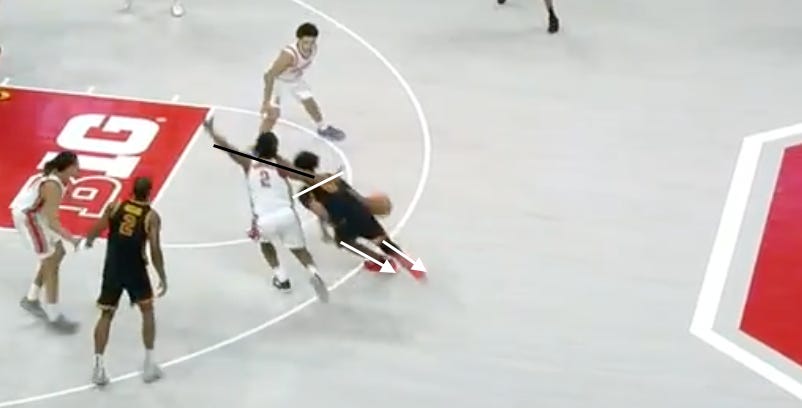
Arenas is four inches taller than his defender, but is still able to get his shoulders near the defender’s waistline, creating an incredible advantage as a driver. Arenas’s body control is elite; if he can harness it correctly, it can help him unlock more efficient two-point opportunities.
At The Rim
While Arenas has solid driving mechanics, he struggles to actually generate paint touches. He often settles for long twos, exhibiting a combination of complacency in his shot selection and lack of physicality needed to get all the way to the rim. With a wiry frame, he can easily be bumped off his driving lane and struggles to impose himself physically. Increasing his rim pressure is crucial for Arenas to hit his true offensive ceiling. He’s taken just 28.6% of his total field goals at the rim, a number that is less than ideal, especially considering his current struggles as a perimeter shooter.
At 6‘6”, Arenas’s fluidity really pops when he gets downhill, and he truly has an arsenal of different pick-ups and footwork variations that make him incredibly unpredictable coming down the lane. Still, it is pretty damning for Arenas that most of his drives end in long twos and not at the rim, especially when he has the necessary positional size and length, even if the strength may be limited.
When he does get to the rim, he has struggled to finish efficiently (42.9%), which is less indicative of his touch and instead speaks to the quality of shot he is capable of generating. Arenas is at his best when he plays off two feet and is under control, allowing his elite pacing and tempo to throw off his defender’s timing, but he has a tendency to take off just outside the paint or around the rim and get stuck in the air trying to outlast defenders, which results in a lot of difficult attempts and requires a level of upper body strength that Arenas lacks.
Shooting
While Arenas has put up some impressive box scores, it’s his lagging shooting numbers that are cause for concern. At this point, Arenas has been an uncharacteristically poor shooter, going 22.7% from beyond the arc, 39.7% on two-point field goals, and 71.2% at the free-throw line, along with 29.1% on jump shots and 42.9% at the rim.
These numbers could only be semi-excusable if they were attached to a game-wrecking defensive prospect, but Arenas has always been billed as a score-first guard. Without an efficient scoring punch, his ability to positively impact the game significantly dwindles. While I expect these numbers to rise as he continues to get his legs under him, part of his poor shooting numbers is a mix of his offensive process, physical limitations, and context within USC’s offense.
Playmaking
Arenas’s biggest detractor has always been his playmaking and overall feel, and the story remains the same at USC. The flashes are there, and on a handful of occasions, Arenas has fit passes into really impressive windows that take a high level of vision to recognize, but the consistency is simply not there, and even some of the reads he does make come a second too late. In his defense, USC’s two leading scorers have been out for the majority of Arenas’s time, so he is expected to get his shots up and the USC offense is reliant on it, but his ability to process the floor, especially on drives and general reluctance to swing the ball, even after he isn’t able to generate a good look is worrisome, not to mention some real head scratching early shot clock attempts too.
Free Throws
One promising aspect of Arenas’s offensive game has been his free-throw rate, which has increased steadily since the start of the season and has been key in maintaining his offensive productivity while scoring on mediocre efficiency. While he is shooting an underwhelming 71.2% from the line, he does have 5/9 games with 6+ free throws, a lot of which comes from Arenas’s ability to attack quickly downhill with his monster stride lengths, he is able to quickly eat into the space of opposing defenders and push them on their heels, forcing them out of position and making them prone to fouling.
Defense
In a class full of talented guards, Arenas has some of the most intriguing two-way potential because he simply has the size, length, and speed that his peers lack. He’s shown real flashes when navigating screens and disrupting ball-handlers on the perimeter. When he can stay in front of drivers and wall up, it is difficult to finish over him. His defensive stance can be too stiff, and his footwork is unpolished around the perimeter, but he’s still been relatively impactful when generating steals (1.1 per game) and blocks (0.6 per game), where his plus wingspan is on full display.
When he’s fully engaged, Arenas shows promise as a disruptive defender, and any bet on him becoming an above-average defender is contingent on Arenas being able to maintain a consistent defensive motor, something he currently struggles with, and taking massive steps to fill out his frame. At the very least, I expect Arenas to be an average defender at the next level.
Projection
With USC’s top scorers and two of its best playmakers, Rodney Rice and Chad Baker-Mazara, both sidelined, it’s unfortunate that Arenas has to bear such a heavy offensive load, because I think he would look much sharper with more off-ball reps, which could alleviate his self-creation pressure and let him shine attacking close-outs and in movement shooting opportunities. An off-ball role could be more aligned with his NBA future rather than his ball-dominant reality at USC.
Arenas has just nine made shots as a driver this season, four of which came when he was attacking closeouts. The sample size is obviously tiny, but among a barrage of inefficient isolation drives, he has shown promise in getting downhill against closeouts. While Arenas’s flashes as a self-creator are intriguing, envisioning him in an off-ball role is where I see the most value. At 6‘6” with his shooting potential (assuming he can return to pre-injury form) and fluidity getting downhill, he can thrive as a movement shooter running off designed plays and attacking rotations, and when necessary, provide secondary creation in isolation and out of the pick-and-roll.
If Arenas does declare for the 2026 NBA Draft, he will likely be a Top 20 pick, with his high school pedigree doing a lot of the heavy lifting. With the current state of NIL and the fact that he is young for his class, there’s a plausible path he would return for his sophomore year. As tantalizing as the flashes are, Arenas is still unpolished, especially where it matters most, as a decision maker. While yes, he would be a first round pick this year, I think the reps and time to physically develop with another year of college basketball would be more beneficial in setting him up for long-term success in the NBA.
YESSSSSSS
Draft a negative BPM (-2.0) player in top 20? That is too crazy.