


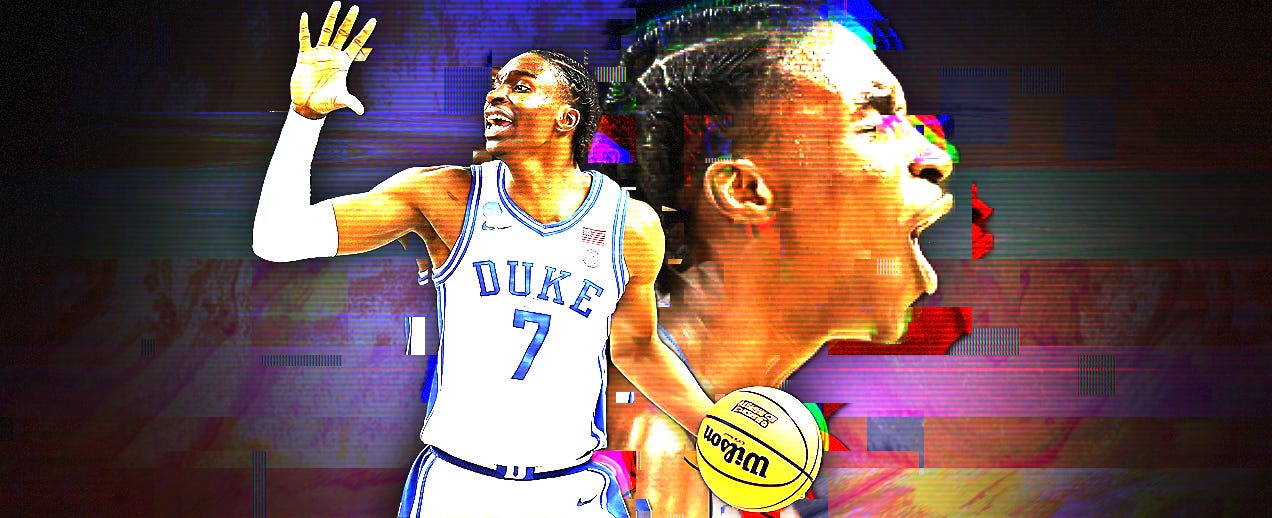
Dame Sarr entered the college basketball world with a long professional track record already in the rearview mirror. After starting out with Orange1 Basket Bassano’s U18 in his native Italy, Sarr moved over to Barcelona for the 2022-23 season. He worked his way onto the roster for the main squad in the 2024-25 season, playing 27 games between Euroleague and ACB appearances for one of the greatest powerhouses of the sports world. After a strong performance at the 2025 Nike Hoop Summit and following the conclusion of his first ACB season, Sarr jumped over stateside to suit up for the Duke Blue Devils.
In many ways, Sarr’s season played out pretty much as expected. The 6’8” wing proved himself as one of the best point-of-attack defenders in college basketball almost immediately. However, he struggled mightily on the offensive end to start the season. While he did show flashes on that end, especially toward the stretch run of the year, his game is still heavily tilted to one end of the floor. His performance in Duke’s Round of 64 game against Siena is about as good of an encapsulation of the Dame Sarr dichotomy as one could get in one game; Sarr went 1-of-7 from the floor, missing all four of his three-point attempts, but he also had two huge blocks in the final four minutes to help Duke avoid the upset and shut the Siena offense down whenever the ball swung toward the man Sarr was defending.
To be honest, Dame Sarr is probably the player whose evaluation I’ve struggled with the most this season. On the one hand, his defense is truly special—even though all rookies struggle defensively at the NBA level to some extent, I’m willing to bet Sarr figures things out very quickly on that end. On the other hand, the NBA has moved further and further away from one-trick pony archetypes; offense-only shooters are targeted relentlessly, especially in the playoffs, and non-scoring threats are increasingly abandoned, leading to extremely difficult 4-on-5 situations for their teams on offense.
In the right situation, I could absolutely see Sarr getting minutes through his defense and showing enough as a shooter, cutter, and transition threat that he puts together a decade-long NBA career as an elite defender somewhere in between Kris Dunn and P.J. Tucker. I could also see a world where he just doesn’t score enough to make that bet worth it. I would take that bet on Sarr personally as a late first round flyer; the offensive concerns are real, but his defense can more than make up for it.
Enough of the preamble, though…let’s dive deep!
All stats courtesy of sports-reference, Synergy Sports, and Hoop-Explorer
Defensive Brilliance
We’ll start with the good stuff with Sarr—and it’s extremely impressive. Very few 6’8” players have the foot speed and flexibility to guard players at the point of attack, and Sarr is among the best of them. He’s a spectacular help defender as well, to be clear; few players in college basketball hedge and recover as well as Sarr on pick-and-roll plays. However, he’s just not as superlative in that area as he is when it comes to locking up whoever is unfortunate enough to be in front of him:
Despite his relatively skinny 190-pound frame, Sarr fights through screens with the kind of competitive fire that you hope to find in your defenders. He seems to enjoy getting up in the jerseys of his opponents and forcing them to shake him by repeatedly running through actions. Most of the time, the opposition gives up on the play before Sarr does; even on the rare occasions where his opponent manages to get a sliver of daylight, Sarr’s length and relentlessness almost always allow him to get back into the play and at least contest the shot.
The advanced stats all agree about Sarr’s defensive impact. He grades out in the 92nd percentile defensively overall, per Synergy. It’s not just perimeter play or interior mastery, either; opponents shot a preposterous 27.1% on jumpers defended by Sarr, and they shot an even more preposterous 32.4% when Sarr defended them around the basket—a number that would make even the most potent rim protector jealous. Sarr also finished the year with the fourth-most Defensive Win Shares (2.2) on the ACC, and the fifth-best Defensive Box Plus/Minus (5.0) in the conference as well. He was an obvious choice for the ACC All-Defensive Team.
The more basic box score numbers on defense are solid, but not quite as superlative. The defensive playmaking with Sarr is not bad by any stretch of the imagination, but his 2.5% Steal Percentage and 1.9% Block Percentage don’t exactly jump off the page. That doesn’t mean that he can’t make those highlight reel plays, though:
Still, if you only focus on those defensive playmaking numbers with Sarr, you’re kind of missing the point. I haven’t followed the NFL in quite some time (and this analogy will make that abundantly clear), but Sarr has a lot more in common with the Darelle Revises of the world than the playmaking safeties. It is remarkable watching how Sarr uses his condor-like wingspan and ridiculous athleticism to just shut off one side of the floor for possessions at a time.
It’s honestly difficult to talk about Sarr’s defensive acumen without trending toward hyperbole. There aren’t many 6’5” players who have his combination of defensive feel and athletic tools, much less players of Sarr’s dimensions.
Offensive Profile
Let’s start with the good parts of Sarr’s offensive profile. For starters, he’s a better shooter than his ugly 40/32/53 would indicate. He actually graded out in the 61st percentile as a jump shooter, per Synergy, largely due to his impeccable shot selection.
Sarr’s exceptional feel for the game defensively isn’t at all lacking in his offensive game; he’s well aware of his strengths and weaknesses, and plays to them quite well. He knows that his primary goal is to space the floor offensively, and he gets himself into those positions well. All but four of Sarr’s jumpers this year were catch-and-shoot looks, and all but five of them came from beyond the arc (ironically, he actually shot far better on mid-range jumpers and off-the-dribble jumpers than he did on his standstill looks, but the sample size is way too small to take anything away from his 4-of-5 mark on mid-range looks and 2-of-4 mark on four off-the-dribble threes). The shot from distance looks smoother than one would expect given his percentages, which is also encouraging:
In addition to his shot selection overall, Sarr also has the most important part of his three-point arsenal down pat. Per Hoop-Explorer, Sarr shot 41% from the left corner and 44% from the right corner this past season. Being a complementary offensive player who can nail corner threes and play exceptional defense can lead to a 14-year NBA career—just ask the aforementioned PJ Tucker.
Sarr’s 54.7% mark on his two-pointers is well above average and is mostly driven by Sarr’s picky shot diet. His 56.1% mark at the rim is solid but not spectacular; however, his two-point percentage is helped quite a bit by the fact that all but nine of his shots inside the arc came at and around the basket. He doesn’t force his shots around the basket, and can throw down some beautiful above-the-rim finishes when he gets to the cup:
Now, for the sake of honest evaluation, we need to look at the areas of improvement in terms of Sarr’s offensive game, which is…basically everything else. While there is some noise in his shooting splits as discussed above, 40/32/53 just isn’t going to cut it at the NBA level.
He can and does make good reads as a connective passer, but Sarr still has room to grow there. He shows flashes of being more viable as a passer who can fill in the gaps. He mostly makes the obvious reads, but every once in a while, he shows that he is capable of making plays at a higher level:
Although there are interesting moments on the film, Sarr’s passing still has plenty of room for improvement. His just barely positive A:TO ratio (42 assists to 40 turnovers) isn’t exactly fantastic. His shooting volume from beyond the arc is large enough that defenses at least have to pay attention to him out there, especially from the corners, but Sarr’s handle and rim gravity are nowhere near good enough to make opposing defenders pay consistently when he’s forced off the three-point line.
Despite his athleticism and frequency of runouts, Sarr ranked in the 38th percentile in transition success, with just one point per possession on those plays. He isn’t helping himself out with his cutting, either; while the sample size of 16 possessions is surprisingly small and arguably too limited to draw any sort of conclusions, Sarr ranked in the 37th percentile as a cutter despite playing with Cam Boozer. Sarr’s much better numbers as a transition finisher and cutter at Barcelona are certainly encouraging, but it would have really helped his case to provide that off-ball value while at Duke.
It’s not like Dame Sarr’s offensive game is dead in the water; the shot doesn’t look broken, and there’s reason to believe that he’ll be more efficient around the basket at the NBA level—especially since he made 60% of his two-pointers in conference play. Still, there are far too many question marks with Sarr’s offensive game at the moment, even if there’s plenty of reason for optimism.
Future Outlook
The main reason Dame Sarr has probably been my most difficult evaluation of the season is just how many outcomes for his NBA career seem entirely plausible at this stage in his development. As someone who buys into Sarr’s shooting form and feel for the game, I’m tempted to buy in on his upside. As someone who has called himself a partial free-throw truther on many a podcast (and will continue to), his free-throw percentage is very concerning.
It’s tempting to go with the cop-out answer and say that Sarr’s NBA outlook will depend on which team ends up drafting him—but that’s true of pretty much every prospect ever who didn’t go in the Top 5 of their respective drafts.
Instead, I’ll put my non-existent GM money where my mouth is and say that I would take the bet on Dame Sarr. While his limited offensive game is concerning in terms of his projection going forward, there are quite a few NBA teams drafting late in the first round who have the offensive side of the ball pretty much figured out and just need help defensively. Sarr went to one of those nearly-perfect situations in our most recent Mock Draft with the Denver Nuggets taking him with the #24 overall pick, and I would fully expect him to be one of the steals of the draft if he ends up there. I also can’t help but wonder about the San Antonio Spurs picking him up at #20; a Castle-Harper-Sarr-Bryant-Wembanyama defensive Voltron would cause nightmares league-wide for many years to come.
The Dame Sarr dichotomy makes it difficult to judge where his NBA career will go once the dust settles on the 2026 NBA Draft. As many areas for improvement as there are in his offensive game, his defensive brilliance more than makes up for it. Only time will tell if he has enough juice to his offensive game to make it all work out; given his current offensive profile and overall awareness on the court, though, it’s hard for me to believe that arguably the best defender in this draft class will fail to find a home at the NBA level.
When you can shut the lights off for any star player who dares to challenge you in the way that Dame Sarr can, you’ll get your chance to shine.