


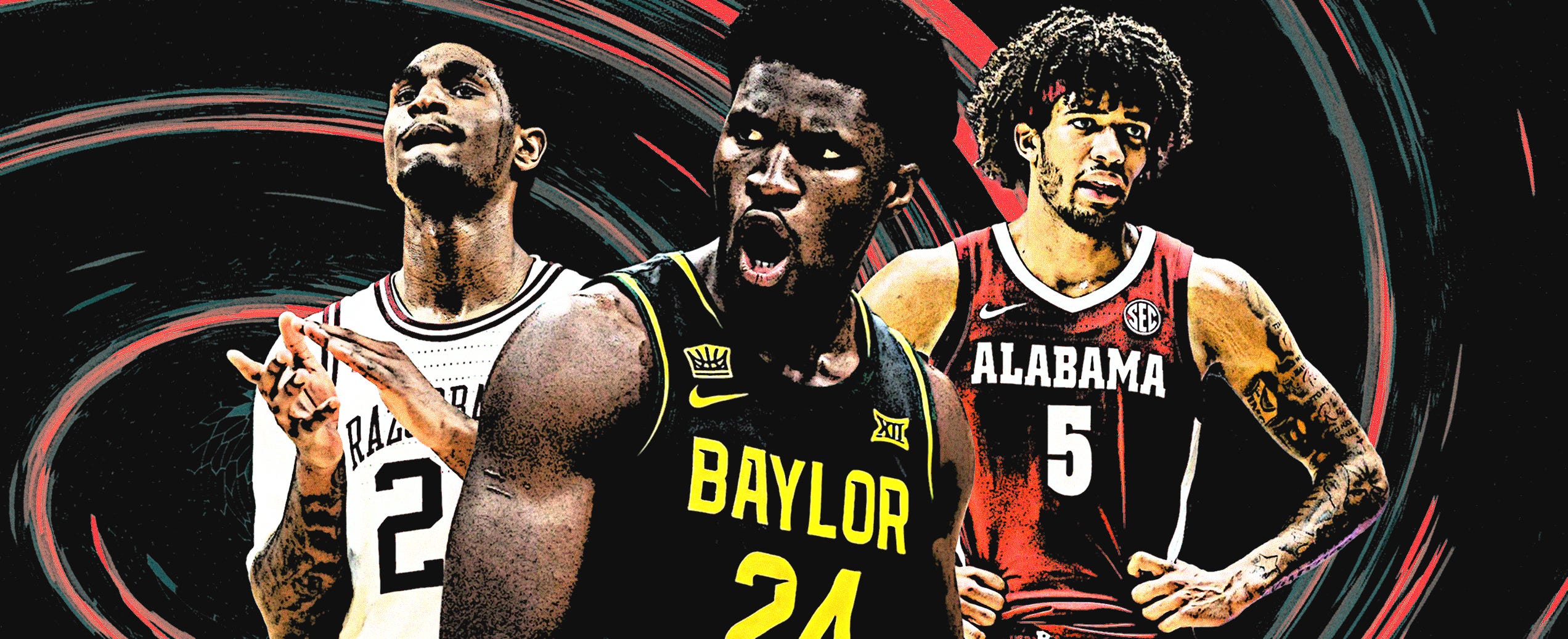
The NCAA Early Entry Withdrawal deadline has come and gone. That means we know which underclassmen are staying in the draft and which are returning to school for the 2026-2027 season. The only thing we don’t know yet is which players who opted to stay in the draft could end up suing the NCAA in an attempt to regain their eligibility a few years from now. While all eyes are focused on the 2026 draft, I wanted to take some time to spotlight a few of 2027’s top returners today. That draft is considered a bit more open at the top than this year’s was, and these players all showed significant promise. As a result, there is room for each of them to move the needle in a big way if they can make improvements in these key areas.
Amari Allen
Why he’s a top returner:
Alabama’s Amari Allen has some super intriguing NBA traits. For starters, he fits the dribble-pass-shoot skill set that so many teams look for. He brought the ball up the floor more than most players his size (6’5.25” barefoot is still good size, even if he’s not the absurdly off-base 6’8” he was listed at), and he does a great job of picking opponents apart from the perimeter. His 18.1 AST% is a high mark for someone who will play most of their NBA minutes on the wing, and his 8.2 three-point attempts per 100 possessions show he isn’t afraid to let it fly, either. There’s also an underlying toughness that accentuates everything he does. He gets to the line pretty often (.380 FTr), he’s a good rebounder on both sides of the ball (6.1 ORB%, 17.9 DRB%), and he’s a physical defender who’s tough to get through at the point of attack. If he can continue on an upward trajectory, he could be a no-brainer, plug-and-play wing with playoff equity.
The swing skill: Attacking from a spot-up
Last season, Amari Allen shot 6-for-21 on two-point attempts generated from a spot-up. Given that he’ll likely be a secondary playmaker at the next level, his inability to create efficient shots for himself downhill is a serious problem. There are a few issues at play. The first is that Allen often holds the ball for a second when he doesn’t have a clean look from three, allowing the defense to prepare itself for what comes next. I’d like to see him throw in a stampede dribble here and there to keep the momentum rolling. The other issue is that Allen’s first step isn’t anything to write home about, and his strides can be choppy. He’s not going to dust his man. And while he’s strong enough to hold his line downhill, and he tested well vertically at the NBA combine, the upright nature of his drives limits his pop at the rim. I also think his overall process needs to improve in this context. He doesn’t mix in many Eurosteps or counters. It doesn’t look like he’s reading the floor beyond his man at times, leading to missed passing opportunities and possessions where he drives directly into a rim protector who had ample time to get into position at the rim. If Allen can maximize his burst while keeping his head up on the go, he’ll be in a better position going forward. That improvement would really make the rest of his game sing.
Tounde Yessoufou
Why he’s a top returner:
Tounde Yessoufou didn’t have the one-and-done campaign he may have hoped for, but he was still damn good. He put up 17.8 PPG, excelled on the offensive glass at a time when that’s a super-relevant skill for non-bigs (8.7 ORB%), and was a disruptive force on the defensive end (3.5 STL%, 1.9 BLK%). At 6’4.25” with a 6’10” wingspan and a pro-ready 219.8-pound frame, Yessoufou has awesome tools and a relentless desire to put them to use. If he’d entered the draft this year, he’s a guy I personally would’ve had in my Top 30. Sure, he’s a bit rough around the edges from a skill standpoint, but he’s a type of bet I’d like to make—a physical, hard-charging wing who can provide value in the absence of shooting efficiency, but will be a big “value win” if the shooting efficiency ever comes around.
The swing skill: Pull-up process
There are two glaring deficiencies with Tounde Yessoufou’s offensive profile—his negative assist-to-turnover ratio and his 29.3% mark from three-point range. I believe these two are more correlated than one might expect. Yessoufou has some decent shooting indicators. He took 9.4 threes per 100 possessions in a higher usage role as a freshman, and generally, those types of guys end up figuring it out. Plus, he made 39.5 of his unguarded catch-and-shoot threes, and if he can at least get to “you can’t just ignore him” level, that would go a long way. Still, Yessoufou loves to hoist exceedingly difficult pull-ups, which both hurts his efficiency and prevents him from, well, creating anything better for his team. He went 8-for-46 on threes off the bounce this past year. Yessoufou will hesitate off the catch when he has some space, only to launch into a more contested step-back from well beyond the arc. It would be one thing if these shots were anomalies at the end of the clock, but they happen with plenty of time remaining to create something better far too often. If Yessoufou can pull off the catch quicker to make his life easier, or focus on breaking down the defense instead, it could both boost his efficiency and give him better playmaking opportunities.
Billy Richmond
Why he’s a top returner:
Rising junior Billy Richmond delighted Arkansas Razorbacks fans when his return to the program was announced after a brief “he’s staying in the draft” scare. The dude is a livewire athlete who plays like his hair is on fire. Richmond is electric in transition (88th percentile per Synergy) and excels at finding holes in the defense in the halfcourt (96th percentile per Synergy). Throw in serious above-the-rim bounce, and he’s super-efficient around the basket. Richmond dunked 38 times last year and made 63.5% of his twos, which you don’t see too often for a guy his size. There’s a lot to like on defense, too. Richmond can use his lightning-quick feet and intensity to smother the ball or his motor and speed to make hustle plays as a disruptor (2.2 STL%, 3.0 BLK%). Richmond’s athleticism, work rate, and feel make him an intriguing upside proposition.
The swing skill: Three-point shooting
The good news is that Billy Richmond improved his three-point percentage last season. The bad news is that he was still a bleak 25.9% from deep on extremely low volume for his position (3.1 attempts per 100 possessions). The eye test isn’t great, either. The lefty brings the ball up the right side of his body in a near semi-circle motion before slowing down his release around the top of his head and launching it. Still, there’s reason to believe. Richmond tweaked his mechanics during the pre-draft process, and it’s looking more traditional now. And while I put very little weight on combine shooting drill efficiency, Richmond shot it pretty well in Chicago. If he’s an extremely poor shooter at the NBA level, it will be tough for him to carve out a role at a hair under 6’6” with a 6’8” wingspan and a 195.4-pound frame. But Richmond has long outpunched his physical dimensions thanks to his gritty, gutsy play style, athleticism, and feel. If he can get to a decent place as a shooter, it would be hard to imagine him as anything other than a long-term rotation player.
Tyler Tanner
Why he’s a top returner:
Tyler Tanner had a phenomenal statistical season as a sophomore at Vanderbilt. He shot the ball well (36.8% from three on solid volume, 85.3% on free throws), finished above the rim (18 dunks), got to the line at will (.464 FTr), took excellent care of the ball (28.9 AST%, 10.6 TOV%), and disrupted plays on defense (4.1 STL%, 1.1 BLK%). On paper, there’s not much more that anyone could ask for. Unfortunately, the NBA Combine process wasn’t kind to Tanner. His stubby measurements (5’10.75”, 7’9” standing reach, 166.8 pounds) cast serious doubt on his scalability. During the scrimmages, he didn’t look like he was clearly above the competition. Tanner decided to return to Vanderbilt, where he’s sure to be handsomely paid. While Tanner is unlikely to get bigger, he’s one of the most talented and productive players in the country, and it’s scary to imagine what his numbers could look like if he takes another step forward.
Swing skill: Mid-floor play
Tyler Tanner can be really good inside the arc at times. He pressures the rim well, taking 35.8% of his halfcourt shots at the basket and converting on 58.2% of them, per Synergy. He’s also a turnover-averse player, generally speaking. Still, the margins are razor-thin for players with physical dimensions similar to Tanner. He can be prone to launching off-balance floaters. I’m pretty anti-floater in general, as it’s a high-variance shot. That variance bit Tanner last year, as he went 15-for-51 on those attempts in the halfcourt this season, per Synergy. He’s more efficient when he continues all the way to the rim, both because he converts more often there and because he’s more likely to draw a foul that way. I also think Tanner’s handle in that part of the court didn’t quite look as polished as a player like Braden Smith’s. By keeping the ball lower and tighter in traffic, he’ll be able to cut his turnover rate even lower. If Tanner can score more efficiently and better control the ball in the mid-range area, he’ll be even better than he already is, and he’s already one of the best players in college basketball.
Milan Momcilovic
Why he’s a top returner
Milan Momcilovic just put together one of the best shooting seasons in the history of college basketball. He hit 48.7% of his three-point attempts on 7.5 attempts per game. Factor in his 6’8” barefoot height and a positive assist-to-turnover ratio, and he’s a jumbo sniper fever dream. So many NBA rotation players make boatloads of money because they’re tall, they can shoot it, and they take care of the ball. Momcilovic is exactly that type of player.
Swing skill: defensive viability
My big concern with Momcilovic is that he’s going to be a hunting target on defense at the NBA level. Off-ball, his lackluster athleticism will always put a ceiling on how disruptive he can be. Throw in that his feel is just run-of-the-mill, and his stock rates (1.6 STL%, 1.0 BLK%) are quite poor. The good news is that with a 6’9.25” wingspan and a 218.2-pound frame, he has size. The bad news is that he doesn’t use it particularly well, even at the point of attack. Premier jumbo shooters who can hang on defense, such as Sam Hauser, do a great job of leveraging their frame. Hauser is constantly staying square and getting up on his man, attacking with his lateral strides and absorbing them into his chest. Momcilovic makes the mistake that many slower-footed defenders make, which is that he plays too far back. This makes it easier for his man to generate space off of step-backs while also making it easier for them to get him off balance with dribble counters. Plus, he tends to retreat backward rather than covering ground laterally and attacking with his steps when he slides his feet. Basically, it’s too easy for opponents to get wherever they want on the floor against him right now. If Momcilovic can at least improve his ability to stay in front of the ball, he’ll be a much more viable defensive player. And given how much value he’ll provide as a spacer, he might be able to get away with being below average on that end, at least in the regular season.
Been a while since I commented but common Maxwell W