


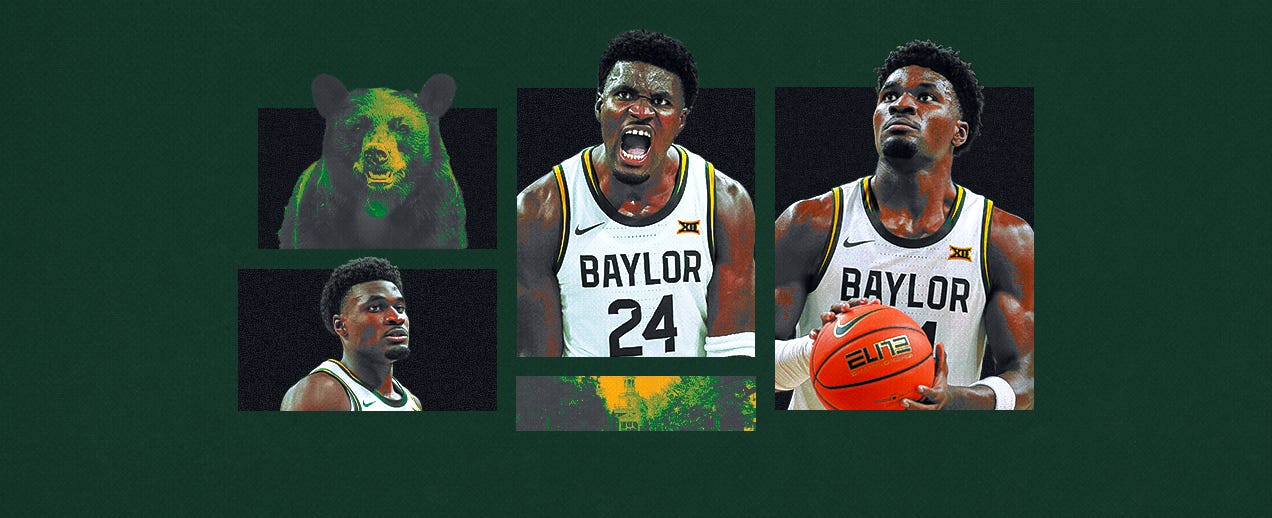
In a season of incredible freshman success stories, Tounde Yessoufou has had perhaps the most polarizing season of any top guard in the 2026 NBA Draft class. Born in Cotonou, Benin, Yessoufou came to the U.S. to play high school basketball. It would be fair to say that it went pretty well, given that he broke California’s 21-year-old high school career scoring record before he wrapped up his career at St. Joseph’s in Santa Maria, CA.
Yessoufou committed to Baylor as the 11th-ranked prospect in the 2025 high school class per RSCI. Unfortunately for Yessoufou and Bears fans, this season has not gone according to plan. After starting the season 10-2, Baylor has limped to a 16-15 record since, including a brutal 6-12 record in conference play. Despite much higher expectations, Baylor is going to miss the NCAA Tournament for the first time since 2017-18 after losing in the Big 12 tournament to Arizona State.
For Yessoufou’s part on the court, he has had an odd year. On the one hand, he has shown pretty significant improvements as a defender both on and off the ball; he has also clearly made an effort to expand his shooting range and become more comfortable shooting from beyond the arc. On the other hand, his struggles have been pretty reflective of Baylor’s overall performance; outside of a sensational performance against BYU despite a loss, Yessoufou has performed worse in conference play than he did to start the season. After seeming like a lottery lock, he has fallen toward the end of the first round on many draft boards—including the most recent No Ceilings Board and No Ceilings Mock Draft, where he ended up at 29th and 30th, respectively. In many draft spaces, he has been leapfrogged by his teammate Cameron Carr in terms of his draft stock.
Suffice it to say, I (and many others) did not expect that to happen. Tounde Yessoufou was the second-most impressive player on the court at the Nike Hoop Summit last year, behind Cam Boozer (including AJ Dybantsa, though Darryn Peterson did not play at the Hoop Summit in 2025). His performance there, combined with his incredible tools, motor, and high school tape, led me to rank Yessoufou at #4 on my personal board heading into this season. I have dropped him down my board quite a bit since then, but I’ve held firm on keeping him in the lottery range.
This is the part where the enigma comes into play, at least for me. I’ve talked quite a bit on Deep Dives podcasts and in some of my articles this year about anchoring bias, and trying to figure out just how strongly to weigh a player’s last 10 games (or more) against the larger sample size of what they’ve previously shown that they can do on a basketball court. Yessoufou has taken important developmental strides this year while demonstrating that his spectacular athletic tools are not muted by the higher bar of college-level athleticism. Even as he’s struggled, especially in conference play, I’m still willing to bet on the tools and the work ethic.
Now, this is the part where it gets a bit personal. I promise I’ll keep this part brief (I’ll get back to it at the end of the piece, but I’ll try to keep that part brief as well), but I think it’s important for the sake of this piece for me to be honest with you, the reader.
I have never been more personally biased in favor of a prospect than I am when it comes to Tounde Yessoufou.
Maybe I’m being too stubborn about some of the faults he’s shown in terms of his game this season and clinging on too tightly, but keeping him in my lottery is as much of a bet on Tounde Yessoufou the person as it is on Tounde Yessoufou the basketball player.
Maybe more.
Back to the evaluation, though—let’s dive deep!
Note: All stats are current as of 3/11/26, and are from sports-reference and Synergy Sports.
Offensive Deep Dive
The place to start with Yessoufou on the offensive end is with his driving ability. Yessoufou is listed at 6’5” and 215 pounds, and he certainly appeared to be every bit of those measurables at Hoop Summit. Yessoufou is already built like a 10-year NBA vet, and he looks like it when he’s attacking the rim. Plenty of business decisions have been made by defenders on his drives, but Yessoufou also has the craft near the rim to work his way around taller/lengthier opponents:
Yessoufou is shooting 57.1% on his two-pointers this season and 63.4% at the rim—not the craziest finishing numbers you’ll see around the basket, but quite strong. He ranks in the 72nd percentile in at-rim scoring, per Synergy; most of the players ahead of him on that list are big men with a much more rim-based shot diet. He’s also a master of the mid-range, which was his main tool outside of relentlessly getting to the basket in terms of climbing to the top of the California state scoring leaderboard. He’s continued to be a menace in that mid-range area; Yessoufou is shooting 49.0% on all two-point jumpers, with the vast majority (81.6%, to be exact) of those looks coming off the dribble, where he’s connected on 52.5% of those looks inside the arc. He is preternaturally gifted at using his body to shield off defenders as he gets into his preferred spaces from 12-15 feet:
The three-point shooting is another story, so let’s get into that part of the breakdown now. There’s both good and bad news there: the good news is that his shot looks quicker and more consistent on his attempts from distance this year than it did before. Here are some clips from Yessoufou in high school:
Now, for contrast, here are some clips of him this year at Baylor:
I’m not a shot doctor, and I don’t claim to be, but I can back up what looks to me like a quicker and more confident long-range shot with some numbers. Yessoufou averaged 5.4 3PA per game this season, which is certainly far more than I expected him to take. He has also looked less hesitant in taking those shots than he did in high school. The bad news is that he connected on just 30.2% of those triples this year.
I’ve staked my claim pretty firmly at this point that volume from distance matters at least as much as the percentages, and maybe more; simply put, there has been a long history of players shooting 40+% from distance on a tiny volume of attempts in college and then not shooting well in the pros, and it leaves me skeptical about them as actual shooting threats at the NBA level. You don’t space the floor if you hit the one uncontested three-pointer that defenses let you take every game 40% of the time. I’m not claiming that Tounde is guaranteed to become an elite shooter or even an above-average shooter from three-point range because he’s taking tons of shots; however, his solid enough 74.4% mark at the charity stripe and years of mid-range shot-making give me hope that he will continue to develop as a shooter from beyond the arc.
My concerns with Yessoufou’s offensive game are primarily about his passing rather than his shooting. Despite averaging 17.8 points per game and being one of the two offensive focal points for Baylor, along with breakout sensation Cameron Carr, Yessoufou is averaging just 1.6 assists per game against 1.9 turnovers per game. While his shooting from long range was slightly better in conference play than in non-conference play (shooting 30.8% in 19 Big 12 games, including his rough 0-for-7 line from distance in the tournament game against Arizona State, versus his 30.2% from deep overall), his assist-to-turnover ratio dipped even more into the negative against tougher opponents. Yessoufou had just 25 assists against 36 turnovers in conference play.
Some of his mistakes came from being forced into tough situations, but Yessoufou just didn’t make enough of the plays under pressure as a passer that he’ll need to at the NBA level. He also has room to grow as a ball-handler. While his handle isn’t a problem, he could also stand to improve in that area to leverage his athletic gifts and to navigate his way out of jams that he’s not quite ready to solve yet through his passing touch.
It’s not that he’s a selfish player offensively by any means; he’s willing and able to make the basic passes, and he does show real flashes of higher-level passing—especially when he makes quick decisions. However, his weaknesses as a passer are his biggest area for improvement right now. His forays to the basket would be even more dangerous if he could make defenses pay more often when they collapse on his drives:
Ultimately, I think his offensive struggles this year are a bit overblown, particularly his shooting. In addition to his ability to get to the rim, Yessoufou is an absurd offensive rebounder for his size; he finished 12th in the Big 12 in offensive rebounds this year, behind a whole bevy of big men. As his shooting continues to develop and his rim pressure continues to be excellent, I’m willing to bet on Yessoufou to figure out enough as a playmaker for others to let his other offensive gifts shine through.

Defensive Deep Dive
One of the questions that is consistently asked of players of Yessoufou’s archetype as a scoring force is this: how much are they helping (or taking away) on the defensive end of the floor?
Before this season began, I was hoping that Tounde would be a much better defender as his offensive emphasis scaled back a bit (which was all but guaranteed for literally the all-time scoring leader in the state of California). While it hasn’t been a perfect season for him on that end, he has been much more consistent as a defensive force in college than he was in high school.
Let’s start with the highlights. Yessoufou averaged 2.1 steals per game at Baylor this season (third in the conference) with a Steal Percentage of 3.6% (fifth in the conference). The question that I most frequently ask myself when a player has those kinds of steal numbers is: how many of those are reckless gambles, and how many of those are just great plays?
With Tounde’s steals in high school, that equation tilted heavily to the former. This season, there has been a lot more of the latter. He also has a strong Block Percentage for a guard at 1.6%, which isn’t as elite as his ability to generate steals, but helps contribute to his overall abilities as a defensive playmaker:
Yessoufou’s ability to create turnovers and block shots from the weak side is an encouraging sign for his defensive future. However, his off-ball defense outside of those big events will be even more important in terms of his NBA future. I don’t want to overstate the case in terms of his current status as a defensive prospect; Tounde still has a lot of room to grow as an off-ball defender, and can get caught ball-watching at inopportune times. Still, he has shown really promising signs this year in terms of his screen navigation.
While there are some clear areas for development in Yessoufou’s offensive game, his defensive development will be more about consistency than anything else. He has both the tools and the ability to read the game that are needed to be an above-average defender; if he continues to improve off-ball, he could become quite a bit more than that.
Future Outlook
With Baylor and Yessoufou’s season likely to be over after the Big 12 Tournament, there remains the question of where Tounde’s basketball career will take him next. While his freshman season hasn’t quite gone as he or the team might have hoped, Yessoufou has shown enough on the court to still be in heavy consideration for a first round pick. Additionally, he’s a good bet to dominate the athletic testing at the NBA Draft Combine. He could decide to return to college, whether at Baylor or elsewhere, if he thinks that he might have a shot to go in the lottery in next year’s draft. When factoring in his development this year, a potential heater at the Combine, and his track record prior to this college basketball season, he may end up being picked sooner in the 2026 NBA Draft than some might expect—especially if the intel on him as a person continues to be as stellar as what I’ve heard from others and witnessed myself so far in his journey.
This is the part where I circle back to Hoop Summit 2025 (again, I promise I’ll try to keep this brief). Suffice it to say, the week of Hoop Summit last year was in the middle of an incredibly difficult time for me and everyone in my family. I was not exactly emotionally at my strongest at the time, and one press conference is an even worse indicator of a prospect’s future than one basketball game.
Still, I doubt that I will ever be more impressed by anyone in any press conference than I was by Tounde Yessoufou following Team World’s tough overtime loss to a Team USA squad that was expected to blow them out. Yessoufou, of course, led Team World in scoring and made the bucket that sent the game to overtime.
After a great speech by Team World Coach Marshall Cho about how moving it was to see the Team World players come together over the course of the week of practices and cap it off by nearly knocking off Team USA (following perhaps the most genuine run of “nobody believes in us” discussions I can remember), Yessoufou took the microphone. He spoke in a deeply impactful way about how much it means to him to represent Benin on the world stage, the friends he made among the Team World crew, and his hope to one day invite some of those new friends to the place where he grew up. It was remarkably inspiring to hear a teenager speak with wisdom and poise far beyond his years (or mine, quite frankly) about how important it was for him not only to follow his own basketball dream but also to blaze a trail for other Beninese young people to follow in his footsteps.
Yessoufou’s leadership on the court was obvious enough. His capturing the room during the press conference was much harder to anticipate—in no small part because it was not exactly the kind of environment likely to create that moment.
I know that I was not the only person in the press room who got choked up, but I think it would be safe to say that I would rank pretty high on the leaderboard of most choked-up media members in that room. Maybe I’ve oversold it a bit—or maybe, as the son of an immigrant mother who was fighting cancer (and still is, though she’s doing much better now) and was between major surgeries at the time, hearing Yessoufou’s story was bound to leave me in shambles since I was barely holding it together at that point in time anyway. The fact that the impression he made on me in that press conference has stuck with me to the point that I’m writing about it 11 months later, though, makes it unique among post-game press conferences in and of itself.
Whatever the case may be, intel is always the murkiest piece of the puzzle when it comes to prospect evaluation. Sometimes, guys who seem like the safest character bets out there lose some steam work ethic-wise when they make it to the NBA; other times, guys who had intel red flags all over the place figure it out and become much better NBA players than college players because, you know, most of the freshman prospects are literally teenagers who are still figuring life out and then they do a better job of that when they’re not in college.
I can’t say that I have Tounde Yessoufou’s phone number, or that I have some deeply rooted personal connections at Baylor to feed me the day-to-day info on Yessoufou’s makeup. What I can say is that Yessoufou is physically built like a 10-year NBA vet already, and his improvements defensively and shooting-wise both speak to him putting in the work. Also, Baylor has a history of guards with massive offensive roles and polarizing draft stocks who proceed to outplay those expectations at the NBA level (Keyonte George, Ja’Kobe Walter, Davion Mitchell, etc.). With all of that in consideration, it’s easy for me to believe in his NBA future in my mind.
My heart believes in him more powerfully than my mind ever will.
I am a huge fan of this guys game and I really wish he had stayed in this year. I think he still could have went lottery. Its also crazy he is transferring instead of going back to Baylor, but we will just have to see what Rick Pitino does for him next season. I am excited about his development.