


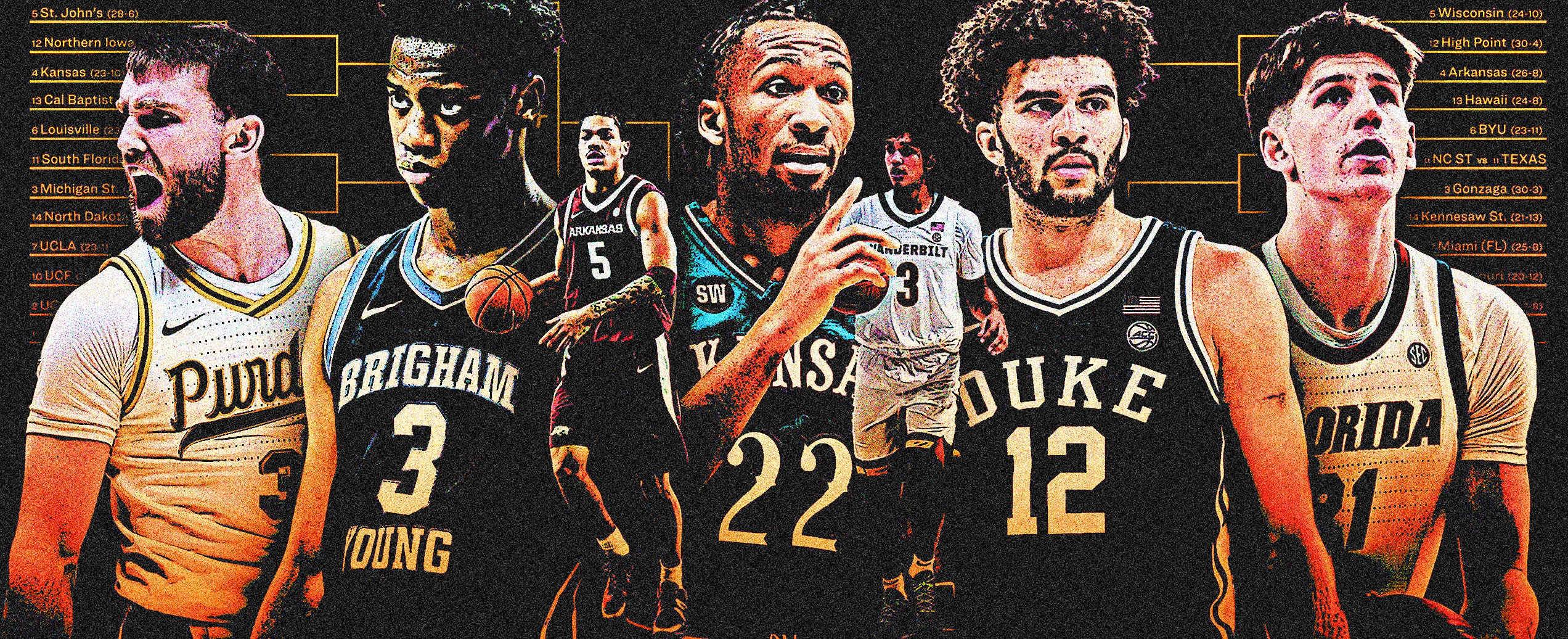
It’s finally here! March Madness! You know the deal—the stakes, the drama, etc. Because this is No Ceilings, and we cover the NBA Draft, I’m going to take you through an NBA Draft prospect-centered preview of THE ENTIRE NCAA TOURNAMENT FIELD.
Yes, I’ve dedicated film time to the entire field to make this happen. If you appreciate this type of content, make sure you’re subscribed to No Ceilings + and following me on Twitter/X! Let’s get down to business!
EAST REGION
#1 Duke vs. #16 Siena
The Duke Blue Devils will be led by Cameron Boozer, the number two prospect on our most recent consensus Big Board. The 6’9”, 250-pound freshman is a threat to score everywhere on the floor. His Synergy profile is absolutely preposterous, as he ranks in the 80th percentile or higher in post-up, transition, spot-up, cutting, put-back, pick-and-roll roll man, pick-and-roll ball-handler, and isolation efficiency. It’s not normal to be that good at that many different play types. He’s long been heralded as an interior scorer, and that’s held up at the college level. Boozer owns the offensive glass; his power enables him to go up strong, and he’s got great touch around the basket. He’s gotten more comfortable on the perimeter this year, though, hitting 40.9% of his threes on high volume for a forward. He can drain triples off the catch, but he’s also shown a willingness to keep defenders honest with a pull-up if his man gives him too much space.
What makes Boozer all the more exciting is that he’s an unbelievable passer. The number of “holy shit” passes he throws on a game-by-game basis is not something I’ve personally encountered from a player his size and age. He has excellent poise and vision against doubles inside, and he’s super quick to punish help. He’s exceptionally sharp and creative, while sacrificing nothing in execution. He can make “.5” reads out of the short roll to the weakside corner or slot while delivering the ball with pinpoint accuracy. His 26.4 AST% is a number more common among point guards than power forwards. Throw in a low 12.0 TOV%, and he’s not just an awesome playmaker, he’s a refined one, too.
There are a few nits to be picked here. Boozer hasn’t shown off much of an in-between game, going only 1-9 on pull-up twos this year. His handle can get wide, and his counter moves are slower and clunkier than most perimeter creators. He doesn’t fly off the floor around the basket. While he can swallow up smaller players on defense, his off-ball effort can be lacking, and he doesn’t cover ground fast, leading to a meager 0.9 BLK% in ACC play. His lateral footwork is just okay.
Cameron Boozer is a more polarizing prospect in front offices than his overall production may suggest. Some are down on his lack of traditional run-jump athleticism and worry that he doesn’t have the juice to be a true lead initiator. Others believe that he’s a “false ceiling” prospect in the mold of Luka Doncic or Alperen Sengun, with his future prospects being downplayed because of aesthetic bias. He’ll have one final chance to compete for the number one spot during the big dance.
Duke big man Patrick Ngongba came in at 27th on our most recent board, though he’s currently dealing with an injury. The 6’11”, long-armed big man is an analytics darling. A big part of that is his super high-feel playmaking from the block and top of the key. He has awesome vision and can send the ball right on the money to open cutters. His 15.5 AST% and strong assist-to-turnover ratio bode well for his NBA translation. Still, he’s not a soft, perimeter-only guy, as he’s a force on the offensive glass. Plus, he’s shown good refinement on the defensive end this year, being in the right spots in drop coverage and turning away opponents at the rim more consistently. The concern with Ngongba is that he’s not a great end-to-end athlete, which limits him in transition, and he’s also dealt with foot issues in the past, which is always scary for a big man. Personally, I’m bullish on his intersection of size, physicality, and intellect.
Isaiah Evans slots 30th in our rankings. The 6’6” sophomore wing is a lethal shooter who’s hit 36.5% of his threes on 15.9 attempts per 100 possessions through his two seasons with the Blue Devils. He’s got parking lot range, and he’s capable of movement. Plus, he’s rounded out his game this year, increasing his defensive activity (3.1 BLK%, 1.7 STL%), getting to the free-throw line more often, and showing off some on-the-go passing ability. He’s rail thin and doesn’t rebound much, which is concerning given how unforgiving the NBA can be to skinny wings. Still, he has a signature skill in his jumper and some ancillary insulation via his defense and decision-making.
Dame Sarr came in at 45th in our latest rankings. The 6’8” freshman is a bit rough around the edges in terms of his offensive skill set. He’s an inconsistent three-point shooter, and he’s under 60% at the charity stripe. That said, he’s not afraid to shoot, he’s an excellent athlete, and a suffocating defender. He strikes me as a player likely to return to school, given that he’s been a lower usage player and may find more security at the college level, but he’s a name to watch long-term. The framework of a versatile wing is here; he just needs some time to put it all together.
6’8” senior Maliq Brown is another favorite among spreadsheet enthusiasts, and for good reason. He’s an awesome defender, a super smart passer, and a good rebounder. He’s just never been able to score on volume efficiently, particularly from long range. 6’4” freshman Cayden Boozer is a future NBA guy in my book. He’s a poised, calculated orchestrator and physical defender who just needs to get his jumper sorted out. 6’8” freshman Nikolas Khamenia has some long-term enthusiasts due to his size and skill, but he’s pretty far away defensively at the moment. 6’5” junior Caleb Foster (dealing with injury) has been on the radar for ages thanks to his shooting and mistake-free point guard play, but he’s a limited athlete and subpar defender.
Siena’s 6’5” sophomore Gavin Doty is a baller. He’s a dynamite shooter off the catch who can also put it on the floor before draining a pull-up or getting to the rim for a finish. He’s a solid passer, too, and he rebounds more like a forward than a two-guard. He’s not much of a defensive playmaker, which is generally a red flag for players with smaller programs, but he has long limbs and isn’t a bad lateral mover when he guards the ball. Freshman Francis Folefac caught my eye, too. He’s a 6’9” defender and rebounder who shoots the ball well at the foul line and makes some nifty passes. He’s more of a post-up guy now, but if he can modernize his offensive approach, there could be something here.
#8 Ohio State vs. #9 TCU
The Ohio State Buckeyes are led by Bruce Thornton, the 58th-ranked prospect on our board. The 6’2” senior has a hard time staying in front of his man on defense because he’s not particularly fast or long, and his below-the-rim interior scoring approach could be tricky at the next level. Still, he’s in the mix for a reason. Thornton may not be the tallest, but he has the type of strong, sturdy frame common among shorter guards who stick in the NBA. He’s been a killer scorer at all three years this season, using his power to finish inside, showcasing buttery touch in the mid-range, and setting the nets on fire from three with his ridiculous range and fast release. He’s also a wonderful caretaker who does a tremendous job of limiting his turnovers while running the offense. Defensively, he does a good job of using his bulk to fight back when mismatched, and he can also “pull the rug” effectively against backdowns. It’s a tough world for shorter guards, but Thornton may have the goods to get over the hump.
The Buckeyes have another guard to watch in sophomore John Mobley Jr. He’s smaller and slimmer than Thornton at 6’1” and 185 pounds. His defense and playmaking consistency need refinement, but he’s an excellent, dynamic shooter. 6’8” freshman Amare Bynum has a hulking frame and big-time athleticism. He’s more of a pure play-finisher at the moment, but his tools are intriguing. 7’0” senior Christoph Tilly has great ball skills for a player his size, but he’s always struggled defensively, and he’s never been a knockdown guy from three, making an immediate NBA projection a bit murky.
The TCU Horned Frogs don’t have a go-to 2026 NBA Draft prospect, but they’ve got a few interesting deep cuts to monitor. My personal favorite is David Punch, a 6’7” sophomore who makes a ton of plays on defense, rebounds, and has good passing feel. His jumper needs work both in terms of mechanics and efficiency, but everything else is there. 6’8” junior Xavier Edmonds is a super versatile defender and an awesome rebounder who’s started to knock down the occasional three. His assist-to-turnover ratio was deeply underwater, which is troublesome given that he’d likely need to be more perimeter-oriented at the next level. Micah Robinson is a 6’6” sophomore who defends, makes good decisions, and gets to the free-throw line often thanks to his physicality, but his scoring efficiency is lacking. 6’7” junior Liutauras Lelevicius doesn’t have the best counting numbers, but I’ve always loved him from an eye test perspective. He’s a great shooter with a smooth playmaking arsenal and good size.
#5 St. John’s vs. #12 Northern Iowa
The St. John’s Red Storm are an interesting team with some fascinating prospects. Their highest-ranked player on our board is Zuby Ejiofor at 44th. The 6’9” senior leaves his fingerprints all over every game. He’s a good, versatile defender who can use his big body to wall up and block shots inside or slide seamlessly to contain smaller players. His balance and timing are awesome, and that allows him to get into positions to make plays on the ball consistently. Offensively, he can bully his way to spots inside and hit the occasional jumper. He’s also got a smooth dribble game for his size and top-notch vision. The question for Ejiofor is how he scores at the next level. He’s both a poor finisher and a subpar shooter on low volume at the moment.
6’8” senior Dillon Mitchell is a complete non-shooter, which is a huge problem at his size. Still, he has a puncher’s chance to find a “gadget player” role because of his high-end athleticism, rebounding, physicality, defense, and passing feel. 6’4” sophomore Ian Jackson has his moments as a shot creator, but he’s in his second straight season with a negative assist-to-turnover ratio. 6’5” senior Oziyah Sellers is a lackluster defender and rebounder, but he can shoot it and move it effectively, so he might get some looks. 6’10” sophomore Ruben Prey doesn’t get much run, but he’s big, can really move, and has some skill. He needs to do more on the glass, but I want to see more of him regardless.
The Northern Iowa Panthers have two fun names to watch. Junior Leon Bond III, a 6’5” wing with serious bounce. He dunked 25 times this season, and he has a 2.9 BLK%, which is awesome for his size. He’s also improved his shooting touch, going 36.5% from three on solid volume this season. If he continues to progress as a shooter and playmaker, he could be a name to watch in 2027. I also dig 6’3” Trey Campbell, the rare senior who stayed in one spot for all four years in this day and age. He’s a career 37.8% from three with parking lot range, and he really gets after it defensively (3.1 STL%, 1.0 BLK%). He’s also really improved his playmaking over the years after coming to college as an undersized wing. Campbell doesn’t get downhill much and struggles at the rim, though.
#4 Kansas vs. #13 Cal Baptist
Kansas’ Darryn Peterson is the top-ranked player on our consensus board. The 6’5” freshman sensation has been excellent as an off-ball player this season. He can move into his jump shot and has a lightning-fast release. His 38.4% mark from deep is impressive as-is, but when you factor in his volume and usage (13.7 attempts per 100 possessions, 33.4 USG%). When he’s run off the line, he has baby-soft touch on his stop-and-pop mid-range pull-up. He takes good care of the ball, too. Peterson had shown lead-guard potential at the prep level, and this year, he’s posted a measly 8.3 TOV% despite drawing heaps of defensive attention.
He’s not just a one-way proposition, though. Peterson’s long arms and feel make him a disruptive defender. His timing on digs is excellent, and he’s speedy when he decides to jump into a passing lane. He also knows where to be off the ball and isn’t afraid to get his hands dirty around the basket. His 3.0 STL% and 1.9 BLK% are great numbers for a wing, but particularly for one with his level of sharpshooting prowess.
We have to address the elephant in the room, though. It’s been a weird year for Darryn Peterson. He’s been bothered by a hamstring injury, and he’s had to pull himself from a few games due to issues with cramps. These issues have limited what he can do on the floor. He doesn’t get all the way to the rim very often, nor does he get the same elevation on his jumper that he did a year ago. One has to wonder if his limited playmaking this season (13.5 AST% despite an enormous usage rate) ties back to the fact that it simply hasn’t been as easy for him to create advantages because of his injury. Still, he misses more open reads than one would like to see.
Darryn Peterson’s floor feels extremely safe. He’s a killer off-ball shooter who doesn’t screw anything up on offense, and he’s a tremendous defensive playmaker. Even if he can’t turn back the clock to his high school flashes as an offensive initiator, that’s a good player to have. But if Peterson can get fully healthy, regain some of his vertical pop, and get back to reading the floor more consistently, he could absolutely be a franchise-changing prospect. He’s had a ridiculously productive season despite his injury and the media hubbub around it, and that shouldn’t go overlooked. A big-time performance in the tournament could help him rubber-stamp his top ranking.
There are other names to watch here, too. Sophomore big man Flory Bidunga ranked 32nd on our latest board. At 6’9”, he’s a bit undersized for the NBA 5. That said, he’s really intriguing. He’s a potent offensive rebounder, a big-time lob target, and a versatile defender. He can swat everything around the rim (9.2 BLK%) or switch down seamlessly onto smaller players. And after operating purely as a play-finisher during his first year on campus, he’s started to show that he can handle and pass, too. His defensive rebounding isn’t anything to get excited about, and he’s not a floor spacer, so there’s still some work to do. But his high-motor, high-athleticism skill set is nothing to sneeze at.
6’4” senior guard Melvin Council Jr. has some fans because he does an excellent job of taking care of the ball, but he’s long been an inefficient scorer. 6’7” senior wing Tre White is a hard-charging rebounder who’s made over 40% of his threes this year, but he’s not much of a ball mover or defensive event creator, though he does hold up well at the point of attack. 6’10” redshirt freshman Bryson Tiller is a bit raw, but he’s got an excellent frame, a pretty jump shot, and he can throw down some big dunks when he gets a runway. He’s one to watch long-term.
Cal Baptist is led by Dominique Daniels Jr., a fill-it-up guard who dropped 41 points against Utah Tech this past week. At 5’10” and 32.4% from three, NBA interest has lagged, but he can hoop. 6’3” Martel Williams is a good interior bucket-getter, but doesn’t have much else to write home about. 6’3” Jayden Jackson can fill it up from deep, but brings little else to the table from a pro perspective.
#6 Louisville vs. #11 South Florida
The Louisville Cardinals are led by Mikel Brown Jr., a 6’5” freshman guard who ranks sixth on our board. He came into the year with significant acclaim, but he started a bit slow in part due to injury. After healing up, Brown put his foot on the gas in a big way. Brown is a big-time shooter. While his three-point percentage might not pop off the page, it’s important to consider that he’s taking 7.6 attempts per game, the degree of difficulty is extremely high, and his range extends to the back row of the arena. Any shot that he puts up has a chance to go in. Plus, Brown makes some incredibly precise, difficult-to-find passes. What has surprised evaluators the most this year is his downhill play. At the prep level, Brown didn’t put a ton of pressure on the rim, draw many fouls, or show much vertical pop. This year, he’s both gotten to the basket and finished there at an above-average level for a guard. He’s developed a fantastic first step, and he’s thrown down some mesmerizing dunks.
Brown’s defense is an issue right now. He gets way out of sorts off the ball at times, and teammates have to cover up for his lapses on a consistent basis. Because he’s on the skinnier side, he can struggle to deal with screens both on and off the ball, and he doesn’t work that hard to recover. These traits leave him behind the play too often. That said, Brown’s been much better defensively since coming back from injury. His activity has been much better, and it’s shown up on the stat sheet in both his rebounding and steal numbers.
Mikel Brown Jr.’s off nights can be a tough watch. When he’s lobbing up deep threes that don’t fall or biting off more than he can chew as a passer while not providing much value on the defensive end, it can scare me a little bit. But a lot of the time, Brown looks like a genuine NBA offensive engine. He can hit threes from anywhere, make passes that few other players can even dream of seeing, and dust opponents downhill. He’s a late bloomer to an extent, too, as he’s grown a lot over the last few years, and that makes him even more intriguing. The 2026 draft class is loaded with guards. A rough March could see Brown slide to the back of the pack, but a strong final run could potentially see him knock on the door of the top four.
6’4” senior Ryan Conwell has long been a favorite of mine, and he comes in at 35th on our board. The knock on Conwell is that at 6’4”, he has a limited handle, and he’s a ground-bound athlete. That said, he’s a career 37.6% three-point shooter on super high volume who can drill threes off screens, handoffs, and in transition. He’s also built like a tank, so he’s a better rebounder and brings more defensive versatility than others his size. And while he may not have a ton of playmaking sauce, he doesn’t monopolize the ball or make many mistakes as a passer. I think there’s some “what if Landry Shamet was built like a tank?” upside here.
6’4” senior Isaac McKneely is an awesome shooter, too. He’s a career 41% from three through four high-major seasons. He’s a good decision maker, too. His lack of defensive production has him more on the margins, though. I like 6’5” sophomore Adrian Wooley long-term, too. He’s a shifty mover who can score at every level and read the floor pretty well. His defensive technique and ambidexterity as a driver need to come along, but I like his size and skill.
South Florida’s Izaiyah Nelson is a buzzy sleeper name. The 6’10” senior is an incredible run-jump athlete. He’s one of the sport’s most prolific dunkers, and he’s a dominant force on the offensive glass. Defensively, he’s a top-of-the-line playmaker thanks to his foot speed, lift, and timing. He’s a bit skinny by NBA standards, and he’s never offered much in terms of playmaking or floor spacing. Still, he could be a big riser both in March and throughout the pre-draft process. I’m also fond of Joseph Pinion, a 6’5” wing with parking lot range. What distinguishes him from most shooters is his speed. He flies all over the place defensively and tallies a ton of steals. He is a solid snap decision-maker, too. He’s a bit thin and struggled inside the arc this year, though, coming in at under 40% from the field. 6’2” junior Wes Enis has some work to do as a playmaker and defender, but the D-II up-transfer is an outstanding shot maker. Josh Omojafo got some buzz as a well-rounded wing, but his shot tailed off as the year progressed. 6’2” sophomore CJ Brown needs his shot to come around, but he’s a super sharp playmaker and defender.
#3 Michigan State vs. #14 North Dakota State
Michigan State doesn’t have anyone in the Top 60 on our latest board, but they have a handful of players who will get NBA looks. Their most renowned prospect is probably Jeremy Fears Jr., a 6’2” junior point guard with a strong frame. He’s a high-feel, low mistake playmaker who guards the ball exceptionally well. While he’s made nearly 90% of his free throws on high volume this season, he’s below 33% from three over the course of his college career on low volume. If his range comes around next season, watch out. 6’6” junior Coen Carr is an absurd athlete and the best dunker in college basketball. He’s built like a tank, he’s a ridiculous vertical athlete, and he’s had some intriguing flashes as a passer. Still, his assist-to-turnover ratio was underwater this year, and he hasn’t figured out the shot yet. 6’9” senior Jaxon Kohler will likely get E-10 and Summer League looks. He’s a hard-nosed rebounder who can stretch the floor with his jumper. His ball skills and defensive position at the NBA level remain a question. 6’8” freshman Jordan Scott has fans as a long-term proposition. He’s a good shooter and defensive playmaker who knows how to take care of the ball; he just needs to fill out his frame.
North Dakota State has two players that I’m genuinely interested in from an NBA perspective. The first is Trevian Carson, a 6’3” switchblade guard who I covered for my No Stone Unturned series this off-season after watching him utterly dominate the D-II JuCo level. He’s scaled up to the Division-I level with ease, posting 12.0 PPG on 48.1/37.9/80.3 splits. What I love about Carson is his feel and motor. He’s a quick decision-maker and a selfless passer. He’s also an incredible defender and rebounder for his size (3.4 STL%, 1.7 BLK%, 7.9 ORB%, 16.7 DRB%), providing value you’d expect from someone four inches taller. I do think the NBA is very much on the table here. Then, there’s 6’10” Treyson Anderson, a sophomore who’s hit just under 37% of his threes on good volume while owning the glass and posting a 6.8 BLK%. His feel and ball skills need to come along, but the three-and-D big framework is here.
#7 UCLA vs. #10 UCF
The UCLA Bruins don’t currently have a prospect in our Top 60, but they have a smattering of interesting players. 6’2” guard Donavan Dent was a hot name coming into the year. He’s a TJ McConnell-style, high-feel, paint-touch guard who makes a ton of plays on defense through his timing and speed. Unfortunately, he went cold on his jumpers this year, shooting under 30% from three and under 70% at the free-throw line. Throw in a skinny frame, and his buzz has simmered. A big March run could change that, though. Eric Dailey Jr., a 6’8” junior wing, was also bitten by poor shooting variance, and he didn’t continue to improve as a playmaker, either. Still, he’s a good point-of-attack defender and rebounder who has another year to put it together. Tyler Bilodeau must have absorbed all of the shooting variance, as he went 46.2% from deep on the year. The 6’9” senior isn’t the best athlete or the most dynamic defender, but he’s become a deadeye shooter, and he’s not afraid to get physical on the glass. He’ll get NBA looks. I’m still drawn to Xavier Booker, a 6’11” center who was the 13th-ranked recruit in the high school class of 2023 via the RSCI metric. He’s a poor rebounder for his size, but he’s got a great jumper (44% from three this year), and he blocks a ton of shots (7.8 BLK%). He’s not the most complete player, but guys that big who can move and shoot are pretty rare. 6’3” senior guard Skyy Clark has been lethal from three this year, and he’s a solid playmaker and defender, too. 6’4” sophomore combo guard Trent Perry quietly had a great year, too. He shot over 40% from three while making good decisions on the ball. Still, he’s a limited athlete and only decent on the defensive end.
UCF’s Riley Kugel quietly had a great season. The 6’5” former Florida Gator had a ton of NBA buzz towards the end of the 2022-2023 season as he went on a massive tear to end the year. Unfortunately, he didn’t make the leap many hoped for the next season. He then had a ho-hum season at Mississippi State before his breakout year with the Knights. Kugel has shot well this year, though he’s long been inconsistent from deep. He has some lapses off the ball defensively, but he has an NBA-ready frame. He’s also evened out his decision-making this year. Kugel was talked about a lot a few years ago, and we don’t hear about him as much now, which isn’t entirely fair. An upset win in the NCAA Tournament could help reignite his buzz.
7’2” sophomore big man John Bol is tough to get around at the rim, and he’s a great finisher/rebounder. He’s also got some of the wildest free-throw mechanics of all-time, but he makes them at a good clip for a player his size. 6’8” senior Jamichael Stillwell is a big-time rebounder who can guard multiple positions, but his jump shot is up and down. Jordan Burks’ ball skills leave something to be desired, but the 6’9” junior wing is a high-flying athlete who hit threes on good volume this season. 6’1” Themus Fulks is undersized, started college in 2020, and rarely shoots threes, but his table-setting ability will make him a pro somewhere.
#2 UConn vs. #15 Furman
The UConn Huskies have no shortage of former pros on their roster. Braylon Mullins is the buzziest name in the bunch, coming in at 13th on our latest board. The 6’6” freshman is a quick mover and thinker, so he’s up to playing the game at an NBA tempo. His signature skill is his shooting. Mullins has drained 34.5% of his threes this season while launching 14.2 attempts per 100 possessions, but he’s also made over 85% of his free throws. He has NBA range off a spot-up and really knows how to relocate. His speed helps him generate off-ball separation to fly off screens and handoffs. Plus, he’s a sharp passer who can make the right decision in no time.
What separates Mullins from a lot of other snipers is that he’s able to impact the game on the defensive end of the floor. He has a 2.3 STL% and a 3.0 BLK% on the year. His speed helps him to get into passing lanes, he covers ground well, and he has a surprising amount of vertical pop on his contests. Mullins likes to get up on his man at the point of attack, and he’s flexible enough to get around ball screens. Off-ball, he’s engaged, aggressive, and knows how to play in gaps.
There are some scalability concerns here. Mullins has a slight frame and doesn’t like to go inside, so he rarely gets to the basket or draws fouls. His handle and footwork aren’t anything special, so he struggles to create against bigger players on an island. Defensively, he can jump stop on closeouts, he’s easy to get through, and his stance is inconsistent. Those issues may inhibit his ceiling, but the framework of a valuable role player is here. Mullins’ sharpshooting, mental processing, and defensive playmaking are all important traits.
At 37th on our board is a personal favorite of mine, Tarris Reed Jr. The 6’11”, 265-pound big man has NBA center size, and he does the basic NBA center stuff very well. He’s an efficient finisher (69.8% on half-court rim attempts), owns the glass on both sides of the floor (13.2 ORB%, 23.4 DRB%), and can patrol the paint in drop coverage (9.2 BLK%). These traits give him a safe pro floor, but it’s the other stuff that has me bullish on him as a prospect. For starters, he’s super mobile, especially for his size, often hedging and switching in ball screen coverages. He’s also great with his hands, which is a part of his 2.2 STL%. Plus, he’s a smart, savvy operator at the top of the key (18.6 AST%) who can put it on the floor a little bit. The basics are great, but his skill and versatility put him over the top for me.
There are drawbacks. Reed is an older prospect. He can be foul-prone (7.0 fouls per 100 possessions), and he’s unlikely to ever space the floor. Throw in the fact that we’re dealing with a loaded center class, and it makes sense that he’s slid under the radar to a degree. While he may not produce the highest-end outcomes, I still feel that he’s been undervalued given his size, mobility, production where it matters for a center, feel, and skill.
I’ve long had a soft spot for our 46th-ranked prospect, Alex Karaban, as well. The 6’8” redshirt senior is certainly on the older side, which has diminished his buzz. He’s also a lackluster lateral athlete, and he’s far from explosive when he attacks the basket. Still, he’s long been an efficient three-point shooter (career 37.7% on good volume), he really knows how to play (nearly a career two-to-one assist to turnover ratio), and he’s got a sturdy frame with long arms (6’11” wingspan) that helps keep him above board defensively. He’s a fundamentally unsexy prospect, but he feels like a great bet to eat innings if nothing else, in my book.
There are other names worth monitoring here as well. 7’1” freshman Eric Reibe might be the most intriguing long-term name to watch among their sleeper group. He’s a good mover who can finish, rebound pretty well, block shots, and shoot a little bit. I love 6’5” junior Silas Demary Jr., who oozes toughness and feel. He’s a great offensive organizer with lead-guard playmaking ability, a persistent foul-drawer, a menacing defender, and a good positional rebounder. 6’3” junior Solomon Ball is the team’s leading scorer, and he can make some incredible shots from distance. Unfortunately, his run-of-the-mill playmaking, shooting inconsistencies, and lackluster defense have kept him out of the draft conversation for this season. Still, he has fans and could get back into the mix next year.
The Furman Paladins have one of the best prospect rosters among the mid-major teams in the tournament. My personal favorite is Cooper Bowser, a junior 6’11” big man who led the country in dunks per game this season. He’s an elite play finisher (77.2 FG%), but he also has passing skill, showing the ability to orchestrate offense from the top of the key (11.6 AST%). Defensively, he can hold down the fort in drop coverage (career 6.2 BLK%) or switch onto much smaller players with ease thanks to his lateral agility, which he did more of this season since he played the four defensively. He’s a real-deal NBA prospect in my book. 6’5” freshman Alex Wilkins has been outstanding all year, too. He took on a massive creation burden in his first college season, and while that came with some growing pains, he ultimately managed to post a 34.8 AST%, which was the top mark in the SoCon. He also put up 17.8 PPG and showed the ability to score at all three levels. He’s really skinny and will need time to fill out his frame, but he had a remarkable season for a first-year player who had a lot put on his plate. I also dig Asa Thomas a bit. He’s a 6’8” sophomore marksman who hit 38% of his threes after transferring in from Clemson. He moves the ball really well, too. I think he could eventually garner interest as a “shoot-it-and-move-it” jumbo shooter. I’ve also got to shoutout Ben VanderWal, one of the few D-I men’s players to come through my high school, Timothy Christian. The 6’7” senior makes his second tournament appearance with the Paladins, as he was on the squad that upset Virginia during his freshman year. He’s the rare player who stayed in the same spot for all four years in the transfer portal era. VanderWal is a hard-charging slasher who cleans up inside (68.1% on twos), has great feel (2.3 APG to 1.1 TOV), rebounds well, and can guard multiple positions. Plus, his uncle was my 8th grade coach, and he gave me far fewer DNP-Coach’s Decisions than he could have, which has to count for something.
SOUTH REGION
#1 Florida vs. #16, The Winner of Prairie View vs. Lehigh
The Florida Gators are headlined by Thomas Haugh, a 6’9” junior who ranked 18th on our last board. Haugh checks a lot of role player boxes. He’s a rock-solid, willing shooter off the catch. He’s a snappy decision maker who always has the floor mapped. Defensively, he plays with discipline when he guards smaller players, but he’s still big and strong enough to take on guys his own size. What I love about him most, though, is how he blends his feel with his aggressiveness. Haugh attacks the basket with ridiculous fervor to draw fouls and can crash the glass like a maniac on both sides of the floor.
The biggest knock I’ve seen on Haugh is that he might be a “jack of all trades, master of none.” He’s an okay shooter but not a great one, his handle isn’t super dynamic, and he doesn’t shift directions seamlessly on defense. That said, it’s hard for me to imagine him as a guy who doesn’t hang around the NBA for a very long time. He’s big, he moves well, he really knows how to play, and he competes like every possession is a matter of life or death. Haugh’s low-maintenance, savvy, hard-charging, plug-and-play skill set makes him the type of guy you could plop onto any team in the league and say, “Oh, I like that fit.”
6’11” big man Rueben Chinyelu has taken off in a big way this season, coming in at 40th on our board. He turned heads at Elite Camp last year when he posted a 7’8” wingspan. Still, he’s a real deal basketball player, not just a set of measurements. He’s probably the best rebounder at the college level, grabbing everything that comes off the rim on both sides of the floor. His polish and timing have made him an exceptional defensive anchor as well. Offensively, there are skill questions, as he’s a shockingly poor finisher for his size, and he doesn’t see the floor much at all. That said, he’s a good free-throw shooter and a rapidly improving player, so it may just be a work in progress.
6’11” hybrid big Alex Condon came in at 51st on our rankings. He brings a dizzying blend of size, mobility, motor, and feel to the table. Think Australian Paul Reed. Condon has been a big-time offensive orchestrator thanks to his vision from the top of the key and his impressive handle for a player his size. He’s another big-time rebounder for Florida, too, attacking the boards with reckless abandon. Defensively, he can block shots from the weakside or switch onto smaller players. He has some positional questions at the NBA level. Condon is a bit skinny for the five, and his jumper regressed this season, so the four is a dicey proposition for him. As a junior, he does have another year if he wants to use it.
6’3” senior Xaivian Lee and 6’2” sophomore Boogie Fland were both highly touted coming into the year, but were ice cold from three this season. I do dig reserve big man Micah Handlogten as a deep-cut prospect. He’s an excellent per-minute rebounder who moves really well for someone who’s 7’1”, and he can pass a little bit. I think he’d be a way buzzier name on any other team; he just happens to play alongside three awesome bigger dudes in Haugh, Chinyelu, and Condon. I’d love to sneak him into my NBA program if I were in a front office.
The Prairie View name I’m most drawn to is Cory Wells, a 6’7” defensive playmaker (2.0 STL%, 3.6 STL%) who hit 37% of his threes this past season. He started college in 2020 and posted a negative assist-to-turnover ratio. 6’4” Dontae Horne is a subpar shooter, but he led his conference in points produced, and he generates a ton of steals (1.9 SPG). Lance Williams is undersized at 6’1”, but he hits his spot-up threes, gets into the paint at will, and makes great decisions. He was awesome in their tournament final. 6’3” Tai’reon Joseph can fill it up, but he’s an inconsistent shooter and passer.
Lehigh has a few names to monitor. 6’9” sophomore Hank Alvey has heaps of skill and fantastic defensive instincts, but he’s more of a back-to-the-basket, throwback four-man. If he adds a face-up wrinkle and a spot-up jumper, he could get some traction at some point. 6’4” junior Joshua Ingram is a great catch-and-shoot player who makes good decisions quickly and can defend, though he’s sort of a guard/wing tweener. Junior guard Nasir Whitlock is a smooth self-creator who can get to his shot at all three levels, but he’s undersized, skinny, and a run-of-the-mill athlete.
#8 Clemson vs. #9 Iowa
Clemson doesn’t have a surefire NBA guy, but they have a handful of interesting talents. I’m partial to Carter Welling, a 6’11” junior big man who can really move his feet, fly off the floor, and has some skill to him. Unfortunately, he had an ACL tear in the ACC Tournament, so we won’t get to see him. If he can find shooting consistency once he heels up, he’ll be the rare dribble-pass-shoot big. 6’7” senior RJ Godfrey is an awesome athlete and defender with a powerful frame. Unfortunately, he’s a non-shooter, which has stifled his NBA buzz. 6’2” redshirt freshman guard Ace Buckner is a polished player with the defensive toughness we’ve come to expect from Clemson’s backcourt players. He really heated up from three in conference play, so he could be a sneaky breakout candidate next season. 6’8” redshirt senior Nick Davidson is likely too far behind the NBA’s athletic curve, but he’s very skilled and has consistently posted good all-in-one metrics because he affects the game in so many ways.
6’4” Bennett Stirtz is the engine for the Iowa Hawkeyes, and he ranked 15th on our last board. He’s an outstanding shooter who can drill deep threes off the catch. He’s also excellent at pulling up and will get the ball out of his hands fast when defenders give him space from deep. His scoring prowess is no joke inside the arc, either. He’s been elite on mid-range jumpers, and he’s a better vertical athlete than he gets credit for, who chooses his angles at the rim wisely. Despite a preposterous creation burden, he’s still managed to score efficiently at every level of the floor this season. On top of that, he’s a great passer. Stirtz knows the right pass to throw and throws it on the money regardless of the context. He sees the whole floor and will thread the needle to get it to his man, no matter how tiny the opening may be.
Stirtz is a senior, so he’s on the older side. Offensively, he’s a crafty ball screen operator, but he’s not the most natural separator. His first step isn’t out of this world, and he’s not a shifty mover. Defensively, his ground coverage is run-of-the-mill, and his lateral agility is just okay. Still, I can’t get over how high the degree of difficulty has been for Stirtz this year, and he’s been fantastic. It’s hard not to imagine him succeeding when he has more help around him. What’s more, his success despite that degree of difficulty makes me wonder if he’s just that good, and if he could be this year’s “false ceiling” prospect. The 2026 NBA Draft has no shortage of guards, so for Stirtz, a blow-away run in the big dance could help him shed the perception that he’s a finished product.
6’9” junior Alvaro Folgueiras has some fans. He’s a big, long forward who can shoot a little bit, finish efficiently, pass and rebound on both ends, and use his size to make plays on defense. While he’s super well-rounded, none of it is “out of this world” good, so he’ll need to get his jumper back going to get onto draft radars next season. Cam Manyawu is a big, physical 6’9” junior who owns the glass and can guard multiple positions on defense, but he’s undersized for an NBA five and doesn’t provide any spacing. 6’7” senior Tavion Banks is a hard-charging cutter who gets after it on the glass, but his perimeter game is lacking given his height. 6’8” sophomore Cooper Koch can really shoot it, so if he adds more dimensions to his game, his size and jumper could get him some buzz. I really like 6’5” sophomore Isaia Howard’s defense, athleticism, intensity, and feel, but he’s been a poor shooter this season.
#5 Vanderbilt vs. #12 McNeese
Vanderbilt’s Tyler Tanner has put together one of the most exciting breakout seasons in the country. He ranked 31st on our last board, and he’ll be facing one of the most interesting “stay or go” decisions come the draft withdrawal deadline. The biggest knock on the sophomore guard is that at 6’0” and 175 pounds, he’s tiny by NBA standards. His lack of length makes it hard for him to contain the ball, and bigger players can plow him backwards. It may also be harder for him to draw fouls and finish through contact at the next level. Still, Tanner has some big advocates. For starters, he’s a great mover. He has super-fast hands, he has ridiculous burst, and he gets off the floor well. His 4.1 STL% and 1.2 BLK% are awesome marks that scream “Jose Alvarado type,” and his 16 dunks on the year are more of a wing number than an undersized guard number. He’s got deep range and a fast release on his jumper. His playmaking is slick, as he can pick up low-hanging fruit in a hurry or make incredible finds before executing on-point deliveries in heavy traffic. If Tanner can scale up successfully, his shooting, creation prowess, and defensive event creation could make him a valuable contributor. The NCAA Tournament will give NBA teams another key data point heading into draft season.
The Commodores have a deep roster of sleepers, too. My personal favorite is Tyler Nickel, a 6’7”, 222-pound sharpshooter who’s shot nearly 40% from deep across his college career on high volume. He’s got a fast release, and he’s great off movement. Still, he’s made over 60% of his twos, he dunks more than most marksmen, he knows where to be on defense, and he has that strong frame common among shooters who manage to stay above board on the defensive end. I think he’s really undervalued. Jalen Washington is a 6’10” shot blocker who moves pretty well, has some shooting touch, and can finish above the rim. He’s on the slender side, though, which could make his NBA fit at the five a bit trickier. 6’7” senior AK Okereke is a pesky defender and high-feel playmaker who has expanded his range to three. He’s also a late-bloomer who initially didn’t have a D-I scholarship, and I love that type of growth trajectory. 6’2” guard Duke Miles is old by prospect standards, but he’s an awesome creator who gets a ton of steals. 6’7” senior Devin McGlockton is a big-bodied forward who owns the glass while being an okay decision-maker and shooter.
McNeese returns to the big dance with yet another wagon of a squad by mid-major standards. Their leading man is Larry Johnson, a 6’4” redshirt freshman walking bucket who came over from Creighton. He’s a high-level athlete who lives at the rim. On the defensive end, he uses his tools in passing lanes and rebounds more like a power forward, which is a cool intersection of skills. His playmaking process still needs work (12.7 AST% on 32.2 USG%), and his jumper isn’t there yet, but his rim pressure, defense, and rebounding are already high-level skills that could get him NBA attention down the road. 6’5” junior Garwey Dual was a buzzy name a few years back. He’s still a poor shooter, but he’s also still a frightening defensive presence with excellent length and agility. He can really pass it, too. 6’2” redshirt graduate Javohn Garcia is older and a pretty standard offensive player, but he’s fantastic on defense (3.6 STL%, 3.6 BLK%), so I could see analytically inclined teams looking at him for their G League program. 6’1” junior Tyshawn Archie may lack size, but he’s quick, has great hands, and has good shooting touch.
#4 Nebraska vs. #13 Troy
The Cornhuskers have been a revelation this year, and the same can be said of their star player, 6’6” wing Pryce Sandfort. He looked like a run-of-the-mill shooter during his first two seasons at Iowa, but he’s been a legit dribble-pass-shoot wing this season. He’s a genuine bomber from three, and he sees the floor well on the move. His lackluster frame and athleticism have kept him on the periphery of draft discussions this year, but he could be a serious riser in 2027. Rienk Mast first arrived in college in 2019. He’s too ground-bound and short for the NBA five-spot at 6’9”, and he’s likely not quick enough to compensate. That said, he’s kind of College Jokic-adjacent on offense, so that’s really fun. 6’7” freshman wing Braden Frager is one to watch for down the road. He’s got a pretty jump shot, and he’s a nasty straight-line driver with big-time bounce. His playmaking process and defense both need a good deal of refinement, though.
Troy Trojan Thomas Dowd has always been of interest to me. The 6’8” junior shot 34.2% from deep this year, but he took 5.8 attempts per game and showed a high level of dynamism for a guy his size. He also grabbed 10 rebounds per game while creating events on defense (2.1 STL%, 4.2 BLK%) and making good decisions (2.1 APG to 1.3 TOV). Dowd is big, he can move pretty well, he plays his tail off, and he knows how to play. If the shot takes another step forward next season, his wide-ranging production, size, and low-maintenance effectiveness could be extremely appealing to NBA front offices.
#6 North Carolina vs. #11 VCU
The North Carolina Tar Heels will be without their best prospect, Caleb Wilson. The 6’9” freshman is the fourth-ranked prospect on our board, but he’s out for the year due to a hand injury. His speed and athleticism give him the ability to make incredible action plays on defense (4.4 BLK%, 2.8 STL%), he’s got a ridiculous motor on the glass (10.6 ORB%, 22.1 DRB%), he lives above the rim (second in the country in dunks per game), and he’s an impressive creator for his size (18.0 AST%). His shot remains a question mark (25.9% from three, 71.3% from the free-throw line), and he needs to fill out his frame. Still, he has all the traits a lesser shooter needs to succeed, and if he does start to shoot…my goodness.
Their top-ranked prospect on the court is Henri Veesaar, who came in at 33rd on our last board. The 7’0” junior big man is a skilled bruiser. He’s hit over 40% of his threes on the season, showcasing soft touch from the top of the key. Still, he’s not one of those plodding, unathletic bigs. He’s dunked 55 times this season and gets off the floor quickly for lobs. He can marry the interior and perimeter stuff, too, because he’ll take big, long strides to the rim to finish handoff keepers or attack closeouts. He also makes quick reads from the perimeter and can really whip it to open teammates to generate assists. Defensively, he’s best when he’s bodying up opposing big men on the block. His footwork and positioning in drop coverage can be a little clunky, and that’s where he’ll need to improve the most.
On the sleeper front, I quite like Seth Trimble and snuck him into my last Top 100. The flaws are clear; he’s a 6’3” senior who struggles from three and is more of a combo guard than a lead playmaker. Still, he’s a menacing point-of-attack defender who has given trouble to everybody from Darryn Peterson to Cameron Boozer. He’s also a hard-charging driver who lives at the line. The flaws are really serious, but I’d love to get him in my G League program if I were in a front office. 6’5” freshman Derek Dixon has struggled mightily inside the arc, and he has a long way to go defensively, but he’s a nuclear shooter who can really pass it.
The VCU Rams have a wealth of depth and talent that you don’t often find at the mid-major level. 6’3” sophomore guard Terrence Hill Jr. has been excellent this season. He’s a dynamite pick-and-roll scorer and off-ball shooter who sees the floor well. His defense needs to come along for him to generate more interest, though. 6’10” junior Lazar Djokovic always pops on tape. He’s able to shoot a little bit, and when he draws closeouts, he has the handle and physicality to attack the rack and draw fouls. He’s also got some lift to finish above the rim. Defensively, he can fight with bigger players and slide down the lineup pretty well. His playmaking process needs work. If he improves there while knocking down a few more threes next season, I could see NBA interest coming his way. Sophomore guard Brandon Jennings’ offensive game is still a work in progress, but he’s a ridiculous defensive playmaker (4.0 STL%, 3.5 BLK%). 6’1” freshman Nyk Lewis may not have height, but he can shoot it pretty well, and he rebounds well above the positional norm. 6’5” Jadrian Tracey is up there in years, but could get some looks as a “shoot it and move it” guy. 6’8” senior Barry Evans has always popped analytically. He’s a do-it-all wing with an awesome handle for his size and impressive passing flashes. He’s also a high-level athlete who can finish above the rim. Unfortunately, his shot has betrayed him a bit this season.
#3 Illinois vs. #14 Pennsylvania
The Illini are headlined by Keaton Wagler, an out-of-nowhere success story who ranks 7th on our board. The 6’6” freshman is a maestro. He excels at using pace, footwork, and ball screen manipulation to collapse defenses. From there, his excellent view of the floor enables him to find open teammates time and time again. Part of the reason he’s able to do that is that he’s a serious threat to score everywhere on the floor. He has a specialist-level range from three (40.2% on 10.3 attempts per 100 possessions), and his herky-jerky movement patterns create openings for him in the mid-range and at the basket. He also relishes contact, so he’s constantly getting to the free-throw line and sneaking in for second-chance opportunities on the glass. This blend of smooth operating and feel has drawn comparisons to the likes of Tyrese Haliburton and Austin Reaves.
Defensively, things are a bit of a mixed bag. Statistically, his inability to create steals and blocks is worrisome, though much of that is a product of Illinois’ defensive scheme. Wagler is really thin, so he’ll have a hard time containing bigger players at the NBA level, at least out of the gate. He’s also prone to crossing his feet when guarding the ball, and his effort on closeouts can be lackluster. Other times, he doesn’t look so bad. He can get skinny around screens and frustrate opponents with his length. Plus, the fact that he’s a good offensive rebounder should carry over to this side of the ball if he’s asked to crash more often at the next level, which he isn’t asked to do currently.
There are Wagler pessimists out there who worry about his skinny frame, lackluster defensive production, and substandard athleticism. I get it. The hit rate on slender wings is poor, and I don’t remember the last time a one-and-done prospect this tall didn’t have a single dunk on the season. Still, Wagler’s skill, production, feel, and rapid ascent make him a favorite of mine. He’s a lethal shooter, smart passer, dizzying ball-handler, and a guy who’s not afraid to get physical. I also think his rapid ascension from non-Top-100-recruit to one-and-done might indicate that he’s just starting to scratch the surface of what he could be. The Big Dance will give us another data point as to what his NBA outcome may look like.
Zvonimir Ivisic comes in at 53rd on our board. The idea here is simple: he’s 7’2”, he can shoot a little bit, and he blocks a ton of shots. He’s a pretty good rebounder, too. Ivisic is old for a junior, and he’s rough around the edges, skill-wise. He doesn’t pass much, he’s not going to put it on the floor, and he’s a clunky mover who has some lapses on defense. Still, guys with his combination of size and shooting don’t come around often, and even fewer of those guys can protect the rim. He feels worthy of a second-round swing.
The 6’7” Andrej Stojakovic ranks 59th for us. If you’re asking, “Oh wow, a Stojakovic, does he play like his dad?” I am going to ask you to flip that entirely on its head. Andrej Stojakovic is a poor shooter who suffers from tunnel vision. That said, he’s a nasty competitor. He has a herky-jerky, bullying downhill game and above-the-rim bounce. Defensively, he’s a super high effort player who loves to body up his man. The junior’s offensive game is too raw for my liking right now, but his tenacity, size, and physicality make him one to watch for next year.
We’ll lead off the sleeper crop with David Mirkovic, a 6’9” freshman with heaps of skill. He can really shoot it, he has an awesome level of comfort with the ball for a player his size, and he can see the floor well. He rebounds, too. Defensively, let’s just say there’s work to be done. Tomislav Ivisic, the 7’1” brother of Zvonimir Ivisic, is also a reliable floor spacer. Where he differs from Zvonimir is that he’s far better as a playmaker, but far worse as a defender. I’m very bullish on his offensive skill level, though. 6’2” senior guard Kylan Boswell has long struggled with consistency from deep, but he’s a polished orchestrator who hounds the ball on defense. 6’9” senior Ben Humrichous might get some looks because he’s huge, can shoot, and rarely makes mistakes on offense, even if his defense and interior scoring are problem areas.
The big name to watch at Penn is TJ Power, a 6’9” junior who was the 21st-ranked recruit in the country back in 2023. After lackluster stops at Duke and Virginia, he emerged in a big way this season, hitting over 40% of his threes on high volume while contributing on the glass and showing some passing ability. He’s not the fastest, he’s not much of a leaper, and his defensive metrics are lackluster for a mid-major prospect. He’ll need to address those issues to get back into the NBA mix, but he’s starting to gain steam. 6’5” wing Ethan Roberts can shoot the cover off the ball, he’s a solid playmaker, and he relishes contact downhill, but he has similar defensive shortcomings.
#7 Saint Mary’s vs. #10 Texas A&M
The Saint Mary’s Gaels don’t have a prospect in our Top 60, but they still have some real-deal prospects that draft enthusiasts should start monitoring. I love 6’7” freshman Dillan Shaw, who’s a real deal, dynamic three-point shooter, going 41.7% from three on 8.2 attempts per 100 possessions. Plus, he’s a good defender with length, timing, and awareness, helping him accrue a 1.9 STL% and 2.5 BLK%. His mid-range touch and tendency to settle rather than get all the way to the rim need to improve, but the framework of a three-and-D wing is all here. 7’3” redshirt sophomore big man Andrew McKeever is a fascinating sleeper, too. He can be a bit slow-footed, and he needs to add strength to bolster his interior finishing. That said, he’s a monster rebounder and a bright, skilled passer. He’s also a great rim deterrent in drop coverage. This intersection of skills is rare, and I’m bullish on his upside. 6’8” junior Paulius Murauskas is big, can score, moves the ball, and he rebounds. If he can become a more consistent shooter and a better defender, he could get more NBA attention next season. 6’3” sophomore guard Mikey Lewis is an outstanding three-point shooter who blossomed as a passer after playing an off-ball role as a freshman. In order to generate more NBA traction, he’ll need to find more efficiency inside the arc. 6’3” sophomore Joshua Dent had an awesome out-of-nowhere season. He’s a dynamite shooter off the catch and a savvy passer. He competes on defense, too. His first step is good, but his second and third steps downhill are a bit slower, so I worry about how he creates at the next level, especially since he’s an iffy pull-up scorer.
Texas A&M doesn’t have any prospects currently ranked in our Top 60, but their frenetic “Bucky Ball” style makes them a joy to watch. They pick up full-court and shoot a ton of threes. The NBA name to watch is Rylan Griffen, a 6’5” three-and-D senior. He’s hit over 40% of his triples this year while showing he can make good decisions on the ball and create events defensively with his length and tenacity. He’s really skinny for an upperclassman, and the Aggies’ less traditional playstyle may raise front office skepticism about how scalable his production will be at the next level. I also quite like Zach Clemence. He’s a 6’10” sniper who hit 40.7% of his threes this year and made significant progress on the defensive end as the season progressed. 6’6” sophomore Ruben Dominguez is old for his class (turned 23 in January), and he doesn’t bring much to the table defensively, but he’s an outstanding shooter and a razor-sharp decision maker. 6’7” Rashaun Agee is a bruising rebounder, defender, and finisher who makes good decisions. He first enrolled in college in 2019, though, so he’s older and a poor shooter, which has stifled his draft buzz.
#2 Houston vs. #15 Idaho
The Houston Cougars have a bevy of prospects to watch. The big name to watch is the 5th-ranked prospect on our board, Kingston Flemings, a 6’4” who took the college basketball world by storm this season. His signature skill is getting into the paint. He’s a super-fast, super-shifty mover who routinely dusts opponents, whether he’s operating on an island or attacking from a spot-up with his stampede dribble. From there, he can get all the way to the rim and finish or use his excellent deceleration to stop and pop in the mid-range. Defenses need to show him a solid level of respect, too, because he’s made 45.5% of his catch-and-shoot threes this season. Plus, he sees the floor on the move. He’s a fluid processor who can make last-second reads at the basket or make the correct, simple pass when he draws two on the ball.
Flemings’ defensive projection is pretty solid, too. His size may create certain limitations, but he’s great at using his hands to compensate for his lack of length when guarding the ball. He thrives at getting into his opponents’ handles. Off-ball, his feel enables him to read the opposing offense and pick off passes before leading the break in transition. His 3.0 STL% and 1.3 BLK% are both strong marks for a guard prospect, giving him a chance to be a positive impact player on both sides of the floor.
Flemings’ jumper looks a little funky, as he shoots a flat ball and doesn’t have the most traditional mechanics. Throw in his lower volume from behind the arc, and there’s a chance that NBA defenses might not need to respect him as much as other guards. He also doesn’t draw all that many fouls for someone who gets into the paint that often. Defensively, he’ll get discombobulated off-ball at times, and he’s prone to fouling at the point-of-attack.
There’s a world where Flemings’ limitations hold him back in the NBA. Still, it’s hard not to see the upside. He collapses defenses at will, has strong shooting indicators, sees the floor extremely well, and knows how to create events on the defensive end. His potential to be a genuine playmaker on both sides of the floor has earned him consideration in the better half of the lottery. We’ll see if he’s able to crack the top three or four with a strong performance in the NCAA Tournament.
6’10” freshman Chris Cenac Jr. ranked 22nd on our last board. He’s a polarizing prospect. There are a few things that hold him back from playing the center position at the NBA level right now. For starters, he’s very thin. But from a skill perspective, his off-ball defense can be a total mess at times. He has frustrating lapses as a rim protector and gives up easy looks inside too often. He’s easy to get off his feet, even when he does get to the right spot on time. When guarding on the perimeter, he tends to hop rather than slide, making him easier to get around than he should be. Offensively, he doesn’t see the floor well as a passer, and he’s not able to bully smaller players inside for easy buckets.
All of that said, he’s still genuinely intriguing. He has a beautiful jump shot and baby-soft touch in the mid-range and beyond. He gets down the floor in a hurry in transition, and he has the bounce to finish above the rim. Cenac is a high-motor rebounder on both sides of the floor. Defensively, he covers ground like a much smaller player, and when he’s committed to staying in his stance, he’s a nightmare for guards and wings to deal with. I also love that he chose to attend Houston, a hard-nosed program where minutes are earned rather than given. Cenac’s shortcomings shouldn’t go totally overlooked, but his drive and tools make him a fascinating upside swing. His performance in March could indicate whether he’s a guy who goes one-and-done, or if he’s a premier returner who could make a run at the tippy top of next year’s draft.
Emanuel Sharp comes in at 54th on our board. At 6’3”, he’s a bit undersized for a guy who doesn’t have a ton of juice as an on-ball creator. Still, he has an awesome complementary skill set. He’s hit just under 40% of his threes on high volume over the past two seasons, boasting parking lot range and a quick release. He’s also a low mistake player who moves the ball quickly when he doesn’t like his look. His defense is something to behold. He can jump into passing lanes (career 2.8 STL%), but it’s work at the point-of-attack that really stands out. Sharp applies immense pressure to the ball, with his strong frame and fast feed making him nearly impossible to shake. He’s also great at chasing and staying connected to his man away from the ball. Simply put, whoever is being guarded by Emanuel Sharp won’t be having any fun. He’s a great bet to be drafted as a three-and-D winner.
6’4” senior Milos Uzan will get plenty of NBA looks. He’s a super sharp, crafty pick-and-roll creator who sees the floor really well. His inconsistency as a scorer and mundane defensive output have limited his buzz. 6’7” junior Joseph “JoJo” Tugler has a lot of fans, too. He has a massive frame and comically long arms, so there are very few players he isn’t able to cover. Plus, he has ridiculous speed, mobility, and balance for a guy his size, which he pairs with a great nose for the ball. As a result, he’s one of the most horrifying off-ball defenders in the sport, boasting a career 3.2 STL% and 10.3 BLK%. Offensively, he can clean up on the glass. He’s not much of a playmaker, shooter, or scorer, though, so he has a lot of questions on that side of the floor.
The Idaho Vandals aren’t the most loaded prospect squad, but if you tune in, the guys to know are Isaiah Brickner, Kolton Mitchell, and Jackson Rasmussen. Brickner is a 6’4” senior who can shoot threes and get out in transition for dunks, but he’s not very well-rounded. Mitchell is a 6’1” junior who lacks scoring efficiency, but he’s a great table setter and a pesky defender. Rasmussen is a 6’7” freshman who won Big Sky freshman of the year, but he’s sort of a jack-of-all-trades, master-of-none at this stage.
WEST REGION
#1 Arizona vs. #16 Long Island
The Arizona Wildcats are loaded up with NBA talent, featuring five prospects in our most recent Top 60 board.
Brayden Burries ranked ninth on our latest board. There’s a lot to like about the 6’4” combo guard. For starters, he’s an aggressive shooter who’s hit 38% of his threes on good volume in Big 12 play. He’s capable of scoring off the catch and relishes the opportunity to pull up when opponents give him room out of a ball screen or in early offense. Still, he’s far from just a shooter. He elevates well off one foot while having both the strength and coordination to get the job done through contact. While Burries has mostly played a secondary playmaking role, he’s got some juice to him. He reads help well and makes the right, simple pass consistently. That said, he’ll also throw in the occasional advanced read and impressive delivery.
Burries’ defensive output bolsters his case. He’s very active guarding the ball, making him a stout defender at the point of attack. He also has really great hands, which enable him to get in on the rock or tip passes the second they’re thrown. He’s able to jump into passing lanes, too. On top of this, Burries is an aggressive rebounder by guard standards. All of this marries very well with his offensive playstyle. Burries thrives in transition, so the fact that he creates turnovers and grabs rebounds goes a long way in getting him out on the break.
The limited nature of his role and the plethora of talent around him do raise a few questions. Burries can get too forceful as a passer and pick the ball up rather quickly against heavy pressure, making it a bit unclear as to what he’d look like in a lead-guard capacity at a high level. He can be a bit of a ball-stopper at times. Defensively, he can be narrow in his stance and too quick to open up his hips. Despite these shortcomings, Burries checks a boatload of boxes for an NBA guard. He’s an efficient scorer at all three levels, he’s a reliable decision-maker, he rebounds exceptionally well for his position, and he can make plays on defense.
Next up, we’ve got Koa Peat coming in at number 17. The 6’8”, 235-pound freshman is one of the most perplexing evaluations I’ve ever had to make. Let’s start with the positives. Peat is built like a tank, and he knows it. He’ll drive opponents backwards to get to his spots inside on offense, bully opponents on the glass, and make his man wear his frame on defense. Still, he’s far from being brutish. Peat has a solid dribble game, excellent stop-start ability, and beautiful floor vision, which enables him to thrive as a playmaker from the middle of the floor when he doesn’t like his own look or forces the defense to collapse on him.
There are real questions about how his game will scale up to the NBA level. The biggest hangup is that he doesn’t shoot, taking only 19 threes on the year while shooting 59.7% at the free-throw line. Given that he doesn’t have NBA center size, that’s concerning. Defensively, he gets a bit “ball watchy” at times; he can be narrow in his stance, and he can be a hair slow laterally. That said, Peat has been a productive player who’s won a lot everywhere he’s been. It may take him some time to adapt his skill set, or perhaps a smart coach can unleash his unorthodox playstyle sooner than I think. While his flaws are obvious, so is his talent, making him one of the most fascinating prospects to monitor in the tournament.
Then at 42nd, there’s Ivan Kharchenkov, a 6’7”, 220-pound Swiss Army knife. Kharchenkov’s value is most evident on defense, where his overwhelming physicality, timing, and feel enable him to smother opponents and rack up steals. Offensively, he has an impressive level of skill and feel for a player his size. The reason the freshman is often projected to return to school is that his jumper isn’t fully there yet, as he sits at 28.9% from deep this year. But as soon as he figures that out, watch out.
7’2” big man Motiejus Krivas came in at 43rd on our board, but I’ve got him quite a bit higher, and he’s been generating a lot of buzz behind the scenes lately. Krivas is enormous, but he moves really well, making him a massive rim deterrent. His 7.5 BLK% is a good number, but it undersells the fact that he’s a true rim protector. He doesn’t block as many shots as other bigs because he often scares opponents out of even testing him. On offense, he’s a great rebounder and polished post operator who can be trusted to make decisions. Krivas’ unique blend of size, agility, toughness, and skill makes him a great bet to have a long NBA career in my book.
Jaden Bradley comes in at number 60. The 6’3” guard is tough as nails, getting into the paint and drawing fouls at will (.527 FTr). He’s also a crafty playmaker who can break down a defense before using head and eye manipulation to further open up teammates. He’s also willing to use his body to make opponents uncomfortable on defense, and he thrives at collecting steals off the ball. His low volume from three-point range and inconsistent off-ball defense are issues that have held him back.
6’8” freshman Dwayne Aristode is one to watch long-term. He’s a great mover who can really shoot it; he just needs time to develop some more connective tissue to his game. He could be a guy whose stock explodes as a sophomore. 6’8” senior Tobe Awaka grabs every rebound under the sun and has a blend of size and strength that should be enough to get him a Summer League or Exhibit-10 look. He’s probably just a bit too undersized for what he is to generate more traction out of the gate. 6’6” Australia native Anthony Dell’Orso is another senior who might get a look, as he’s a rugged competitor with shooting touch who knows how to play, though he lacks a go-to signature skill.
Long Island University will be headlined by Jamal Fuller, a 6’5”, sixth-year college player who led the NEC in Box Plus-Minus this season. He’s a rock-solid shooter, a pesky defender (1.8 STL%, 3.4 BLK%), and a steady playmaker. He has a super well-developed frame, which he uses to push opponents back after attacking the cup from a spot-up position. His age and methodical, bullying playstyle may inhibit the type of pro looks that he gets. 6’5” junior Jomo Goings is interesting, too. He’s a three-and-D guy (37.8% from deep, 2.6 STL%, 2.2 BLK%) who might be able to generate traction if he improves his negative assist-to-turnover ratio.
#8 Villanova vs. #9 Utah State
The Villanova Wildcats might not have a blow-away, “this year” guy, but they have talent. I quite like Matthew Hodge, a 6’8” redshirt freshman, but we won’t get to see him due to an injury. He’s a great shooter with a big frame who really knows how to play. 6’2” freshman guard Acaden Lewis is miles away as a shooter, but he’s an exceptional passer who racks up a ton of steals. If the shot gets there in time, he’ll be one to watch. I’ve always wanted Tyler Perkins to really pop off. He’s a 6’4” guard with heaps of strength who’s continued to develop as a shooter and passer. He’s a pain to deal with defensively because he’s so physical and intense. If he keeps growing as a creator, he could be in the mix next year. 6’10” senior big man Duke Brennan is a limited defender, but he’s an awesome rebounder and a savvy passer who should thrive overseas. 6’3” Bryce Lindsay can get red hot from three, and he’s grown as a playmaker, but his defense is still a big issue, and he’s a positional tweener.
Utah State has a quirky collection of talent. I’m big on Mason Falslev, a 6’4” junior guard who stuffs the stat sheet. He’s an impressive three-point shooter who thrives off movement. He’s also got a big frame that he uses to drive to the basket with reckless abandon. He’s super sharp as a connective passer, and he’s great at picking up low-hanging fruit when he attacks from the second side of the floor. He rebounds more like a forward than a guard, which is a ton of fun. On defense, he’s one of the best gap defenders in the country. He excels at reading the opposing offense before picking off passes (3.6 STL%). His well-developed body makes him a chore to deal with at the point of attack, too. There’s some Colin Gillespie, Jordan Goodwin type stuff going on here, and I like that type of guard.
6’4” senior MJ Collins is a walking bucket. He’s a flamethrower from three, but he still has above-the-rim bounce when he attacks the basket, tallying 29 dunks on the year. He doesn’t look to pass much, though, and his lack of defensive effort is frustrating. 6’4” Drake Allen has been in college since 2020, and he only scores 7.5 PPG, but he’s getting a “sentimental favorite” shoutout because he’s a super intelligent player who leaves his fingerprints all over the game. He’s a dynamite passer, a nasty defender, and a hard-charging driver. 6’9” freshman Adlan Elamin caught my eye, too. He looks the part in terms of length and movement, but he’s productive, too. He can score inside, make plays on defense, and shoot a little bit. Keep an eye out for him down the road.
#5 Wisconsin vs. #12 High Point
The Wisconsin Badgers don’t have a prospect in our Top 60, but they still have a few guys I’m interested in, mainly Nolan Winter. He’s a 6’11” junior with a pretty jump shot who can rebound and pass it. Defensively, his positioning is rock-solid, and he moves his feet pretty well. He’s never been a real knockdown shooter, though, and he’s just okay around the basket, so he needs a go-to scoring area to really take off. 6’4” junior guard John Blackwell is an awesome scorer who’s started to figure out the playmaking process. His interior finishing and defense have held him back. 6’3” guard Nick Boyd first enrolled in college in 2020 and he doesn’t make many action plays defensively, so he hasn’t drawn a ton of NBA attention, but he can shoot it and he’s a great table setter. 6’10” sophomore Austin Rapp needs to improve defensively and on the glass to get into the mix, but he’s a genuine movement shooter, which is exceptionally rare at his size, so he could pop off at some point.
High Point returns to the big dance once again; as always, they have a loaded roster by mid-major standards. If I had to bet on one of their guys getting onto an NBA roster at some point, it would be senior Owen Aquino. The 6’8”, 230-pound forward is super-skilled and strong. He can put it on the floor, make great passing reads, and bully opponents for buckets inside. He’s super light on his feet defensively while still having real-deal strength and bounce, leading to a 7.8 BLK% and a 2.5 STL%. My worry for him has always been that he’s stubby by NBA interior player standards, but he’s started to take the occasional three this year. He’s sort of in the Jonathan Mogbo mold, though not as good a rebounder. 6’6” Terry Anderson is a sixth-year forward who loves to get out and run, but he’s pretty limited offensively in the halfcourt. 6’2” Chase Johnston has been in college since 2019, but he’s this year’s Jack Gohlke stylistically. He’s taken four two-point field goals all season while going 48.5% from three on high volume. Plus, he’s got a 3.0 STL%, so he’s not toast on defense! Gohlke has gone on to have a good career as a G League player, but I think Johnston will have a harder time because he’s both shorter and skinnier. Gohlke was built like a tank, and his conditioning really impressed teams during the pre-draft process. We’ll have to see if Johnston can go on a similar run.
#4 Arkansas vs. #13 Hawaii
The Arkansas Razorbacks have one of the best offensive players in the country in Darius Acuff Jr., a 6’3” freshman who is the 8th-ranked prospect on our board. He’s been a remarkably efficient scorer despite taking on a massive usage load. He’s a deadeye shooter who can drill pull-up threes or knock down shots off the catch with his super quick release. When he goes downhill, he has excellent unstructured touch in floater range, giving him the ability to bail out his team late in the clock when necessary.
He’s not just a scorer, though. He’s a real-deal point guard. Acuff has the speed to split ball screens, but he’s still strong enough to hold his line through contact downhill. Once he collapses a defense, he does a great job of identifying openings. He can sling out of his live dribble, make simple pocket passes, find improvisational cutters, or whip it to the weakside corner. This vision and craft are a consistent part of his game; they aren’t something that show up in “flashes.” His 9.9 TOV% is a number more common among low-maintenance play finishers than players who have to spearhead a power conference offense as a freshman.
Acuff isn’t perfect. The biggest knock from his naysayers is that he’s a poor defensive event creator, posting red flag-level steal and block numbers. He gets lost off the ball a lot, and at the point-of-attack, he tends to play his man with his hands rather than his feet. Offensively, he takes a lot of floaters, which is scary given that the floater is a notoriously inefficient, high-variance shot. He’s a bit ground-bound when he gets all the way to the rim, and he’s struggled at the basket in the halfcourt as a result.
Darius Acuff Jr.’s shortcomings are a bit scary. Shorter players who struggle defensively have to hit really high offensive thresholds to return positive value. But that’s the thing—Acuff is an amazing offensive player. He’s a big-time shooter and a magnificent orchestrator who can drill threes off the ball. His March Madness run will play a role in how teams assess his stock relative to the bevy of other high-level guards in the 2026 NBA Draft class.
6’5” freshman Meleek Thomas ranks 34th on our board. He’s an excellent, dynamic shooter who’s hit 41.7% of his threes on high volume this season. But he’s so much more to him than that. He’s also got a slithery downhill driving game, and he can make some nice passes on the go. Thomas also gets after it on the glass and can bring the fight defensively. Unfortunately, his interior scoring in the halfcourt this year has been quite poor, and his off-ball defense has been wildly inconsistent. There’s some awesome creator stuff going on here, but there are still a lot of questions. His performance in March could swing his “stay or go” decision one way or another.
6’5” sophomore Billy Richmond III came in at 36th in our last rankings. If he doesn’t work out at the next level, it will likely be because of his shot, as he’s sitting at 24.4% from three on low volume. That said, he’s an awesome on-ball defender and event creator. He’s big, long, mobile, and he plays with a red-hot motor. Whether he’s locking down his man, generating a pick-six steal, or stuffing someone in transition, it feels like he makes a handful of standout plays every single game. Offensively, he compensates for his shot with his offensive rebounding, above-the-rim finishing, and playmaking. His lack of size means that he probably needs the shot to stick in the NBA, but at a certain point, he becomes a tantalizing bet.
On the sleeper side of things, we won’t get to see 6’5” Karter Knox due to injury, unfortunately, but he’s a physically powerful rebounder and inside-out scorer. I’m coming around to Trevon Brazile, a 6’9” forward with super long arms, high-end run-jump athleticism, and a solid jump shot. He’s looked much more comfortable dribbling and passing this season, and I don’t think he’s gotten enough credit for it. Watch for him to push for second-round consideration. Junior D.J. Wagner is a former five-star recruit. The 6’3” guard’s buzz has died out, and he certainly has his shortcomings as an interior scorer and rebounder. That said, he’s quietly improved as a shooter, playmaker, and defender this year, so he might get some looks when it’s all said and done. 6’10” fourth-year player Malique Ewin is rail-thin and an inconsistent defender, but he’s a tenacious offensive rebounder who makes some awesome passes and is great at the free-throw line. He could break out next season.
Hawaii has one of the top defenses in the country, predicated on drop coverage defense and preventing scramble situations. 7’0” big man Isaac Johnson is the linchpin of their system. He’s a polished drop defender who cleans up on the offensive glass, and he has some shooting touch. Still, he’s sub 33% from three and not super bouncy, so he’s got an uphill battle. Quandre Bullock is a 6’6” wing who can rebound, defend, and make good passes, but the shot isn’t there. Australia’s Harry Rouhliadeff should get some looks back home due to his inside-out scoring ability.
#6 BYU vs. #11, the winner of Miami OH vs. SMU
The BYU Cougars are headlined by AJ Dybantsa, the third-ranked prospect on our boards. The 6’9” freshman has put together an unbelievable season. It all starts with his ability to get to his spots. He’s already well developed physically, which helps him overpower smaller opponents. And while his dribble game isn’t the most dizzying, mesmerizing thing in the world, Dybantsa knows how to keep it away from defenders. He also brings breakneck speed changes and the ability to utilize misdirection to the table. Dybantsa has the bounce to finish above the rim when he gets there, but he also has soft touch inside. He’s also been an outstanding pull-up scorer both in the mid-range and from behind the arc, so defenses have to play up on him. 6’9” self-creators don’t grow on trees, but that’s AJ Dybantsa.
What Dybantsa has impressed me with most this season is his playmaking for others. Early in the year, it felt like he had a tendency to make the game harder than it needed to be, settling for difficult, smothered turnaround jumpers over two defenders instead of hitting open teammates. His progression on this front has been fantastic. It started with Dybantsa’s simple recognition of help blossoming after a few games. Now, he’s a genuine creator, using head and eye manipulation to further open up his teammates. His ability to get his own look efficiency wherever he wants, paired with his knack for leveraging his own gravity, makes him a fantastic offensive prospect.
Dybantsa skeptics often point to his defensive output. To be fair, his 1.2 STL% and 1.0 BLK% in conference play are red-flag-level marks, particularly for someone his size. Those are like, Baylor Scheierman-level steal and block rates that a player with Dybantsa’s tools should be able to sleepwalk into. He gets lost rotationally, hugs his man on the weakside of the floor before missing rim rotations as the low man, and doesn’t show much effort navigating ball screens. When he wants to get after it, especially on the ball, there’s a lot to like. He can really smother opponents with his size, length, and strength. His athletic tools and high-end offensive production give him leeway, but if he doesn’t hit his highest-end outcomes on that side of the floor, the defense will be an increasingly troublesome issue if he doesn’t improve.
The name I’ve seen doubters throw out for Dybantsa is RJ Barrett, and I get that to a degree. If Dybantsa is a mid-range oriented player who struggles to shoot off the catch and doesn’t provide much defensive value, he’d be a player that’s tough to insert into a winning roster in the current climate. I think it matters, though, that Dybantsa is more efficient at each level of the floor, and he gets to the free-throw line more often than Barrett did at Duke. He’s bigger, too. I think Dybantsa is more than worth the risk in the top three. Guys of his size who can score at all three levels while seeing the floor are exceedingly difficult to find. I also love that he’s gotten better as a playmaker throughout the season, and while I worry about the defense, I do trust him to at least stay in front of his man and prevent scrambles. The NCAA Tournament will give him one last chance to push for the top spot in the 2026 NBA Draft.
Richie Saunders came in at 52nd on our board, but he’ll be out due to injury. He’s a 6’5” wing with a big frame who can really shoot it, score at the rim, and generate steals. His age (he turns 25 in September) and injury could really harm his stock, which is a shame given how good he’d been this season. 6’7” Keba Keita might get some looks. He can’t shoot, and he’s purely a play finisher, but he dunks like he wants to rip the rim off the basket, finishes efficiently, rebounds like a much larger player, and makes a ton of plays on defense. 6’1” sophomore guard Robert Wright III will always be fighting an uphill battle because he’s undersized and doesn’t do much on defense, but he’s an excellent offensive organizer who consistently finds ways to get into the paint. He’s also shot the ball well this season, too.
Miami-Ohio has heaps of shooting. 6’5” Peter Suder is a high-level dribble-pass-shoot player who shot over 60% on twos and over 40% on threes. He’s also got enough feel to get by on defense, too. He deserves a bit more buzz. 6’6” Eian Elmer is a true three-and-D prospect. The junior has hit over 40% of his threes in each of his college seasons while posting strong defensive playmaking metrics. He’s never really taken a usage/passing/feel leap, which has limited his NBA traction. 6’8” sophomore Brant Byers is, you guessed it, a tall guy who can shoot. He doesn’t bring as much to the table in other areas as Elmer, though. 6’2” Luke Skaljac lacks size, but he’s a maestro.
Jaron Pierre Jr. is the big NBA name to know for SMU. The 6’5” wing is a high-volume sniper with serious above-the-rim bounce. The game really started to slow down for him as a playmaker this year, too. The knock on him is that he gets lost on defense more than you’d like to see for someone his age. 6’3” BJ Edwards quietly had an awesome season. It’s a loaded guard crop, so I get it. But he’s a good shooter and playmaker who posted a 4.0 STL%. Kevin “Boopie” Miller is tiny at 6’0”, but he’s an awesome offensive organizer. 6’9” freshman Jaden Toombs could be one to watch down the road, as he has size, feel, and some touch. 6’6” Corey Washington is a tough bucket getter, but he’s never had a positive assist-to-turnover mark. 7’2” Samet Yigitoglu is slow-footed and a poor free-throw shooter, but he’s enormous and owns the offensive glass.
#3 Gonzaga vs. #14 Kennesaw State
The Gonzaga Bulldogs don’t have a ton of marquee names this year, but they still have some players with a chance to make it happen in the NBA. 6’3” freshman guard Mario Saint-Supery is their buzziest long-term name. He’s a super polished playmaker who can really shoot it, and he generates a ton of steals on defense. He doesn’t have much burst or bounce, so he struggles to separate and doesn’t get up well at the rim. I’m partial to 6’7” freshman Davis Fogle, a dribble-pass-shoot wing who can use his length to annoy opponents on the defensive end (2.5 STL%, 3.6 BLK%). He needs to get bigger, but he’s definitely a guy to put on your radar now. 6’10” junior Braden Huff isn’t the strongest or best mover, but he has offensive skill and gets after it on the offensive glass. He’s currently questionable, injury-wise. Tyon Grant-Foster is a 6’7” graduate who has long been a premier defensive playmaker and above-the-rim athlete, but he’s old for a prospect and has never found consistency as a shooter or playmaker. 6’9” Graham Ike is a guy who will get NBA looks. The redshirt graduate is extremely powerful, so he gets whatever he wants on the glass. He also has some impressive flashes of shot-making and on-ball creation. He’s an inconsistent defender, though, so he’s long been a poor shot blocker by NBA standards. He’ll need to tighten that up to find a long-term home at the next level.
6’4” RJ Johnson has been a revelation for Kennesaw State this season. He’s a dynamite shooter off the catch and off the bounce. Plus, he puts a ton of pressure on the rim, draws a ton of fouls, and he can really pass it. He’s not a bad defender, either. 6’8” Braeden Lue is a big-time athlete and shot blocker who could get over the top if his skill stuff comes along. Frankquon Sherman is an unreal rebounder for his size at 6’7”, but again, the shooting and passing have to come along.
#7 Miami (FL) vs. #10 Missouri
The Miami Hurricanes have a fun mix of 2026 margin prospects and long-term names to watch.
Malik Reneau is a 6’9” senior who loves to bully opponents inside. While he can win with power, he also has a slick counter game on the block. He’s long been a good rebounder, too. Reneau’s defense has been inconsistent over the years, and while he can make impressive passes, he forces some bad ones, too. His shot is questionable, but he’s had his best season from both the three-point and free-throw line this season. His tweener status and skill questions have hindered his stock, but he’s always produced pretty well. 6’11” senior Ernest Udeh Jr. doesn’t have the fanciest game, but he’s big, strong, and has ridiculous lateral agility for someone his size. He’s great at guarding on the perimeter, grabbing boards, and dunking everything inside. His defense around the basket can be messy, and he’s never posted the best counting numbers, but he has NBA tools. 6’2” senior guard Tre Donaldson has put together a tremendous season as a scorer and offensive organizer, but he doesn’t have a go-to NBA skill.
Shelton Henderson is a super intriguing 6’6” freshman. He has a huge frame and a polished dribble game. He can get inside and finish out of a ball screen or set up open teammates after collapsing a defense. He has a lot of work to do as a shooter, but his strength, skill, and production out of the gate have me very interested. 6’4” junior Tru Washington is a solid shooter who generates a ton of steals, but he’s pretty ground-bound inside and isn’t much of a playmaker. 6’4” freshman Dante Allen’s shot needs a lot of work, but he’s really powerful and has a lot of ways to impact the game.
The Missouri Tigers have an interesting mix of players, too. Their star this year has been Mark Mitchell, a super-intelligent 6’7” wing with a pro-ready frame who guards the ball well. He’s long struggled to shoot efficiently and on higher volume from deep, but he’s big and knows how to play. 6’2” Anthony Robinson II is small and struggles to shoot, but he’s an analytics darling because he’s a super pesky defender who generates a ton of steals, and he gets to the foul line a lot. If the jumper gets there next year, he could be in business. Jacob Crews is old for a prospect, but he hit 45.2% of his threes, and his range extends to the back row of the arena. Senior big man Shawn Phillips Jr. is pretty limited offensively, but he’s 7’0” and blocks shots. 6’10” Trent Pierce is a fun deep cut who can really shoot it and makes plays on defense. He’s really agile, but he’s also really thin and has some technique issues guarding the ball at times. 6’4” senior Jayden Stone can get buckets and rebounds like a wing, but he started college in 2020 and has defensive limitations.
#2 Purdue vs. #15 Queens
Purdue’s 6’0” senior Braden Smith came in at 48th on our last board. He’s obviously not very big, but he’s got everything else you could ask for. He’s a speedster who can get downhill and make excellent passes on the go without having to slow himself down. He processes the game exceptionally quickly and effectively, which is why he’s headed towards his second-straight season with an assist rate over 40%. Plus, he’s long been a good three-point shooter and brings some serious nastiness to the table on defense (3.2 STL%). Even though he basically is the offense for Purdue this season, he doesn’t use that as an excuse to take his foot off the gas on the other end. He’ll press up on his man and bolt into passing lanes at warp speed. A player like Ryan Nembhard immediately carving out NBA minutes should help Smith, who I believe to be both a better shooter and defender than Nembhard. I’m a serious small-guard skeptic, and even I like Braden Smith, so that should tell you how good he is.
I absolutely love 7’4” sophomore Daniel Jacobsen. He can finish everything and block everything. Plus, he moves well for his size and has started to show some shooting touch. He might blow up in 2027. 6’4” freshman guard Omer Mayer could get into the mix down the road, too, as he’s a crafty self-creator with good size. 6’9” redshirt senior Trey Kaufman-Renn has some NBA fans because he’s really big (6’9”, 245) and smart. He’s a great passer out of the short roll and on the block. He’s a poor athlete by NBA standards and a non-shooter, which raises massive questions about what his next-level role would look like. 6’11” big man Oscar Cluff is also behind the athletic curve, but he’s an excellent rebounder and a solid passer, so I can envision a world where he gets a cup of coffee. 6’4” Fletcher Loyer is probably too small for an NBA wing role while lacking point guard skills, but he’ll get looks since he’s in his third-straight season of shooting over 40% from three.
The Queens Royals are making their first NCAA Division-I tournament appearance in program history. I’m quite intrigued by their 6’6” sophomore Yoav Berman, a do-it-all forward who’s shot 34.5% from three through two college seasons and posted a 21.5 AST% this past season. To get onto NBA radars, he’ll need to find consistency from deep and show more on defense. 6’5” graduate Nasir Mann is a hard-charging scorer and rebounder with some playmaking chops, but he’s a lackluster shooter for his size.
MIDWEST REGION
#1 Michigan vs. #16, the winner of UMBC vs. Howard
The Michigan Wolverines have a trio of noteworthy big men. The highest-ranked on our board is Yaxel Lendeborg, who came in at 11th in our latest rankings. The graduate prospect stands 6’9” with a 7’4” wingspan, and he’s overflowing with skill. He’s been great at the free-throw line throughout his college career, and he’s a rock-solid shooter. While he’s only made 31.0% of his threes this season, that’s not bad for a player his size, and his volume (8.4 attempts per 100 possessions) is out of this world. When he’s run off the line, he can see the floor on the go and make impressive passes on the move (career 18.4 AST%). Still, he’s not afraid to do the dirty work on the offensive glass, and he’s got awesome hands, routinely snatching lob passes with one hand before jamming it home. There aren’t a whole lot of dudes this big who have a chance to dribble, pass, and shoot at the next level.
There’s a lot to like on defense, too. Lendeborg does a great job of sitting down in his chair, sliding his feet, and staying in front of much smaller players. Still, he’s big enough to hold down the fort and protect the rim in drop coverage. He’s also engaged and smart enough to get into the right spots as the low man when he plays the four, which is likely his NBA position. Lendeborg is good on the glass on this end, too. Plus, he’s shockingly capable of darting passing lanes, which isn’t common at his size. Lendeborg’s combination of size, strength, agility, and feel gives him the chance to be a positive, versatile defender at the next level.
There are reasons for skepticism. Lendeborg will turn 24 before he plays his first official NBA game. He’s long struggled to finish through contact against high-level opposition, which could put him in a bad spot if he doesn’t iron out the consistency on his jumper. Teams are split on him, as some view him as a plug-and-play, high feel, multifaceted jumbo wing, and others are concerned that his lack of a scoring threat could submarine his value on a pro floor. Personally, I’m a fan, as Lendeborg’s late start to the sport, feel, and consistent improvement have me convinced he’s going to figure it all out.
The next-ranked Wolverine on our board is Morez Johnson Jr. at 19th. Johnson is a high-energy, high-motor hustler who is impossible to miss on the basketball court. At 6’9” and 250 pounds, he’s big, but he’s also exceptionally mobile. There’s no one he hasn’t been able to guard on the college floor. He’s a hyper-versatile defender. On offense, he’s a terror in transition, an above-the-rim finisher, and a great rebounder. There have been some intriguing skill developments this year, too. He’s evened out his assist-to-turnover ratio, hit nearly 80% of his free throws, and started to knock down open threes with a high release.
There are some positional concerns at the next level. He might be a little too small to play the five full-time at the NBA level, and he’s not quite refined enough as a decision-maker or shooter yet to play the four in a lot of lineups at this point. That said, Johnson’s intersection of size, activity, and instincts has made him one of the most productive, winning players in college this season. And considering how much he developed after one college off-season, it’s scary to think about how much better he might be a few years from now.
Aday Mara came in at 26th on our latest board, but he’s a personal favorite of mine. The 7’3” junior is a truly special passer, with his 18.5 AST% currently being the highest on record for a player his size in college. Mara can sling on-point Hail Mary dimes in transition, make great reads from the short roll, or find open shooters quickly after collecting on the offensive glass. Plus, it’s easy for him to score because he’s an enormous human being who does a great job of keeping the ball high on the interior. Defensively, his length makes him a chore to play around, leading to him posting the top block rate in the Big Ten this season. This blend of rim finishing, rim protection, and passing feel makes him, in my opinion, a sure-thing, long-term NBA big man.
The Mara doubters have fair gripes. The difference between him and Zach Edey is that Edey had much better stamina and was much more powerful. Mara can get tired at times, and he’s not as dominant on the block. There are some defensive lapses where he’ll lose the roll man. He commits some frustrating turnovers. He may also be a Hack-A-Shaq target, as he’s only made 56.4% of his free throws throughout his college career. These limitations may make him more of a role player than a star, but I’m still digging his combination of floor and upside.
Rounding out the roster, I’m intrigued by 6’4” wing Trey McKenney as a long-term prospect. He’s built like a tank and can really shoot it. 6’1” junior Elliot Cadeau is a limited athlete and defender, but he’s an extremely gifted facilitator who’s started to shoot it well from deep. He’s young for his class, too. 6’4” wing Nimari Burnett graduated high school in 2020, but he can really shoot it, so he could end up on a Summer League roster. 6’2” sophomore guard L.J. Cason is also a great shooter, though he’s out due to injury. His size may hold him back, but he’s a feisty defender. It will be interesting to see if he can take a leap next season.
The UMBC Terriers are back in the mix. They don’t have anybody with significant NBA buzz, but if you made me roll the dice on one of them, it would be Jose Roberto Tanchyn, a 6’10” rugged rebounder who can stretch the floor (35.8% from three on 6.8 attempts per 100 possessions). They also have a deadeye shooter in DJ Armstrong, a 6’4” senior who drilled over 40% of his threes on high volume. 6’3” junior guard Ace Valentine can score inside-out and run the offense, but his defensive playmaking metrics are subpar. 6’2” senior Jah’Likai King can light it up, but lacks the well-roundedness required of players his size at the NBA level.
I’ve always had a fondness for Bryce Harris, Howard’s 6’4” redshirt senior and the MEAC Player of the Year. He’s built like a tank, so he can guard a variety of positions, and he’s a strong positional rebounder (12.5 TRB%, 2.2 STL%, 3.8 BLK%). Harris is also a smart passer, a rugged foul-drawer, and a decent shooter. If he were a higher volume shooter from deep, interest would be high, but I think he still deserves some looks. 6’7” junior Cedric Taylor is worth keeping an eye on, too. He isn’t much of a shooter, but he won the MEAC DPOY award because he’s an electric, long-limbed defensive playmaker with a strong level of feel.
#8 Georgia vs. #9 Saint Louis
The Georgia Bulldogs aren’t loaded up with names for 2026, but they have a few players that NBA fans may want to monitor long-term.
6’5” junior Blue Cain is going to be on 2027 radars. He’s a downhill guard who lives at the rim because he’s slippery, shifty, and knows how to make defenders miss. He’s a great finisher, too. He makes decisions quickly after collapsing defenses, and while he’s long been an inconsistent shooter, he has some incredible flashes of shot-making. Defensively, he does a good job of staying in front, and he loves to punish half-hearted plays. If opponents throw looping passes or get too casual during a handoff exchange, Cain will blow it up and get his team in transition the other way. If he can get his three-point efficiency up, he’ll be cooking with gas.
6’11” sophomore Somto Cyril might not have the most sophisticated game, but he dunks everything, gets offensive boards, and blocks a ton of shots. If he can add some sort of playmaking wrinkle next season, his stock could explode. 6’9” freshman Jake Wilkins’ perimeter skill set needs work given how thin his frame is, but he’s a ridiculous vertical athlete who’s already shown himself to be a good defensive event creator. 6’9” sophomore Kanon Catchings is a super polished scorer for his size who thrives at getting his own looks, but he loves to settle for mid-range shots, and his defense leaves a lot to be desired. 6’1” sophomore Jeremiah Wilkinson is one of the best microwave scorers in the country, and he’s also started to show a lot more on the defensive end. He’ll need to start reading the floor better to get NBA buzz, though. It’s going to be an uphill battle for Marcus Millender, a 5’10” junior guard, due to his lack of size. Still, he’ll make a lot of money somewhere after college because he’s a phenomenal shooter and orchestrator.
Saint Louis Billikens big man Robbie Avila has long been a social media favorite, and the dude can really play. The 6’10” center shot over 40% from three this season, and he’s an outstanding passer from the top of the key (4.1 APG to 1.7 TOV). The issue from an NBA perspective is that he’s both slow-footed and not particularly strong, which limits him both on the perimeter and the interior defensively. Still, don’t be surprised to see him turn up at Summer League, because he’s one of the smartest and most skilled players you’ll find anywhere. 6’6” sophomore Amari McCottry is big, physical, and smart. If his jumper starts falling, NBA interest could soon follow. I like Quentin Jones, a 6’5” junior who can really shoot it, moves well defensively, and makes good decisions. He’s skinny and probably needs a breakout scoring season next year to get over the hump, but if you squint really hard, there’s some Keon Ellis-adjacent of stuff going on there. 6’0” junior guard Trey Green has size limitations that hinder him in a number of ways, but he can shoot the absolute cover off the ball. 6’3” senior guard Dion Brown is a great mover who cleans up inside the arc, but he has a negative assist-to-turnover ratio, which is a tough hurdle to overcome given his age and size. 6’5” sophomore Ishan Sharma had an incredible season, but hasn’t shown much outside of that. If he can, he could draw attention.
#5 Texas Tech vs. #12 Akron
The Texas Tech Red Raiders are led by Christian Anderson, a 6’3” sophomore guard who has put together an excellent breakout season. Anderson came in at 16th on our last board. He’s an unbelievable shooter who will pull the trigger the second a defender gives him too much space or if the big man doesn’t at least get to the level out of a ball screen. His 42.7% mark on 8.0 threes per game is an outstanding mark. He’s also a poised offensive orchestrator from the perimeter who can fit the ball through needles. Off-ball, he’s a razor-sharp relocator who can provide elite spacing.
Anderson is listed at 178 pounds, and that leads to issues on both ends of the floor. He doesn’t like to go downhill if he doesn’t have to, preferring to operate on the perimeter as much as possible. He’s had some issues with turnovers in conference play. Defensively, he’s going to be a mismatch target at the next level. He’s not much of a defensive playmaker or rebounder, either. These issues make him a fascinating “stay or go” case for draft enthusiasts to monitor. A rough March, a loaded guard class, and Texas Tech’s large NIL offers could see him return to school. Conversely, a big tournament run where he further showcases his feel and shooting prowess could solidify him as a 2026 prospect.
6’8” junior forward JT Toppin slotted 41st on our board, but he’s out for the year due to injury. The Red Raiders will deeply miss the elite rebounder who can guard just about every position on the floor while creating chaos on defense. 6’5” senior Donovan Atwell isn’t the most well-rounded player, but he’s a ridiculous shooter (career 41.4% from three on 15.1 attempts per 100 possessions), so he could get some looks. 6’6” junior LeJuan Watts is an awesome playmaker with a hulking frame. He loves to use his body to get to his spots, and he’s a great decision maker from there. He’s not much of a shooter, and his defensive production is lackluster given his size and feel. 6’10” sophomore Luke Bamgboye is raw and skinny, but he blocks everything and moves super well for his size, so he could get there eventually.
The Akron Zips have one of my favorite mid-major prospects this cycle in Amani Lyles. The 6’7” senior checks a ton of boxes. He’s transformed himself from an interior banger to a true wing, hitting 37.5% of his threes this year. Still, he rebounds like a big (10.2 ORB%, 23.4 DRB%). He’s also a well-rounded defender (career 2.7 STL%, 4.7 BLK%) and a decent passer. If the shot is fool’s gold, then his standard level of traditional run-jump athleticism might not enable him to carve out a role at the next level. That said, the fact that he’s a rapidly improving, well-rounded player with size warrants two-way consideration, and a Cinderella run could propel him into draftable territory.
6’6” Evan Mahaffey might get some NBA looks because he’s a high-wire athlete that plays with a scoring motor, and he’s got some passing feel, too. Unfortunately, his jumper has just never gotten there. 5’11” Tavari Johnson is tiny, but he can shoot it and make plays. 6’2” Shammah Scott is a lethal shooter, but is likely too far behind the defensive curve.
#4 Alabama vs. #13 Hofstra
The Crimson Tide are led by 6’4” sophomore Labaron Philon, who made the last-second decision to return to college last season. That risk has paid off so far, as he ranked 12th on our last big board. Philon is a shifty, crafty, and creative guard who thrives playing an up-tempo game. He’s an outstanding pick-and-roll player thanks to his ball screen manipulation, slithery driving game, newfound pull-up jumper, interior touch, and vision. Previously knocked for his poor jump shot, Philon has sunk 42.6% of his threes as a pick-and-roll ball-handler this season, which is one heck of a way to keep defenses honest. If opponents play up on him, he has the craft to get by them before either finishing or making a last-second, well-disguised pass to punish help.
Philon’s defensive numbers this year aren’t anything to write home about, but part of that is his high usage offensive role. Last season, when he took on less of a creation burden, Philon had a 2.9 STL% and a 1.2 BLK%. He has excellent timing with his hands, he’s more eager to help around the basket than most guards, and he maximizes his frame.
There are Philon skeptics out there. He’s extremely thin, which could be a big problem for both his finishing and defense at the next level. He doesn’t provide much on the glass. He’s also a below-the-rim athlete who doesn’t get off the floor well, particularly in traffic. If these issues plague Philon at the next level and his shot reverts back to his freshman year efficiency, it could get dicey for him. That said, Philon’s been the engine of one of college basketball’s best offenses this year. He took tremendous strides as a shooter, he’s gotten increasingly comfortable absorbing contact at the basket, and he processes the game so quickly that he feels ready for the NBA’s pace. It’s a loaded guard crop, and Philon’s March Madness run could determine where he slots in that pecking order.
6’7” freshman Amari Allen ranked 24th on our last board, and he could make for one of the cycle’s most interesting “stay or go” decisions. Naysayers will point to Allen’s lack of run-jump athleticism. When he goes downhill, he’s more likely to put his back to the basket than he is to dust an opposing wing with his first step. He’s also only dunked nine times this season, and he’s shooting a frustrating 50% on half-court rim attempts.
So, what’s all the hubbub about? Allen has an awesome intersection of size, strength, savvy, skill, and shooting. He’s already extremely strong, enabling him to hold his line on drives, bully smaller players, and body up opponents on defense. He’s also really comfortable putting the ball on the floor. They’ve let him bring the ball up the court pretty frequently this season, and his second most common play type, per Synergy, is running pick-and-rolls. Allen has also knocked down nearly 40% of his threes on good volume during conference play. The NBA is a dribble-pass-shoot league, and Amari Allen is a dribble-pass-shoot guy. Throw in that he’s a freshman doing those things in the SEC, and it’s hard to imagine him slipping out of the first round.
Sleeper time! I’m into 6’10” sophomore Aidan Sherrell long-term. He’s a bully on the offensive glass, can shoot a little bit, and swallows up drivers around the basket. He’s a bit lumbering and heavy on his feet, though. 6’8” freshman London Jemison can shoot and has some intriguing flashes on defense. I’ve always wanted to buy in to 6’10” junior Taylor Bol Bowen, a jumbo wing who makes mesmerizing plays on defense and likes to shoot the ball. The connective tissues has yet to materialize, though. 6’3” guard Latrell Wrightsell Jr. graduated high school in 2020, but he’s still an awesome shooter and a rock-solid decision maker, so it wouldn’t shock me if he turns up on a Summer League roster.
Hofstra has a real-deal NBA prospect in Cruz Davis, a 6’3” fourth-year guard who scored 20.2 PPG on 44.3/39.9/82.9 splits this season while also posting a 26.4 AST%. He has a super slick dribble game to get to his spots, and he’s a great shooter off the catch, too, so he can provide value on or off the ball. His lackluster finishing and the level of competition he’s played this season raise questions, but it’s worth noting that he had stellar outings against the likes of Pittsburgh and Syracuse this season, which is encouraging. 6’1” freshman Preston Edmead is similarly electric out of a ball screen, but he’s smaller and has a long way to go on defense.
#6 Tennessee vs. #11, the winner of NC State vs. Texas
Tennessee’s Nate Ament ranked 10th on our board. The 6’10” freshman is known for his blend of size and skill. While his three-point percentage this season hasn’t been great, his surrounding indicators are stellar. His volume is great, his usage is high, he’s awesome in the mid-range, and he’s good at the free-throw line. Generally, players who check all of those boxes shoot at the next level. Still, the fact that he’s been lackluster efficiency-wise from deep has left some evaluators frustrated. His interior game has been a mixed bag, too. He’s struggled to convert at the rim, but he’s also drawn a ton of fouls. His playmaking can be rigid in that he occasionally suffers from tunnel vision and misses reads, but his pass placement is on-point, and he rarely turns the ball over.
The defense started rough, but I thought it got better throughout the year. When Ament gets into his stance and moves his feet, his combination of length and strength makes him tough to beat. Unfortunately, he tends to play narrow and put his hands on his man a lot, which leads to a lot of fouls. In terms of off-ball defense, I thought he was late to plays around the basket far too often early in the year, but he’s gotten better at that as the year has progressed. He’s a solid rebounder, too.
A pessimist could look at Ament and say that he hasn’t been spectacular in any one area this season, and that’s a fair criticism. Still, 6’10” freshmen with great shoot indicators who are tough enough to draw fouls, post a 15.0 AST% while rarely turning the ball over, and can move well defensively don’t grow on trees. Ament feels relatively safe given his well-rounded skill set, feel, and size, and it’s easy to talk yourself into him really blossoming given where his baseline sits currently.
6’11” senior Felix Okpara will get looks, as he’s a good athlete and shot blocker who’s started to hit the occasional three. His ball skills and feel are lacking, though. 6’0” senior guard Ja’Kobi Gillespie has parking lot range from three, is a slick playmaker, and leverages his speed to get a ton of steals. His thin frame, poor rebounding, low foul rate, and inefficient scoring this year have kept him more on the periphery of the draft conversation this year. 6’4” sophomore guard Bishop Boswell is an interesting, unorthodox player. He’s got a scary high turnover rate for a low usage player, but he’s an awesome “action player” on defense who rebounds well for his size and is lethal in transition. If he can figure out half-court offense, watch out. 6’5” freshman Amari Evans doesn’t get a lot of playing time, but he has a super strong frame, and he makes a ton of plays on defense. He’s been bad from deep and at the free-throw line, but if that changes, he could be a dude, and time is on his side.
Texas’ Dailyn Swain has been a big-time riser this season, coming in at 21st on our board. The 6’7” junior is known for his driving ability. He’s tall, he’s got a great first step, and he’s a decisive attacker, which makes it exceptionally difficult to keep him out of the paint. Plus, he’s got some wiggle and a counter bag to respond to defenses when he doesn’t have a straight line to the rim. When he gets to the cup, he’s an efficient finisher with above-the-rim bounce. Still, it’s not all about him, as he has rock-solid vision on the go and can make super precise passes on the move. And while his three-point percentage might not blow you away, the fact that he’s more than doubled his volume from deep this season and has long been a good free-throw shooter is encouraging. Defensively, he’s a persistent pick-six threat (career 3.2 STL%) who generates high-efficiency transition opportunities for his team. At the point of attack, he can overwhelm his opponent with his length.
Swain is still a low-volume shooter from three, so if the leap this year is fool’s gold, he could find a harder time carving out an NBA role. While the passing highs are great and he’s generally consistent, he can be prone to missing reads downhill. His defensive stance isn’t always fundamentally sound, and he can be late to plays as a help defender. With all that being said, Swain is still the type of guy that I’d be inclined to swing on given the value of his skill set if it all clicks. The NBA is a dribble-pass-shoot-think-defend league, and Swain might be the type of wing who can check every single one of those boxes. Those guys come at a premium.
7’0” sophomore big man Matas Vokietaitis is a monster finisher and offensive rebounder, but his defensive positioning and lack of playmaking can be frustrating. He’s definitely a guy to monitor for down the road, though. 6’5” graduate Tramon Mark can do a little bit of everything, but he started college in 2020 and doesn’t have a particular standout strength. 6’2” senior Jordan Pope can really score it, but there’s not much to his game beyond that.
The Wolfpack have a slew of draft prospects. Paul McNeil Jr., a 6’5” sophomore, came in at 55th on our last board. He’s an exceptional three-point shooter who can drain triples in any context, going 42.3% from deep on 7.1 attempts per game this past season. He’s got some athleticism and feel to him, too, as he can finish above the rim, fly in for boards, and has the lowest turnover rate in the ACC this year. McNeil is very skinny, and he gets lost off the ball defensively at times, which is a scary proposition as it pertains to his value on that side of the floor. How he fares in the NCAA tournament could determine whether he goes into the draft this year or returns to school.
Darrion Williams is a popular sleeper name. The 6’6” senior has athletic limitations, as he has a bulky frame, doesn’t get off the floor particularly well, and doesn’t have much speed. Still, he’s long been a productive college player. He has great touch from three (career 38.6% from deep), makes some phenomenal passes, has strength, and knows where to be on defense. He’ll be an interesting test case for how far skill and intelligence can go relative to physical shortcomings. 6’6” senior Quadir Copeland is a high-feel handler who excels at setting up teammates. He’s also a quick straight-line mover who generates a ton of steals. The ball-dominant nature of his game and his inconsistent results from three raise questions about his scalability, but if he can hit enough jumpers, he could be a valuable role player. 6’6” freshman Matt Able is a guy I like a lot for down the road. He’s a high-volume shooter with bounce inside who moves the ball well and really gets after it on defense. His rim finishing and physicality downhill are swing skills to monitor for him as a 2027 prospect. 6’8” senior Ven-Allen Lubin owns the offensive glass and can guard down the lineup well, but he’s small for the NBA five without the perimeter skill to play the four as of now.
#3 Virginia vs. #14 Wright State
Virginia’s leading scorer, Thijs De Ridder, is already draft-ineligible due to age, but he’s a freshman somehow. What a world we live in! From a “draft eligible” perspective, I’m fond of two big men here. 7’0” freshman Johann Grunloh can shoot a little bit (35% from three), he cleans up on the offensive glass, and he’s an awesome rim protector (11.9 BLK%). His ball skills and defensive rebounding are a work in progress, but the big picture stuff is tremendous and intriguing. I like 6’11” center Ugonna Onyenso a lot as a margins bet. He’s a good lateral mover and one of the top shot blockers in the country. Despite swatting everything, he’s really disciplined and hardly fouls relative to his production, demonstrating tremendous poise and staying grounded inside when needed. Offensively, he doesn’t do much other than dunk, but he doesn’t bite off more than he can chew, either. He’s sort of an unsexy, straightforward proposition, but I think he can eat innings at the next level. 5’10” freshman guard Chance Mallory is tiny, but I wouldn’t write him off because he’s incredibly smart, generates a ton of steals, rebounds bigger than his size, and has won a lot everywhere he’s been. 6’6” junior Sam Lewis is a rock-solid wing who can really shoot it but lacks some “wow factor.” 6’4” combo guard graduate Malik Thomas is a great movement shooter but is a bit undersized for the NBA wing without true lead-guard skills or serious defensive acumen.
Wright State has a young, talented squad. Their best player is TJ Burch, a 6’1” sophomore guard who lives at the rim. He’s a quick, slippery driver who plays low with his dribble to dice through the paint. His 5.9 STL% is out of this world, too. He’s been an iffy shooter on lower volume, so that will be the swing skill to watch in the coming years. 6’9” freshman Kellen Pickett (who won Horizon League Freshman of the Year) is a great defender and rebounder who could be off to the races if he becomes a consistent shooter. 6’3” freshman Michael Cooper is a polished ball screen operator with good size for a point guard and a beautiful pull-up game, but there’s not much going for him athletically.
#7 Kentucky vs. #10 Santa Clara
The Kentucky Wildcats always have a ton of NBA prospects. Unfortunately, we won’t get to see their top-ranked prospect on our board, Jayden Quaintance, who came in at 15th overall. The 6’9” sophomore has dealt with a lot of injuries, so we haven’t gotten to see much of him this past year. That, paired with his limited scoring ability, makes him a risky proposition. Still, as a freshman who should’ve been in high school last year, he put together one of the best defensive seasons in the country, registering a 2.2 STL% and 9.8 BLK%. He covers ground with ease, he’s strong, and he’s a big-time leaper, making him a threat at all times regardless of where he is on the floor. Plus, he’s had some intriguing flashes as a passer. If he does enter the draft, it won’t be too long before a team takes a swing on his outlier defensive production, age, and ball skills.
7’0” freshman Malachi Moreno came in at 57th, but I’m personally much higher on him. He’s a fluid defender who’s continued to show more assertiveness around the basket as a shot blocker. He’s also got a great nose for the offensive glass, and he’s a super sharp passer, both of which are exceptionally valuable skills for a big man in the modern NBA. He’s got a little bit of shooting touch, too. Moreno needs to get stronger so he can better finish through contact, and he leaves something to be desired on the defensive glass. That said, I’m super intrigued by the blend of length, fluidity, and feel.
6’5” senior Otega Oweh missed our board, but I’m a big fan of his. He’s an excellent athlete who generates a ton of super valuable pick-six steals and easy transition buckets. Oweh is a nasty downhill athlete with a great frame who dunks with high frequency. He’s also a good shooter off the catch despite having funky mechanics and being a solid decision-maker. Oweh is a pretty limited playmaker, and he’s long been inconsistent from deep, which is concerning in the dribble-pass-shoot era. Still, I’d love to roll the dice on his combination of power, speed, finishing, and defensive playmaking in the second round.
6’5” sophomore Collin Chandler is old for his class, but he’s a nuclear shooter who can throw down some nasty dunks. He’s a solid passer and defender, too. He’s worth keeping an eye on. 6’8” sophomore Kam Williams has an interesting three-and-D skill set, but his lack of physicality limits him as a rebounder and driver. Senior Denzel Aberdeen has good size for a guard at 6’5”, and he knows how to set the table, but doesn’t have a go-to signature skill by NBA standards. 6’11” big man Brandon Garrison had a down year. He lacks strength, and his defense has been inconsistent, but he can move and has skill. 6’5” freshman Jasper Johnson can dribble, pass, and shoot, but his defense has been a mess. Mouhamed Diabate is a 6’7” junior forward who struggles to shoot, but he’s a great defensive playmaker and offensive rebounder with a little bit of dribbling and passing acumen.
The Santa Clara Broncos have yet another NBA prospect. This time, it’s 6’9” redshirt freshman Allen Graves, who ranked 39th on our last board. Graves is probably the most talked-about prospect in niche scouting circles this cycle. He’s shown pretty much everything you could want in a role player this year. He drills threes (41.6% from three on 6.7 attempts per 100 possessions), cleans up on the glass (13.8 DRB%, 20.0 DRB%), makes great decisions quickly (14.1 AST%), and uses his blend of length and feel to create events defensively (5.0 STL%, 4.9 BLK%). It is exceptionally rare for any player, especially an underclassman, to be so productive in so many different areas.
So, what’s the risk? My first concern with Graves is that he’s more of an eater than a chef. All of his threes have been assisted, and he hasn’t hit a mid-range pull-up this season. Synergy has only logged 12 total isolation possessions and two pick-and-roll ball-handler possessions for him this season. He’s unbelievable at the complementary aspects of offense, and he does generate extra possessions on the glass, but he’s far more play-finisher than playmaker. He’s a bit heavy on his feet laterally, and how he measures will determine whether or not minutes at the five are viable. I also wonder whether he’s a genuine knockdown shooter, as we’re dealing with a small sample size from three (89 total attempts), and he’s just okay at the line (73.6%). He also has a low release point.
Personally, Graves is the type of guy I’m willing to swing pretty high on. I’m not as big a fan as his strongest advocates, as I don’t think he has the juice to become a top-three offensive option on a high-end team. But I do think he might be awesome everywhere. I want an elite fourth or fifth option to be awesome. He’s a decisive shooter, a razor-sharp connective passer, a super competitive rebounder, and a potent defensive playmaker with tons of length and strength at his disposal. I love to apply what I call “The 5-S Test,” which checks whether I think a player has the size, strength, savvy, skill, and shooting to play an NBA role. Allen Graves might be a 5-S player, and you don’t want to put a 5-S player too far down your board.
6’7” senior Elijah Mahi is a name to know, too. He’s well-built and extremely powerful, but has the handle, footwork, and passing ability of a much smaller player. He’s also gotten better defensively with regard to his on-ball footwork and off-ball attentiveness this season. Mahi is a bit ground-bound inside, and his shooting indicators are a mixed bag. Still, I like him as a two-way contract target. 6’4” redshirt sophomore Christian Hammond has been great this year, piecing teams up with his pull-up scoring. He’s not much of an athlete in terms of downhill speed or explosiveness, and his playmaking isn’t anything to write home about. If he can become more of a lead guard, he could get looks. 7’1” redshirt sophomore Bukky Oboye is rail thin, but he’s a super mobile defender who can jump out of the gym. He’s a standard dunks-and-blocks big, but if he adds a playmaking wrinkle, that could go a long way in compensating for his frame.
#2 Iowa State vs. #15 Tennessee State
The Iowa State Cyclones are led by Joshua Jefferson, and I mean that quite literally. The 6’8”, 240-pound senior, who ranks 28th on our board, has taken on a massive usage load this season. He’s an awesome passer for his size who can see the floor from the top of the key or with his back to the basket. He has one of my favorite odd-ball quirks in this class, which is that he loves to palm the ball like a water polo player before whipping it to the open man. Plus, he can handle it downhill, and he loves to bully smaller guys for easy ones inside. It’s tough to find guys his size with a 28.0 AST%, but that’s Jefferson. And while he’s long struggled to find consistency from deep, he’s made over 40% of his spot-up threes this year.
His defense is magnificent, too. He knows where to be, and he has the tools to get there. He’s consistently disrupting opposing offenses. It shows up on the stat sheet (3.0 STL%, 3.4 BLK%), but he also just stifles a lot of advantages that pop up throughout the course of the game before forcing the opposing team to reset the offense. He’s massive, but he knows how to slide his feet, making him a chore to get through or around. He’s great on the glass, too.
Jefferson isn’t a risk-free proposition. He’s below 33% for his career from deep, and he’s a below-the-rim finisher. If he can’t score on an NBA floor out of the gate as an older prospect, things could get ugly fast. Still, I’d swing on him higher than the consensus. A big part of that is my belief in his shot, based on his expanded range, the volume of contested attempts vs. uncontested, and his percentage on spot-up shots. If it all clicks, he could be something like a mix between Naji Marshall and a jumbo Sion James.
Milan Momcilovic came in at 50th on our board. The 6’8” junior is having, and this is not hyperbole, one of the greatest shooting seasons in NCAA history. He’s hitting 50% of his threes on 7.4 attempts per game, which is wild given his level of competition. The reason he often slots lower on boards is that he’s super slow when run off the line, and he’s not a fast-moving, run-around-the-floor separator on the perimeter, which limits his dynamism. He’s more Steve Novak than Landry Shamet. While he’s a low-mistake connective passer, he doesn’t have much playmaking juice. Defensively, he’s slow-footed and doesn’t get in on the glass much. His production isn’t very wide-ranging, but I believe his shooting is a specialty-level skill and that he’s simply large enough to not totally stink all the time on defense, so I’m higher on him than most.
6’1” senior Tamin Lipsey is a tricky predicament because he’s a poor long-range shooter, but he’s got a strong body, he’s a super smart passer, and he’s an outstanding off-ball playmaker on defense. I think he’s got a real shot. 6’3” freshman Killyan Toure is a long-term name to know. He’s an unbelievable on-ball defender with a solid baseline skill set on offense that should develop well in the coming years. 6’11” junior big man Blake Buchanan moves well, feasts on the offensive glass, and makes some nifty passes, but his defensive rebounding and positioning can leave something to be desired.
Tennessee State’s Aaron Nkrumah is one to watch. The 6’6” senior is a multi-level scorer with above-the-rim bounce, pull-up polish in the mid-range, and the ability to drain threes (35.2% on 4.5 attempts per game). He’s also one of the top takeaway artists in the country, tallying a 5.0 STL% on the year. He has unbelievable hands and thrives at getting into his man’s handle at the point of attack. Even when guys aren’t getting sloppy with their dribble, Nkrumah finds a way to get in there and steal it. He’s super skinny and listed at 175 pounds, which is troublesome from an NBA perspective. Still, I’d love to see him at a Portsmouth Invitational Tournament type of event, given how skilled and productive he’s been. It will be fun to get another high-level data point on him here. 6’6” graduate Travis Harper II is also worth monitoring. He’s not the most well-rounded player, but he’s hit over 40% of his threes on high volume this season.
Best in the biz