


The NBA Draft is a gamble.
But none of us in the public sphere actually know the feeling. The blistering anxiety of picking up that war room phone. The adrenaline spike of calling that gamble into the NBA league office—knowing that once that name is called, there’s no taking it back. The closest we get is making our private opinions public and letting the community pass judgment on our work. The scrutiny pales in comparison to the pressures of the real gig, but you still need the stomach for it. The confidence to plant your flag and the humility to live with being wrong in front of everyone.
There’s no shame in going to bat for the dudes at the top that you can watch on TV from your couch. There’s a ton of work that needs to be put in to get those evaluations right, and those are the most important decisions a front office can make in the draft. But nobody is really checking the receipts on why you thought Cooper Flagg or AJ Dybantsa were awesome.
The deeper cuts might not carry the weight of a franchise-changing pick, but they’re tougher to identify and are super valuable if you can actually hit on them and get them to contribute on their rookie deals.
They don’t smack you in the face like the Flagg’s do, though. Finding those sleepers means traveling off the beaten path to get eyes on a guy nobody’s really talking about. It means squinting at some somewhat sepia-toned tape that’s filmed from a vantage point that would make Sting jealous.1 It means querying weird statistical profiles and sitting in a half-empty gym without back support.
You have to do some uncomfortable mining to find an uncut gem.
That’s what this series is. The process of identifying and betting on a group of prospects, broken down by archetype, that live on the fringes but still intrigue me heading into the 2027 NBA Draft cycle. Prospects who popped during an in-person scouting trip or on tape during some past deep dives. They might be dudes flying under the radar with a cool statistical profile that made me run to my laptop to fire up Synergy. Sometimes it’s the old trifecta.
Our beloved Maxwell Baumbach authored a legendary No Ceilings offseason series called No Stone Unturned with the same goal in mind. Maxwell identified hits like Yaxel Lendeborg, Cedric Coward, Dalton Knecht, and Ben Sheppard well before they were taken seriously as first round prospects.2
This is history right here. You understand?
I’m aiming to do something similar here, even if the road I take to get there looks different than Mr. Boards.
Because at some point as a public evaluator, you want to go deeper. You have to call your shot if you want to win.
You like to win, right?
This is no different than that. This is me, all right? I’m not a fucking athlete. This is my fucking way. This is how I win.


“You said I got til Monday. It’s still Monday.”
“I’ve been telling ya that’s why I wanted you to see it”
“Here, go through my loupe”
From the moment I watched the ball leave his fingertips at Wasatch for the first time, I became a John Mobley Jr. believer.
When it comes to John Mobley’s junior season NBA prospect campaign, I have a ton of questions–but those questions have little to do with my belief in him.
The questions I do have?
Is a NPOY season on the table?
If Christian Anderson could be a top 20 pick in a loaded draft, why can’t John Mobley Jr. in a quote-unquote “weaker” draft?
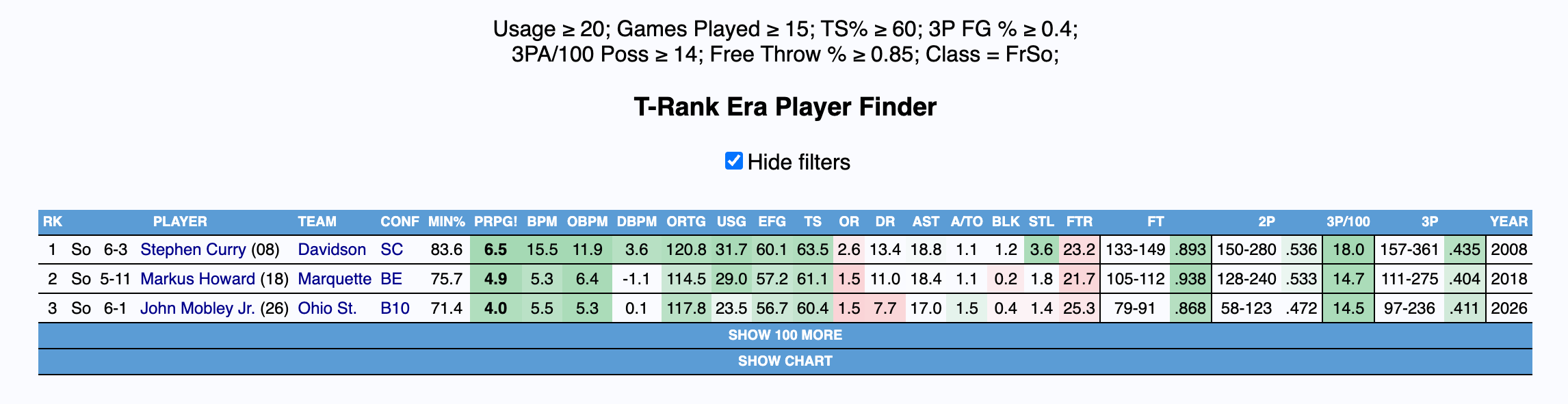
Is this just a Markus Howard redux?
Or…is Juni Mobley the next Wardell Curry?
Well, obviously that is a bat shit crazy question…BUT!

Nobody is going to be the next Steph Curry. He is an outlier of outliers. But what if Mobley sees a big bump in creation responsibilities this season, raising his usage AND his assist percentage balloons above 30 percent?
What happens if you give the best shooting prospect in the world an upgraded engine? Steph Curry didn’t carry a crazy offensive load until his sophomore season, when he nearly doubled his assists per game. Christian Anderson went from an AST% of just 12% during his freshman season to 35% in his sophomore season once he took the keys to the offense.
Now that Bruce Thornton has moved on and won’t be around to dribble the air out of the ball1, it isn’t completely off the table that we see a similar scenario with Juni.
As will be a common thread amongst all the players covered in this article, the small guard tax is real. No longer can a small guard be a one-trick pony, even if said small guard is best in the world at that one trick. Where Anderson and Steph separated themselves offensively in their pre-draft seasons was not only in their floor spacing specialty, but in the volume in which they were able to leverage their gravity to make plays for others. I believe we’re going to see Mobley make plays for his teammates at a higher clip this season, as he has shown comfortability in operating ball screens and making reactionary reads when he does touch paint. In ball screens, Mobley plays with good pace, using creative set-ups through a series of crossovers and in-and-outs to try to get the defense on their heels a bit. Mobley’s logo range means that those defenses are going to hard hedge at best or play at the level at worst. When teams blitz to get the ball out of his hands, Mobley does a good job staying calm and getting the ball out quickly. When he can retreat out of a hard hedge, Mobley uses his creative handle to maneuver around the floor, with all eyes on him. Survey enough to sling the ball wherever the open man may be. He slips pocket passes in catchable spots to the big, can throw over the top leading his roller to the rim, and has shown intriguing passes skipping the ball to the weak side. If Mobley shows more manipulative passing, reading the backside early as he shifts the defense by simply choosing a side, we’re cooking with gas.
I know at this point you may be reading this and wonder how I’ve merely mentioned Mobley’s all-world shooting in passing, so let’s get to the fun part. I believe that John Mobley Jr. is the best shooting prospect in the world. I think whether you want to eye test the beauty within the aesthetics or look at the metrics, this is an all-time shooter. As a sophomore, Mobley connected on 41.1% of his 236 total threes–good for a whopping 14.5 3P/100. These are tough looks, not just stand-in-the-corner spot-ups–though he knocked down 45.3% of his spot-ups, including 50% of his unguarded attempts–Mobley is an audacious shooter, with parking lot range. His first-ever college shot attempt was a logo three against Texas that barely grazed the net.
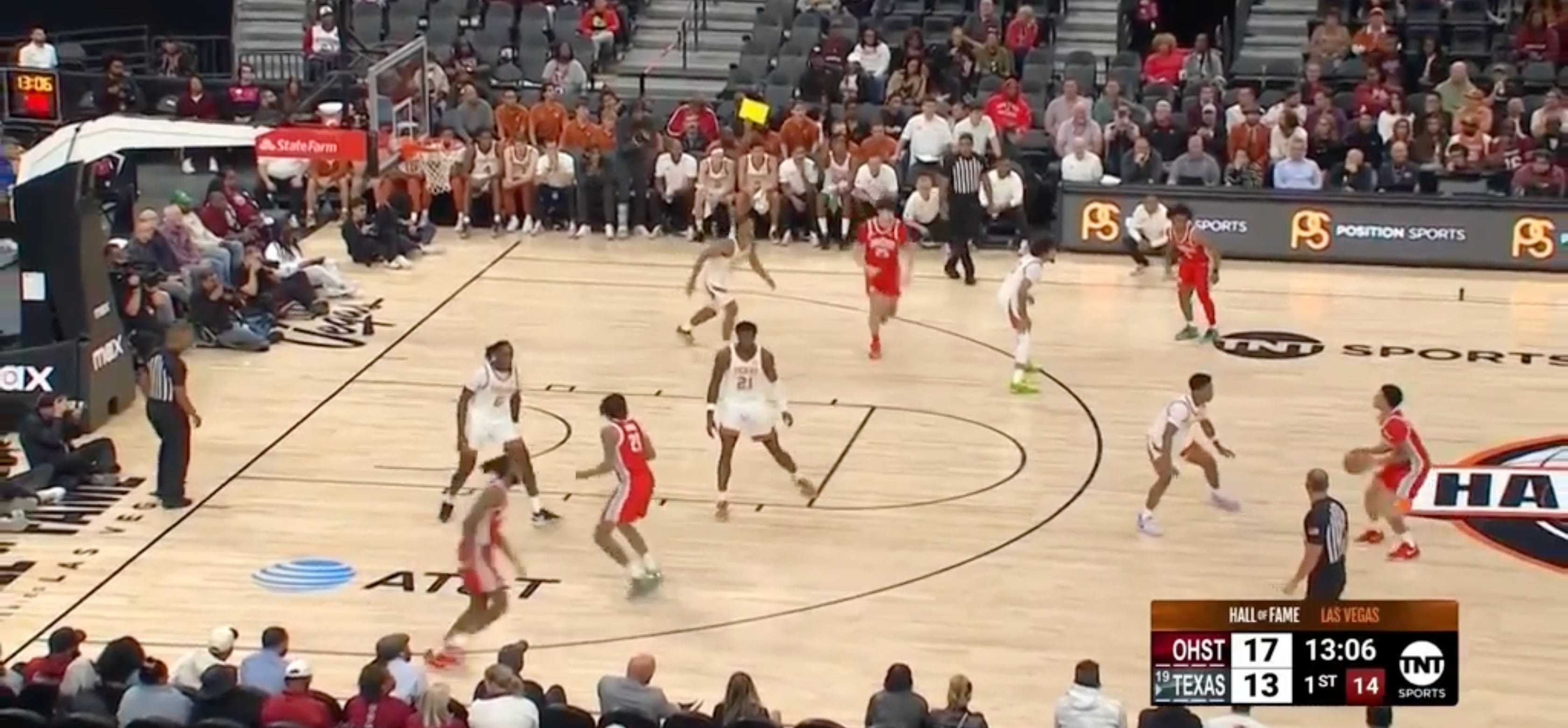
Mobley knocked down 38.3% of his 115 dribble jumpers as a sophomore that he created by utilizing his tight creative handle and ability to play high-to-low. Mobley can also marry his on-ball shooting with elite off-ball creation. If Mobley gets a clean look out of a spot-up, you may as well start running back the other way, but he also flies off screens and uses his lightning-quick release and ability to stay balanced off-platform to connect on movement threes.
The shooting profile is as Teflon as it gets, but Mobley needs to see real growth as a finisher if he is to become a 2027 prospect. He is a legitimately poor finisher right now. Mobley is a ground-bound finisher who is bothered by length (He hasn’t registered a single dunk). He tries to change his shot in the air to avoid rim protectors and usually makes the shots tougher than they’d need to be if we went straight into their body, while also taking away any pressure a ref would have to call a foul on the lay-up. Mobley also doesn’t get to the rim all that often, finishing just 48.5% of his 105 rim attempts over his two college seasons. To put that number in context, Mobley has put up over four times the amount of threes in that same span. Mobley does have soft floater touch to mitigate some of the finishing concerns, but he still needs to show much more craft as a three-level scorer. Despite that poor finishing, Mobley still boasted a 60.4% TS% last season, the same percentage as junior Steph, so if he can boost that rim percentage in a tangible way, while maintaining his elite shooting volume, we are looking at an all-time offensive season.
One of the ways that Mobley could help his finishing woes is by adding real strength to his frame. If we’re to believe the Ohio State website (always be cautious of team sites), Mobley hit the 190lbs mark this season, which would be huge if true. Strength is one of the more underrated qualities a prospect needs to stay alive at the NBA level, and it is paramount if you are a small guard. Mobley has clearly added mass since he came in at a listed 175 as a freshman.
As important as the strength gains are, the athletic gains need to continue. Mobley needs to keep his strong frame while increasing his burst. What allows a guy like NBA Finals MVP Jalen Brunson to not only succeed but also operate as the best player on any hardwood floor he’s on is that he is not only strong and skilled, but he’s got real-deal tight-space burst. Mobley does have some underrated quickness when he’s creating off the bounce, but an improved stand-still first step he can use to take advantage of how tight defenders need to play him on an island will open up a lot for him.
On the other side of the ball, Mobley has been a fine college defender, but his best defense at the next level will be elite offense. Mobley competes on the ball, staying pretty engaged and competing to stay in front of his man. He can get slippery over screens, and he uses his compact frame to stand his ground when creators try to bump him and move through his chest. Mobley’s undoing on this end is that he just doesn’t have the length to really be all that disruptive. Whether on the ball or off of it, shooters can get clean looks off even with a hand in his face, and even though he is good positionally in help, he struggles to create deflections or tips, as he doesn’t have the reach to get to balls other guards can get to. This shows in his pedestrian steal and block rates–an area where Steph Curry mogs him—instead putting him more in line with Seth Curry’s senior season. Mobley will probably never be a positive on the defensive end given his physical limitations, but if he can get to a level where the defense doesn’t fall apart completely, he should provide enough value offensively to make up the difference.
“I do some research”
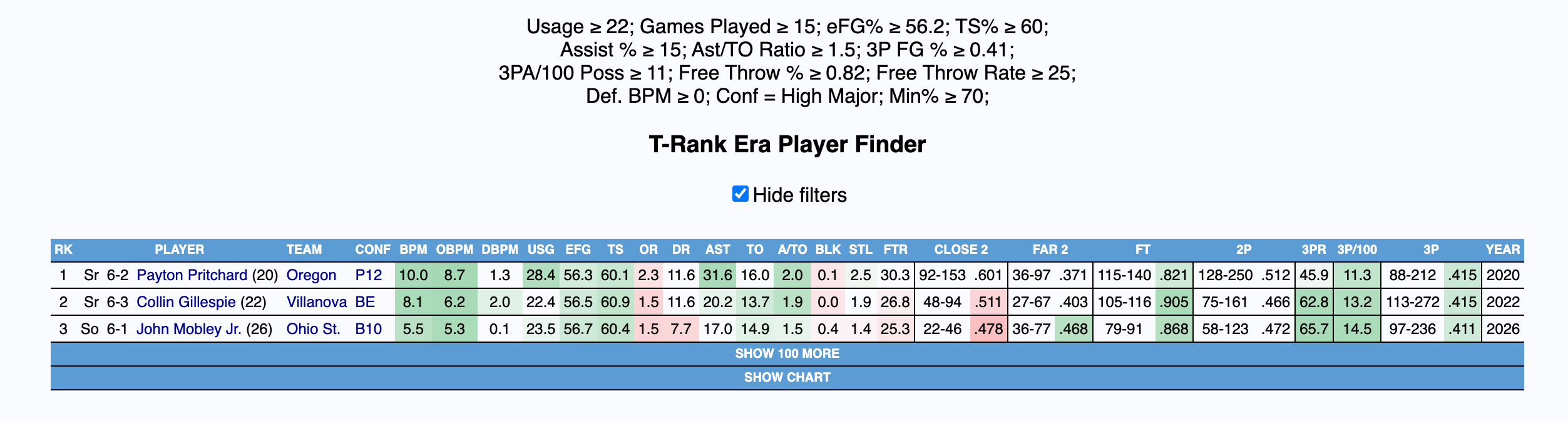
Mobley has flaws that some NBA teams may struggle to overlook. Despite the fact that we’re now living in a world where NBA teams are moving on from first round picks faster than ever before, I remain unwavering in my belief that Mobley can carve out a role as a positive NBA contributor. I like to find value in outlier skills, and Mobley is an outlier-level shooter. Now, I don’t truly believe that he is the next Steph Curry, but he is such a nuclear shooter that there is a world where he becomes the next Payton Pritchard or Collin Gillespie. That underrated value makes him a dude worth betting on.

“You Can’t Get Your Hands on These Things”
“I’ve been telling ya that’s why I wanted you to see it”
“Here, go through my loupe”
Kahamare Holmes is a junior guard transferring to DePaul from Wofford. In many ways, he represents the physical antithesis of John Mobley Jr. At 6’3” and 210 pounds, Holmes is a strong, well-built combo guard with impressive length who makes his impact through quick-twitch athleticism, physicality, and two-way versatility.
Holmes caught my attention last year after an intriguing showing against Auburn during a strong November where he filled up the spreadsheet. That spreadsheet stuffing speaks to the versatility of his game.
Holmes carried a huge offensive load for Wofford last season, carrying a 30% USG%, putting up a cool 19.5 pts on 57.3 TS% last season. Holmes has a slick, creative handle, with a fair bit of wiggle and a quick first step to consistently get downhill and put pressure on the defense. When he got downhill, Holmes finished over 60% of both his overall and halfcourt attempts and fully embraces physicality, both finishing through contact and using his strong frame to get to the free-throw line–holding an impressive 49.5 FTr. Holmes is more than just a downhill athlete, as he is also a nuanced ball screen operator who plays with good pace, stays patient when he gets a defender on his hip, snakes screens, and can pull up in the in-between when bigs play in a drop. I’d never classify Holmes as a full-time point guard or a primary initiator, but he does a good job leveraging his scoring gravity to make plays for his teammates. Despite his huge usage and penchant for attacking crowded driving lanes, Holmes rarely turns the ball over, holding a career 10.2 TOV%. Holmes was also a strong off-ball player during his sophomore campaign–an important aspect of his skill set given the upgrade in on-ball talent he’ll play with at DePaul this season–finishing as a 98th percentile cutter and knocking down 37% of his catch-and-shoot attempts per Synergy.
Holmes’s shooting is the weakest component of his offensive profile. He’s not necessarily a non-shooter, having connected on 35.2% of his 9.1 three-point attempts per 100 possessions, but the results are streaky. The mechanics are workable, as he has a strong, balanced base with nicely squared footwork, and a comfortable overhead release. However, he tends to generate much of his power through his upper body, especially when he gets tired, and shoots it with a relatively palmy release, contributing to some inconsistency. More concerning is his subpar free-throw shooting. Holmes has converted just 65% of his 200+ career attempts at the charity stripe, a troubling indicator for a guard whose ability to draw fouls is otherwise one of his greatest offensive strengths. Despite his knack for getting to the line, he hasn’t consistently capitalized on those opportunities the way you’d hope from a 6’3” guard.
Defensively, there’s arguably even more to like. Holmes is a smooth lateral mover who flips his hips quickly and uses his length to wreak havoc both in passing lanes and on the ball. He has an active, opportunistic approach to defending the ball, capable of swiping it clean if an opponent gets careless with their handle. He also brings the physicality to absorb contact through his chest while moving laterally, allowing him to hold his ground against stronger opponents. Combined with his length and strength, Holmes has the positional versatility to defend multiple spots and take on a variety of assignments. Auburn represented the highest level of competition he faced last season, and Holmes drew assignments against Keyshawn Hall, Tahaad Pettiford, and Elyjah Freeman.
Off the ball, he does an excellent job reading passing lanes for deflections and steals, using his length to dig down to the nail to deter dribble penetration. His quick-twitch mobility allows him to cover considerable ground and make plays as a help defender. He can be a little too prone to overhelp and trust his recovery athleticism a little too much, leaving himself out of position a bit, but he generally does a good job of picking his spots. Holmes also goes hard attacking the glass, showing a penchant for reading the ball off the rim on both ends of the floor.
“I do some research”
Holmes presents a pretty unique combination of physical tools and skill, which makes his statistical comps fairly wide-ranging. This query illustrates the breadth of his potential NBA counterparts, reflecting just how difficult he is to fit into a box.
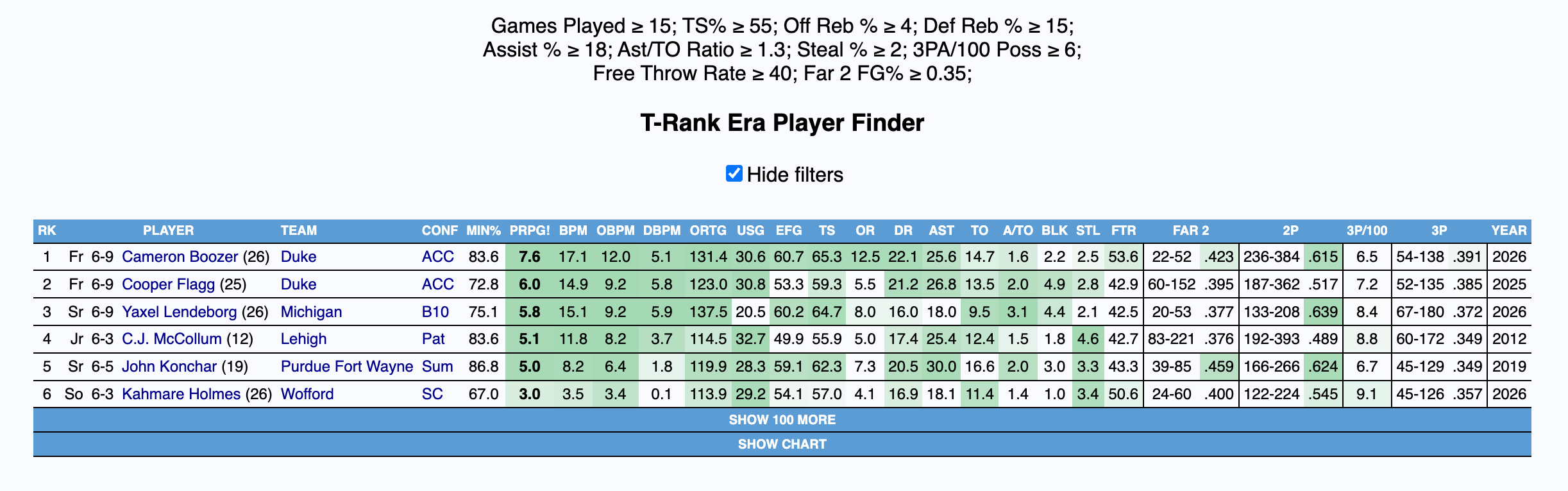
It’s going to be fascinating to see how he handles the jump in competition heading to the Big East after putting together some dominant stretches at Wofford last season.
The most impressive stretch came over a nine-game run in which Holmes averaged 23.3 PPG on 59.4% true shooting, knocking down 44.8% of his 2-point attempts (29 FGA) and 38.6% from three on 8.7 attempts per 100 possessions. The only game during that stretch in which he failed to reach 20 points was against Chattanooga, when he exited early after taking a fall while pursuing a rebound. He wasn’t just getting buckets during this stretch. Holmes stuffed the stat sheet with 3.0 assists per game on a 19.1% assist rate with a 1.9 assist-to-turnover ratio, while carrying a massive 32.6% usage rate and keeping his turnover rate to just 8.5%. He also grabbed 5.4 rebounds and generated a 2.8% steal rate. Perhaps most impressively, he posted a monster 63.2% free-throw rate. Some truly elite shit there.
There aren’t too many off-the-radar prospects of Holmes ilk that can produce as many ways as he can with his physical tools. He’s got some shit to iron out, but this is an NBA player hiding in plain sight.

“I mean this is old school, Middle Earth shit.”
“I’ve been telling ya that’s why I wanted you to see it”
“Here, go through my loupe”
Cruz Davis has one of the most visually pleasing games in college hoops.
The lefty guard is suiting up for Texas Tech this season, where he looks primed to garner more national attention sliding into the Christian Anderson role after spending the last two seasons tearing up the CAA at Hofstra.
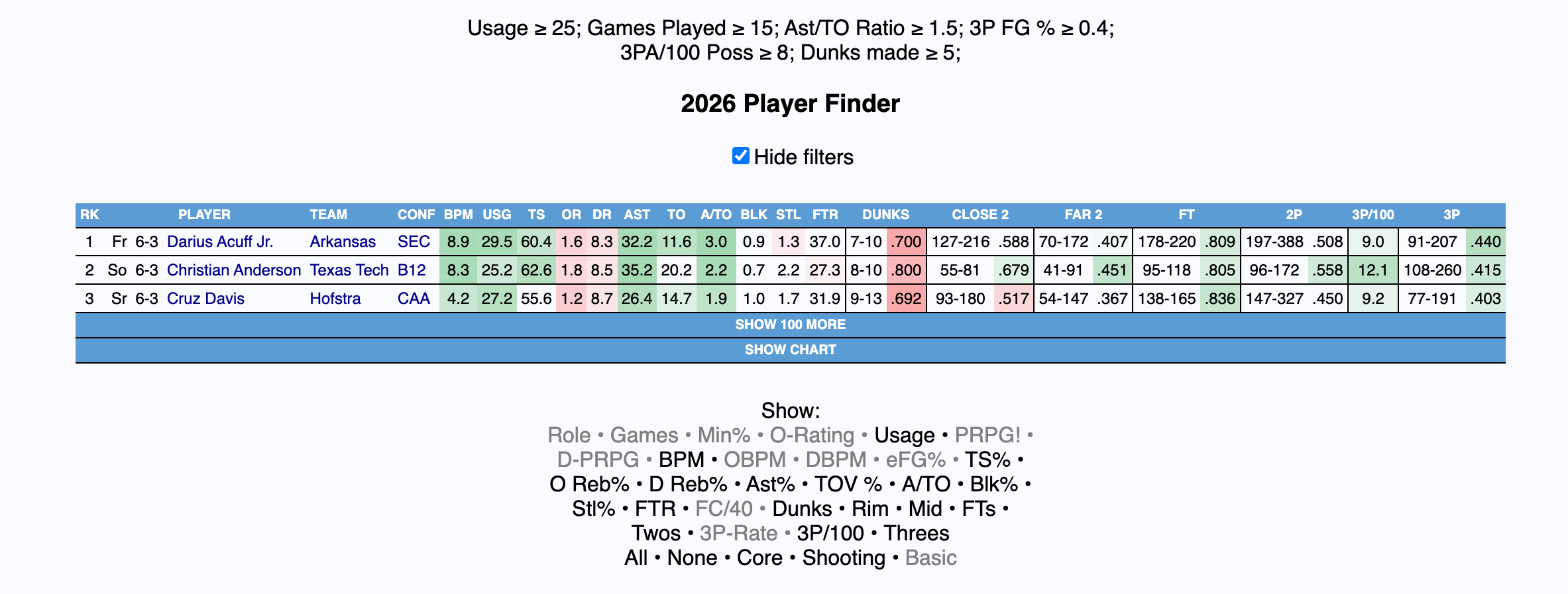
Davis is one of the most shifty and creative volume self-creators in college basketball, hungry to get buckets at all three levels. His quick-twitch movements alongside his tight handle give him an unpredictability that allows him to create space and generate clean looks all over the court. He knocked down 40% of his 191 attempts from deep last season, with 82 of those attempts coming on self-created looks. Davis has NBA-caliber shotmaking footwork, stringing together creative combos to create separation for smooth step-backs. He already has a go-to move, attacking hard to his right before hitting a hard pound dribble and flowing into a smooth step-back jumper. Davis is also a sniper off the ball, an important skill given that Darrion Williams is returning to Texas Tech along with additions like Damarion Dennis, who will give Cruz plenty of opportunities to play alongside other creators.
While Davis can get to where he wants on the floor out of isolations, he’s also a nuanced pick-and-roll creator. Despite his somewhat slender frame, he’s comfortable coming tight off a screen, putting dudes in jail, and then snaking to an open area of the floor where he can both get himself a look or make a play for his teammates. As talented a shot maker as he is and as much of a consistent theme as this has become for the smallish guards, Cruz will need to become more efficient at the rim at Tech. Davis has no problem getting there, but his slender frame prevents him from consistently finishing through contact. Davis will often change his shot when he can’t beat a defender to the spot, which both makes his rim attempt tougher and prevents him from getting to the FT line where he knocked down 83% of his 171 attempts. Where he does excel at getting to the rim is through his ability to play with pace, and time his drives in coordination with the roller so he can use Gortat screens to create open layups for himself. When he can’t get all the way to the rim, Davis does a good job countering by getting to his float game in the short midrange–a shot that he can get to with either hand.
Davis carried a heavy load for Hofstra last season, posting a 27.5% usage rate. He shouldered a big time scoring burden, but that also carried over to his responsibility to make plays for his teammates. Davis was the alpha and omega for Hofstra, and as such, teams would often send two to the ball to get it out of his hands. Davis did a really stellar job handling that pressure–utilizing retreat dribbles and keeping his head up to avoid needless turnovers. If you watch his game against Pitt, you’ll see back-to-back lasers from the sideline hash and then the center court logo, to the big in the paint, creating wide-open dunks for him. Cruz’s shooting gravity dragged the defense up to the level, and he did a good job reading the backline defense and then throwing live dribble passes all over the floor with either hand. Davis also used his quick-twitch speed to touch paint and collapse the defense, where he could then dump-off or kick-out to his teammates. When I saw Cruz last season, it felt like his teammates consistently struggled to capitalize on the looks he created for them. I expect that to be less of an issue this season as he’ll get to play alongside higher caliber talent.
Like the majority of the guards on this list, Davis’s viability on the defensive side of the floor will ultimately decide his NBA fate. I thought Davis really competed on the ball, taking away space to make the ball handler uncomfortable and using smooth lateral slides to beat guys to spots or to stay skinny and slither over screens. Offensive players with a size and strength advantage will always inhibit his ability to guard at the next level to some degree, as strong shot creators can simply shoot over the top and strong creators can go through his chest. He’ll have to make up ground as an event creator off the ball. Last year he took a step back generating steals, which may be attributed to his heavy workload offensively, but it should be an area of focus to get back to previous disruption levels this upcoming season.
“I do some research”
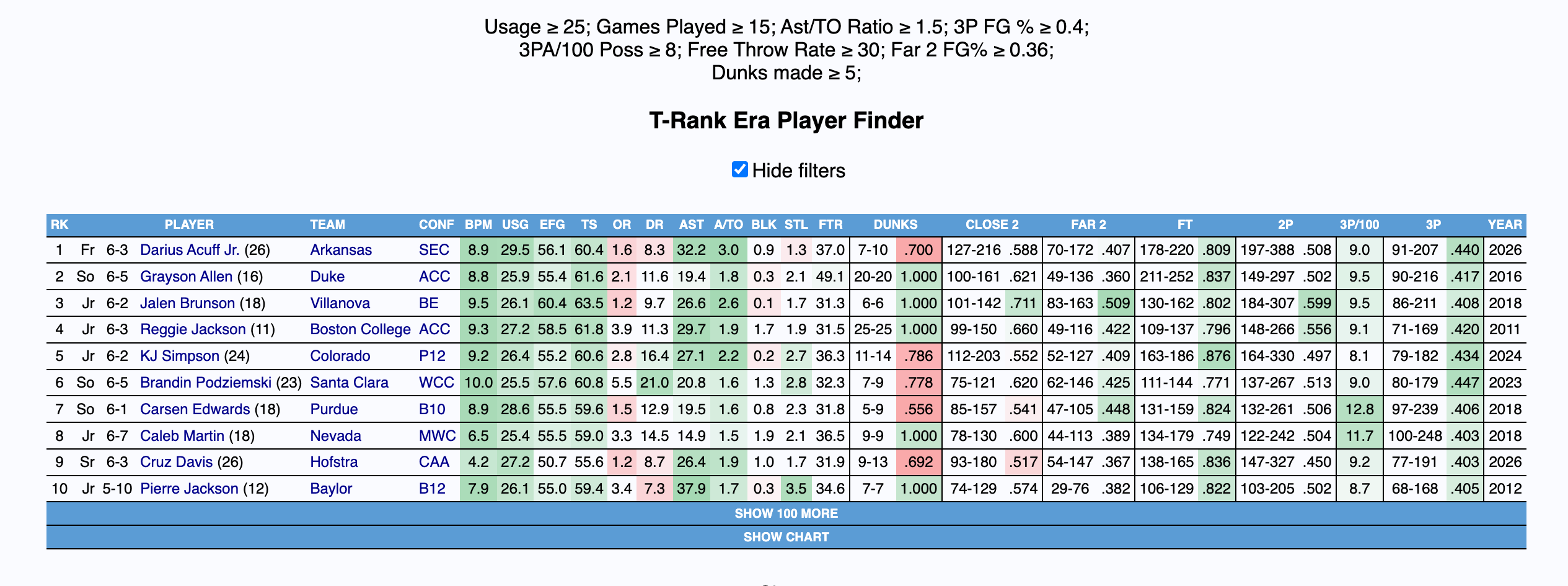
Davis’s blend of volume creation, shooting efficiency, playmaking, and athleticism screams NBA guard. Every player on this list touched an NBA floor in some capacity, though the range of outcomes is vast, varying from NBA Finals MVP to a quick cup of coffee. Much of Davis’s success at the next level will hinge on situation and opportunity.
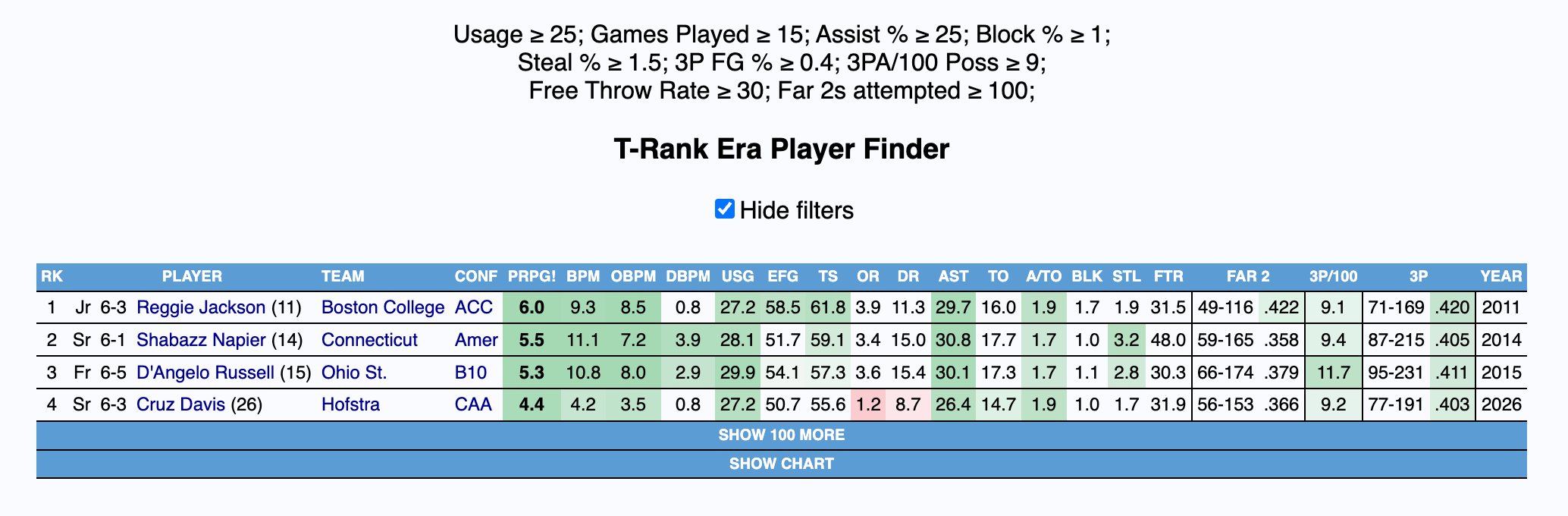
In many ways, Cruz Davis is reminiscent of the high-usage sparkplug guards who have become something of a disposable archetype in the NBA, particularly when they struggle to translate their college efficiency to the next level fast enough. I’m pretty confident Davis will get an opportunity in the NBA. The bigger question looming is whether he’ll need to bounce between multiple teams before carving out a more permanent role or if he’s ultimately just destined to run wild in the G League or abroad. The development we see–or don’t see–from him this season should help bring those questions into sharper focus.

“Why’s it got so many colors in it?”
“I’ve been telling ya that’s why I wanted you to see it”
“Here, go through my loupe”
Ryan Prather Jr. is funky.
That funkiness stems from the combination of his football-esque build and the smoothness with which he moves around the floor. Listed at 6’4”, 220 pounds, Prather looks more like Cam Skattebo than Devin Booker, which gives the appearance of someone who would win with physicality; however, his game is built more around finesse and skill. Prather plays with a kinetic vigor–there’s a decisiveness to both his movement and his decision-making that belies an innate feel for the game, which allows him to slide in seamlessly to any line-up.
Prather is headed to Iowa State via Robert Morris, where the Cyclones will rely on Prather to replace much of the shooting volume they lost from Milan Momcilovic’s departure to Kentucky. While Prather didn’t produce the kind of historic shooting season that Momcilovic, that doesn’t mean that dude don’t got a strap. Prather shot 37% from deep on 12 3P/100, 45% from the midrange, and knocked down 85% of his FT’s. Prather has excellent shot prep, with real repeatability in his mechanics. He hops into his shot off the catch and uses a one-two step off the bounce, consistently getting himself organized without wasting much motion. He does a nice job staying balanced, generates good elevation with a high release that makes his jumper difficult to contest, and finishes with a smooth follow-through that results in a soft, high-arcing ball. When he is creating shots off the bounce, he does a good job keeping his line when he gets bumped, and he’ll use his shoulder to bump his man and create a little extra room to get his shot off. While Prather has a strong handle that allows him to limit turnovers, he does have trouble consistently generating clean looks against stronger defenders. High-volume self-creation isn’t his game, though. Prather likes to flow into actions–catching and ripping to create an advantage or utilizing a screen to get to a pull-up. He’s also got real movement shooting equity, where you can run him off floppy-style actions for him where he can then get off a clean look, or leverage his gravity to attack the defense and make a play.
It is that playmaking in combination with the shooting that makes Prather an intriguingly unique prospect. Most shooting prospects don’t show off the ability to pass at the level Prather did for Robert Morris last season, where he boasted a 20% assist rate to just a 5.6% TO rate for an insane 4.4 AST:TO ratio! The pesky kids like talking about turnover aversion, and you’ll be hard-pressed to find many guards who exceeded 20% usage who hit a 20% assist rate and turned it over as infrequently as Prather. Whether he can replicate that playing high major ball will be something to monitor, but the results from his 25-26 campaign are notable.

What Prather isn’t is a vertical pop athlete. He finished with just three dunks and, despite his sturdy frame, struggled to finish in the halfcourt, converting just 51.6% of his attempts at the rim. Things will only get tougher in the Big 12, where the athletes will be bigger, stronger, and faster. Some film study of Kon Knueppel’s two-foot finishing would be a worthwhile exercise for Prather. Knueppel was excellent at leveraging his shooting gravity to get into the paint, using his similar frame to bump help defenders off their spots. He also displayed a patient array of pump fakes, getting defenders to bite and creating slivers of extra space for cleaner looks around the basket. Prather has shown some two-foot finishing ability, particularly later in the season, but too often found himself out of control, trying to contort his body in midair to avoid length at the rim. Developing a more deliberate approach to finishing through contact, rather than trying to maneuver around it, is an important next step if he is to find a way onto NBA radars this season.
Defensively, Prather won’t wow you with eye-popping steal or block rates, but his tape shows the makings of an effective defender. He has the frame to handle physical drivers, along with the lateral mobility and footwork to stay in front of creative ball handlers. His off-ball positioning is sharp, and he rarely finds himself caught out of position. His anticipation and agility allow him to beat opponents to their spots as the low man, often positioning himself just above the restricted area to force roll men to finish from further out. However, when he does concede deeper positioning, his lack of vertical pop limits his ability to offer any meaningful rim deterrence.
“I do some research”
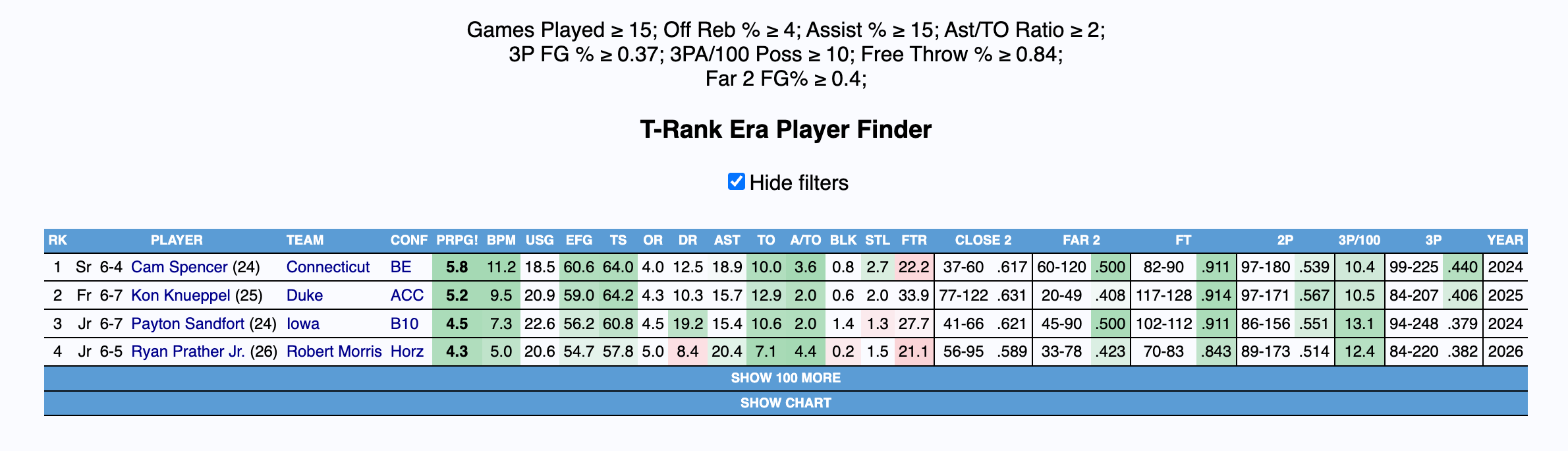
Ryan Prather Jr. isn’t going to be an NBA star, and he may not even stick as an NBA player. But he has a unique enough game and statistical profile to warrant monitoring as a potential low-maintenance cog who can help keep an offense humming. We’ve seen upperclassmen like Cam Spencer carve out NBA opportunities despite unconventional physical profiles by pairing high-level feel with the skill and decision-making that earn a coaching staff’s trust. Spencer is an outlier-level maniacal competitor who also happens to be one of the best shooters in the world, so Prather will need to make a modest shooting leap to put himself in that conversation. Playing at Iowa State alongside more dudes who are capable of putting pressure on a defense could help facilitate that growth in a similar fashion to the jump that Cam made from mid to high hoops.

“Whaddaya know?”
“I dont know. I just know.”
“I’ve been telling ya that’s why I wanted you to see it”
“Here, go through my loupe”
While there are a number of more highly touted prospects on North Carolina’s roster that you may find on a mock draft, Isaiah Denis might actually be the guy poised to snatch their chains and emerge as the team’s best NBA prospect.
Denis missed most of his freshman campaign after re-aggravating a pinky finger injury that he originally sustained in high school. Now entering his sophomore season fully healthy and playing under a former NBA champion head coach, Denis is primed for a breakout campaign.
While I’ve blended film and statistical analysis for the other prospects in this series, Denis is a bit of a call on gut instinct. There’s very little to work with on either front, considering he played just 33 minutes last season. Not per game, mind you. Total. But even in those very limited minutes, he was a dude who caught my eye.
If I had to use one word to describe Denis’s playstyle, it’d be electric, erratic, and kinetic. You may be saying to yourself: that was three words? I guess that’s why my application has never been accepted as a member of Spreadsheet FC.
On a more serious note, Denis has real game.
Listed at 6’4” with what looks like legit length, Denis is a bursty guard whose motor runs hot. He’s about that action and seems to find his way to the ball. He crashes the glass hard on both ends, and when he corrals a rebound, his first instinct is to grab-and-go. He’s a blur in the open floor, looking to attack the rim or fill a lane. He can slither through tight spaces and put real pressure on a defense when he gets it on its heels. He’s also willing to leverage the attention he draws with the ball in his hands to create opportunities for teammates who run with him. In UNC’s exhibition against East Carolina, he made a beautiful cross-court skip pass to the weak-side corner in semi-transition.
In the halfcourt, Denis uses his quick-twitch burst and herky-jerky cadence by playing at different speeds to create advantages. He’s a confident pull-up shooter who can get into the paint, and he does some of his best work operating out of ball screens. He’s comfortable flowing into quick screen-rescreen or pitch actions, using those opportunities to create a clean look for himself or to slither into the paint. Once there, he attacks the rim with fervor, looking to get into the defender’s body or drop the ball off to cutters and bigs in the dunker spot. Getting into the paint isn’t an issue as his quick-twitch burst and variety of strides allow him to create openings and put pressure on the rim. The finishing, however, remains a question mark. It looked excellent in UNC’s exhibition against USC, where he showed real mid-air flexibility and physicality around the rim. But the last meaningful sample we have of his finishing, from his 17U EYBL days, saw him convert on fewer than 50% of his attempts at the rim. That was a couple of years ago, and Denis has clearly put some work into his body since then, so it’ll be worth monitoring how that translates over a full college sample.
Denis figures to play more of a combo role for the Tar Heels, operating alongside Neo Avdalas, who could handle a significant share of the primary initiation duties. That should still leave Denis with plenty of opportunities to attack from the second side, make plays against tilted defenses, and deliver the quick, connective reads that keep the offense humming when defenders close out hard.
Defensively, Denis is a smooth lateral mover who gets into his man’s shirt, taking away space and applying consistent on-ball pressure. He plays with good anticipation, beating opponents to spots and showing the ability to stay in front on an island or slither over screens without getting caught up. He also uses his length to get clean contests on perimeter jumpers. That said, Denis can be a little too eager to make a play, often taking chances and swiping at the ball when a creator plants. That split-second gamble can give his man just enough breathing room to get a shot off. While Denis has the length and twitch to recover, it’s an unnecessary habit that may drive Coach Malone mad. He’ll also need to continue filling out his frame, as stronger creators can bump him off his spot and create enough separation to shoot over his standing reach in the short midrange.
Off the ball, Denis is positionally sound and uses his length, twitch, and active hands to punish lazy or errant passes in the passing lanes or generate deflections and tips. Those same tools allow him to cover ground and recover to shooters when he’s tasked with X-ing out, closing out on a swing, or chasing a movement shooter around screens.
The Tar Heels have a crowded backcourt, and while Denis should complement whoever he shares the floor with, there are still plenty of mouths to feed. He’ll have games where he pops off and looks like the best player on the floor, but consistency and opportunity will be worth monitoring.
I recently texted an Eastern Conference scout and asked him to talk me out of getting too high on Denis, and he replied: “I’d never talk you out of the guy that Malone is going to utilize like Will Barton.” Barton was a little taller, but I think Denis has all the tools to carve out an Immanuel Quickley-type role at the next level. I’m not sure he’s a surefire draft dude this year, but he has the look of an NBA pro. Denis should firmly be on your watchlist.
Thorton has been an Ashton Hagans 1st Team Guard the last two seasons—a.k.a: a guard who is in the way of the real best prospect on the team, like Ashton Hagans handling too much usage next to Tyrese Maxey