


The NBA Draft is a gamble.
But none of us in the public sphere actually know the feeling. The blistering anxiety of picking up that war room phone. The adrenaline spike of calling that gamble in to the NBA league office—knowing that once that name is called, there’s no taking it back. The closest we get is making our private opinions public and letting the community pass judgment on our work. The scrutiny pales in comparison to the pressures of the real gig, but you still need the stomach for it. The confidence to plant your flag and the humility to live with being wrong in front of everyone.
There’s no shame in going to bat for the dudes at the top that you can watch on TV from your couch. There’s a ton of work that needs to be put in to get those evaluations right, and those are the most important decisions a front office can make in the draft. But nobody is really checking the receipts on why you thought Cooper Flagg or AJ Dybantsa were awesome.
The deeper cuts might not carry the weight of a franchise-changing pick, but they’re tougher to identify and are super valuable if you can actually hit on them and get them to contribute on their rookie deals.
They don’t smack you in the face like the Flagg’s do, though. Finding those sleepers means traveling off the beaten path to get eyes on a guy nobody’s really talking about. It means squinting at some somewhat sepia-toned tape that’s filmed from a vantage point that would make Sting jealous.1 It means querying weird statistical profiles and sitting in a half-empty gym without back support.
You have to do some uncomfortable mining to find an uncut gem.
That’s what this series is. The process of identifying and betting on a group of prospects, broken down by archetype, that live on the fringes but still intrigue me heading into the 2027 NBA Draft cycle. Prospects who popped during an in-person scouting trip or on tape during some past deep dives. They might be dudes flying under the radar with a cool statistical profile that made me run to my laptop to fire up Synergy. Sometimes it’s the old trifecta.
Our beloved Maxwell Baumbach authored a legendary No Ceilings off-season series called No Stones Unturned with the same goal in mind. Maxwell identified hits like Yaxel Lendeborg, Cedric Coward, Dalton Knecht, and Ben Sheppard well before they were taken seriously as first round prospects.2
This is history right here. You understand?

I’m aiming to do something similar here, even if the road I take to get there looks different than Mr. Boards.
Because at some point as a public evaluator, you want to go deeper. You have to call your shot if you want to win.
You like to win, right?
This is no different than that. This is me, all right? I’m not a fucking athlete. This is my fucking way. This is how I win.


“Why’s it got so many colors in it?”
“I’ve been telling ya, that’s why I wanted you to see it”
“Here, go through my loupe”
Layers. That’s what makes Sam Orme’s game intriguing. You have to sit with it for a bit and focus on all the little things to see the bigger picture. And once you do, it’s like you can see the whole universe.
First, let’s talk about what he’s not. Sam Orme is not a self-creator. He logged just three isolation possessions during the 2025-26 college season per Synergy. He lacks the side-to-side wiggle and second-gear burst to blow by his man, and that missing burst leads to him killing his dribble and getting stuck in the in-between when defenders beat him to the spot on a drive. The lack of self-creation puts the kibosh on any kind of playmaking role too, so he isn’t going to be initiating a ton of ball screens and making high-level reads to the roller or cool Luka-esque skips to the weak side. Orme is a smart, sharp ball mover who makes quick .5 decisions to keep the offense humming. He’s also not the most vertically explosive off a no-step or one-step leap, so despite the listed height, he probably shouldn’t be logging much time as a small-ball five where he has to shoulder some defensive anchor duties.
So where are the layers?
At 6’10” and 220 pounds, Orme has legit NBA forward size and is the ultimate connective tissue player you can drop into any lineup construction and expect to fit in seamlessly. While he doesn’t create a ton on the ball, he stays in constant motion off the ball, creating opportunities as a cutter. When he slips a screen or cuts through the middle of the floor, he exits out to the corner and makes himself available for spot-ups with a sharp understanding of when to flatten and when to lift into space. Orme knocked down nearly 40% of his threes with the same level of success whether the shot was contested or wide open. The shot itself could be smoother, but it’s a nice starting point for Fred Hoiberg to tinker with. He’s got a solid, balanced base with his legs shoulder-width apart and a smooth, high, repeatable release with a good finish on the follow-through. He gets slight elevation on the release, but the legs stay awkwardly stiff with a slight bend instead of a clean extension, all culminating in a soft, high-arching ball. The outside shots are primarily coming off the catch, as he registered just six dribble jumper attempts last season.
Where Orme does have opportunity to create off the bounce is by using the leverage of his shooting gravity to attack close-outs. Once he gets some momentum downhill, he can get up and punch it at the rim.
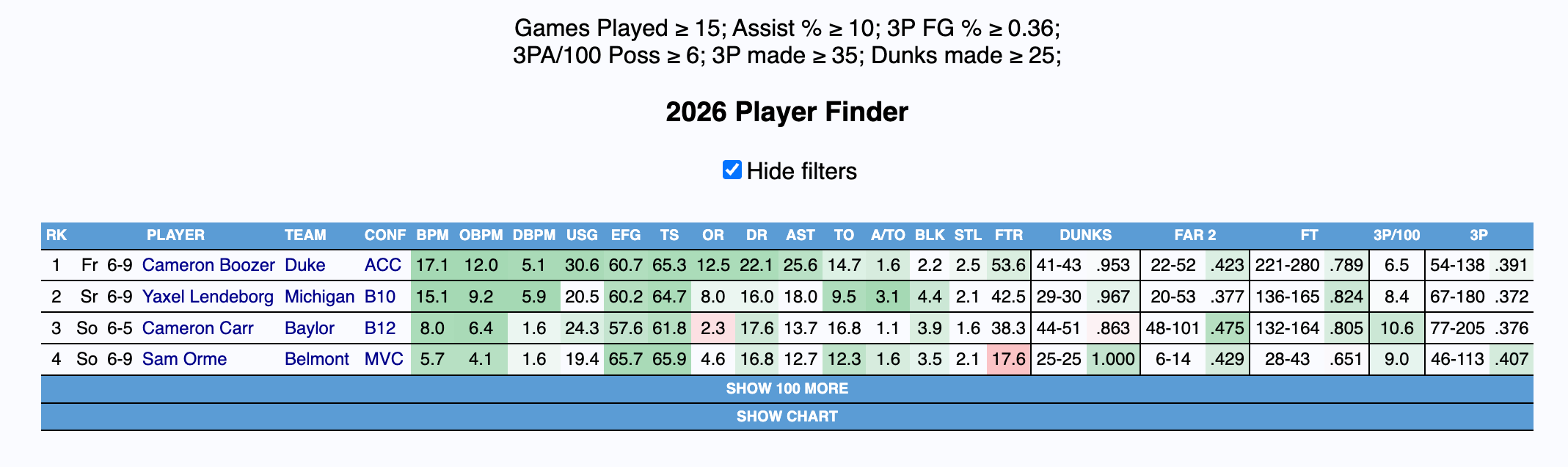
In our first fun statistical query, we see Orme join three first-rounders from the 2026 NBA Draft as guys who show the ability to knock down outside shots and consistently play above the rim. Even within this query, you can point to some athletic limitations in the rate at which Orme gets to the free-throw line compared to the rest of the 2026 prospects. Still, he finishes around the rim like a big, converting 72.7% of his overall rim attempts and 70% of his attempts in the halfcourt. He gets clean looks off smart cuts and likes to take advantage of smaller players who get switched onto him on the block.
With just three midrange shots and a shot chart focused on rim and threes, Orme has a clean, efficient Moreyball profile that should entice teams looking for a smart, versatile offensive wing.
On the other side of the floor, Orme has two seasons of impressive disruption under his belt, boasting a career 2.1 STL% and 4.2 BLK%.
When guarding the perimeter on the ball, Orme sits in a stance, gets long, and does a good job playing with his chest while making an effort to beat guys to a spot. His size and strength let him absorb bumps and stay on the line of the driver, and he uses his length well to get good contests on drives. He can appear a bit heavy-footed at times and often gets stuck playing flat, allowing quicker guards to dictate the possession and create an advantage. When he’s guarding as the big in ball-screen scenarios, he plays good cat-and-mouse, but good passers can throw over the top of him to the roll due to his lack of vertical explosion while back-pedaling.
Orme’s off-ball defense might be my favorite aspect of his game, because it feels like he never makes a mistake. He keeps his back flat to the hoop as his man cuts through the middle of the floor, which lets him see both the ball and his man. He’s very touchy in tight spaces to stay cognizant of where his man is, and he’s always in the right spots in a shell, which puts him in position to snipe errant passes, dig on drivers who don’t have a plan, or get vertical with high hands to contest at the rim. Despite the athletic shortcomings, his feel and effort as a defender are so high that he’s almost always making an impact.
“I do some research”
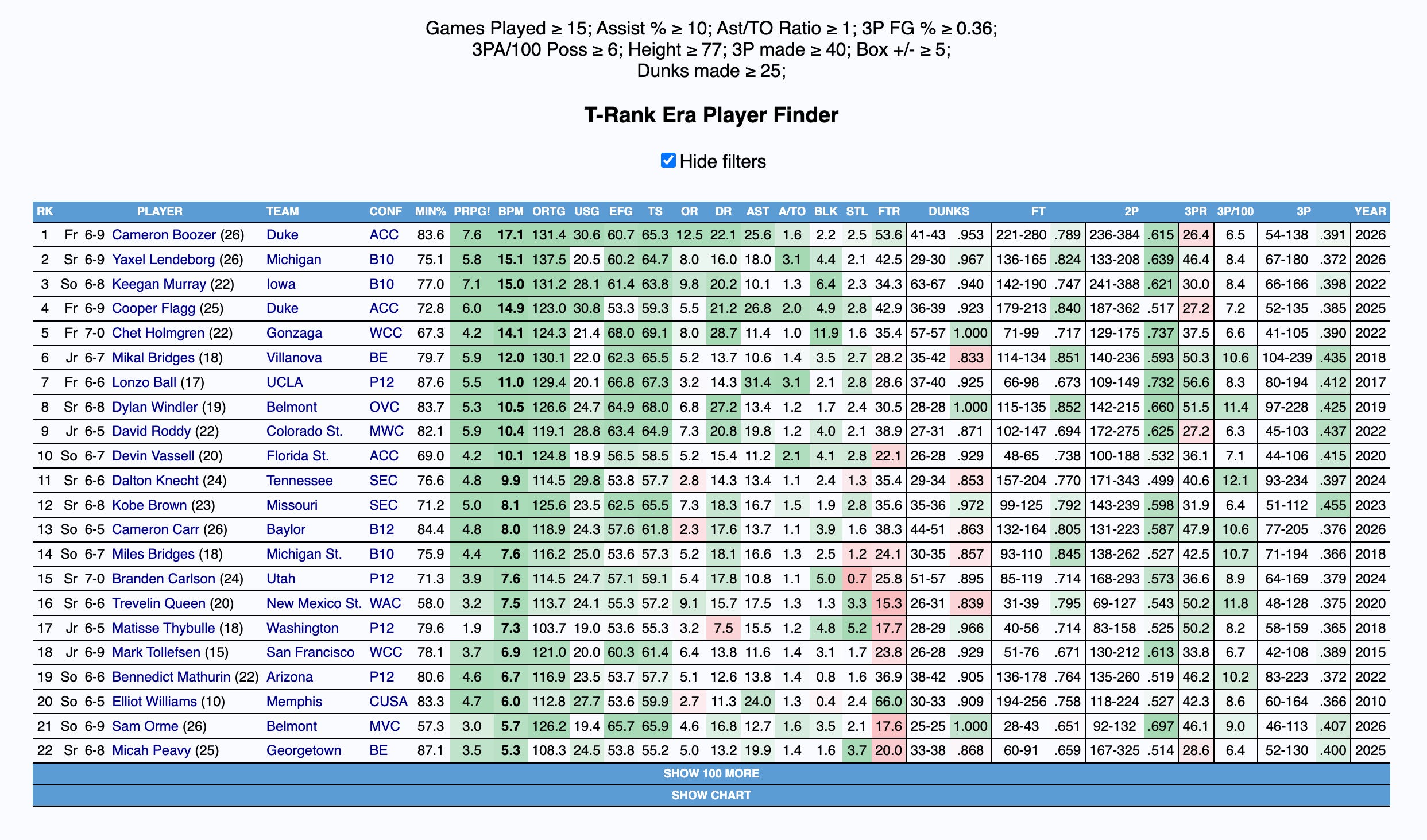
Sam Orme’s Bart query is perhaps the craziest I’ve ever run.
When searching for forward-sized pro prospects with some feel, shooting indicators, and athleticism, Orme sits among 21 other prospects, 20 of which have touched an NBA court. If you’re looking for reasons to be optimistic about Orme’s chances of gracing an NBA roster, a query like this builds that excitement.
Of course, getting to the NBA and sticking in the NBA are different objectives, and Orme finding himself on this list guarantees no such thing. But I like his chances. I’d like to see him become a more consistent scorer on volume and involve himself in the offense a bit more, work on some flexibility training to open up his hips, and make some incremental athletic improvements. But he’s got NBA physical traits and the feel is so high that coaches are going to want to find him minutes.

“You said I got til Monday. It’s still Monday”
“I’ve been telling ya that’s why I wanted you to see it”
“Here, go through my loupe”
We all have those prospects we grow an affinity for and just can’t quit, and for me, Amani Hansberry has long been one of those dudes.
I first remember watching Hansberry as a member of Team Durant during his EYBL career. I was scouting Kwame Evans, but my eyes were continuously drawn to Hansberry’s game. I saw a dude who had an intriguing all-around game and did a lot of the little things that contribute to winning.
Hansberry has certainly been well-traveled throughout his college career. His first stop took him to Illinois, where he mostly rode the pine pony during his freshman campaign. From there, he transferred to West Virginia for his sophomore season, forming an intriguing trio with Javon Small and Tucker DeVries before following assistant coach Chester Frazier to Virginia Tech, where he played out his junior season. Hansberry returns to the Hokies this season in a position to continue his steady improvement and become a mainstay in draft convos, rather than a dude I’ve tentatively placed on my personal big board heading into every cycle since the summer before he landed in Champaign because of a potentially irrational belief in his pro potential.
Hansberry’s game can be described as a weird amalgamation of an old-school and new-school four. The intrigue lies in his ability to do a little of everything at the four spot, but skeptics will ask whether he actually does anything at an elite level, given that he’s a bit undersized to play real minutes at the five at the NBA level3.
Those questions and concerns are certainly valid, but I think Hansberry’s combination of feel and skill on both ends will ultimately allow him to carve out a career in the league.
For me, it starts on the defensive side of the floor. Amani may be a little undersized, but he’s strong, long, and an excellent lateral mover. When he gets switched onto a shifty ball handler on the perimeter, he can get low and wide and use his physical tools to force tough shots or make a ball-handler over-dribble. He’s great at playing with his chest and can absorb contact so he doesn’t get bumped off his defensive path. And he can use his standing reach and leverage his strength to body up and guard the post. I also really like his ability to cover ground off the ball, as he knows where to position himself in help so he can rotate, disrupt, anticipate, and recover after sinking into the low-man spot or executing a reactionary switch off a broken possession. Hansberry is also a strong rebounder on both sides of the ball, and I think his penchant for boxing out and pushing back so a teammate can grab a board can mute his DREB% somewhat and isn’t indicative of his true ability to grab a defensive board.
He certainly has areas on that end where he’ll need to get better. Hansberry was asked to play more center minutes last season than I’d care for, or anticipate he’ll see at the next level4, and as such he was tasked with ball-screen coverages that maybe aren’t so ideal for his game. I thought his cat-and-mouse game in drop was a little inconsistent, which to me felt like a lot of it could be attributed to conditioning, as he is certainly capable of executing it. Hansberry had plenty of moments when he was locked in and looked awesome in those spots, using his mobility and length to guard two and blow up ball-screen actions by jabbing at the guard and recovering back to the big. He also had plenty of moments where he looked like his feet were stuck in mud, getting caught in no-man’s-land and giving up throw-overs at the rim where his lack of center height hurt him. That will need to improve this season, but drop isn’t my favorite coverage for him, and I don’t think it’s how he should be used at the next level or even how he should be used next season. I think he’s much better in a hedge-and-recover scheme, where he can use his mobility to mix up his hedges to be disruptive and blow up actions, forcing the action away from the hoop.
There’s a lot to like with Hansberry offensively too.
He may not have an offensive superpower, but he does a bit of everything, which makes him a pretty easy fit to slide in next to offensive stars who handle the bulk of the creation.
He isn’t a guy you’ll want to run your offense through at the next level, but he isn’t going to turn into a pumpkin if you give him the ball and ask him to create something. He has smooth footwork on the block, is comfortable spinning over either shoulder, and finishes with both hands. He even has a nice mid-post fader he can use as a counter when they take away the baby hook5. He’s also a competent ball-handler, though not a particularly creative one, who can attack space or rip-and-go in a straight line. When forced to handle too long, though, Hansberry can be baited into throwing up junk when a defender sticks with him and rides his body. His finishing can also be affected by legit size and length down low, as he’s mostly a below-the-rim finisher. Still, Hansberry finished over 60% of his rim attempts in the halfcourt and can get to a pretty decent float game to counter some of those issues when he’s forced to match up against centers. I also really dig the screening, as he’s a nuanced, versatile screen setter. I love that he actually looks to make consistent contact on his screens, allowing his guards to create an advantage, but he’s also comfortable in touch-and-goes, slips, or ghost actions. He’ll switch up actions after the screen too, diving to the rim, popping for a three, or moving into the short-roll area where he gets to show off his playmaking chops.
The playmaking is one of my favorite aspects of his offensive game, and now that Neo Avdalas has transferred to North Carolina, I’d expect to see a more featured playmaking role where he potentially ups his AST% over 20%. I mentioned his short-roll passing already, where he displays the ability to make multiple reads. He hits the weak-side shooters when the help sinks into the paint and even shows off his lob touch when he has a baseline cutter or a teammate in the dunker spot. Hansberry can also be used in modern offenses as a playmaking hub out of dribble handoffs, where he can hand the ball off or hit cutters off a keep if the defender gets through the screen. Plus, he’s quick to just move the ball and keep the offense flowing, making the kind of .5 decisions an NBA offense necessitates.
“I do some research”
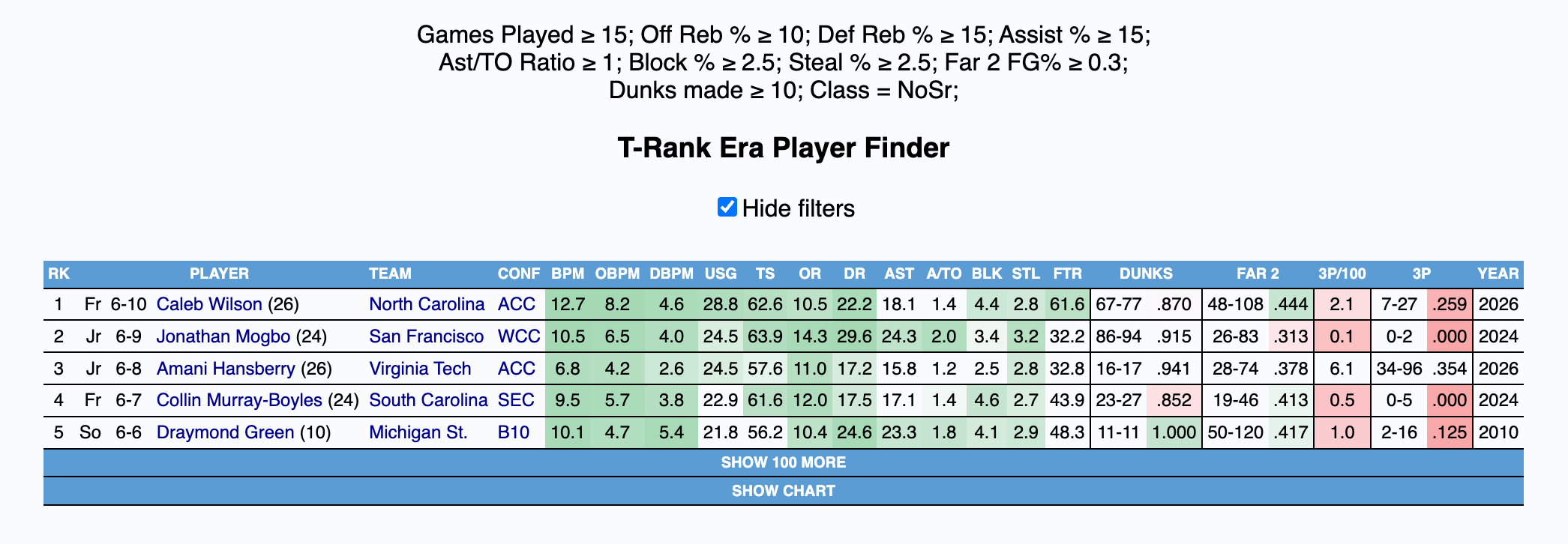
This Bart query shows the prospect chemistry of the kind of NBA player archetype that Hansberry belongs to. You watch him on the floor and can see that he is a Draymond Green disciple. Draymond is the 100th percentile version of this kind of player; projecting Hansberry to ever show that level of impact and longevity is an expectation that would set him up for failure. It wouldn’t be smart to place that direct one-to-one comparison on him; instead, using the Draymond/CMB role as an instruction manual rather than an expectation helps to figure out how Hansberry could succeed on both sides of the ball at the next level.
I would have had Hansberry in a draftable tier last cycle, and I think he can work his way to a potential late-first-round grade with a big senior campaign this season. He’s gotten better every year. His offensive efficiency, playmaking, shooting, penchant for contact, and defensive event creation have all grown on a consistent upward trajectory. Continuing that trend would do wonders for his stock.

“You Can't Get Your Hands on These Things”
“I’ve been telling ya that’s why I wanted you to see it”
“Here, go through my loupe”
It’s hard to really pop onto the draft radar when you’re an upperclassman. It’s a bit easier when you’re 6’8” with ball skills. Paulius Murauskas is going to be 23 years old on draft night, but his combination of size and offensive skill could intrigue NBA teams enough to make him a popular sleeper during the 2027 NBA Draft cycle.
If I were to sell you this pen on why Murauskas will carve out an NBA career, it’d be because he’s a 6’8” wing who can go get himself a bucket, cleans the glass, limits turnovers, and brings a skillset that lets him pretty seamlessly play off of other stars.
Murauskas’ standout skill at the college level is his ability to put the ball in the hoop. He scored over 18 points a game last season on nearly 60% true shooting thanks to his ability to score in a multitude of ways.
At the college level, Murauskas has thrived as a self-creator operating out of the mid-post. He likes to catch in that in-between area and use his slick footwork to turn over his shoulder and get to a little fader, a shot he typically gets off cleanly due to his size. He also has crafty footwork on the block, where he can pivot into really fun counters. He isn’t necessarily a post threat you dump the ball down low to, but he’ll get there off a cut and make himself available when he can take advantage of a mismatch on a switch. Murauskas has a good feel for those cuts and did a nice job playing off center Andrew McKeever’s playmaking. He also does a nice job as a screener, with the versatility to pop for an outside jumper or dive to the rim, where he’s excellent at generating contact and getting to the charity stripe. And last season Murauskas was money from the line, knocking down 84% of his 6.1 FTA per game. 84% on that volume is an elite number for a 6’8” wing. Shit, it’s pretty elite for anybody. But I’m interested to find out how real it was after he came in at 70% and 74% the previous two seasons. Add in the fact that Murauskas has been a middling three-point shooter on both volume and efficiency historically, and his projection becomes a bit stickier. But if you take the glass-half-full approach and assume the free-throw leap is real, then project a similar level of improvement from three after an offseason of work, we’re looking at a real-deal dude. Functionally, there isn’t any reason Murauskas shouldn’t be at least an average shooter. He’s got decent form: base shoulder-width apart with a slight knock-knee and duck-toe in his stance, and a pretty clean release up top, shooting a high-arching ball. There are times he releases the ball a bit early through his elevation, which is something I’d like to see tweaked, but this is a shot form you can work with. And again, the free-throw shooting last season, along with the midrange comfort level, shows touch and reason to buy in. As is, he can leverage the threat of the outside shot to get downhill, where he finished over 60% of his overall rim attempts per Synergy. Murauskas can play off one or two feet, has a nice hop step to avoid defenders, and has the strength to stay balanced when he absorbs contact. Outside of becoming a more consistent deep threat next season, you’d like to see Murauskas leverage his scoring to make more plays for his teammates. This is an area where he’s grown year over year, but he’s still definitely geared to score first. Still, he’s quick to dump the ball off to cutters off drives, can make the skip when he operates out of the mid-post, and will willingly make the one-more swing. If he shows any ability to make P&R reads next season, we’re cooking with gas.
Now defensively, there are some real concerns. At 6’8”, Murauskas probably has a bit more leeway than a guard, but it’s the area of the floor that could prevent him from sticking. On the ball, Murauskas is fine. He moves well enough laterally and can take a bump, but he’s prone to happy feet and isn’t overly physical. He’s not someone who’s going to dictate the defensive possession, but he’s competent enough to survive on an island. I thought he had some very good moments using his strength to bang down low. He was able to wall off AK Okereke consistently when he played Vandy. Off the ball is a whole different issue. His awareness is genuinely poor, even bordering on disastrous at times. He frequently turns his back to the ball and chases; he loses his man when he’s too focused on the ball, and he’s regularly late to rotate. NBA offenses are so sophisticated that if he doesn’t grind his balls off in the film room and start building better defensive habits, he won’t stick in the league.
“I do some research”
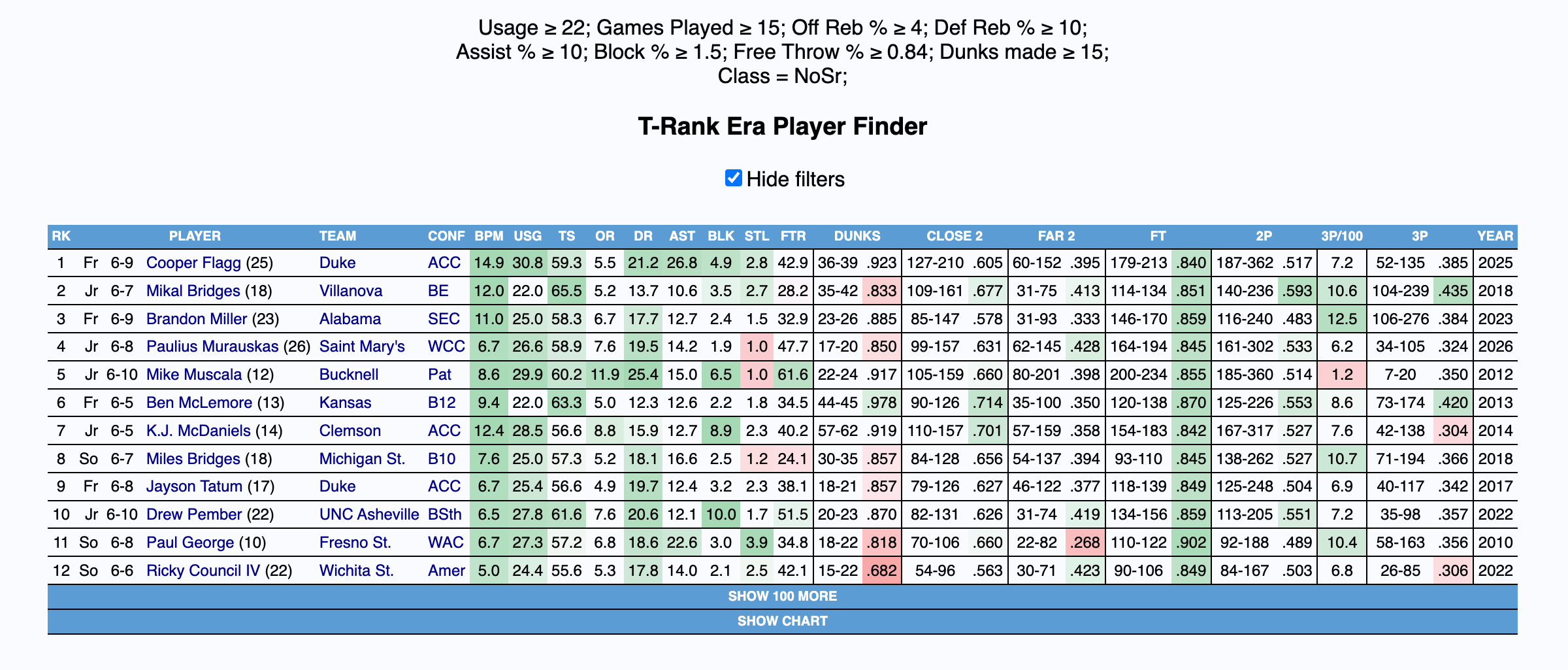
Even with the defensive concerns, I’m bullish on Paulius Murauskas as a draftable prospect. How high will depend on some of the questions I raised, but dudes who have the requisite height and ability to contribute on the periphery will typically get a cup of coffee.
I think this Bart query communicates that point well. I’m not expecting Murauskas to reach the higher-end outcomes of some of the names on this list, but every dude on it sans Drew Pember has logged minutes on an NBA floor. Whether he ends up as a name on this list that actually sticks will depend on his ability to answer those questions. These queries are an inexact science and often need the film study to corroborate the results, but I’m confident there are NBA teams that are going to find value in getting a dude like Murauskas in their building.

“I mean this is old school, middle earth shit.”
“I’ve been telling ya that’s why I wanted you to see it”
“Here, go through my loupe”
Xavier Edmonds didn’t have a traditional route to becoming an NBA prospect. Before transferring and showing out during his junior season at TCU, Edmonds played two seasons at Salt Lake Community College in the National Junior College Athletic Association. Despite the jump in competition, he looked right at home in the Big 12.
Edmonds blends the worlds of the traditional old-school power forward and new-school positionless versatility. He loves to operate on the block and midpost to get to his post bag. He can dip his shoulder into his defender’s chest and drop in a baby hook with either hand, or counter and turn over his left shoulder where he likes to get to a smooth fader. It’s certainly not the most efficient shot, and one he’ll probably be discouraged from spamming at the next level, but if he gets the ball in the mid-post with a low clock, Edmonds knows what to do.
I’d classify him as a good athlete when accounting for his agility and ability to move on the perimeter defensively, but he definitely lacks some vertical explosion in tight spaces. As such, he likes to use pump fakes to get rim protectors to bite and create openings in moments where he needs to finish over length. Because he lacks true big height, he can get stuck in the paint against more disciplined defenders, putting himself in a spot where he spams those pump fakes and has to settle for an inefficient, tightly guarded look. There are also moments where he fails to read where the help is positioned and loses sight of defenders looking for strips and pokeaways. This is one of the reasons for his negative assist-to-turnover ratio. But don’t get it twisted, because Edmonds can pass that rock.
Now before we get into that, let’s talk about the shooting, because so far we’ve talked about a post game that isn’t going to be how an NBA team wants to utilize him. Where teams will be interested is using him as a spacer who can pick-and-pop or play out of handoffs and make teams pay when defenders sag off. Edmonds knocked down 43.6% of his jumpers on a modest but encouraging four 3PT/100 as a junior, a number I’m hoping gets into the sixish range during his senior campaign. I don’t expect him to be a 40-plus percent shooter at the next level, but the shooting upside is real. He has a nice balanced base and a consistent release with good follow-through, and there’s smooth synergy from his lower-body dip through his release. The results at the free-throw line leave me wanting more given his form and his success beyond the arc, especially since he gets to the line a ton, boasting a near-60 FTr. But I’m a believer in the shot, and I think the jumper opens up some nice options for the offense as a play finisher in spot-ups or leveraging counters like slipping a screen to finish at the cup or make plays out of the short roll.
Which leads to the aforementioned playmaking. On the surface, it looks fairly limited given the numbers, but there’s some ridiculous stuff on the tape. The decision-making and precision could use some fine-tuning, as sometimes he bites off more than he can chew, but some of the looks are nasty. He hits and leads cutters from the perimeter, makes live-dribble passes with both hands, and consistently makes weak-side skips. With a season under his belt letting the game slow down for him at the D1 level and with more comfort in TCU’s system, I think we can see real progress as a passer this season.
Defensively, Edmonds manned the middle for TCU, but I think he’s more of a swing big at the next level. At a listed 258 pounds, he has the strength to bang down low, but lacks the vertical pop to protect the rim full-time at the next level. Where he shines is his lateral mobility. You can feel confident letting him switch onto shifty guards like Christian Anderson or Isaiah Johnson, or bigger ball handlers like AJ Dybantsa and Josh Jefferson, and he’ll sit in a stance, body up, and slide with them. His mobility lets him cover a ton of ground and play in different schemes. TCU loved to throw hard hedges at guards, and Edmonds was a big reason they could run it effectively, thanks to his ability to hedge and recover.
“I do some research”
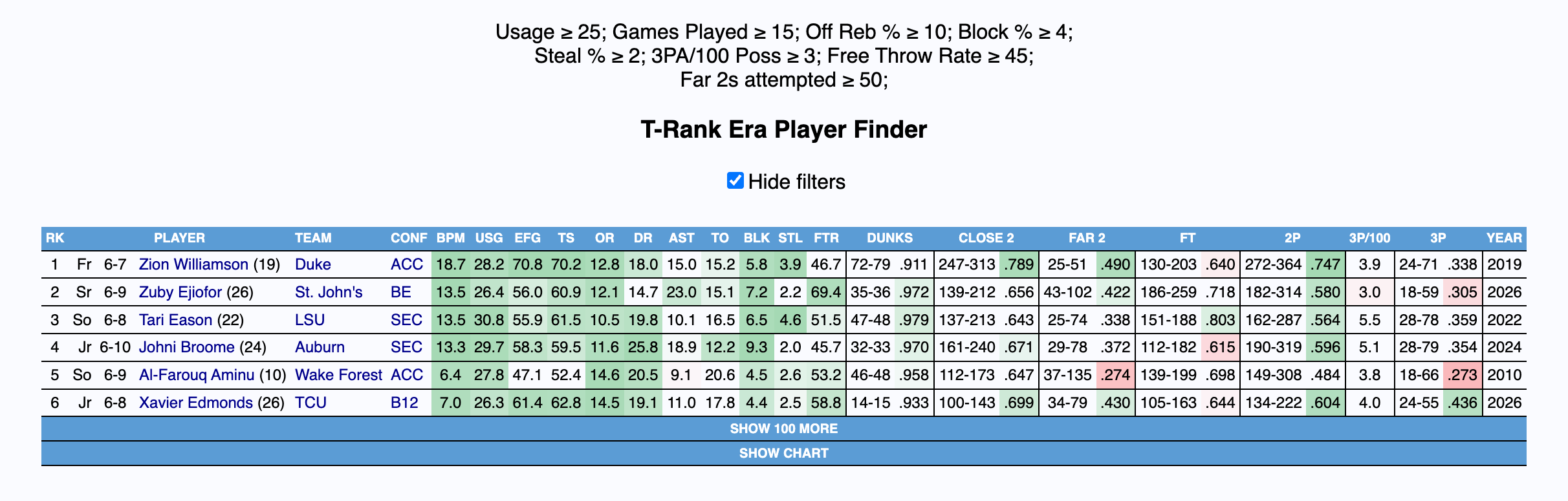
Making the statistical case isn’t going to lead to a ton of sexy outcomes for Edmonds at the next level. You can see in this Bart query that we’re mostly looking at a tweener forward/big of the role player variety, as Edmonds does not possess the outlier athleticism of Zion. Ultimately, we’re probably looking at a role more in line with your Xavier Tillman, Grant Williams, PJ Washington type of guys. There’s also a real outcome where he bounces around the G League like an EJ Liddell. But I think this is a real NBA prospect heading into the 2027 NBA Draft cycle, and I believe he should be on the late first radar heading into the season.

“Whaddaya know? I dont know. I just know.”
“I’ve been telling ya that’s why I wanted you to see it”
“Here, go through my loupe”
Alexandros Samodurov is the wild card of this group.
After coming up and developing through the Panathinaikos system, Samodurov is headed to UNC to use college hoops as a means to get on the public’s radar.
Samodurov first popped up on my radar during the 2025 FIBA U20s. This was an offseason with a ton of hype surrounding Neoklis Avdalas coming stateside, so catching him as the lead dude for Greece was a great way to evaluate him heading into that cycle. The only problem was that I couldn’t stop drifting my attention to Samodurov instead.6 I was so intrigued by his performance that I convinced the No Ceilings crew to take him with the 60th pick in our first 2026 mock draft last cycle.
So what was it about Samodurov that kept pulling my attention away from Avdalas?
It just felt like the dude was always making cool shit happen. He averaged 17.6 points, 6 boards, nearly 2.7 assists to just 1.3 turnovers, threw in 2.5 stocks, and got to the charity stripe 7 times a game. A 6’11” dude who’s super mobile and does a little bit of everything on the floor? Sign me the hell up.
Now, a 6’11” Swiss-army-knife is an intriguing enough sales pitch as is, but it’s important to note that Samodurov isn’t a dude who’s going to soak up big-time usage. He never really has—boasting a career sub-20% usage rate—and that’s going to ultimately place a cap on any star-level outcomes at the next level.
Despite the fact that he isn’t the type of dude you’re going to hand the rock off to with the intention of letting him cook, Samodurov is going to be a dude who stuffs the stat sheet. I’m fully expecting him to be a Sheets FC fan favorite this year.
Samodurov’s low-maintenance, high-feel game is going to make it easy for him to slot into most lineups for UNC. While the minutes have been up and down, Samodurov has carried a 1.63 AST/TOV ratio between Panathinaikos and the Greek National Team across various FIBA competitions over the last three seasons. He isn’t a primary playmaker who’s going to be initiating ball screens, but he’s comfortable making plays out of the short roll, attacking closeouts and hitting the open man when the defense collapses, leading the break, and making quick .5 decisions that keep the offense humming.
As a scorer, Samodurov is at his best when he can fill in the gaps. He’s got soft feet and hands rolling to the rim, he’s quick off his feet roaming the baseline in the dunker spot, he fills the lanes in transition, and he’s a willing but not yet efficient outside floor spacer. I don’t know if I’m quite glass-half-full on the jumper, but I do think he has pretty workable form. He shoots with a slightly narrow base, feet sitting around the 10 and 11 o’clock. He gets to a high release point that’s tough to contest given his height, with the ball coming up slightly in front of his body, and does a nice job finishing his shot with a strong follow-through. A lot of his power seems to come from his upper body rather than his base, which can lead to some inconsistency in how he misses, with some hitting front rim, some back rim, and some side rim. Since the majority of his shots will come from catch-and-shoot situations, continuing to build consistency and efficiency in those opportunities will be important, and the results aren’t there yet to fully project any real confidence, especially given that he’ll have just turned 22 on draft night. The volume has been on the lowish side with a career 33.6% 3PTr, and he’s been a sub-30% shooter in the 100+ games dating back to 2020-21 per Cerebro’s database. If you want to drink the optimism Kool-Aid, Samodurov has knocked down 84% of his FTs with Panathinaikos over the last two seasons and knocked down 43% of his catch-and-shoot threes with the Greek National Team in 2025—but again those percentages come on limited attempts, so there’s certainly some noise. I do think there could be enough touch that he gets to league average eventually, though.
Samodurov is going to fill it up defensively as well. He’s consistently hovered around a BLK% of 5, demonstrating good timing and recovery tools and getting off his feet quickly to contest at the rim. He has a strong feel for off-ball position, where he puts his mobility and ground coverage are on display when he’s tagging rollers and closing back out to the perimeter when the ball skips. Samodurov is comfortable hedging and recovering or switching onto shifty ball handlers, and he uses his length and size to get strong contests and force tough shots on the perimeter. As much as I dig his defensive potential, you could tell there were moments for Panathinaikos, when he was trying to really make the most of his limited minutes, where you’d see his feet get a little fidgety and excited. There were also moments where he’d allow a stronger player to drive through his chest, as he’s built more like your Mobleys and Holmgrens. At his size, he’ll certainly be asked to play some five, and if he can handle that level of physicality, it will open up more pathways to success at the next level.
Samodurov’s two-way ability at his size is going to make him an interesting chess piece for Michael Malone as they both navigate his first college season. Samodurov will have immediate chemistry with Avdalas, which should help him acclimate to the college game. And while there are a lot of highly touted names on that UNC roster, I think Samodurov’s experience should help vault him into a significant role for them.
“I do some research”
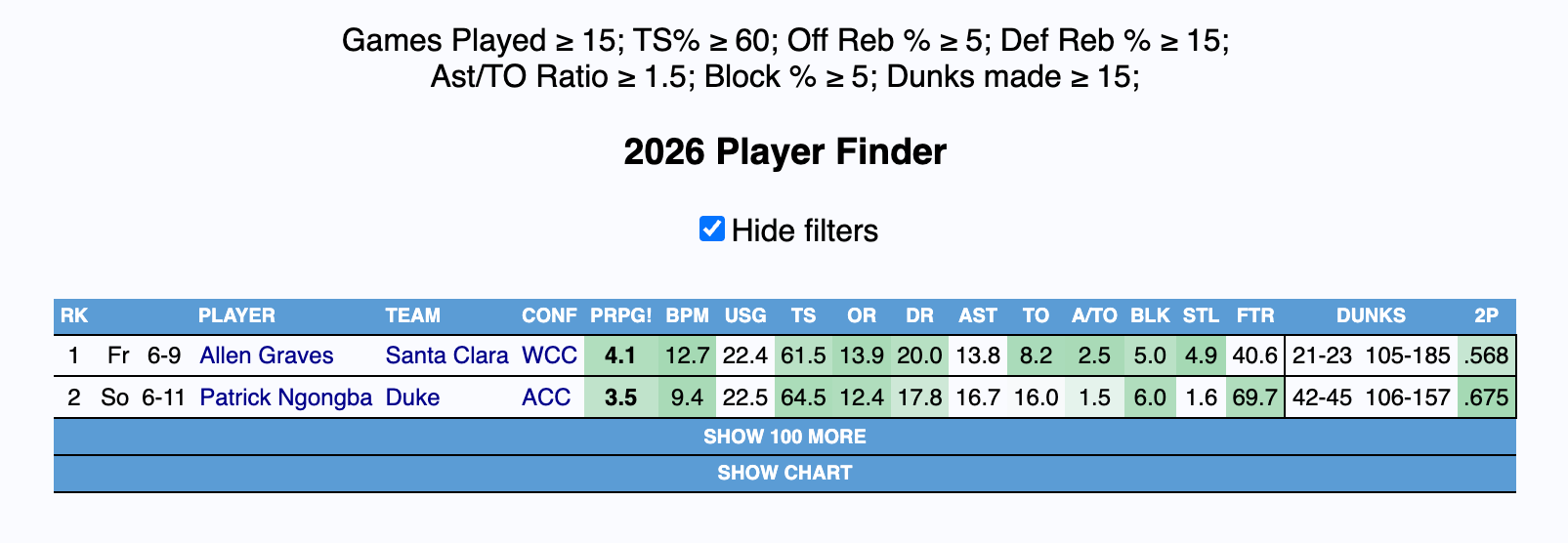
Now, coming over from the international game makes it hard to build out a fun Bart query to show his statistical case the same way we can for the domestic prospects. We have to lean a bit more heavily on rate stats due to his low minutes threshold, and the competition he faced was fiercer than his college contemporaries, as he was playing against pros, many of whom are ex-NBA dudes. But if we input some basic rate stats along with total dunks from the 25-26 season, we get two of Draft Twitter’s favorite 2026 prospects in top-20 pick Allen Graves and Duke’s Pat Ngongba. It’s not one-to-one, but I think Graves is a fairly strong stylistic parallel for Samodurov, as neither guy is going to be expected to create, but they provide the ancillary skills to make life easier for everyone else on the floor. Samodurov’s age may prevent the rise Graves saw last cycle, but given the versatility, malleability, and overseas experience, it wouldn’t shock me to see him garner some first-round buzz by the end of the 2027 NBA Draft cycle.
Follow me on Twitter/X: @coreytulaba
Follow No Ceilings on YouTube: @NoCeilingsNBA
IYKYK
Sometimes years early.
Though he can get away with it at the college level thanks to his strength and length.
He’ll need to be able to play some small ball to stick.
Not a shot you want him spamming.
To be fair, I’m a known Avdalas non-believer.