


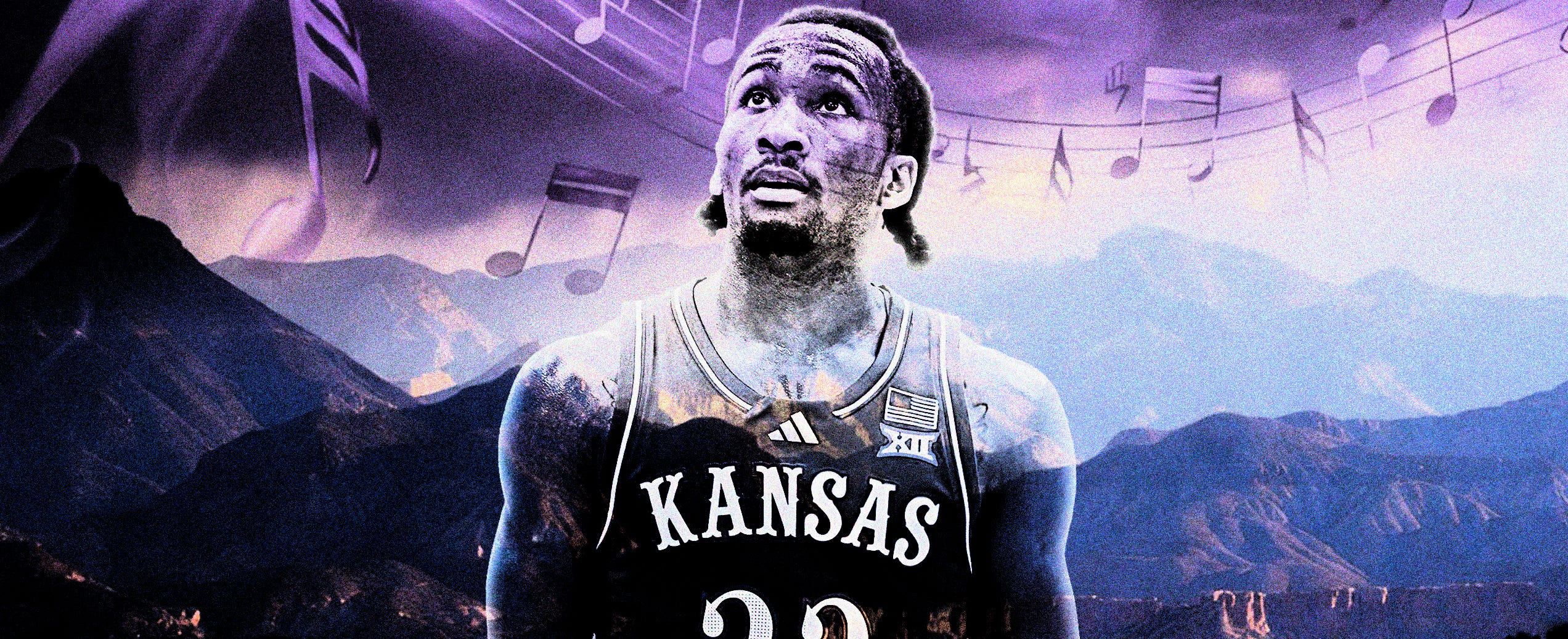
The 2026 NBA Draft is in a raging debate cycle regarding which prospect should go first overall between AJ Dybantsa, Darryn Peterson, Cameron Boozer, and Caleb Wilson.
All four prospects have separated themselves from the rest of the pack in terms of “prizes” in this draft class (though there are ALWAYS players taken later who emerge as some of the best in a particular draft).
It’s one thing to rank a player’s talent in a pure vacuum and assign a grade on a big board. It’s another to consider a prospect’s FIT within an organization on a projected mock draft. How would the player actually work with the talent the organization has? Is he a player to build around, or an addition to a current situation that raises that team’s competitive ceiling?
The Washington Wizards, at this point, barring a potential trade down, are widely expected to select BYU’s AJ Dybantsa with the top pick in the draft. That would leave a combination of Peterson, Boozer, and Wilson available to the Utah Jazz with the No. 2 overall pick.
Out of the top options available, there’s one clear answer as to who makes the most sense with the CURRENT state of the Jazz roster: Darryn Peterson.
Let’s explore Peterson’s game, why he makes the most sense in terms of fit with this current roster, and why the Jazz shouldn’t consider a move up for another prospect at that top spot, and should choose to build with the current personnel on the roster heading into the 2026-27 NBA season.
Darryn Peterson’s Evaluation
To understand how Darryn Peterson would fit within an organization, it’s important to understand who he is as a prospect.
Coming into the 2026 cycle, Peterson was actually the consensus top prospect in the field as a 6’6” shooting guard who could score on anyone and provide defensive versatility and playmaking in the backcourt.
Last season at Prolific Prep, Peterson did just that in a multitude of ways. His defensive playmaking metrics were off the charts, as his athleticism would pop any time he had to rotate to cover ground or move to help protect the rim. Whether it was in transition or coming from the weak side, Peterson’s shot blocking ability was some of the most impressive I’ve seen from a high school player, period, let alone a guard/wing.
But conversations around top players generally don’t start with the defensive side of the ball. Peterson came to Kansas as a dynamic perimeter creator and shotmaker. Essentially rated as “Excellent” per Synergy Sports in both transition and half-court offense, Peterson was seen as a player with few holes in his game on that end of the floor. Explosive rim finisher, a blur in the open court, and the type of confident jump shooter who didn’t care if he had a hand in his face or not. That’s a player who sounds like the type of qualities teams fantasize about selecting in the draft.
High school is an important talking point about Peterson’s grade as a prospect because of how he was utilized compared to his time at Kansas. At Prolific Prep, Peterson played extensively with the ball in his hands as a lead guard and ball-screen operator. Per Synergy’s 13 games on record for Peterson’s season at Prolific Prep, he had 202 of 351 offensive possessions in pick-and-rolls, including passes. Stripping away the non-scoring possessions, Peterson made 49.4% of his field goals in ball-screen offense, good for 1.03 points per possession. A high percentage of those looks were Peterson using the screen to get downhill and either finish at the rim or pull up in the midrange, but of 27 threes attempted, Peterson hit 44% of those looks, too. Already, you can see Peterson’s excellent profile as a guard who can score at every level.
When factoring in assists and passes out of those pick-and-rolls, those possessions generated 1.13 points per shot, which is an excellent mark for a HS prospect looking to make his mark as a primary ball handler at the next level.
Again, a lot of Peterson’s offense derived from having the type of first-step burst and explosion to the rim that really put pressure on opposing defenses. If a team didn’t send a double at Peterson and played that ball screen straight up, it was potentially curtains even if he faked and rejected the screen. Peterson got by almost anyone he wanted en route to making an excellent play on the ball.
Even taking into account how he fared as a one-on-one scorer, Peterson’s possessions in isolations, including passes in those 13 games, generated 1.14 points per possession, also an “Excellent” mark per Synergy Sports. Because Peterson can create a jump shot over anyone from nearly any angle, he’s a threat to hunt for a certain matchup, get them on an island, and cook them as he so chooses. Any time Peterson has discussed his offensive approach in an interview, he’s said he views himself as unguardable. And boy, is there tape to back that notion up.
All of that context is crucial because his offense at Kansas didn’t quite look the same as it did in high school. Due to issues that Peterson has now addressed with body cramping, he wasn’t his full self for a considerable stretch of the college season. He didn’t have much explosion as a driver, which really limited the areas on the floor he could “dominate” from a scoring AND distributing standpoint, as he did in high school.
His burst to come off that screen and attack wasn’t nearly the same this year at Kansas. In high school, Peterson was lethal, taking wider angles off ball screens and just gunning it downhill, daring anyone to keep up and step in front of him. If he was able to catch a defender sleeping, he could reject that screen and go the opposite direction en route to the rim. In college, defenses keyed in on Peterson not having the same level of explosion on screens, which made it easier for them to blitz those plays and pressure him as a ball handler. This limited opportunities to pressure the rim and break into those next levels of the defense.
So, without a dominant screening presence to catch some of those defenders and force a switch when an additional body was showing help near the level of the screen, there were enough possessions where Peterson didn’t have an effective answer and either had to find a pass out, force a tough, contested look in the midrange, or turn the ball over. Thankfully, a lot of those possessions ended with the former, as Peterson maintained a low 11.4% turnover rate in PnR’s, including passes for the Jayhawks. But without that ability to break defenses in ball screens the same way he did in high school, Peterson was moved off the ball in favor of focusing on his ability to knock down jumpers at absurd volume on just as absurd efficiency.
And boy, did he go to extraordinary lengths to get buckets at Kansas.
Not only did Peterson score 20.2 PPG at Kansas, but he did so on a slash line of 43.8/38.2/82.6. Peterson took about 30 shots per 100 possessions. Despite some struggles that affected his ability to create better looks around the basket and in the paint, he still ranked as a top scoring option because of his prolific shooting. Living on 13.9 threes per 100 possessions is one thing, but making what was 40-plus percent of them for a vast majority of the season was another. Few prospects have had shooting seasons as Peterson did at volume.
When Peterson could work off the ball and utilize screens to get off quick shots, he was simply unstoppable. With much better space and flexibility, lifting to look on the wing rather than working straight from the top of the floor, Peterson found cleaner looks on offense and made the most of them in a big way. He hit on 43% of his catch-and-shoot triples and connected on another 41% of threes that came off screens or handoffs, per Synergy.
There’s no question that Peterson’s priority is to get back the explosiveness he had as a driver, take better angles working off screens, and improve his ball handling in traffic to make the most of actually being able to progress through the decision tree that is pick-and-roll. Those things are all tied to his highest ceiling as a player if he is to go to an organization that expects to put the ball in his hands consistently.
What seems to work more in his favor, though, is operating as a secondary option who doesn’t have the pressure to run 30 pick-and-rolls every single game out in favor of a blend of on-and-off ball shot attempts to diversify his overall attack.
There’s one lottery team in particular that has the roster to take advantage of Peterson’s strengths as a shooter and offer him another viable option in the backcourt that can play true point guard, freeing him from the sole responsibility to do everything.
That franchise would be the Utah Jazz.
Utah Jazz Current Roster Fit
I do want to start this section of the piece by stating that the Utah Jazz COULD absolutely be open to trading players on the roster. Lauri Markkanen has long been rumored in potential trades to bring back significant assets, despite all reporting indicating he loves Utah and wants to keep spending his career there, fresh off a massive contract extension.
Walker Kessler is a restricted free agent expected to sign a new deal to remain in Utah. Still, one can never be too sure, given how expensive the Jazz are projected to get after the trade deadline acquisition of Jaren Jackson Jr., another centerpiece for this organization.
I say all of that to paint a picture that things can absolutely change in terms of a roster’s overall outlook by the time I’m even putting this together. The best I can do is project with the pieces currently in place, which includes the aforementioned star frontcourt talents, along with the fifth starter in this equation (apart from the projected Darryn Peterson), Keyonte George.
That starting five of George-Peterson-Markkanen-Jackson-Kessler has three-point shot-making written ALL over it, which is a key component of offense in today’s NBA.
Per Basketball-Reference, the Jazz attempted 40.2% of their shots from distance this past regular season, good for 21st in the NBA. That checks out, given they were 25th in three-point percentage at 34.5%, which is below the league average.
Clearly, offensive structure has been a focus of the Jazz organization, as evidenced by the hiring of Will Hardy as head coach. Hardy is excellent at scheming different sets and getting guys open for shots based on their strengths. Look at what he did for Ace Bailey and Brice Sensabaugh as the season went on in Utah. Those two in particular are at their best getting shot attempts on the move, and using variations of second-side actions and movement off screens to do so. Both Bailey and Sensabaugh excelled from deep post All-Star break, hitting 35 and 40% of their triples, respectively. I would expect that type of focus around generating quality looks from deep only intensifies with FOUR three-point shooters on the court at positions one through four.
All of George, Peterson, Markkanen, and Jackson Jr. would be able to knock down threes off the catch, making life difficult for opposing defenses depending on where they want to load up. Staying too far home on the shooters in a spread pick-and-roll offense with Kessler at the helm could open the door to lobs on the roll, pull-up shots from George, or straight-line drives to the rim, where George improved significantly as a foul drawer this past year. Send help on that ball-screen action, and George has a plethora of options to spray the ball out to off that double.
One thing to keep in mind with how Utah has navigated offense over the last few seasons, especially last year in particular: the Jazz ranked third-last in PnR’s, including passes run per game in the NBA per Synergy Sports. This is an offense that hasn’t just continuously run the same actions from the top of the floor every trip down the court. Having Peterson, WITH all of the aforementioned shooting talent, opens up so many doors for set executions that aren’t just high pick-and-roll. So while I certainly want to see George get more reps in ball-screen actions with someone like Peterson next to him more often on the court, it’s not something that’s required for this team to generate points on a possession-to-possession basis.
What makes this type of offensive structure so fascinating is that, apart from George, these are BIG shooters in play. Imagine offensive sets that are designed to run Peterson off multiple screens from Markkanen and Jackson, with one slipping to the basket and the other flaring out from three, with Kessler in the dunker spot and George in the opposite corner. That’s a lot of space and effectiveness from deep at positions with size.
But what about when Peterson would operate in pick-and-roll offense with one of the best screen-assist big men in basketball, in Kessler? Peterson’s primary roll partner at Kansas was Flory Bidunga, who doesn’t possess nearly the same level of physicality in actually catching a body off a set screen. Kessler can withstand that contact, freeing up Peterson for a mismatch or open pull-up three coming off that initial screen. Peterson can even read the defense before the screen is set and choose to reject it by going the other way against defenders who were looking to load up on that screening action and step into open space for a pull-up two.
I’m not even getting too deep into other offensive elements that could lead to open catch-and-shoot triples for Peterson that are more frontcourt-centric. Both Jackson Jr. and Markkanen are threats to cut or post up, particularly Jackson Jr. in terms of finding position on the block. If either of them can draw enough attention to the middle of the floor, that’s a skip out to Peterson for a corner triple, where he was almost unstoppable on unguarded catch-and-shoot threes at Kansas.
Even in transition, Peterson is a live threat as a shooter on the break. Utah will be able to throw enormous size on the defensive glass, meaning ample opportunities for George and Peterson to work off one another.
The best part about what Utah has been building from a roster perspective is that there are answers off the bench to continuously fill in this formula of pace-and-space around several bigs on the court. Both Bailey and Sensabaugh would be featured options for the Jazz's second unit. Kyle Filipowski is another versatile seven-footer who can defend, rebound, handle a bit on face-up attacks, and knock down outside shots. Isaiah Collier may not be a proven perimeter shot maker, but he is a blur of a bowling ball in terms of getting downhill and forcing his way through traffic to create kick-out looks from deep based on his assist numbers last season.
Peterson fits what Utah wants to be on offense like a glove, more so than arguably any other prospect in this draft class. So, despite what many rumors are saying about viable trade-up scenarios, the Jazz shouldn’t make that move up to the top with the Washington Wizards.
Why The Jazz Shouldn’t Trade Up To 1
For the Utah Jazz to even consider a trade up to No. 1 overall with the Washington Wizards, the price would have to start at the No. 2 pick and forward Ace Bailey, whom the Wizards were looking to select last year in the 2025 NBA Draft before the Jazz selected him one slot ahead.
What that’s essentially saying is that the Jazz would have to give up TWO Top 5 picks in the last two drafts to get back just one player in this current 2026 draft. That is a lot to give up in any NBA scenario, especially given where this Jazz team is positioned for the future.
AJ Dybantsa is one hell of a talent in this 2026 class. There’s a reason why many have projected him to have an MVP-caliber ceiling in the NBA, and the odds-on choice for the top overall pick in the draft. At 6’9”, Dybantsa is a mismatch nightmare on the perimeter. He has the type of first-step explosiveness of a lead guard with long strides that can get him to the rack on two dribbles or less. Factor in how he always hunts for contact and can get to the line at an excellent rate, and it’s easy to start projecting how he could pile up points in a hurry at the next level.
Not just that, but Dybantsa has an excellent mid-range game that’s built around establishing post position in the middle of the floor. Dybantsa can literally take over games from that spot, and either rise up to score OR kick the ball back out to a shooter/cutter, depending on how defenses choose to load up on that action.
Every NBA team needs a go-to offensive option that can seemingly take on almost any defensive matchup in one-on-one situations. At his absolute best, Dybnatsa can be that guy. At this moment, Utah thinks it has that player in Lauri Markkanen. Still, he’s not nearly as gifted in terms of exploding to the rim and creating passing windows like Dybantsa is (though at this point, he’s a supremely more talented pull-up shooter at 7’0” tall).
What Dybantsa would potentially take away from what Utah is trying to build on offense is the fact that, at his best, he’s a ball stopper of sorts. Now, I’m not saying that as a full-on negative against AJ. As I said, every team needs a player who can hunt and go to work one-on-one against some of the best defenders in the league. And to AJ’s credit, he’s really become a much more willing passer when the windows are presented to him, be it from a standstill or on the move.
But a lot of the offense would likely be running through Dybantsa as opposed to the other players on the team. That’s because at this point, Dybantsa isn’t a knockdown shooter from deep, even off the catch. Dybantsa made less than one-third of his catch-and-shoot triples this past season at BYU, and even though his shot projects to continue improving, he’s not someone that defenses have to sell out on regarding closeouts to prevent him from getting those looks up.
With Peterson potentially on the Jazz, that’s not an issue at all. Peterson doesn’t have to dominate the ball to bring forth excellent offensive value because of how versatile he is as a shot maker. Utah’s offense can rely more heavily on motion schemes rather than just spamming ball screens at the top of the floor. That is a much harder offense to stop most of the time, with Markkanen as the short-term answer as a go-to shotmaker. At the same time, Peterson would continue to round out the rest of his game, hopefully becoming that player in the long term for the Jazz.
Sacrificing assets to get a player like AJ sounds like an option for a lot of franchises out there in need of a “face” of the organization. For any team without an offensive identity, it’s easy to talk oneself into handing the keys to a long, imposing forward like Dybantsa, who can hunt and take what’s his offensively.
That just isn’t what the Jazz currently need, however. Utah has some key pieces in place with a roster that’s quietly deep enough with young talent to start making some noise in the Western Conference. Drafting a player who fits like a glove schematically now, while also having the type of ceiling to continue growing into that number one option, AND doesn’t eat away at your defensive gameplan, seems like too good a proposition while retaining all future assets.
Conclusion
I didn’t mention Cameron Boozer or Caleb Wilson regarding other potential options at No. 2 or in other trades. This team made a large move for established frontcourt talent. By taking someone like Boozer at 2, the Jazz could have even more frontcourt flexibility than it currently possesses. Still, this team needs a secondary ball handler in the backcourt to alleviate pressure off Keyonte George and maintain any advantages created by attacking displaced defenders. Ace Bailey showed promise on the ball as the season progressed, with Utah post All-Star. Still, he’s not the ideal answer right now at the shooting guard position next to George, compared to someone like Peterson, who has a more proven track record (when healthy) of operating in primary or secondary actions as a ball handler.
Barring a trade of someone like Lauri Markkanen (find me the trade, trust me, I’ve looked around), there doesn’t seem to be a fit proposition like Peterson by selecting Boozer, even if I have a higher personal grade on him by my rankings.
Every year, teams have to debate whether they want to take the best player available, regardless of fit, OR draft for a specific roster need to stay within the context and move forward with an established identity. In reality, teams should ALWAYS draft the best player available who FITS the current identity of the roster. That player doesn’t always fall into a team’s lap based on where they’re positioned to draft.
This time, however, I believe it is the case with Darryn Peterson and the Utah Jazz. He fits with what this team is looking to build offensively, while filling a positional need and not sacrificing anything defensively in a meaningful way, while still having considerable upside as a lead offensive option if his pre-Kansas tape is to be taken seriously.
Peterson is a home-run selection for the Jazz, and the organization doesn’t even have to trade up for him. It’s a great time to be a fan in Utah.
I am a huge Jazz fan and couldn't be more thrilled to have jumped in the lottery. As much as I love AJ, I think getting the No. 2 pick is really the best case scenario because Darryn Peterson is arguably the better player and definitely the better fit. No matter who we end up with, AJ or Darryn, I will be thrilled!
Solid writeup. I think AJ is the best prospect on the board, his college production is just unmatched and defense and shooting being concerns are overblown imo. But DP can shoot the lights out it's a clear strength and you think with improved spacing and hopefully a little healthier year he can put pressure on the rim in the NBA. He fits in so well with the Jazz lineup