


A couple of years ago, I struck writer’s gold in my mind with an idea for an article. I wasn’t breaking any ground in identifying a player archetype who was a jack-of-all-trades, or, in the case of my article name, a skeleton key, but the idea stuck in my mind like glue when I started my dive into Anton Watson’s game.
There was something about the phrase that fit Watson’s game like a glove. It didn’t matter what problem the Zags needed to solve; Watson, as an older player, was willing and able to plug any hole on the team. That earned him a late-round selection by the Celtics, and although he’s bounced between the NBA and the G League, he’s currently playing well for the South Bay Lakers.
While I do have some set article templates that I love, like Magic 8 Ballers and The X-Factor Files, I don’t always set out to operate as a cyclical writer. I do love a good callback; however, I was hoping to find a player in the 2025 NBA Draft class who fits the same “skeleton key” mold as Watson. Sadly, no one quite fit the bill for me, although Carter Bryant and Cedric Coward were close facsimiles.
Instead, I’ve had to wait a little longer to find someone else who has the same versatility and problem-solving potential as Watson. I’ve found that prospect now, albeit at an even higher level, with Michigan’s Yaxel Lendeborg. I had Lendeborg as a borderline first-round draft prospect last season when he was tearing apart the competition as UAB’s heart and soul, but I understood his decision to head back to college and have a chance to contend for a national title under Dusty May.
I didn’t quite know what to expect from Lendeborg when playing for my alma mater, though I was optimistic. Simple optimism, however, doesn’t cover what he’s done as the engine behind Michigan’s rise to the top of the college basketball scene this season. Instead, by playing a ton of different roles for the Wolverines, Yaxel Lendeborg has become a Super “Skeleton Key” prospect who should feature in the late lottery in an otherwise loaded 2026 draft class.
Combination on Lock: Lendeborg’s Numbers
By now, if you have been following college basketball and/or the NBA draft, you’ve heard Yaxel Lendeborg’s story before. I won’t re-tell the positive tale of how he became a leading figure on a top team this season. Instead, I’ll focus on the pedigree of his success at each level and where his impressive numbers stand now in his final season at the college level.
No matter the level, since his fateful 11-game prep school basketball season as a senior, Lendeborg has been a dominant force. It’s a lesson in patience with Lendeborg: it took him a few years at Arizona Western, but he ended up an NJCAA 2nd and 3rd-team selection in his last two seasons, and won Conference Player of the Year and Defensive Player of the Year awards there as well.
That same success snowballed while playing for Andy Kennedy at UAB, as he was the driving force behind one of the best teams in the American Athletic Conference for the past two years. Lendeborg’s all-around excellence earned him two 1st team All-AAC selections, two Defensive Player of the Year awards, and an NCAA tournament berth with the team.
All of that winning and individual excellence has seen itself repeated at Michigan, even as Lendeborg has taken on a slightly different role on the team. He’s no longer as featured as a scoring option for the Wolverines compared to the Blazers, nor is he down in the trenches as often as he was at UAB. Instead, even as he’s transitioned to playing more minutes as a wing-forward hybrid, Lendeborg has been similarly sublime for another team that is winning a ton of meaningful basketball games.
There are a few key metrics that contribute to Lendeborg’s success as a player, worth mentioning. Since he’s a late bloomer, Lendeborg will be 23 on draft night and will likely be in the athletic prime of his career when he reaches his second contract. He doesn’t have as much strictly untapped upside as other players in this draft class, which may hurt his ceiling in the draft. Where Lendeborg makes up for that perceived lower ceiling is in his higher floor, which comes from his physical attributes.
Lendeborg has shown, over his half-decade in college basketball, just how great an athlete he is. Last year at the NBA Draft Combine, Lendeborg measured 6’8.5” without shoes and had a 7’4” wingspan, giving him both great size as a tweener wing and a gargantuan wingspan. That, alongside his modest 31.5” max vertical, paints a numerical picture of the strong vertical and horizontal athlete on the court. Lendeborg has a strong frame to absorb and dish out contact, is often one of the first players down the floor thanks to his sprint speed, and has the leaping ability and length to be a real problem for teams on both ends of the floor.
This season at Michigan, despite a slight drop in raw box-score output, has been a masterpiece of basketball by Lendeborg. He ranks second in the country, per BartTorvik, in BPM this season, only ranking behind freshman phenom Cameron Boozer. With great metrics besides his BPM, like his miniscule 10.5% turnover percentage, his 4.8% block percentage, and 2.2% steals percentage, and his efficient 63.8% true shooting percentage, it’s worth exploring which other players fit into a query that meets those cutoffs.
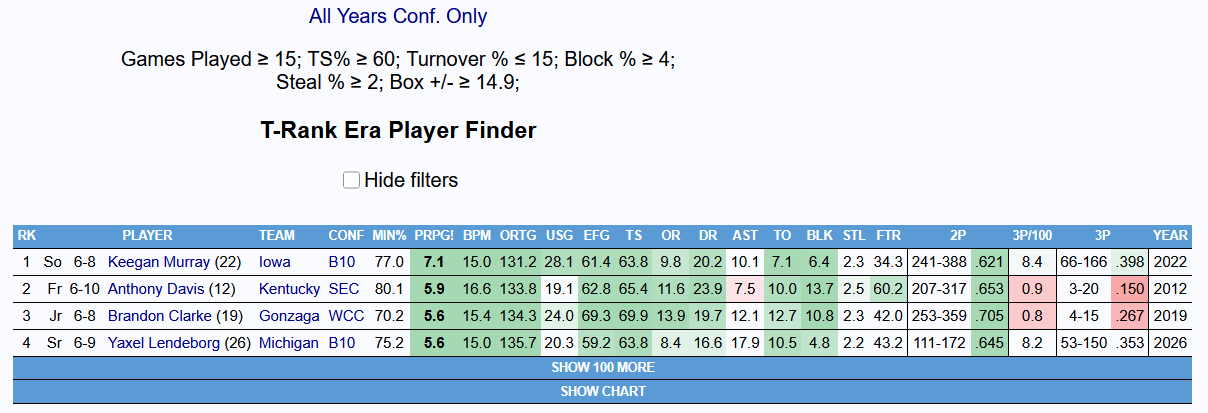
The answer is not many! At these metrics, only four players have hit these benchmarks, including Lendeborg. The field is strong and intriguing, given its diversity. It includes a freshman Anthony Davis, who illustrates just how singularly alien his lone college season was in retrospect. His age and behemoth production as a teenager make him less useful compared to Lendeborg, too, leaving two other players worth consideration.
The other seasons that appear are the draft years for Keegan Murray and Brandon Clarke, two other first-round picks with different styles of play. While Murray and Clarke occupy different archetypes at the NBA level, they’ve both been crucial players on the floor for their teams, and each has signed a lucrative second contract. From a playstyle perspective, Yaxel Lendeborg exists at the intersection of their respective games, with key differences, and he is a bit older than both players.
It’s an important distinction, too, that Lendeborg is one of a pair of players in this rarified air who are volume shooters from deep in college. Both Anthony Davis and Brandon Clarke profiled as pure big men, while Lendeborg and Murray let it fly with aplomb from deep. Murray’s appeal as a prospect came more from his sterling shooting numbers, an area where Lendeborg is still improving, but the willingness and frequency of his shooting does make his playstyle slightly more appealing in the modern NBA.
A Bart query, while useful, is nowhere close to a surefire way to scout a player. It is encouraging that Lendeborg fits into a great group of players who have had prolonged success in the NBA. That may mean he’s already had a season that, historically, points to a player worth spending a first-round draft pick on due to his production. It doesn’t mean, however, that he will have the same career based solely on those numbers.
Good thing, then, that my projections for Lendeborg’s success aren’t just based on his numbers, despite how great they are. Instead, I love how the play on tape, down to the minuscule moments that can get lost in a season, match the mighty numbers that he’s putting up on the stat sheet. His overall play on both ends of the court has made Lendeborg a Super Skeleton Key for Michigan and vaulted him into well-earned lottery-caliber potential.
The Lockdown: Lendeborg’s Defense
Usually, when I write about an NBA draft prospect, I tend to highlight their bare minimum and median outcomes. This is not to obfuscate a prospect’s ceiling, as projecting out a player’s potential future is really where the butter is churned in the draft space. Instead, my insistence on what a player can do right away at the NBA level is a testament to how hard it is to earn early NBA minutes and develop a consistent role on a team.
That’s something that’s less useful to do with Yaxel Lendeborg, given he already does so many things at an NBA level. There won’t be a specialized role a team needs him to play to get him onto the floor in an NBA game; rather, teams will get to choose how to deploy him given his wide range of ready-made skills. That alone is the crux of his appeal as a Super Skeleton Key player, even though his ability to play high-level defense will keep him on an NBA court more than any of his other skills.
As an athletic 6’9” forward with a gigantic reach, there’s little that Lendeborg can’t physically do out on the floor. He’s light on his feet when defending drives, doesn’t lunge at ball-handlers willy-nilly, has the strength to body up against larger players when he plays inside, and can even stick to smaller guards on the perimeter. While Michigan has benefited from the behemoth trio of Lendeborg, Morez Johnson Jr., and Aday Mara, it’s the versatility of Lendeborg that Dusty May has been able to deploy however he needs it that’s propelled the team to their 2nd-place adjusted defensive efficiency rating, per BartTorvik.
The counting stats for Lendeborg are flashy, as he has a 16.6% defensive rebounding percentage, a 2.2% steals percentage, and a 4.8% blocks percentage, but none of these numbers do his work justice. Lendeborg is a motivated terminator on defense, throwing his weight around to snatch rebounds, swiping in with great, spontaneous technique on steals, and meeting shots at their apex before turning them away.
It was notable to me that Lendeborg doesn’t just get his steals and blocks from one place. For some prospects who blow up the stocks box score, the tape reveals that their stocks are a product of risky passing-lane play or gimmicky plays. That’s not the case for Lendeborg. As a robber, he’s just as likely to time his digs out well in the post and pilfer a possession there as he is to use his massive wingspan to get his mitts in the passing lanes before running off for a thunderous dunk.
It’s the same for him as a shot-blocker. Lendeborg is just as potent when defending at a standstill at the rim as he is when he has to chase down his opponents. Smaller players can occasionally catch him flat-footed on the perimeter, but they rarely get all the way to the cup and don’t feel his wrath afterward. When playing a more centrally-located anchor role, Lendeborg is stern inside. He’s held opponents to a 30.4% shooting percentage at the rim. That last tidbit makes me bullish on his ability to play small-ball center quickly at the NBA level, which would be another pathway that the Super Skeleton Key could unlock for his future team.
It’s not just defensive playmaking where Lendeborg excels; he does great at the things that don’t show up on the box score as easily. Lendeborg is a disciplined defender, whether on or off the ball, using his feet and positioning to win more with his feet than with his hands. He rarely closes out with reckless abandon, keeps his man in front of him, and has great, fluid hips for switching on defense. When contesting off-ball shots, Lendeborg can cover much more ground than other players his size. When guarding against on-ball attacks, Lendeborg shrinks the floor and makes his opponents feel like they’re in phone booths.
With no clear holes to his game, it’s tantalizing to imagine how quickly Yaxel Lendeborg will get a role on an NBA team. He’s capable of sticking with guards well enough, as he showed against Maryland’s David Coit in the second half of their game earlier this year, that it’s not a tax on a team’s defensive structure to deploy Lendeborg at the point of attack. That, alongside his rim protection, opens up a frequent switching scheme that a team could run with him to great effect.
It’s tough to look at a prospect as old as Lendeborg and imagine him in the lottery, given historical precedent, but his unconventional path to basketball stardom shouldn’t outshine his clear production and potential. It’s going to be clear from day one that Lendeborg will stay on the floor with his defense just as much as his offense for a team, and after showing off an equally dominant picture to teams at a much tougher level, there’s little reason to doubt the Super Skeleton Key on D.
Rim on Lock: Lendeborg’s Interior Scoring
As an offensive weapon, Yaxel Lendeborg has been the leading scorer for UAB and Michigan over the past two seasons. Lendeborg’s scoring is only part of his offensive appeal, but it’s a crucial factor in his versatility. There’s been a handful of past prospects who could do everything but score, which makes it a relief that Lendeborg has some sharp interior scoring chops.
Lendeborg is shooting a very healthy 68.6% percentage at the rim, which has an “excellent” rating on Synergy. Numerically, this is a great number, but it’s even better when you take into account all of the ways that he can get it going in the paint. The lowest hanging fruit for Lendeborg is on the offensive glass, where he’s been a productive pest for the past few seasons. Lendeborg averaged 1.9 offensive rebounds this season and shot 65.5% on his putbacks this season, off the strength of outmuscling and out-hustling everyone else near the rim.
Putbacks, alongside transition twos, are some of the simpler but more effective two-point looks players can get, which is a boon for Lendeborg. He shot 76.2% in transition from two-point range, galloping past other players to do real damage at the rim. His slam dunks and looping finishes are hard to stop, especially since he has the sort of body control that he does in the air while moving at full speed.
When it came to creating for himself, Lendeborg was potent in smaller doses both on and off the ball. He shot a scalding 82.4% on cuts, using shifty back cuts and timely dives to catch lobs and slip passes. These plays weren’t among his featured looks in Michigan’s offense, but they’re an area where Lendeborg can easily grab a few points in each game.
Due to his solid touch from deep, Lendeborg also had success pump-faking and driving off spot-up opportunities. He shot 56.5% on these two-point looks, peppering them in alongside his other rim attempts, but having a developed counter to his spot-up bombs is an important micro-skill that can open more doors for his future teammates on O.
While he would operate more as a pick-and-roll ballhandler to create for his teammates, I wouldn’t count on Lendeborg to be a creator on offense for himself. Instead, his productivity on putbacks, transition looks, cuts, and the occasional spot-up drive should help him be a double-digit scorer even without a reliable handle.
Yaxel Lendeborg’s rim scoring is varied enough that he can open up a team’s portfolio just by playing in the flow of the game. That’s worthy enough alongside his defense and other ancillary offensive attributes to warrant high consideration in this draft as a Super Skeleton Key problem solver.
The Answer Key: Passing with Flying Colors
Despite the presence of Elliot Cadeau, I’ve considered Lendeborg to be the truly important engine behind Michigan’s offense this season. That doesn’t contradict my last statement about Lendeborg’s scoring creation ceiling, as I also don’t expect Lendeborg to warrant lead creator options due to his passing.
Instead, I’m more intrigued by how great a decision maker Lendeborg is on the floor. He had a 17.9% assist percentage and a 10.5% turnover percentage, which aligns well with his instincts and decision-making at the next level.
The most frequent spots where Lendeborg turned the ball over were when a team sprayed a quick double at him or had heavy pressure on his intended targets. He did have a judiciously low turnover percentage this season, but his handle probably won’t be good enough to warrant creation clips.
Enough about the minuscule amount of turnovers, though; the fun part of Yaxel’s passing game is more important anyway. Michigan invoked Lendeborg a ton this year, putting him in a position to pinch-hit against a defense and find his other talented teammates. He did so with gusto, leveraging his smarts and length to create a ton of chances for the Wolverines.
Yaxel Lendeborg served as a Super Skeleton Key by unlocking two key looks for Michigan: open threes and shots at the rim. Whether on a drive, off a swing pass, or a tipped rebound, Lendeborg was always looking to find one of his teammates to take a deep shot. It’s a skill he can quickly use in the NBA, given he’ll be playing alongside better shooters with more gravity.
Lendeborg also did a great job finding his teammates in the paint through various avenues. He tossed lobs to Aday Mara, dimed a cutting Morez Johnson Jr., and was unselfish even when he had a solid look in the paint. Lendeborg also showed some nice touch on his passes in transition and as an outlet passer.
Again, I’m not expecting Lendeborg to be a high-volume creator in an NBA offense. Most of Lendeborg’s assists this year were in the flow of the offense. That’s more valuable to me, however.
As a future role player in the NBA, Lendeborg has shown he has the patience and placement to make the passes he needs to keep an offense afloat. That will unlock a bunch of fun wrinkles for his future team, which further adds to Lendeborg’s value as a draft prospect.
A Bit Keyed Up: Lendeborg’s Shooting
I haven’t been avoiding Lendeborg’s shooting when discussing him as a prospect, but it is where I’m most conflicted on him. There’s evidence on either side of the equation for him, but the uptick in Lendeborg’s willingness to shoot deep looks does make me more optimistic about his Super Skeleton Key status.
So what’s the good for Lendeborg as a shooter? Firstly, he’s not afraid to take shots from deep in the flow of the offense. Lendeborg has grown his shots per game from deep from less than two a game at UAB to a healthier 4.3 attempts per game this year as a Wolverine. He’s a career 34.5% three-point shooter, which isn’t a standout number but has remained consistent across his three years in Division 1.
Lendeborg’s shooting form is solid, as he gets lift on his jump shot, has a snap to his wrist that lets him get his attempts off quickly, and can also get into his form while on the move or off the dribble. He could stand to make his form a bit more fluid, but there’s nothing glaring that Lendeborg needs to fix with his shooting. Thus, it’s both comforting that his smaller sample size hasn’t shown too many wild spikes and a bit concerning from a ceiling perspective when studying his shot.
There’s not a ton different when looking at Lendeborg’s makes and misses from deep, especially as the Wolverines have had a stellar inside-out offensive season. That’s generated both a ton of shots at the rim and, by design, a glut of open shots for all of Michigan’s perimeter players. That bears out in the stats, per Synergy: Yaxel Lendeborg shot 41.0% on unguarded catch-and-shoot three-pointers. On the other side of the coin, Lendeborg only hit 30.6% of his guarded looks of the same type, which does seem to offer Lendeborg a clear place where he can improve.
Improving as a guarded shooter is a bit of a befuddling concept. In theory, a player should try to shoot the same way, no matter how they are closing out, with only adjustments needed for massive defenders or when needing to shoot quicker. That makes it messy to tell a player to simply shoot over the defender when a good closeout can have a real effect on a shooter. It would be the magic bullet for Lendeborg’s shooting, alongside getting more consistent with his pull-up three-pointers.
When I started writing this article, Lendeborg wasn’t hitting a ton of these shots. After nailing a few more against Purdue and Michigan State, he had a 35.5% percentage as a pull-up shooter from deep, albeit on a limited volume of 31 attempts. By the time I finished this piece, given a recent hot streak for this type of shot, the problem had apparently fixed itself. That’s the danger of small sample sizes when projecting any skill for an NBA player, but shooting variance is one of the toughest beasts to tame.
Some of my balance and contest concerns are there for Lendeborg when he’s taking deep shots off the dribble, but I do think they’re less pressing than they would be with a bigger sample size. Instead, I remain bullish on Lendeborg becoming a league-average three-point shooter. That’s going to lead to some lineups where he sits while a team optimizes its offense, but he’ll be part of smaller lineups that can do damage on both ends thanks to his shooting. That keeps him as a Super Skeleton Key, given that teams have to respect his shooting capabilities and can’t lock down a team on defense.
Keynote Draftee: Lendeborg’s NBA Outlook
As a Super Skeleton Key, there’s little that Yaxel Lendeborg can’t do on the floor or can’t unlock on either end for his future NBA team. His athleticism opens a lot of doors for him on the court, but his mind is just as potent a tool to dissect and dissuade. With passing chops that open up holes in a defense, finishing that doesn’t require him to dominate the ball, and a shooting stroke that is just good enough to demand respect, there’s a tantalizing outline of a positive player that can make an impact quickly next season.
That may lead you to think that Lendeborg is a low-ceiling, high-floor player. In some ways, you’re right. At his current age, despite his later start into organized basketball, it wouldn’t be fair to put a star ceiling on Lendeborg. He doesn’t demand enough attention as a scorer, lacks the controlled handle to break down defenses, and has shooting projections that are too shaky to convince me he has another level to reach as a scoring threat.
On the other hand, the idea of a low ceiling/high floor doesn’t account for his median outcomes. A Yaxel Lendeborg who scores off of assists, creates chances of his own, hits a three-pointer or two a game, and hassles the heck out of the opposition is already close to starter-level value for an NBA team. A Lendeborg who improves his handle, becomes a sniper from deep, or adds a bit more bulk to play small-ball five is one who would be a highly coveted piece of a winning team’s puzzle.
If he keeps working on the parts of his game that need refinement, Yaxel Lendeborg could evolve into a hybrid of the two players he was also comped to in my query of Keegan Murray and Brandon Clarke. If that’s not worth a lottery swing after the first crop of freshman star bets, then I’m not sure what is.
That’s what I keep coming back to with my evaluation of Yaxel Lendeborg. Based on his dogmatic zeal to crush his opponents, his all-around game with virtually no major holes, and a continued presence on winning basketball teams, I feel quite comfortable breaking historical first-round trends by including a 23-year-old in my lottery. As a Super Skeleton Key, I anticipate Lendeborg making an impact quickly, flipping his team’s fortunes, and continuing to morph his game to plug any leak and unlock a world of new wrinkles for his eventual NBA home.