


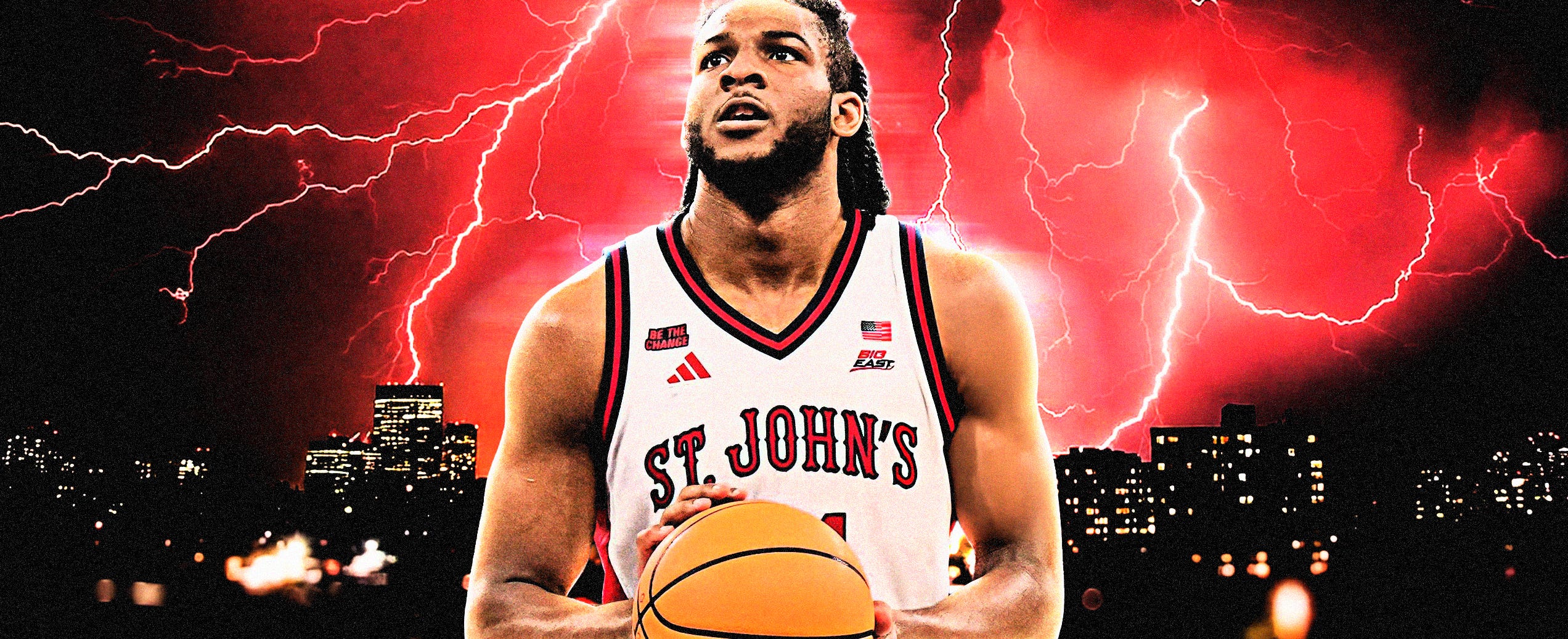
I like players who are productive. Guys who leave their fingerprints all over the game. St. John’s Zuby Ejiofor is one of those guys, and as a result, he’s become a hot name in the 2026 NBA Draft class. There’s a lot to unpack with Ejiofor on both ends of the floor, so let’s get into it!
Defense
Zuby Ejiofor doesn’t seem like he would be a fun guy to play against. His presence on the defensive end feels inescapable. At 6’9” and 245 pounds, Ejiofor moves more like a modern big man than a throwback post player, making him a pretty versatile point-of-attack defender. He’s tremendous on the perimeter. He’s comfortable sitting down in his chair and containing smaller players. Ejiofor isn’t one to cede ground, either. He’s the rare bigger dude who feels comfortable playing tight against guards. He’s light on his feet, stays square well on an island, and has great anticipation when switching onto smaller players. Even speedsters like Tahaad Pettiford have run into difficulty trying to shake him. Digging through his film, I was surprised by how many of his blocks came on the perimeter in a one-on-one setting, where his length and quick lift enable him to get to jumpers that opponents don’t expect him to impede. Still, his size makes him a viable post defender.
He brings value off the ball, too. Ejiofor is a clear communicator even on tape, visibly talking and pointing things out to his teammates throughout the course of a possession. He routinely knows where to go and works hard to get there. When he closes out, he showcases impressive balance when an opponent tries to “catch-and-go” against him, quickly shifting back the other direction to prevent penetration. His engagement allows him to help around the basket and get to errant passes on the perimeter. His 2.3 STL% and 6.8 BLK% both grade out well relative to long-term NBA big men during their pre-draft seasons.
One of the biggest things we’ll touch on with Ejiofor throughout the course of this article is the “tweener” nature of Ejiofor’s game. This does show up on the defensive end. Given his reported 7’1” wingspan, he’ll likely be undersized from a height/length standpoint for an NBA center, which will limit him in drop coverage. Even at the college level, big men have managed to find success driving him backwards and shooting over him on the interior. His discipline needs to come along, too, as he can be baited off his feet too easily at times, both inside and on the perimeter. And if Ejiofor is going to be a switch defender, he will need to continue to polish up his footwork, as he can tend to cross his feet in space at times.
Ejiofor might be a mixed bag, but it’s still mostly positive. He’s registered a 4.9 DBPM thanks to his smarts, timing, and eagerness to make plays on the ball. Even his subpar-13.9 DRB% can be explained away by his team’s “crash the glass” nature. Ejiofor generally does a good job of finding a body and containing his man on the boards. Ejiofor’s size limitations are nothing to sneeze at, so continuing to improve his perimeter technique will be paramount.
Offensive Rebounding
One of my favorite traits of Ejiofor’s is his ability to rack up offensive rebounds. Crashing the glass has started to come back into fashion at the NBA level, and for good reason. The shots generated by offensive rebounds are extremely efficient. Obviously, put-backs tend to be efficient, as it’s an NBA player going up with the ball right next to the basket. But there’s also the “spray out” component to it. All basketball viewers have been beaten over the head with the “the best time to shoot a three is after an offensive rebound” adage over the years, but there’s truth to it. Often, defenders have already leaked out, or they’re also trying to crash the glass, meaning that perimeter players who receive the ball are likely getting a cleaner look than they would otherwise. Simply put, if you get an offensive rebound, a high-efficiency shot is likely to follow.
Ejiofor has posted a 14.6 ORB% over the course of his college career. That’s a high-level mark, topping the likes of Donovan Clingan, Mark Williams, and Jalen Duren during their final pre-draft seasons. He’s been that type of force on the glass. Ejiofor is always battling for position. It doesn’t matter if you get the initial box out because the fight is never over with him. The “effort switch” never shuts off. He’s always trying to find a way to get around his man and grab a board, even if it’s initially out of his area. From there, that same toughness pays off as he’s more than content to battle through contact (.847 FTr) to get a finish. Ejiofor’s ability to snag offensive rebounds doesn’t just benefit himself, either…let’s get into the playmaking.
Playmaking
Ejiofor is an intriguing playmaker, too. His 20.0 AST% this season is an extremely high number for a big man. That tops the marks of skilled big men like Santi Aldama, Kyle Filipowski, and Xavier Tillman during their pre-draft seasons. Obviously, the “post-offensive rebound spray outs” are there. He can sling it out of the post, too. But it’s the overall ball skills that make Ejiofor’s playmaking arsenal sing. He’s comfortable putting the ball on the floor from the perimeter. His handle makes him a tricky cover for big men, and smaller players often can’t offer much resistance to his overwhelming physicality. As a result, whether he’s attacking from an iso, spot up, or charging to the basket on a short roll, Ejiofor often manages to force rotations. When he does, he quickly picks up the low-hanging fruit that defenses provide him. What’s more, Ejiofor brings a level of fluid processing and problem-solving on the go that few big men can offer. He’ll make sharp last-second decisions against help that lead to wide-open looks for both cutters and shooters alike. He’s also able to execute on these clever, creative deliveries effectively more often than not, as evidenced by his 1.3 assist-to-turnover ratio. Ejiofor’s feel, vision, and skill set him apart from most of his size.
Scoring
Arguably, my biggest question about Zuby Ejiofor’s NBA prospects is “How does this guy score on an NBA court?”
Let’s cover the positives first. As previously mentioned, Ejiofor gets a ton of high-percentage looks through his offensive rebounding. The fact that he draws a ton of fouls also helps bolster his efficiency, as he’s an acceptable free-throw shooter (career 70.1%). His physicality enables him to pound out mismatches in the post and convert through contact. He moves like a freight train when he’s rolling to the basket and has the bounce to finish above the rim. Ejiofor isn’t bereft of touch from long range, either. While his 30% mark from distance isn’t anything to get too excited about, he’s increased his volume from three on the year. His 35.3% on spot-up triples, per Synergy, points to the fact that he’s at least okay when he’s simply standing behind the arc.
Still, I worry a great deal about his scalability as a scorer. His 56.0 eFG% on the year is a poor mark by big man standards. Per Synergy, his most efficient play types this season have been post-ups and isolations, things that role players don’t get to do often at the next level. Plus, given his lack of size and elite athleticism, he’ll likely be less of a mismatch/power threat in these settings at the next level. He’s good as a roller, but he’s pretty below the rim, tallying a below-average 0.84 dunker per game while shooting a dismal 47.8% on half-court rim attempts. Then, you throw in the fact that his jumper has yet to actualize in a meaningful way, and things get pretty scary.
Conclusion
As I mentioned in my last column, I can tend to struggle with players who don’t fit into a clean archetypal box. Ejiofor is an undersized big man, but doesn’t have a go-to undersized big box checked. He’s not the shooter that a Kyle Filipowski was, the athlete that a Trayce Jackson-Davis was, or the rim-runner that DaRon Holmes was. He’s not as bouncy as a Brandon Clarke, as nimble as Onyeka Okungwu, or as slick as Derik Queen. I’m not sure what the “special” thing is that gets him over the tweener hump. Even in a “double-big” era, it’s hard for me to think which type of big he would slot best next to, as he doesn’t yet space the floor, nor is he a ready-made lob target.
But I can’t quit Zuby Ejiofor. His presence is inescapable. He’s always in the right spots and making things happen on defense. He’s a super-intelligent player on both sides of the ball. He plays his tail off on the offensive glass. His fluid playmaking process draws the occasional audible “oh shit” out of me when I watch his film. If there’s something that gets him over the hump, it’s going to be the intersection of his strength, smarts, and motor. Betting against big dudes who really know how to play and compete hard never sits right with me, and that’s why I feel like he’s got a real shot to end up in my “guaranteed contract” tier. Ultimately, much of that will come down to his efficiency. How Ejiofor shoots and finishes over the next few months will have a big impact on where his stock ultimately settles.
Quick Hits
-Kentucky’s Malachi Moreno is growing on me. He’s quietly been on a tear lately. The 7’0” freshman frustrated me early on in the year due to his passive approach on defense. I watched his game against Texas this past week and loved what I saw on that front. He was matched up with the absolutely massive Matas Vokietaitis, but he didn’t back down on the interior. Moreno stuffed him in transition, after an offensive rebound, and on a post-up. That type of fight against such a big, strong player is worth noting. Plus, Moreno tallied two more blocks, one on a three-point jumper and another after swallowing up Tramon Mark in ball screen D. I always liked Moreno’s overall skill and level of feel. Now that he’s really putting a lid on the basket and elevating the Wildcats’ defense, I’m all the more interested.
-Morez Johnson Jr. has been a trendy name lately. I go back and forth on him. He’s a bit undersized for a five and suffers from frustrating tunnel vision at times. However, his impact is undeniable. He’s a high-energy athlete who plays with a relentless motor. He’s an incredible offensive rebounder (13.1 ORB% despite playing alongside two other great offensive rebounders) who flies in to generate high-efficiency looks. His end-to-end speed in transition gets him a bunch of easy buckets, too. Defensively, his lateral foot speed and bounce give him an intriguing degree of versatility. Plus, he’s gotten better. While his passing and ball-handling still have a long way to go, he’s improved his assist-to-turnover ratio. He’s also now hitting the occasional three and making his free throws (78.6 FT%). I don’t quite know how to value him just yet. Part of me worries that he’s sort of an Adem Bona, “you feel good about him in the second round because he’ll be just fine out there” type guy and nothing more. But the other part of me is very intrigued by his blend of production, motor, and skill improvements and thinks that I could be selling him short.
-Vanderbilt’s Tyler Nickel has officially reached “my guy” territory. The 6’7” senior is one of my favorite prospects on the margins, and I think he’s been really undervalued. He’s shot 43.1% from deep over the past two seasons on a tough, versatile shot diet. Plus, he’s got a solid enough inside-the-arc game, he’s well built, he doesn’t turn the ball over, and he’s so much better defensively than most shooting specialists. If the draft were tomorrow…guaranteed contract territory.
-Missouri’s Trent Pierce caught my eye as an oddball prospect to monitor this week. For starters, he’s 6’10”, and he’s hitting 44.8% of his threes on 11.8 attempts per 100 possessions this season. He has a pretty high release, and he’s eager to let it fly when he gets space. Plus, he can move. Pierce is bouncy, boasting the necessary lift to finish above the rim in transition. In the halfcourt, he takes big, long strides to the rim. Defensively, his tools and timing make him a disruptive force (3.3 STL%, 2.6 BLK%). The downside is that he’s rail thin, which makes it hard for him to hold his line on drives. Defensively, he’s mobile, but his footwork is wonky. He gets crossed up easily because he plays upright instead of sitting and sliding. Low usage skinny guys are always scary, but the length, athleticism, and touch are interesting.
-Utah State’s MJ Collins popped up on a “dunks and threes” query I ran this week, so I took a deeper look. The 6’4” combo guard is an unbelievable long-range shooter. Coming into the year, he was a career 28.1% from deep. This season, he’s hit 42.9% of his triples on over six attempts per game. He hits deep threes off a variety of actions while absolutely smothered. The shot-making displays that he puts on have to be seen to be believed. Plus, he has a speedy first step and ways to score inside the arc. He has soft floater touch, but the best stuff comes when he gets all the way to the rim. He’s got serious lift, rises through contact, and has the coordination to contort and convert. There are shortcomings here. Collins has a 25 USG%, but only an 8.0 AST%, as he doesn’t look to pass much. He’s also a passive defender both on and off the ball, providing little value on that end. Still, he should be a Portsmouth-type guy, as his ridiculously efficient microwave scoring (19.3 PPG on 67.8 TS%) is sure to catch some eyes.
This column still isn’t over! No Ceilings+ subscribers get an additional bonus section every week! This week, I wrote about Joshua Jefferson! There is no better way to support the work that we do at No Ceilings than by subscribing to NC+. I believe our track record of consistent, thoughtful work over the past four years speaks for itself. It’s only $8/month or $80/year, so please consider supporting the work that we do. You’ll get our pre-season draft guide, access to our Discord, this extra section of my column each week, bonus columns from our entire team, live scouting reports, and MUCH MORE!