


It doesn’t hold the same weight as a potential all-time great reaching the mountaintop, potentially multiple times. However, there’s something about a young player taking a big enough leap to impact winning and raise their team’s ceilings. It’s a cool storyline to monitor, serving as an arrival point for said player in any capacity.
In recent years, Victor Wembanyama and Anthony Edwards have risen to superstardom, and their teams have become contenders. Oklahoma City became champions not only with Shai Gilgeous-Alexander launching into the best-in-the-world tier but also with Jalen Williams and Chet Holmgren becoming All-NBA players.
Pascal Siakam and Bam Adebayo took big leaps to become real co-pilots for NBA Finalists—or winners, in the latter’s case. You can still find this trend down the pecking order where the casual impact isn’t as loud, but the magnitude to team success is vital. Cason Wallace and so many other Thunder contributors are great examples. Andrew Nembhard was a playoff riser in the Pacers’ special 2025 run. Duncan Robinson’s movement shooter opened up a dynamic for the Heat’s offense in the Bubble. Jordan Poole’s nuclear shot creation was a jolt for the Warriors in 2022.
So many more cases exist for young players who took leaps and helped their teams go to the playoffs, and perhaps make a little noise in the process. The list can go on and on.
This NBA season has pathways for teams to break out as bona fide contenders. The New York Knicks, San Antonio Spurs, and Oklahoma City Thunder are on the list in Sharpie—withstanding health. These young players taking a leap could impact the playoff picture and the inner circle of contenders to a real degree.
Rules: All young players are on rookie-scale contracts. Nobody on the Knicks, Spurs, or Thunder. No rookies. These players are on teams that could be in the mix for a championship, the playoffs, or the play-in.
VJ Edgecombe | Guard | Philadelphia 76ers
Is there any young player with a bigger role than Edgecombe? Sure, some young players will be tasked with more offensive responsibilities, like Cooper Flagg or Cam Boozer. Or young players within this criteria with a larger role and championship possibilities like Victor Wembanyama and Dylan Harper. However, Edgecombe has one of the biggest roles in the league.
With a star-studded offseason bringing in LeBron James and Jaylen Brown, the Sixers are loading up for a title run. When pairing those two with Joel Embiid and Tyrese Maxey, it means that fifth starter has to be ready to do the unglamorous work—spacing and running the floor, crashing the glass, and defending the opposing star on any night.
This is the moment for Edgecombe to become a “little things king.” That’s not to say he’s not going to be a focal point of the offense. LeBron and Embiid won’t be available every night during the regular season with the playoffs as the focus. He’s more than capable of being a dynamic scorer. His main goal will be the little things; that includes taking on difficult assignments like Jalen Brunson, Tyrese Haliburton, or Donovan Mitchell.
From there, he has the tools to become a “little things” king. He has impeccable physical tools with his quickness, athleticism, and frame. It’s amplified by his intensity and nose for the ball. He was in the 80th percentile in block percentage (0.7) and 66th percentile in steal percentage (1.7), per Cleaning the Glass. An uptick in this category may not only be inevitable but also vital for this scaled role. He was also in the 96th percentile in offensive rebounding percentage off missed field goals (4.6); with their shaky center depth and Embiid’s health, it’s a committee effort.
Edgecombe has to become more reliable as a spacer. While converting on 37.5% of his catch-and-shoot threes, he had a relative true shooting percentage (rTS%) of -2.4 in spacing situations per Databallr—essentially his true shooting percentage was 2.4 below the average in these spots. Can he become a formidable shooter that can torch closeouts? Can he leverage that athleticism and power at the rim? He only shot 56.3 at the rim, by the way. He has to improve upon finishing through and around the defense, mainly with his driving angles and contact absorption.
Edgecombe looked the part of a prime Victor Oladipo in his rookie season, but it may be time for him to channel his inner Derrick White—arguably my favorite potential outcome he holds. He’s a critical component of the Sixers’ future, but he can become a vital piece in their championship pursuits in the present.
Anthony Black | Guard-Wing | Orlando Magic
The Orlando Magic is a team where it wouldn’t surprise me if they’re in the Finals or if they miss the playoffs outright—the margins in the East have become that slim, and this team is that talented. If the Magic unlock their ceiling, Anthony Black will be a key cog in the mix.
He took a modest leap as a creator and scorer. In the Magic’s system, he slots well as a player that thrives more in the next action rather than the primary facilitator—typically thriving more by turning a corner in a Zoom action. He elevated his scoring from 8.6 to 15.0 points per game. He may not be a primary playmaker, but he’s a smart player who can wear different hats offensively and find his teammates in multiple vicinities—which complements playmakers like Paolo Banchero, Franz Wagner, and Desmond Bane.
Black is a toolsy defender. He can defend at the point-of-attack as well as a chaser. Alongside the aforementioned trio, he’s a reliable defensive stopper, particularly with his playmaking ability. He was in the 85th percentile in block percentage (1.2) and 80th percentile in steal percentage (2.0), per Cleaning the Glass. His stop percentage was 3.4, which was in the 88th percentile per Databallr. He may lack the physicality to be a full-fledged primary stopper, but he can fill in for Jalen Suggs when he’s off the floor.
The swing skill for him is consistent shooting, particularly in the playoffs. The Magic’s shooting has been a struggle since the Dwight Howard era. Black has to be a key part in elevating their shooting. He only made 31.8 percent of his three-pointers in the playoffs. He held a -3.0 rTS% in spacing situations, per Databallr. As someone who doesn’t project as a lead guard, the outside shooting is a vital development for the Magic and Black’s respective ceilings.
Another offensive leap from Anthony Black, particularly with his efficiency, will be big for Orlando’s playoff outcomes. In addition, it can set him up for a big payday in restricted free agency next summer.
Reed Sheppard | Guard | Houston Rockets
Reed Sheppard can be the breakthrough player that can really shake up the Western Conference.
Let’s start with the defense, where he may be the biggest paradox in the league. His stock and deflection numbers rival players like Alex Caruso. His anticipation and hands are exceptional.
96th percentile in block percentage (1.3, per Cleaning the Glass)
93rd percentile in steal percentage (2.4)
97th percentile in deflections per 100 possessions (6.6, per databallr)
However, the on-ball defense is so rough. He’s frequently targeted due to his size, strength, and stride length—the latter hurts with recovery. It’s a puzzle for the coaching staff to figure out how a projected weak link is also a constant source of stops and transition offense.
Offensively, Sheppard hasn’t been as efficient as he has in Kentucky. However, he’s still a reliable shooter to slot alongside Kevin Durant, Amen Thompson, and Alperen Sengun. He shot 39.3% on catch-and-shoot 3’s and 36.8% on dribble jumper 3’s, per Synergy Sports. The creation equity is his next step. He was in the 14th percentile in potential assists (11.1 per 100 possessions, per Databallr). Is this a product of his load and bandwidth as a playmaker? He needs to lean into making more reads that can bend the defense a bit more, which could go hand in hand with his shooting. In addition, he has to at least develop a counter as a two-point scorer (a floater?), as he only makes 54.4% of his shots at the rim while shooting 42.9% of his runners. Adding more to his game inside the arc would open things up, particularly for his jumper.
Quick stat to watch for progression. He only scored 0.874 PPP as a pick-and-roll handler. A guard of his shooting caliber should be more efficient. Watch for an uptick with Steven Adams back.
Sheppard may not be the breakthrough swing for the Western Conference with his individual abilities, but rather with how his strengths would open up the rest of the offense. It draws help away from Sengun as a hub, Durant as an isolation creator, and Thompson as a driver.
I’m worried about how the returning vets—Fred VanVleet and Steven Adams—look after significant lower-body injuries in their 30s. A leap from Sheppard can be what the Rockets need to stay in the mix at the top of the Western Conference for the long haul.
Collin Murray-Boyles | Big-Forward | Toronto Raptors
Murray-Boyles just absolutely rocks. He’s a monster of a basketball player. He’s one of the few players who deserve the designation of “guarding all 5 positions.” He has impeccable feel applied on both sides of the ball.
A lot of players get the Draymond Green comparison, and it never lands. Murray-Boyles is the only player that feels close to it.
He’s fascinating, because his positional definition is murky. He’s technically a small-ball big man who’s not an explosive above-the-rim athlete consistently, nor is he a massive factor on the defensive glass. He’s not a shooter—making just 32.7% of threes on 52 total attempts through the regular season and playoffs.
However, he blows it all out of the water with his length and superb anticipation. He’s a terror defending in space with his frame, strength, and quick hands on and off the ball. He can defend with high pick-up points to harass ball-handlers. He generates turnovers at a high level—98th percentile for deflections in databallr’s database (6.3) and 89th percentile in steal percentage according to Cleaning the Glass (1.8).
Despite his size as a 5, he’s an immaculate finisher with his touch and strength inside the paint, as he converted on 66.7% of his shots at the rim. He understands how to leverage angles and body control to finish around the defense. He’s a quick decision-maker out of the dunker’s spot as well.
Yes, he doesn’t shoot. He just has to be adequate with his accuracy and volume. Like 33-35% on three attempts per game. That’ll open up his positional viability a bit to expand outside being a smaller 5.
All of these traits come together for the valuable component of the Raptors’ championship hopes, and it’s about playing him alongside Scottie Barnes and Kawhi Leonard. Among all frontcourt duos, Murray-Boyles high-minute lineups were at their best with Barnes without Jakob Poeltl and Sandro Mamukelashvili.
Specifically, a lineup to note within this: Jamal Shead, Ja’Kobe Walter, Brandon Ingram, Barnes, Murray-Boyles. In 63 regular-season possessions, it held a +44.1 NET rating, 123.8 offensive rating, 79.7 defensive rating, per Cleaning the Glass. Now imagine this lineup but with Kawhi in Ingram’s spot. PHEW!
The Raptors have all the ingredients to be a terrifying team in the Eastern Conference. It’s going to be hard to beat them four times in a seven-game series. Collin Murray-Boyles’ development could play a big role in their high-end outcomes.
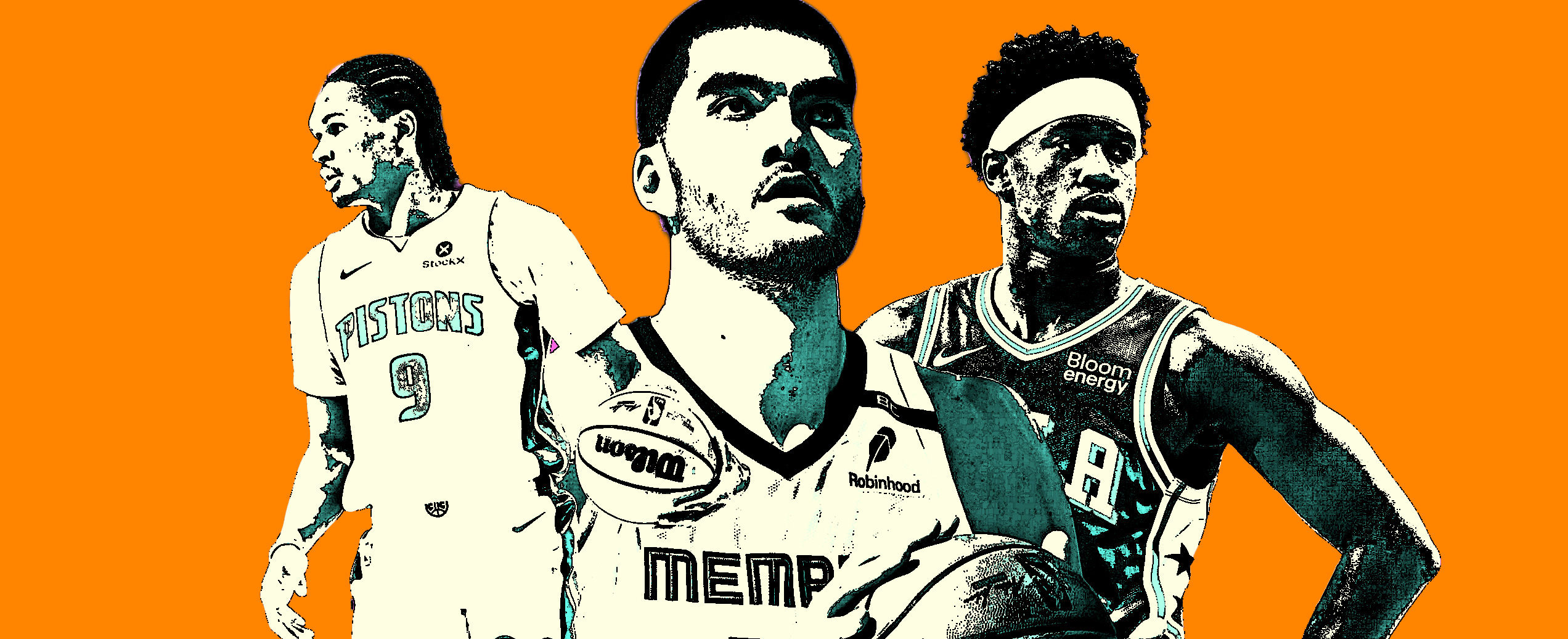
Ausar Thompson | Wing | Detroit Pistons
Thompson has the case for being the best non-Wemby defender in the world.
Thompson was second only to Wembanyama in defensive estimated-plus/minus (D-EPM). Worth noting for his block percentage, per Cleaning the Glass, he was in the 99th percentile among wings here. He’s a menace defensively with this mesmerizing blend of athleticism, timing, speed, and tenacity. He seeks to obliterate his opponents defensively—swiping at drivers in the gaps, seeking chase-down blocks, and exploding in passing lanes. He can do this while hounding his defensive assignment, but he’s at his best as a chaser and helper because of his speed and athleticism in rotation. It’s a ball of clay that warrants real Defensive Player of the Year upside.
This is a Pistons team looking to take the next step with Cade Cunningham. Their core will be examined closely over the next few years, as they (finally) committed to Thompson and Jalen Duren alongside him. Their lack of shooting really cramps their spacing. How can Thompson help here?
Becoming a reliable shooter is definitely a sight. Again, like with Murray-Boyles, he’s already so awesome defensively that he just needs to become adequate and respectable from three. The real offensive leap is providing some creation help. Can he become more of a secondary playmaker alongside Cunningham to alleviate pressure off their star? Now, Cunningham shouldn’t be taking a backseat to Thompson running an offense for a ton of possessions. Can they develop pick-and-roll interchangeability? Thompson’s short roll creation should be something to develop and hone, as his athleticism can create gravity near the rim, and it could play into Duren’s strengths as a finisher near the dunker spot. Grab-and-go offense off the defensive glass is another way to tap into Thompson’s open-court speed.
Thompson is also a lackluster finisher for his impeccable athletic tools—shooting just 59.5% at the rim, per Synergy Sports. In addition, he’s converted on 63.7% of his cuts (1.195 PPP) and 51.9% of his shots as a pick-and-roll roll man (1.000 PPP). JB Bickerstaff should find ways to tap into his athleticism to get easy offense at the rim. That could be tied to finding ways to be more creative with spacing.
Thompson right now is basically a Gen-Z Tony Allen who may have some of the best physical and athletic wings of any young wing in the league. Elevating his offensive game will do wonders for the Pistons looking to stay at the top of a reloaded Eastern Conference.
Joan Beringer | Big | Minnesota Timberwolves
A lot will be on Beringer’s plate after a rookie season mainly spent in the G League. In the Timberwolves’ bet on upside with LaMelo Ball and Jonathan Kuminga, they lost Julius Randle and Naz Reid. Rudy Gobert is also 34 years old.
It’s time for Beringer to play a sizable bench role for the Timberwolves with no other backup 5 on the roster.
When projecting Beringer, it’s more about tools. He runs the floor like a gazelle and can jump out of the gym. His combination of speed, fluidity, and leaping is rare for a player his size. It should pair well with LaMelo’s passing wizardry in staggering lineups—particularly out of the pick-and-roll, in transition, and in the dunker’s spot. His leaping ability and size should bode well for his presence on the interior. Per Cerebro Sports, he averaged 10 rebounds (4.8 offensive) and 2.2 blocks per game in 12 G League games. While competition will have to be adjusted for, he possesses upside as an athletic big man with a two-way influence on the rim.
The substance beyond his tools comes down to his processing and technicality. He has to develop good chemistry in ball screens with Anthony Edwards and LaMelo. Within this comes angles, rolling lanes, and timing on catching passes. He won’t be Rudy Gobert defensively, but can he handle center-field coverages and hold the fort down in their schemes?
He won’t have the biggest role on the team, but he will do a lot to shore up an area that’s become more volatile for the Timberwolves.
Ace Bailey | Wing | Utah Jazz
I really don’t know what to do about Utah. It wouldn’t shock me if they’re competing for the third seed in the Western Conference or if they’re in the back portion of the play-in mix. They loaded up since last season by adding Darryn Peterson and Jaren Jackson Jr., specifically. Do Jackson and Lauri Markkanen provide enough on the glass to be a 4/5 duo? How will Jusuf Nurkic’s injury affect their season? How does Keyonte George look as a lead guard in a winning context? My biggest question, though, revolves around their primary stopper.
Who’s going to guard Luka Doncic, Shai Gilgeous-Alexander, Anthony Edwards, and the rest of the Western Conference’s elite?
They could just make it easy with Josh Okogie or Josh Green acting as a nominal big with this role and with some rebounding-by-committee help. However, Ace Bailey could embrace the little things here to unlock Utah’s full capabilities with its five most talented players.
Last season, Bailey had a stop percentage of 2.1, per Databallr. He’s not entirely the most active defender. However, he has the size and lateral quickness to develop into this stopper role for the time being. If he can have the intensity and engagement revved up to a real degree, he can find a role that plays him on the floor in a lot of big moments.
In addition to stopping, Bailey will have to fit into more of a complementary role. Last season, he shot just 32 percent on catch-and-shoot threes, per Synergy Sports. He made 42.6 percent of his threes off the dribble, but he’ll really be getting those for the extra dribble off actions—off screens, handoffs, or side-stepping closeouts.
While a future in Utah likely revolves around Bailey, Peterson, and George, Bailey has to fit in the present alongside All-Star veterans as well to do the dirty work—which should improve his ancillary skills around his intriguing scoring arsenal.
Jaylon Tyson | Wing | Cleveland Cavaliers
The Cavaliers made a big splash this summer with acquiring Peyton Watson. However, to duck under the second apron to do so, they lost Dean Wade, Dennis Schroder, and Max Strus. An expensive core and the second apron have hit the Cavaliers’ depth significantly—also accounting for losing Ty Jerome in 2025.
Teams struck with the aprons need to hit on their young talent via the draft and two-way contracts around the margins to make up for it. Insert Jaylon Tyson.
The third-year forward has emerged as a solid wing piece for the Cavaliers. He’s a lights-out shooter—making 43.1% of his catch-and-shoot 3s. He’s a sturdy body that can guard multiple positional archetypes. He defends without fouling. He is also a reliable rebounder—ranking in the 91st percentile in offensive rebounding rate off missed field goals (6.6) and in the 67th percentile in defensive rebounding rate off missed field goals (12.2) among wings, per Cleaning the Glass.
With the losses they’ve had, and to amplify their staggered lineups, Tyson needs to level up a bit.
The shooting is spectacular and pretty sustainable, as he was a 37-percent three-point shooter in college but just an adequate 34.5% in his rookie year. It’s a weapon that offers spacing for whatever combination of Donovan Mitchell, James Harden, and Evan Mobley he’s sharing the floor with. He should look to continue building upon it by leveraging his shooting gravity to attack closeouts and make decisions off the bounce. In addition, he should expand his arsenal to be a next-action creator. Both of these traits were tapped into at California and fueled his rise as a first-round pick in 2024
Tyson leans more on his physicality as a perimeter defender. He can move his feet pretty well in space as well. He likely slots best as someone who defends positions 2-4. He’ll likely need to be a secondary stopper behind Peyton Watson, whether it’s alongside him or whenever he’s off the floor. He drew a stop percentage of 2.0, which was in the 36th percentile, per Databallr. His main value add defensively may be with his size and rebounding. He should parlay his nose for the ball into getting more adventurous in passing lanes.
Tyson will likely need to expand upon his 3-and-D skillset with pinches of creation. While he’s etched into the rotation, It’s going to be essential for a Cavaliers team searching for more depth, more players that can play 25-30 minutes in a playoff game.
Zach Edey | Big | Memphis Grizzlies
Zach Edey only played 11 games—technically, 10 as he exited one game six minutes into it. In those outings, they were 7-4, with one of those losses coming from the early exit. The Grizzlies were utterly dominant in his outings—boasting top-five marks in Defensive Rating (108.6), Offensive Rebounding Percentage (34.8), and Rebounding Percentage (55.3) in the span of games after his return. They were 26 points per 100 possessions better with him on the floor defensively (96.2 defensive rating, per Databallr), while outscoring their opponents by 18.9 points per 100 possessions in his minutes.
Edey’s size enables massive impact on both sides of the floor. Translatable on either side, he crushes the glass, as he’s capable of tilting the possession game to a significant degree. Defensively, he’s a monster drop-coverage big man that keeps a lid on the basket — altering, deterring, and swatting anything in his vicinity. He’s not going to be mistaken for a switch big man, but he can hold his own. Offensively, he’s an automatic bucket when diving to the basket. Case in point, the Grizzlies will run a ton of pick-and-roll, and last season Edey only missed two of his shots as a pick-and-roll roll man (15-17, per Synergy Sports).
Teams with an insurmountable advantage on the glass and a formidable defense tend to do well. Edey adds immense value in these departments. He was fifth in D-EPM (+3.4, per dunksandthrees). He ranked in the 99th percentile in offensive rebounding percentage (17.5) and in the 96th percentile in defensive rebounding percentage (26.6).
Edey is on the short list of players with this degree of paint influence.
If Edey plays around 50-60 games, the Grizzlies will be a surprise team in the playoff picture in the Western Conference. It won’t be as a top-four team, maybe not top-six. They will be in the play-in, though.
Donovan Clingan | Big | Portland Trail Blazers
The Trail Blazers added more variance to their defense with Damian Lillard’s return and Ja Morant’s arrival. In addition, these two players alongside Deni Avdija require spacing creation through screening. Ditto with Scoot Henderson.
It’s a big opportunity for Donovan Clingan to shore things up and become a bona fide anchor for a playoff team.
Again on rim influence, Clingan provides that as well with his rebounding and rim protection. He was in the 98th percentile in offensive rebounding percentage (17.1) and in defensive rebounding percentage (28.4), per dunksandthrees. He also had a block percentage of 5.6, which ranked in the 94th percentile. He’s simply an enormous big that leverages his size to patrol the paint, dominate the glass, and minimize opponents’ downhill impact.
One area he has to shore up is his finishing. He only made 42.9% of his two-point field goal attempts in the playoffs. I understand they’ve been looking to do a Brook Lopez-esque development path for him with his floor spacing, but it’s vital for him to improve his touch around the basket. It’d only amplify two-man actions with him and either Lillard, Henderson, Morant, or Avdija.
In the process, I’d like to see him deployed similar to his UConn days as more of a slot hub where these players can generate open space for drives or pull-up jumpers off his passing and screening.
There’s a lot of variance with Portland’s system, but Clingan can become an anchor that holds down the fort on both ends of the floor.
Honorable Mention Part One:
Pelle Larsson, Miami Heat: The Heat need spacing and perimeter defense in a real way, and the tough Larsson can become a breakout player that fits like a glove next to Giannis with improved shooting.
Khaman Maluach, Phoenix Suns: He’s going to get run this season and has the mobility and size to thrive on both ends of the floor. In Mark Williams’ absence, he can take the starting spot and run with it.
DaRon Holmes, Denver Nuggets: The Nuggets need one of these recent picks to hit, and a year removed from returning from his Achilles injury, Holmes can become a dribble-pass-shoot combo big that can also play alongside Jokic.
Adou Thiero, Los Angeles Lakers: Can Thiero become Luka Doncic’s new Derrick Jones Jr. in LA? He’d be a real injection of youth, size, and athleticism in their wing room.
Alex Sarr, Washington Wizards: With Anthony Davis and Trae Young in the fold, Sarr can thrive in the simplicity with one of the NBA’s best bigs and table-setters next to him.
Baylor Scheierman, Boston Celtics: The Celtics are looking to create their wing rotation with size and chaos, and Scheierman can become a source of playmaking, shooting, and dirty work off the bench.
Honorable Mention Part Two (same team mentions)
Cedric Coward, Memphis Grizzlies: Do-it-all forward that impacts winning and can take a massive leap this season with more scoring responsibilities and improved on-ball defense.
Ja’Kobe Walter, Toronto Raptors: 2-guard that would slot perfectly next to Leonard and Barnes, while defending key assignments and feeding off the stars’ gravity.
Jase Richardson, Orlando Magic: The size concerns are real, mainly defensively, but Orlando’s roster construction can mitigate it a bit. He’s always in motion and makes quick decisions with the ball in his hands, and can give them much-needed shooting.