2026-27 NBA Rookie Ladder 1.0 | The Morning Dunk
Nathan Grubel provides his first NBA Rookie Ladder of the 2026-27 NBA season, with detailed looks at the Top 10 rookies of the class.


It’s a special Monday edition of The Morning Dunk!
We’re far enough into the season that it’s appropriate to visit a Rookie Ladder, essentially composed of what both my NBA Rookie of the Year and All-Rookie ballots would look like were I officially voting at this point in the season.
This is my most up-to-date rookie ranking, though everything changes week-to-week when it comes to the nature of the NBA season. A week ago, my order of the top three players would’ve absolutely been different. But after seeing some recent performances over the last few days, I had to make changes to where I would slot in the best players of this class.
Bottom line: don’t let anyone tell you differently. This rookie class is already moving differently, with performers who didn’t make this list, like Allen Graves, Mikel Brown Jr., etc., that I still have my eye on as we progress through the year.
Let’s not waste any more time and start with who I view as the best rookie in the NBA today: Cameron Boozer.
All stats used are as of 11/21/26
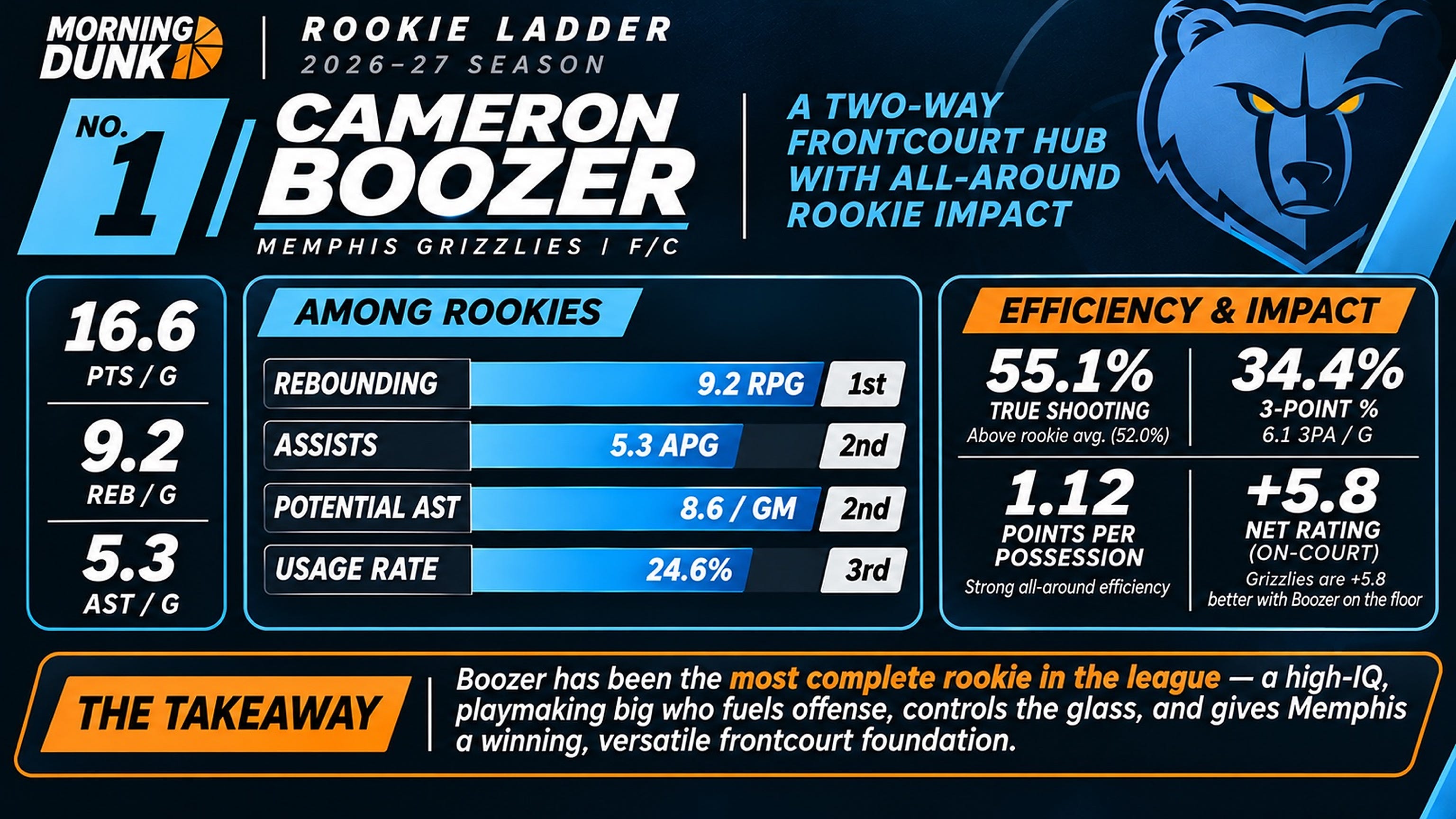
Cameron Boozer didn’t start the season as he would’ve liked to from an efficiency standpoint.
Shooting poorly from two AND three, Boozer wasn’t wowing anyone in the scoring department. That ship, however, has effectively been righted over Boozer’s last five games. Most importantly, he’s finding better ways to create quality shots that aren’t the same drive into a defender and hope a tough floater can go in with pure touch.
From spot-up threes to finding post-up opportunities against mismatches, Boozer is getting to more of his bread and butter in the NBA as far as putting the ball in the basket goes. What hasn’t changed all year is his impact on the glass, how he’s passed his teammates open, and what he’s done in terms of staying with matchups on the perimeter.
At this point in his career, he’s not a small-ball center, or at least an effective one. But operating as more of a “bigger wing” next to a center and even in dual forward lineups, Boozer has emerged as the most impactful rookie across the board up to this point in the season. As arguably the most complete prospect from a skill and processing standpoint in the 2026 draft, it was only a matter of time before Boozer’s presence would be felt game by game.
What I didn’t expect so soon was Boozer’s impact on winning. Now don’t get me wrong, Cedric Coward and Ty Jerome are having career seasons with other personnel stepping up in their roles. Memphis is a deep squad with plenty of firepower coming off the bench to support its starters. But this team is well connected, defends, and gives effort every trip down the floor. That level of trust comes from leadership and those who are on the court to set examples. Boozer is as much a part of that as the other veterans who have helped bolster the Grizzlies to one of the best starts it’s seen in recent years, not too long removed from trading Ja Morant, Jaren Jackson Jr., and Desmond Bane.
Let’s see if Boozer can keep righting the ship shooting the basketball, while remaining as impactful in all other facets of the game.
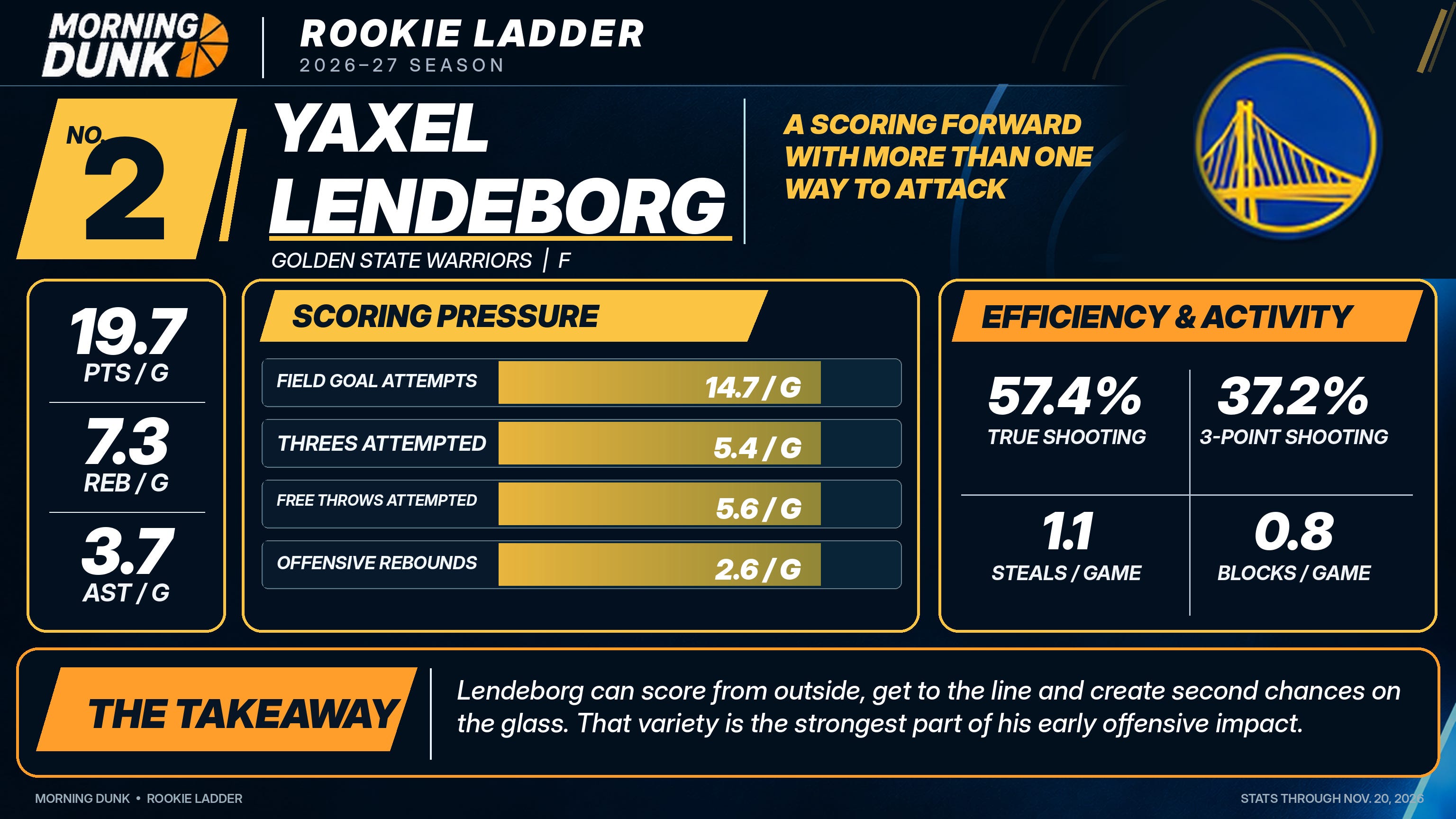
I didn’t expect Yaxel Lendeborg to end up as the second rookie in my current rankings, but Cameron Boozer’s late surge over the last week pushed him down to this spot.
That being said, Lendeborg has still impressed everyone around the NBA and was the talk around the league before the recent losing skid by the Golden State Warriors. With all of Lendeborg, Steph Curry, and Draymond Green on the court, the Warriors looked like one of the more dangerous two-way teams in the Western Conference. Without everyone healthy, that’s not nearly as serious a claim.
But even without the top-tier veterans around Lendeborg to support him, he’s done his part finding new ways to contribute both with and without the ball alongside Brandin Podziemski. As the season has gone on, Lendeborg has added new wrinkles as a playmaker, operating in different sets as the ball handler. He still gets a fair share of his offense in transition or off catch-and-shoot opportunities, but Lendeborg has been asked to do quite a bit to start off his career by the Warriors, and to my eye, he’s succeeded.
Are there still some holes in the game that need rounding out? Absolutely. He’s not as efficient of a scorer in PnR as he’d like to be, and his finishing in the halfcourt directly at the rim also hasn’t exactly been up to par for a 6’9” strong-bodied forward.
But all things considered, it’s rare to find bigger forwards who can impact the game in so many ways early on in their careers. Golden State found a player of an archetype that’s critical to winning basketball games at a high level. I do want to see how those two areas in particular, along with his defense down low against bigger centers, improve over the course of the year.
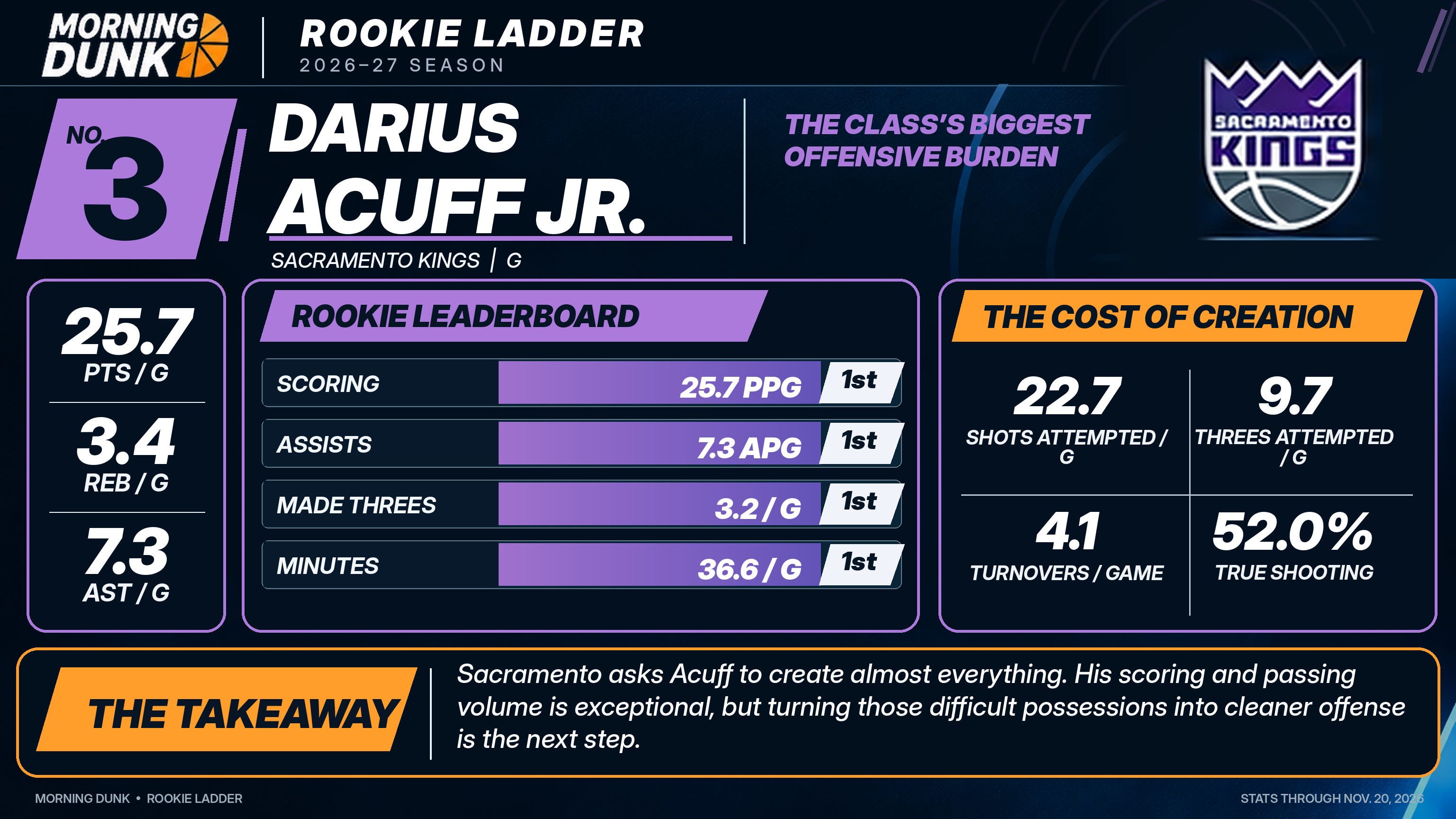
Say what you want about Darius Acuff’s shot diet and overall usage rate. This dude has been utterly impressive by my eye to start off his career, and is doing something we haven’t seen since Michael Jordan entered the NBA.
It’s been that long since an NBA rookie has averaged 25 points per game over the course of a full season. Will Acuff end the year where he’s started it in terms of box-score production? That remains to be seen. But at the same time, I don’t see why not. Acuff is leading all rookies in usage and minutes share, but is also doing everything he can on the offensive end of the floor in terms of points scored, assists generated, and threes made.
Now his efficiency is a real question mark, both overall and at the rim. Acuff hasn’t found ways to be nearly as effective as he’d want to be getting all the way to the basket, but few guards come in as polished as he has in terms of getting his own shot from the midrange. Acuff steps into looks coming off screens with ease, and does so in spectacular fashion.
As he continues to adjust to NBA defensive coverages, some of the turnovers will come down. If you have the ball in your hands as often as Acuff does, turnovers are bound to come. But there are some mistakes you see on tape in terms of passes attempted that I’m sure he’d want back (not to mention some of his pull-up shot attempts early in the shot clock).
At the same time though, how many rookies are matching or exceeding what Acuff is doing even if given the same freedom and keys to the offense? This Sacramento Kings team is bound to look different after the NBA’s trade deadline or next offseason, but Acuff isn’t going anywhere. He’s a franchise point guard, and someone who is firmly in the NBA’s Rookie of the Year race.
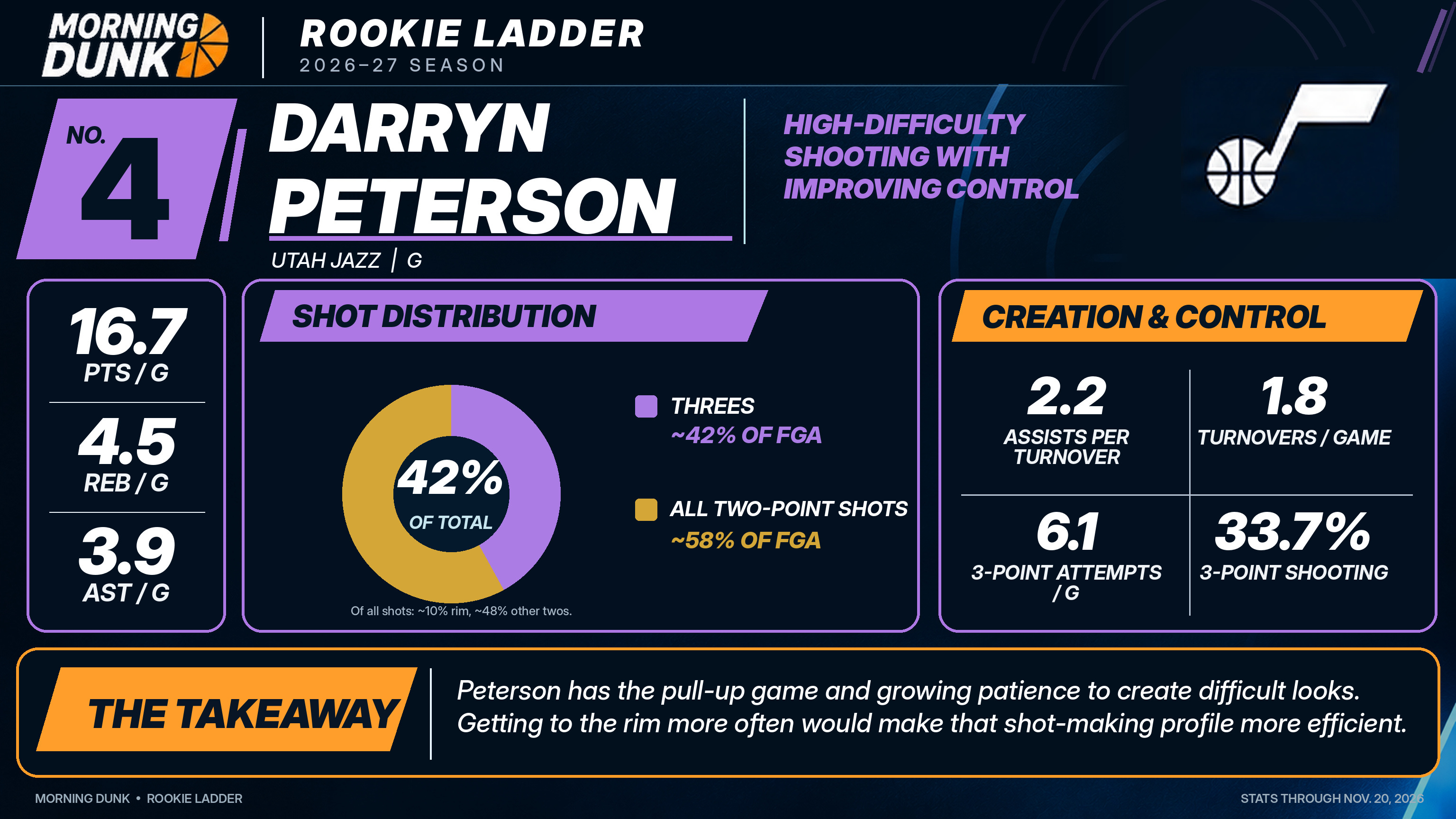
I wrote about Darryn Peterson last week at length, going over how he’s shown growth early on in his NBA career compared to even where he was last year at Kansas.
That floater he’s been able to get to in the paint is one shot that I love that he has in his bag. Is it the most efficient shot in the world, one relying on precise touch? No. But at the same time, if he can’t always get the entire way to the rim, Peterson needs some kind of counter against the defense, especially in certain ball-screen coverages.
I’m sure Peterson is still figuring out how to find balance in that in-between area on the floor. Right now, that push shot is something he’s relying on rather than going to it if needed. But it’s working for him, and has helped him both improve his efficiency from inside the arc, AND set up more opportunities pulling up from three-point range as the lead ball handler.
There’s still a ton of room for improvement for Peterson as a passer in PnR situations, but he’s showing more growth recognizing where the help is coming from and hitting the open man. As he continues to adjust to the speed of the NBA game, more of those reads will come in time.
What is clear, though, is the fact that Peterson needs touches split with Keyonte George as a primary handler. We knew coming in that Peterson had the complementary skill set as a secondary player, both as a movement shooter and transition finisher. But he’s shown more nuance to his on-ball game similar to what was on display at the high school level, and it’s been encouraging to see this level of growth in his game so early in the season.
Besides scoring, Peterson has been a great rebounder at his position in this class, and has also contributed as a defensive playmaker just like he did in both college and high school. His help-side shot blocking remains one of my favorite attributes of his game. If he can keep improving as a ball-screen navigator on defense, while finding more ways to mix up pacing and get some easier looks at the basket on offense, Peterson will remain in the Rookie of the Year race this entire season and firmly on my All-Rookie First Team.
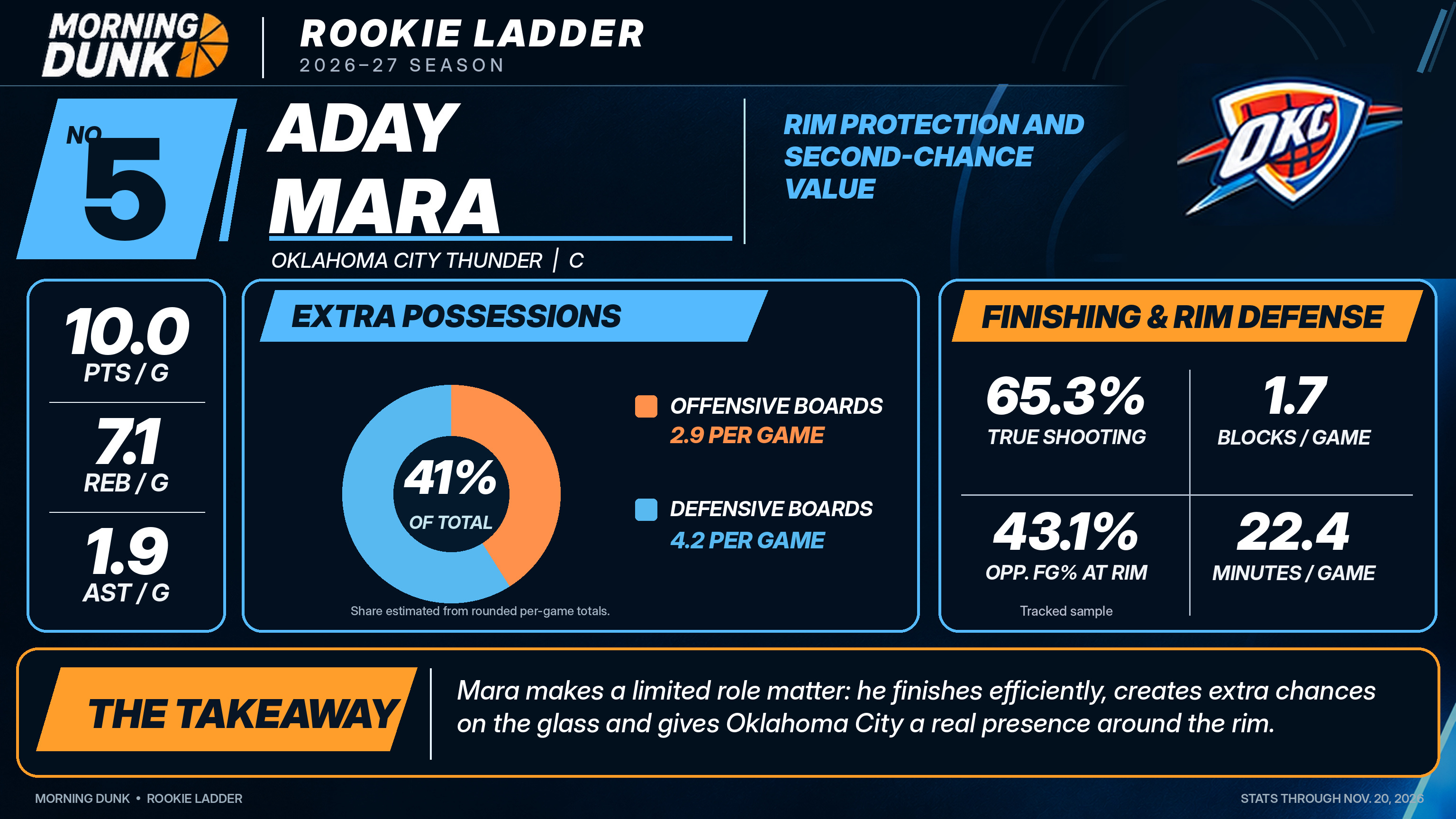
Aday Mara has a strong argument to be higher in these rankings as of today, and if someone wanted to lay claim to that position, I wouldn’t be against it.
Mara has been that impressive in his minutes for the OKC Thunder. After having several key players go down to injury, it was up to the depth of the Thunder to step up and help right away, even if two of those contributors are rookies in Mara and Bennett Stirtz.
Good news for OKC is that Mara showed real promise during the preseason as not only a rim protector, but a real passing hub, offensive rebounder, and interior scorer over real size in the post.
Those same attributes have carried over into the regular season. He’s not the team’s best big man (yet), and isn’t playing as large of a minutes share as those I have ranked ahead of him. But breaking it down by per-minute impact, Mara is right there with the Boozers and Lendeborgs of the rookie world.
I’m continuing to monitor his play as we head into December, especially as the Thunder schedule gets more difficult against powers in both conferences. If Mara can keep holding his own against real size, while flashing more of those finesse elements that have had him on scouting radars for years, it will be hard to keep him at this spot come my next rankings update.
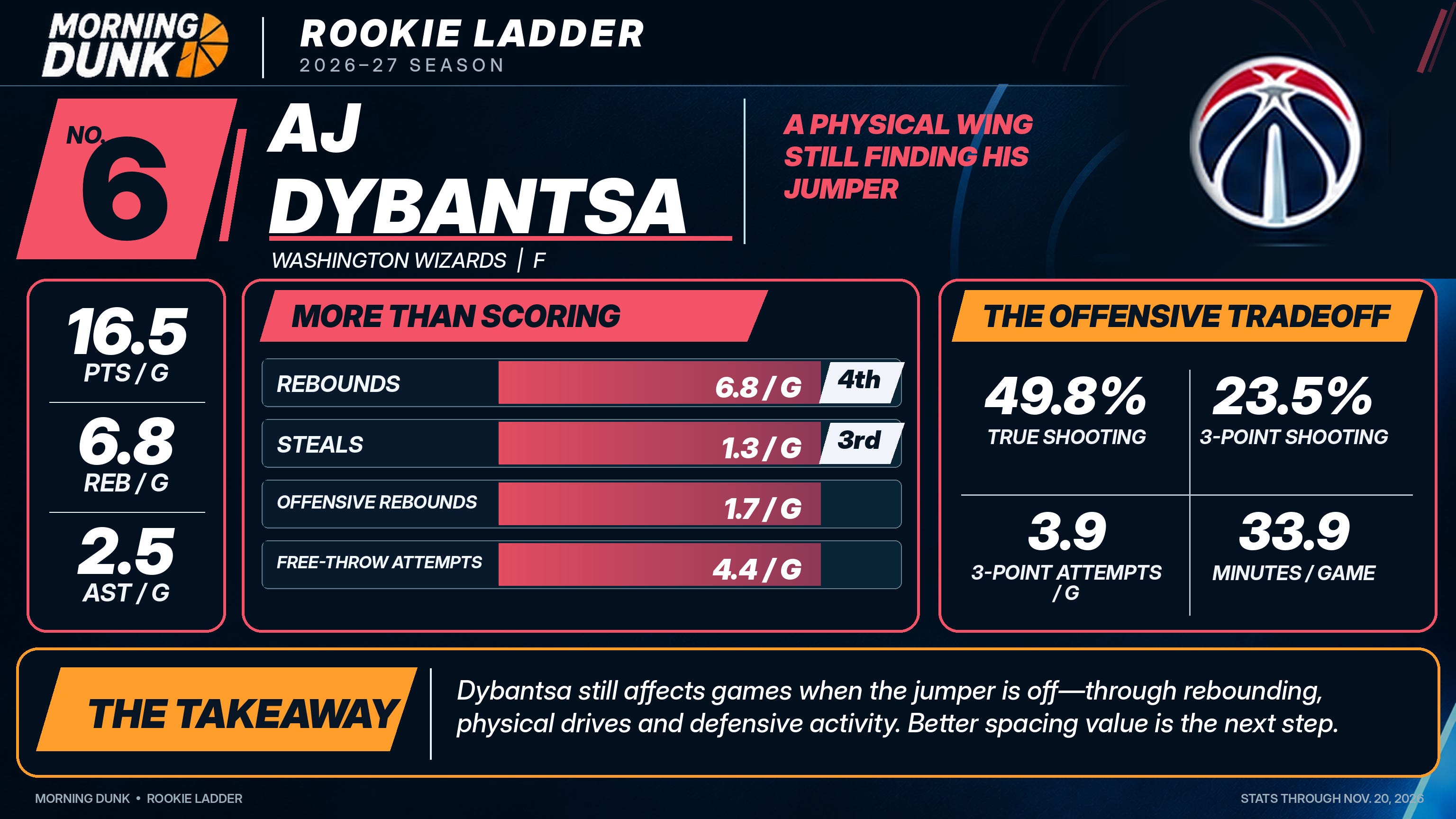
It may be surprising to some to see AJ Dybantsa outside of my All-Rookie First Team to start the season, but I’m not shocked given how things have started for both him and the Washington Wizards.
There’s no denying Washington hasn’t exactly lived up to preseason expectations in terms of competing in the Eastern Conference. The team went on a significant losing streak in November, and Dybantsa himself missed some time to start the season.
Even with him back in the mix, something just doesn't feel right with the balance of the starting lineup. Dybantsa isn’t getting the same share of on-ball touches as he has at lower levels, with Trae Young and Anthony Davis taking on a lion’s share of those possessions (not to mention the growth of Kyshawn George). Dybantsa hasn’t been “bad” by any means, especially when the team has actually given him the rock and let him cook. I’d even argue he’s been better than advertised on defense as an on-ball defender.
But Dybantsa’s biggest question this year was always how he would integrate into being more of a second or third option on offense given the fact he’s not a dangerous spot-up three-point shooter. How would Washington bring him into actions and get him moving downhill to take advantage of his best skill set? Again, when he’s gotten chances to do what he does best (like against the Memphis Grizzlies last week), Dybantsa has looked impressive for a rookie wing. Unfortunately, those opportunities haven’t been there in abundance, leading to some awkward moments on offense where the team just hasn’t gelled together.
Give the Wizards time. This franchise added a ton of firepower at the top, and it always takes some getting to know one another for talented players to come together and start winning basketball games. But those who are pointing fingers at Young and this front office are also justified, as it hasn’t helped get Dybantsa off to the same start many envisioned.
I expect Dybantsa to climb up my rankings as the year goes on, but for now, this is where he is until we start seeing some improvements within Washington’s offensive structure.
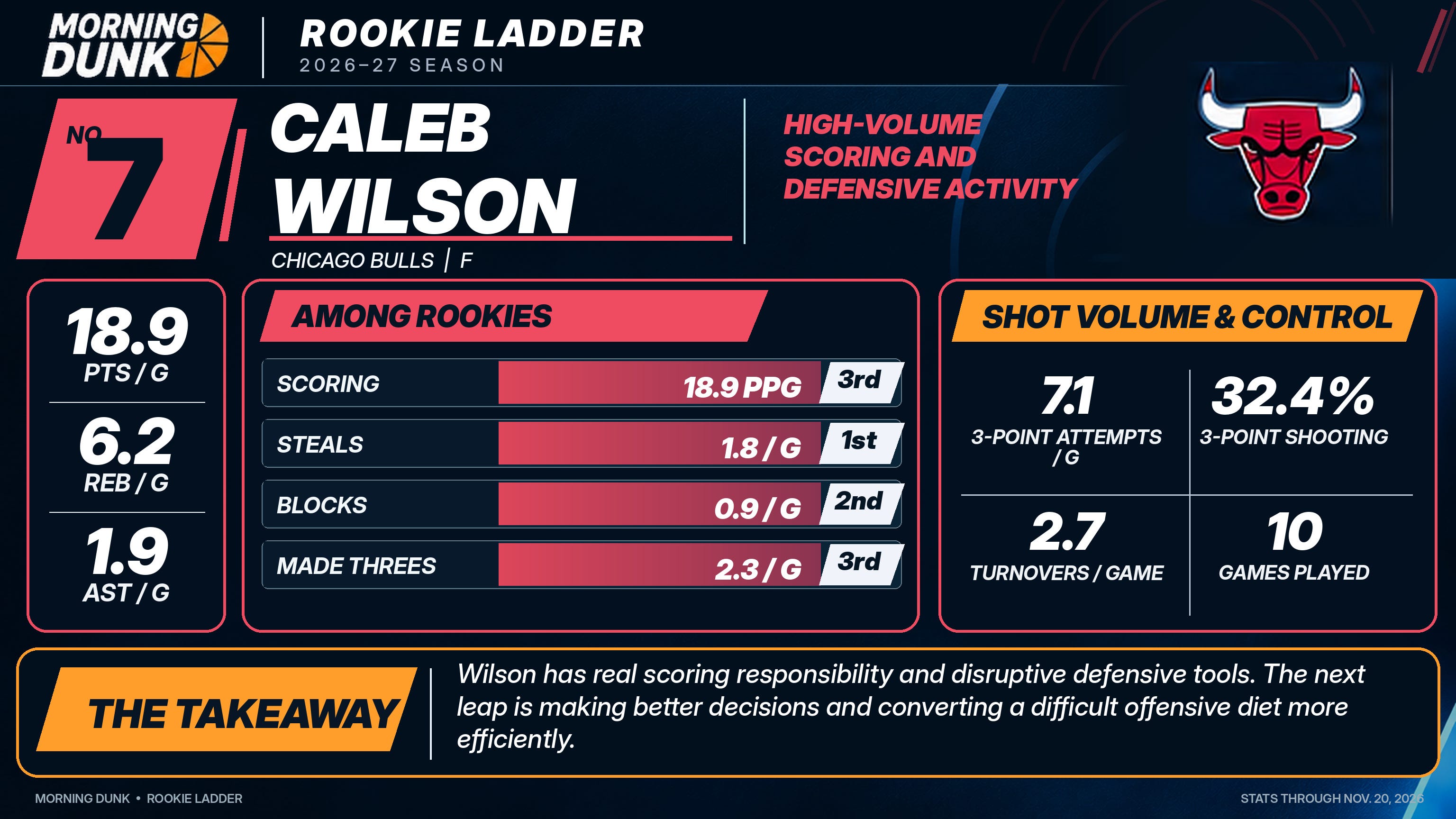
Speaking of players who HAVE gotten opportunities when healthy, Caleb Wilson was essentially handed pure freedom right out of the gate with the Chicago Bulls. With opportunity comes mistakes for young players, and Wilson’s minutes on the court for Chicago weren’t perfect.
Yes, he scored in bunches and showed some improvements already operating with the ball in his hands. However, there were also plays that Wilson likely wanted back in terms of poor passing and driving reads, and miscues away from the ball defensively.
But still, forwards with his athleticism and motor tend to find ways to produce. For Wilson, crashing the glass and running the floor in transition are just scratching the surface for who he can become in time. Given how many threes Wilson was taking with the Bulls, it seems like he wants to fast-track that offensive development.
Wilson is currently missing time due to a hand injury, but when he comes back in the mix, I expect him to also make a push up these rankings just like AJ Dybantsa. I have Wilson here for now because he’s not able to play games that others are. But if I were ranking off pure production, not factoring in minutes or time missed, Wilson would be amongst some of that group on the All-Rookie First Team.
Either way, unless he were to miss an even greater stretch of time, I can’t picture a world where Wilson isn’t named an All-Rookie performer when the season is said and done.
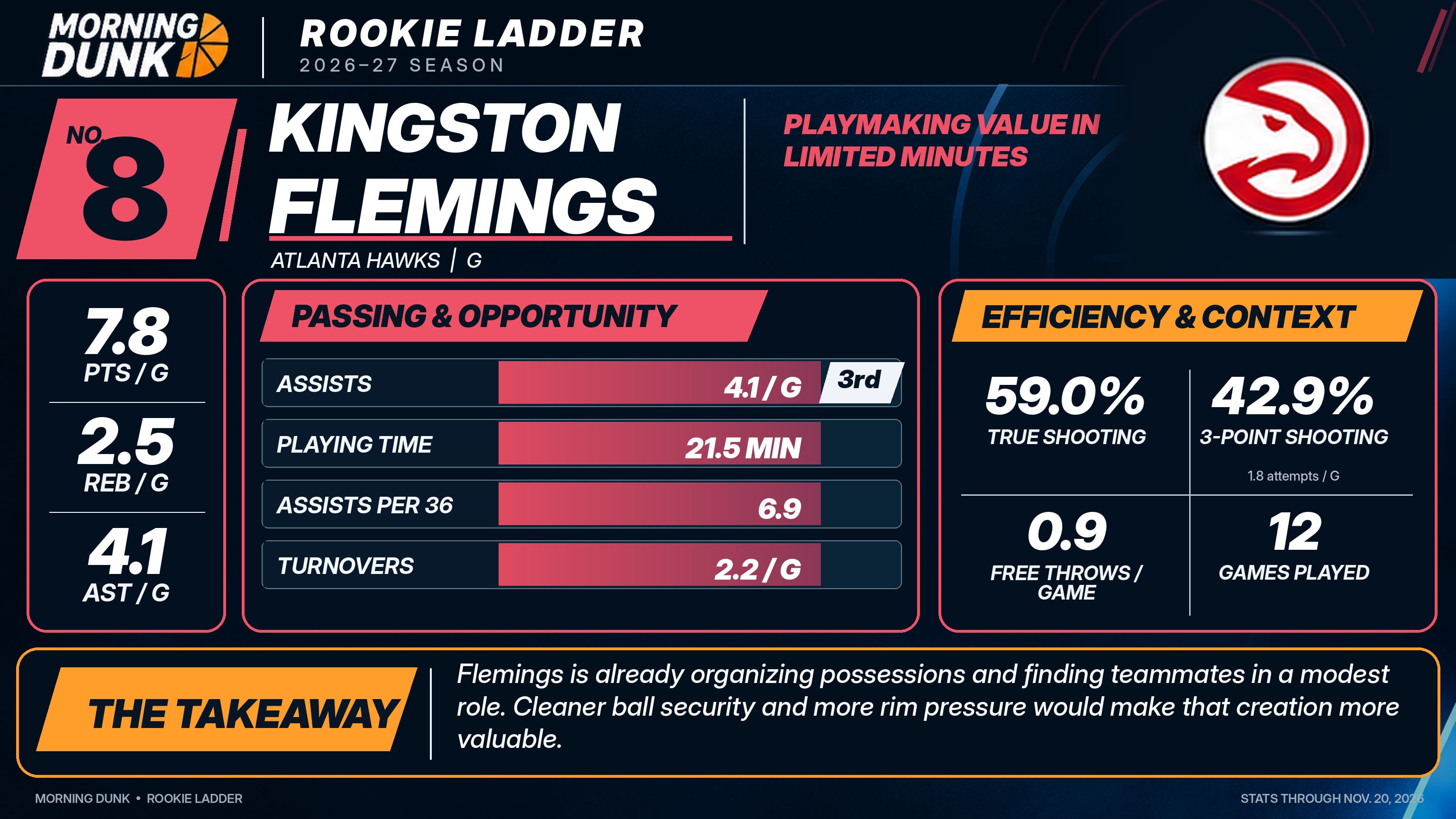
The Atlanta Hawks offense just looks better when Kingston Flemings is on the floor.
It’s not because he’s been an outright star so early in his career. But he’s just a well-organized guard who has everyone’s best intentions in mind, while also being great at taking care of the basketball and limiting turnovers.
Flemings has threatened defenses as a passer, not just a mid-range scorer. At Houston, it was more of the opposite despite his assist share. I always felt like Flemings’ greatest weapon was that pull-up two. It still is even in the NBA, but he’s been much more comfortable generating paint touches and spraying the ball out rather than looking to do everything himself on offense.
When he’s gotten chances to score, Flemings has done so in several ways, even hitting some spot-up threes. But his play as a floor general AND on-ball defender in the backcourt has helped stabilize some of Atlanta’s lineups in ways that just bring some clarity as to what everyone’s role should be on the floor.
I’ve been very impressed with Flemings’ pace of play and maturity with the ball in his hands. He’s been out for a few games now with a back strain, but he should step back into the starting lineup once he’s healthy.
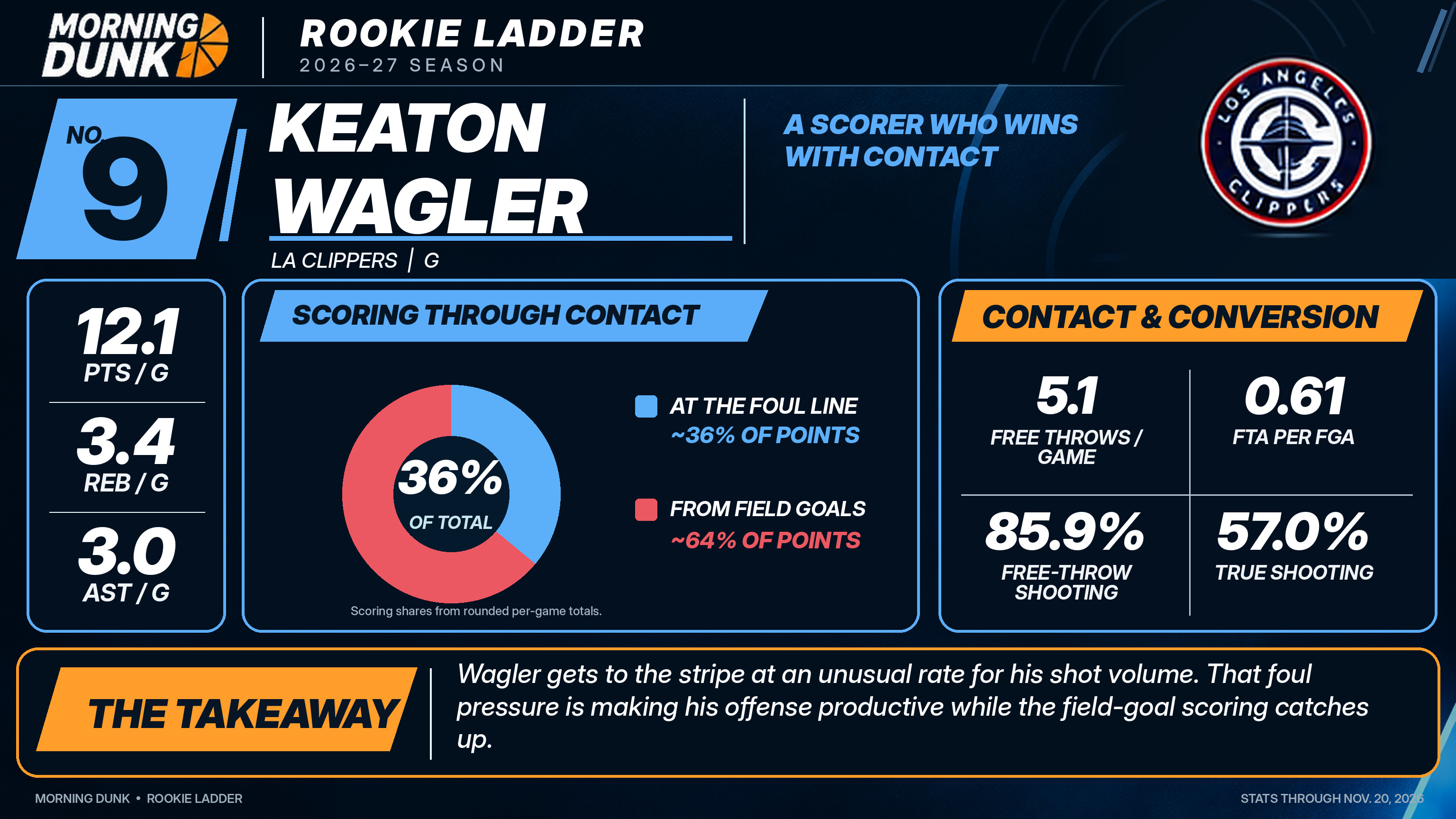
Keaton Wagler hasn’t been better finishing at the basket than in college to start his NBA career, but I’ve still been impressed with this toughness and demeanor as a backup guard.
Wagler still plays aggressively on drives, finding ways to absorb contact and get to the line. Even when he hasn’t gotten the whistle, Wagler still completes his attempts to finish at the rim. Normally, players would shy away from a clear weakness early on as rookies, but that hasn’t been what Wagler’s done.
And those drives, even when they haven’t succeeded, have set up other opportunities for him to either make a play for someone else or set up a pull-up scoring opportunity for himself. We know he can generate threes both on the ball and stepping into shots off the catch. But Wagler is showing real three-level scoring potential even if everything hasn’t clicked yet from an efficiency standpoint.
Still, his free-throw shooting has been an impressive attribute for the Clippers guard as he continues to round out the rest of his skill set. One would think Wagler will start for LA sooner rather than later, especially as we approach December and this team makes moves in the lineup.
Wagler is absolutely a dark horse to finish on All-Rookie First Team ballots by year’s end.
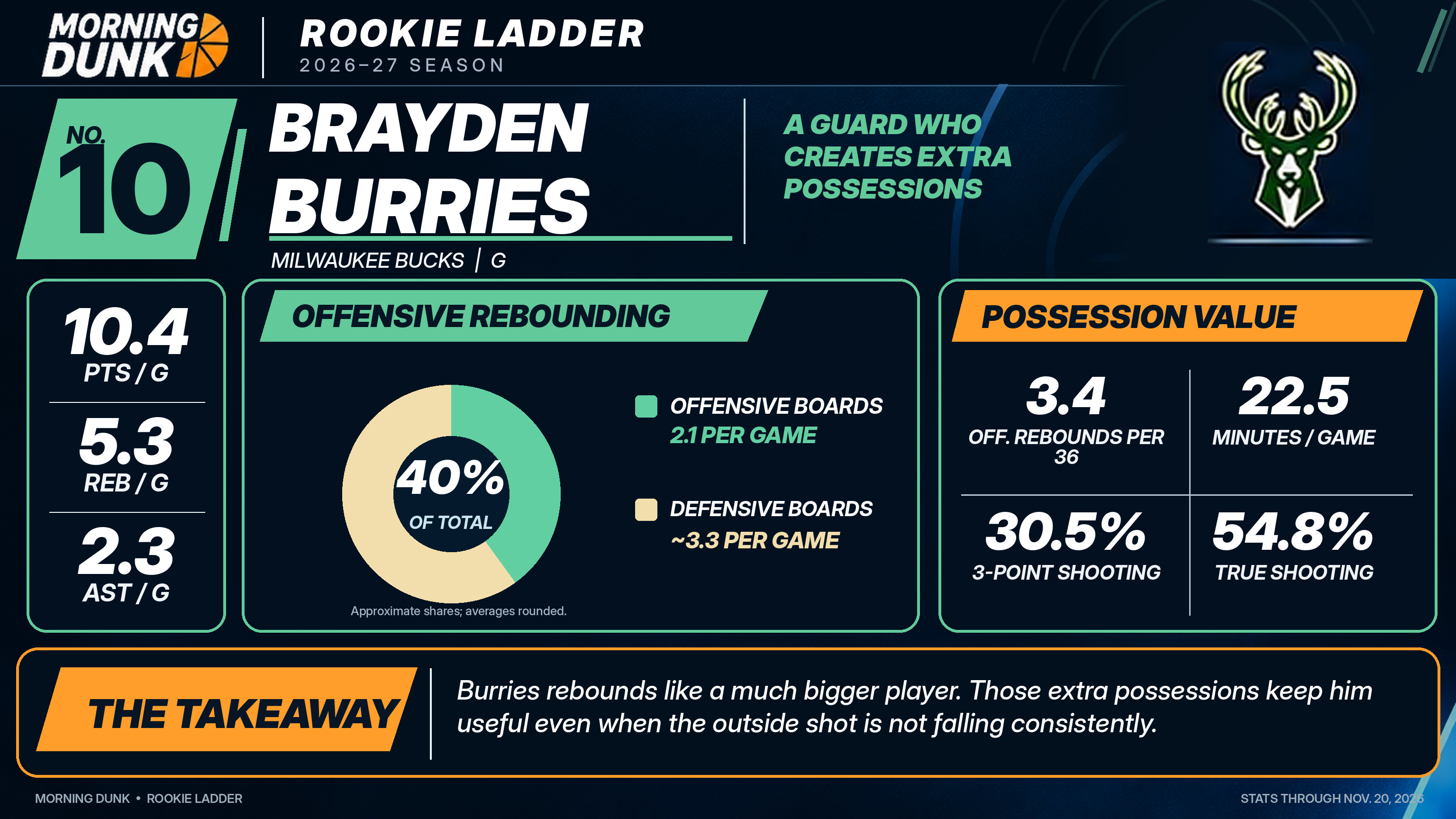
Brayden Burries’ best attribute so far as a rookie guard hasn’t been anything around his shooting or passing. His nose for crashing the offensive glass has been what Burries has hung his hat on to start his career, and it’s been fun to watch his edge as a backcourt rebounder, creating extra possessions for the Milwaukee Bucks.
Burries is tough as nails. He lets opponents feel it as he finds ways to get it on the glass and on defense, taking on matchups on the perimeter. Burries competes on defense, as he’s great at sitting in a stance and fighting through screens to stick with his man. Burries was viewed as a two-way guard prospect coming out of Arizona, and he’s shown that same fight and force during this first month in Milwaukee.
I do want to see Burries’ shooting balance itself out before I’d move him up the rankings, but I fully expect that to happen sooner rather than later. Even when he’s had to create his own looks off the bounce, Burries has been able to separate from defenders. Sometimes, the shots just don’t go down. If Burries had made some more looks to start the year, we may be discussing him for an All-Rookie First Team spot right now.
Still, his competitive energy has been incredibly fun to watch for the Bucks, even if the team hasn’t been able to win games through October and November. I’m keeping an eye on his play as well as what his fellow teammate Nate Ament is doing in a Bucks uniform.
Discussion about this post