


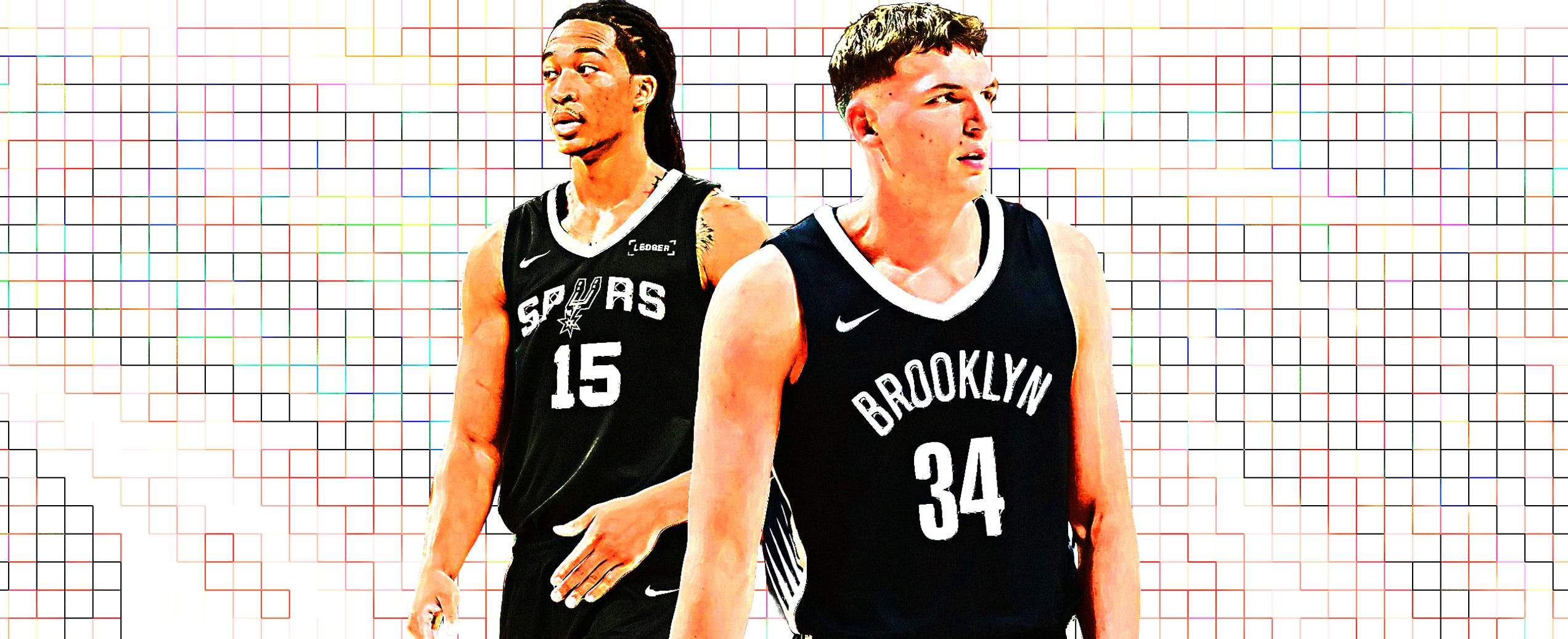
Last season, 32 NBA players had their two-way contracts converted to standard deals. Of that group, some were rookies who quickly found their footing in the pros (Kobe Sanders, Dylan Cardwell), some were sophomores who made big jumps (Daniss Jenkins, Spencer Jones), and others were veterans who finally broke through after bouncing around (Jamaree Bouyea, Jamal Cain). These hidden gems come from all walks of basketball life, but they show how the two-way contract pipeline is becoming an increasingly used and impactful talent-development tool in the league.
This is part one of a preseason series highlighting two-way contract breakout candidates for 2026-27; the guys who are primed to be next up in that pipeline. We’re starting with three 2026 second-round picks who could be real contributors as rookies. Let’s dive in!
Tyler Bilodeau (Brooklyn Nets)
Tyler Bilodeau was a late riser in the 2026 draft. As an auto-eligible senior, he benefited from the wave of early-entrant dropouts (as did the other two players we’ll be talking about). But, looking back at how he produced in his final collegiate campaign at UCLA, he probably should’ve been in second-round conversations all along.
Bilodeau is the textbook definition of a stretch four. He’s a burly fella who will primarily (or exclusively) play power forward in the NBA, and while he has a trusty post-up game, his steady perimeter shooting will be key to unlocking his potential at the next level. He was unbelievably efficient on jumpers in 2025-26 at UCLA, putting up 1.40 points per shot on three-pointers (98th percentile), 1.33 points per possession on spot-ups (97th percentile), and 0.96 PPS on long mid-range shots (84th percentile), according to Synergy.
One of the most important things for two-way players is to have at least one cemented NBA-level skill, which is a theme you’ll pick up on in this series. For Bilodeau, he has shooting and overall off-ball scoring to lean on while he works on the rest of his skill set. Those traits will help him get on the court early for the Nets, and they’ll make him a nice fit alongside Julius Randle, Mikel Brown Jr., Egor Demin, Nolan Traore, and the other creators they have at the top of their food chain.
Bilodeau’s ceiling will be limited by his athletic and defensive limitations, unless he ends up excelling in a 2024 playoffs Karl-Anthony Towns-type role on D, but his floor is high because of his touch, IQ, and polish. Jordi Fernandez should know pretty much exactly what he’s getting from Bilodeau, and that will go a long way.
Maliq Brown (San Antonio Spurs)
To understand Maliq Brown’s value, you have to look well beyond the counting stats. His 2025-26 pre-draft averages of 4.9 points, 5.2 rebounds, 1.6 assists, 1.8 steals, and 0.6 blocks in 20.3 minutes per game don’t capture how much he can contribute to winning basketball. Anyone who watched Duke last season could see how integral Brown was to their success.
The main reason Brown flies under the radar of basic statistics is that so much of his impact comes on defense, the side of the ball that numbers can’t properly evaluate. He’s about as versatile as a big man can be defensively. The reigning ACC Defensive Player of the Year can be deployed in any screen coverage—hedge, switch, drop, you name it. Brown is mobile, disruptive, and smart, and coaches can rely on him to pull his weight within a team scheme.
Offensively, Brown will have to improve to thrive in the NBA, and that growth needs to start with ramped-up aggression. With the Blue Devils, he was almost a total non-factor in the scoring column. He’ll never be asked to average 20 points, or even 10, but he has to be some sort of threat if he’s going to see the floor in high-leverage games one day. Across his senior season at Duke, he attempted just nine field goals as a roll man, per Synergy. That feels like the obvious area for him to increase his volume.
The Spurs made it clear by drafting Brown, Tarris Reed Jr., and Jayden Quaintance that they’re searching for a long-term backup center, and if Brown can overcome scoring-liability status, he could absolutely become their guy and build a 10+ year career. Mitch Johnson will likely struggle to keep him glued to the bench, even in year one. He’s too additive to winning to ride the pine.
Ugonna Onyenso (Detroit Pistons)
Year after year, we see centers who were drafted in the second round, and even ones who went undrafted, exceed expectations and emerge as solid plug-and-play pieces from day one. Ryan Kalkbrenner, Maxime Raynaud, Dylan Cardwell, and Moussa Cisse all exemplified this last season. Before them came guys like Jaylin Williams, Quinten Post, Oso Ighodaro, Trayce Jackson-Davis, and Omer Yurtseven. Ugonna Onyenso has as good a chance as anyone from the 2026 class to continue that trend.
On a list of the best shot blockers in the world right now, Onyenso has to be mentioned. In 2025-26, he averaged an ACC-leading 2.9 blocks in just 18.6 minutes per night. To put that per-minute production in context, the official NCAA leader in BLK% last year was Aday Mara at 12.0%. Onyenso’s BLK% was 17.4.
Onyenso isn’t some Hassan Whiteside variant, though. He’s not disregarding defensive principles to hunt highlight swats—he’s actually protecting the rim. The big fella makes it tough for anyone who comes in his paint to score. You may recall his epic nine-block performance against Duke in the ACC tournament. In that game, he had multiple possessions of fantastic one-on-one defense against Cameron Boozer.
Onyenso’s offensive game is somewhat elementary, but that’s not necessarily a bad thing. He’s a lob threat from a standstill and as a roll man, and he’s an effective rolling finisher in general, doing a nice job of not bringing the ball too low on the catch and maneuvering around defenders with a dribble or a fake if he has to. Those tools will be enough for him to play with a playmaker like Cade Cunningham.
Detroit’s outlook at the center position is murky. There’s the whole Jalen Duren conundrum, of course, but they also have to fill the gap left behind by Isaiah Stewart. Paul Reed should be a major factor this year, but if he gets injured, or if J.B. Bickerstaff wants a more traditional five off the bench, then Onyenso’s number should be called. He’ll fit right into Detroit’s defensive identity.
Other names to watch: Bryce Hopkins (Denver Nuggets), Otega Oweh (Oklahoma City Thunder), Nick Martinelli (Los Angeles Clippers)