


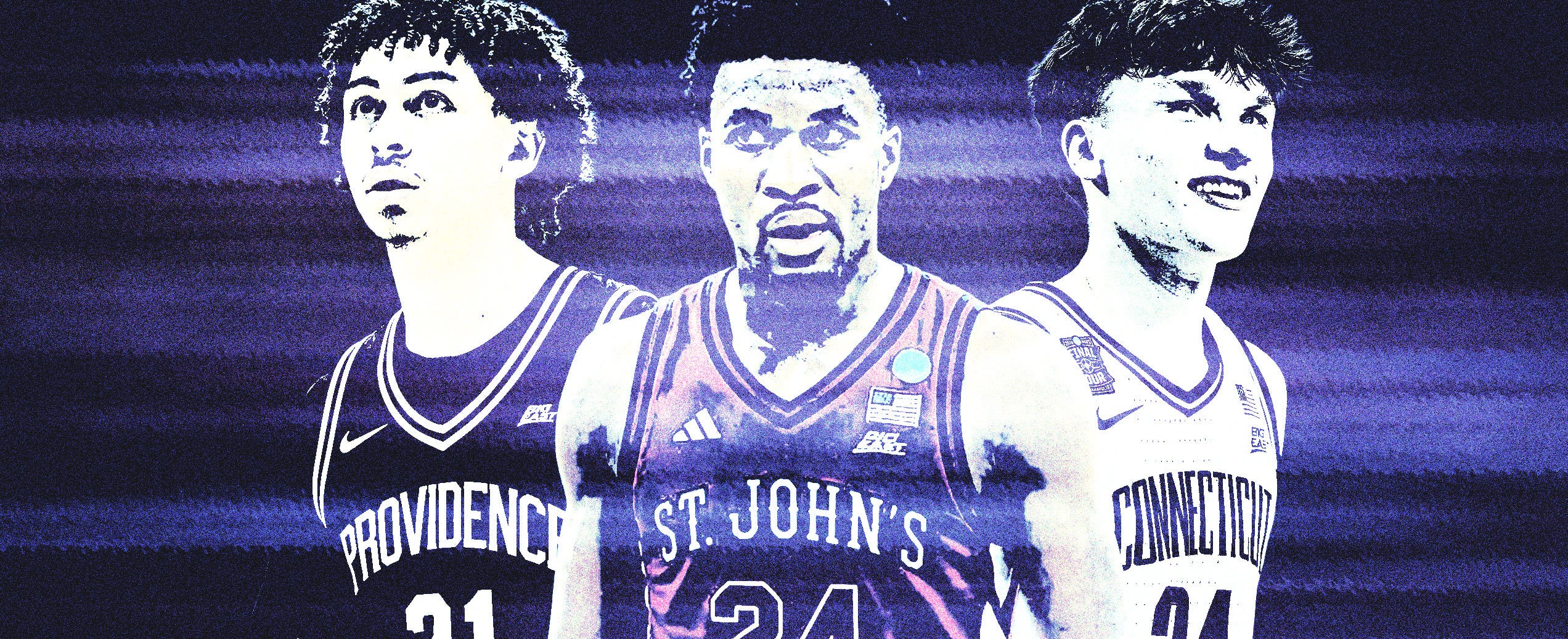
The Big East has some of my favorite returning prospects in the country this season. Whether they’re guys returning to the same program or transferring in, this conference is loaded with experience, versatility, and potential. While I will undoubtedly miss someone who ends up having a monster season, here are some of my favorite Big East players to watch for the 2027 NBA Draft and future drafts as we approach the start of the season.
Butler
Drayton Jones: Jones is a fun athlete who is explosive around the rim but also moves well in space. Jones is a deep-cut prospect, but we routinely see guys in his archetype fill out the ends of rosters. Offensively, he’s a low-maintenance play finisher. He doesn’t create his own shot, doesn’t space the floor, and isn’t a good passer, although he tries at times. What he does do, though, is grab a bunch of offensive rebounds, roll hard to the rim, draw a ton of fouls, and consistently finish. Where Jones needs to take a big step this year is on defense. He can hold his own in space and is an explosive shot blocker. He just needs to be far more consistent with his discipline and rim protection while proving he can play bigger minutes.
Samis Calderon: Calderon barely played last season for Kansas, so any of his numbers are pretty meaningless. This is essentially a restart for him, and the number one goal has to be getting on the court consistently. Coming out of high school, though, Calderon showed some really fun ball skills, especially for his position. He was an adept passer and solid slasher. He also showed some defensive versatility given his athletic tools. The big issue, though, was consistency. He was a streaky, at best, shooter, an apathetic defender at times, and careless with the ball. There was a lot of flash, but not always much substance. This is a big year for Calderon to turn things around.
Herly Brutus: Brutus is such a fun defender. He plays bigger than he is, is super tough, can guard multiple positions, and has super active hands. Brutus’s physicality and defensive versatility should get him on the floor this season, especially since he applies that same toughness to his rebounding. The big question is how he’ll fare on offense. There are some really encouraging flashes, but nothing he can hang his hat on. His shot looks workable and like it could be reliable eventually. He’s a good slasher and makes some nice passes. He just doesn’t have enough consistency in any of those areas to be relied on yet. It’ll likely be more of a slow burn, but Brutus has a fun foundation.
Baron Walker: Walker is absolutely a multiyear college player, and he may not even get on the court much this season. I am intrigued by his offense in the long-term, though. He moves well without the ball, doesn’t get sped up, slithers through the defense, and has a good-looking jumper. I just thought he was worth noting as a potentially fun future guard to keep an eye on, especially for Butler fans.
Creighton
Jackson McAndrew: After a really exciting freshman season, McAndrew unfortunately suffered a season-ending foot injury after just four games. McAndrew's goal this season has to be health and making it all the way through. If he can hit the ground running, though, he offers a lot of shooting versatility with good size. Hopefully, we see McAndrew return to and expand on what he showed as a freshman. His combination of shooting and size is always intriguing, but if he can prove that his foot is 100% and that he added something else to his game, we could see his draft stock bounce back in a big way.
Hudson Greer: Greer had a weird freshman season where they initially convinced him to redshirt, then reversed course. Greer is a nasty off-ball shooter. He moves well without the ball, is a sniper with elite confidence, and has grown every year with attacking closeouts. Greer isn’t an elite athlete, but he’s fundamentally sound and has great defensive instincts. He’s quietly one of my favorite off-ball wings in this year’s sophomore class.
Wes Enis: Last year at South Florida, Wes Enis was one of their more prominent volume shooters. He took over 300 outside shots. The issue is that he shot just 35.0% and didn’t show much else. Enis has to either shoot it at a much higher clip or prove that he isn’t just a one-trick pony.
Kayden Edwards: There’s a common theme with a lot of Creighton players and it’s shooting. Edwards didn’t play a ton last year at TCU, but when he did, he let it fly. He only took 23 attempts, but at 14.9 attempts per 100 possessions while shooting 43.5% is very fun. If he can replicate any of that shooting prowess in a bigger role, Edwards could help make Creighton’s backcourt pretty electric.
Katrelle Harmon: Harmon plays much like a lot of the combo guards who have gone through Creighton over the years. He has a good-looking shot, but his major value comes from his secondary creation. He’s great at attacking closeouts and rotations, getting paint touches, and creating for teammates out of his drives. Whether it’s a dump-off or kick-out, Harmon consistently has his eyes up when he’s attacking the rim. He has to get stronger, be more consistent on defense, and be a little more consistent as an on-ball scorer, but Harmon’s offense could explode if he gets minutes and experience this year.
DePaul
Magoon Gwath: Size, shot blocking, and shooting will always fascinate evaluators, and that’s exactly what Gwath provides. He’s a good offensive rebounder, a legitimate screener, and an efficient play finisher. What he hasn’t proven, though, is that he can play extended minutes. This year, Gwath has to prove that he can maintain his shooting and shot-blocking numbers in a much bigger role. On top of that, it’d be great to see him keep improving his overall defensive versatility. The idea of Gwath and his flashes are tremendous; now he needs to prove none of it’s a mirage.
Georgetown
Jaland Lowe: After an electric year at Pittsburgh where he showed off dynamic playmaking and a slick handle, Lowe had a horrid season at Kentucky, plagued by injuries. Lowe is a shifty on-ball creator with some real creativity to his playmaking. Unfortunately, he’s also very small, limited on defense, and has a lot to prove with his jumper. Hopefully he can get healthy and rediscover his playmaking prowess. He has a lot to prove and build on, but we’ve seen sustained stretches in the past.
Marquette
Nigel James: Nigel James is a ball of fun. Even though he’s very small, it’s impossible not to be intrigued by his future. James is lightning quick, effortlessly pressures the rim, is a pesky defender, and a high-level playmaker. Coming into last season, the big question was his shot. He wasn’t a great shooter last year, but 34.7% from three on 121 attempts was better than I expected. If James can keep improving his jumper while also taking better care of the ball, he’ll quickly move up the list of most impactful PGs in college basketball.
Michael Phillips II: Phillips barely played last season, but I was fascinated with his long-term 3&D potential. In his limited minutes, Phillips shot 37.0% on 11.8 threes per 100 possessions. He also added a 4.5% block rate. He should have a really good opportunity to be a breakout sophomore wing.
Nolan Minessale: Long-time readers will remember I dropped Minessale in multiple of my in-person scouting notes two years ago, as he was consistently the best player in every game he played in. Even though I never went to those games specifically for Minessale, he was always the biggest standout. Minessale is one of those players who does a lot at a very high level. Whatever it takes to win, he’s going to do it. He’s a versatile defender, a great cutter, fantastic passer, and rapidly improving shooter. Even though he shot just 30% from three last year, taking 140 attempts is a massive improvement after reworking his jumper the previous year. Minessale should be a perfect fit with Marquette’s style, and if he can come close to replicating what he did at St. Thomas in the Big East, his draft stock will get scorching hot.
Alex Egbuonu: Egbuonu is super raw but also kind of fun. From a draft standpoint, and maybe even a freshman-minutes standpoint, Egbuonu is going to be a slow burn. He lacks passing instincts, finishing craft, and needs to improve as a shooter. He's also a fun athlete, a versatile defender, a good rebounder, and has some ball skills that let him attack the rim and push in transition.
Providence
Devin Vanterpool: Vanterpool still needs some work to be NBA-ready, but he has a solid 3&D foundation that should make him an important piece for Providence this year. His offensive game is pretty simple. He’s a good spot-up shooter but isn’t stagnant away from the ball. He can attack closeouts, make a simple passing read, relocate, and flow within the offense. Defensively, he’s tough, solid on the ball, and has some encouraging defensive playmaking metrics. The key, though, is: what area of his game takes a massive leap? The easy one is getting his three-point percentage closer to 40.0% on similar volume. He doesn’t need to be a dynamic on-ball creator, but if he can improve as a shooter and incorporate a few more passing reads and off-ball creation possessions, it’d be big. Defensively, he just needs to get a little more consistent and disciplined away from the ball. He can ball-watch a little too much, which makes him more reactive and puts him in scramble mode. If he can pivot his processing and awareness a little more toward the anticipatory end of the spectrum, he should see a massive improvement in his impact.
Miles Byrd: Miles Byrd has been a name floating around the draft space for a few years now because of how ridiculous some of his defensive playmaking numbers are. When it comes to forcing an event on that end of the floor, few in the country are better. He’s a good athlete, covers a ton of ground, and frequently turns defense into offense. I have two major concerns, though. First, his defense is built almost entirely on his willingness to gamble. He gets a lot of steals and blocks, but he also tries to jump every passing lane and jumps at every shot fake. This leaves his teammates out to dry and leads to a lot of unnecessary fouls. Second, Byrd’s offense has just never really grown. He’s a solid cutter and good in transition, but that’s about it. If he can shoot at a mediocre level and be more disciplined on defense this year, it’d significantly help his case for the next leap. We’ve also been saying that for the last two years, though.
Arrinten Page: Page has gotten incrementally better every season he’s played, and I’m really excited about how he’ll fit in and elevate this Providence defense. Page isn’t an elite primary rim protector, but he makes up for it in many ways. He’s still a good shot blocker, but he also moves well in space, can make multiple rotations, closes out on shooters, generates steals, and is a reliable rebounder. It’s a defensive skill set that pairs nicely with his low-maintenance offensive game. Page is a fantastic cutter, rim runner, floor runner, and interior finisher. The question is what else will pop in his offense. There are flashes of good passing reads, and his shot looks promising. They’re both still theoretical. If either takes a meaningful jump while his defense continues its natural progression, Page could return some real value in the second round.
Javon Bardwell: Bardwell has the tools to grow into an electric microwave scorer. He’s springy, unafraid of contact, scores at the rim in different ways, and can get hot in a hurry with his jumper. Unfortunately, he has to play an off-ball role. His passing instincts and capabilities are limited at best. Bardwell can fill up the scoring column in the blink of an eye, but I’m still waiting to see how he can consistently impact the rest of the game.
Seton Hall
Darien Moore: Moore is an insanely fun defender. He plays bigger than he is, has great fundamentals, fantastic instincts, and plays with a lot of physicality. He does a good job of rotating away from the ball, playing with his head on a swivel, and slithering through screens with ease. His defense is good enough to get him on the court from day one, but the question is if his offense can be competent enough to keep him there. Moore’s spot-up jumper looks OK; he’s quick to the rim and super active without the ball. He’s just very inconsistent as a shooter and scorer, hasn’t shown much playmaking, and has gone long stretches of barely being involved. He’s definitely a multi-year college player, but his defense is insanely fun.
St. John’s
Ian Jackson: After a highly decorated high school career, Jackson’s college career has been pretty rocky and hasn't made the big leap we’ve been hoping for. Hopefully, year two with St. John’s provides Jackson with stability and a launchpad to fully achieve the immense potential he has. Jackson has always been tremendous in the open court. He’s a blur who gets to the rim in myriad situations. One of Jackson's big limitations is that he’s the size of a combo guard but has never shown the playmaking chops to be a PG or the shooting consistency to be a reliable SG. Jackson did show some growth last year, though, in his defense. He was still far too inconsistent, especially off the ball, but his on-ball competence improved throughout the season. This is a big if-not-now-then-when season for Jackson. He doesn’t have to prove he’s a first-round pick immediately, but he has to show substantial improvement in his playmaking or shooting.
Ruben Prey: Prey has been an intriguing novelty in the draft space for a few years, but last year was easily his best. He still needs to improve a ton with his ball skills and processing, but his ability to offensive rebound, occasionally space the floor, block shots, and finish plays efficiently at his size will always grab scouts’ attention. Prey's biggest improvement this year is simply to play a much higher minute share. Last year, Prey only had a minute share of 26.8%. That’s never going to be good enough.
Tounde Yessoufou: After once being considered a potential top-10 pick, Yessoufou had a brutal season at Baylor. The strengths and weaknesses of his game weirdly flipped from what they were in high school. I was most impressed with Yessoufou’s growth as a defender. He used his physical tools well, improved his fundamentals, and really battled on that end of the floor. His off-ball awareness still needs work, but if he keeps leaning into that aspect of his game, he could be a monster perimeter defender. What was surprising, though, was how much he struggled to score. He couldn’t buy a jumper, didn’t draw fouls, and struggled to finish around the rim. For someone as athletically gifted as he is, there’s no excuse to be that affected by contact around the rim. Yessoufou likely isn’t ever going to be a primary creator given his long-running lack of playmaking chops, but if he can get to just average with his jumper and massively improve his finishing, his first-round buzz should spark back up rather quickly.
Donnie Freeman: Freeman will miss the entire season after his Achilles tear last season. This sucks… a lot. Just don’t forget he’s on St. John’s for next season.
Theo Edema: Edema is a very long-term prospect, but he could grow into a pretty fun player. Edema’s game is power-based, but he moves well in space. He’s a solid cutter, roller, and at-rim finisher. He has flashes of being able to string together one or two dribbles in the post, but his game away from the rim needs a lot of work. The biggest intrigue with him is his defense. His combination of strength and agility allows him to cover a ton of ground. Unfortunately, he doesn’t always know what he’s doing yet. That’s equal parts exciting and concerning. Edema may not get a ton of minutes early, but once the game slows down and clicks for him, there’s a ton of defensive potential begging to be unlocked.
UConn
Braylon Mullins: Until Braylon Mullins proves he’s not a one-trick pony, he’s going to be very polarizing. Mullins is an elite off-ball shooter. He has limitless range, moves well without the ball, has a diverse shot package, and is supremely confident. The concern is whether there’s anything else to his game. The most obvious counter is his defense. Despite always trending on the more slender end of the spectrum, Mullins has always been a very good defender. He moves his feet well, is tough, and doesn’t get bullied with physicality. For me, that 3&D foundation is enough to stay intrigued. However, if Mullins doesn’t show more offensive versatility, it’ll be tough to avoid comps that paint him as a dying-breed specialist. I do think many of the limitations we saw from Mullins last year were symptoms of his injury and how UConn used him. This season, I expect to see more of the cutting, passing, and slashing capabilities we saw from Mullins in high school. We know he can shoot and defend. Now, he has to prove that he’s also a threat around the rim.
Silas Demary Jr.: I’ve never been a huge Demary fan, but his growth last year is undeniable. He’s always been a really tough, physical guard, especially on defense. That popped again last year. Where Demary was really impressive, though, was his floor-general skills. He by far had the highest assist figures of his career and impacted winning in a big way. Proving he could run the show and do the little things was such a crucial development. On top of that, he had his best shooting year. He needs to improve his volume, variety, and difficulty for me to really buy in on the jumper, but improvement is improvement. This season, Demary has to keep improving his scoring efficiency, especially around the rim. If he can incorporate that while repeating his shooting and playmaking marks, he could be a great value find in the second round.
Nikolas Khamenia: Things just never really clicked for Khamenia at Duke last season. He wasn’t bad, but his minutes were always clunkier than they should’ve been. Khamenia is a great connector on the wing, with toughness, rebounding, connective passing, and off-ball movement. Given his unselfishness and passing capabilities, he should fit perfectly with UConn’s system and thrive off of their ball and player movement. The key, though, is that he has to shoot it better. Shooting 34% on mediocre volume just won’t cut it. He doesn’t have to be Milan Momcilovic, but that mark needs to be closer to 40.0% on higher volume.
Najai Hines: Hines is an absolute load and looks like he’s a nightmare to deal with in the post. When it comes to doing the “big man things” (rebounding, at-the-rim finishing, shot blocking), few players in the country were better than Hines. In fact, going back to 2008, Hines is the only player to match the scoring efficiency, rebounding, and shot-blocking rates he posted last year. There’s a very real world where he’s one of the top big men in the 2027 NBA Draft. For that to happen, though, a handful of important developments are still needed. Offensively, I need at least flashes of something else from Hines. He doesn’t have to shoot it, but he either needs to improve his hands, passing, and/or foul drawing. Defensively, he needs to get lighter. Not significantly, but shedding a few pounds would skyrocket his defense. You can clearly tell that he has good feet and moves well in space, but he really struggles to change his momentum once he gets going. There are a lot of Tarris Reed similarities, and we saw Reed improve in the exact same areas Hines needs to. It just took Reed a couple of years, which may be the case for Hines too.
Oskar Giltay: Giltay will be a fascinating evaluation. As a freshman at Stanford last season, Giltay had incredibly impressive scoring efficiency, rebounding, and defensive playmaking figures. My concerns, though, are that they came in very limited minutes and in games where I frequently forgot he was out there. Playing a more consistent role is the biggest thing I’m looking for from Giltay. If he can come close to repeating those tendencies in more minutes, it’ll speak volumes. On top of that, his ball skills and ball security need to improve. If he repeats last season, he won’t survive in UConn’s offense. If the leap happens, UConn could have the best center rotation in the country.
Colben Landrew: Landrew is going to be a fascinating evaluation this year. It’s very easy to buy all the way in right now. I’m not quite there yet (still an easy first-round pick for me to start the year), but I totally understand if you are. Landrew is a very fun off-ball scorer with a sweet jumper and impressive rebounding pedigree. Landrew is also good in transition and has shown some versatility with his drives. Even his playmaking figures are really impressive. He isn’t necessarily going to consistently break down defenders and manipulate off-ball defenders, but he takes good care of the ball, makes the simple reads, and is comfortable using his scoring gravity to create for others. That alone should make him a better fit than most in UConn’s offense. The big question is how high that complementary guard skill set deserves to be drafted. Thankfully we have a whole college season in an incredible setting to figure that out. Regardless, Landrew could easily be one of the most fun freshmen in the country.
Junior County: County feels like a perfect fit with UConn. He’s tough, a good defender, and has strong offensive versatility. This year, I expect most of County’s impact to come through his defensive versatility and rebounding. Offensively, County is a good slasher, has some fun shot creation flashes, and does a great job flowing through offensive roles. The big hole, though, is his shooting consistency, specifically off the bounce. He was pretty solid as a spot-up shooter, and his mechanics look sound. He just has to improve as a pull up shooter to take his game to that next level.
Villanova
Jake Fiegen: Fiegen is an absolutely filthy off-ball scorer. He’s a sniper off the catch, efficient inside the arc, and a phenomenal off-ball mover. He constantly relocates, runs off screens, and resets out of handoffs if a look isn’t there. He’s improved to the point where he can create after attacking closeouts too. That may be enough to intrigue a team if he can replicate it in the Big East, but there isn’t much else to his game. The size and defenders on the rest of the roster should help insulate him, but Fiegen is a limited defender and on-ball creator.
Elijah Crawford: The odds are that Crawford’s shot will be enough to keep him from making the next leap in his career. While that’s the most likely outcome, it isn’t a certainty, as he has some nastiness to his game. His playmaking volume and efficiency last season were outstanding. He has awesome flair and creativity that make him a dynamic playmaker and slasher. On top of that, he was a disruptive defender. His fundamentals and consistency need to improve, but if he leans into the defensive end of the floor, he could become a Jamal Shead-type player. Given Villanova's size, defenders, and off-ball shooters, this is a realistic path for him to explore.
Devin Royal: Royal has always been a do-it-all forward whose numbers never reflect his impact. He’s tough, versatile, and does all the dirty work that the star players don’t want to do. He has a really understated game that likely won’t show up in any statistical queries and, frankly, may not be good enough to take him to the next level. However, every now and then we see players in this archetype carve out a role somewhere.
Kwame Evans: Tools and potential have never been an issue for Kwame Evans, but consistency and effort have. Evans had his best season by far last season, making a consistent impact on the boards and on defense. He has good physical tools and is finally starting to use them. He still, however, struggles to make a positive impact on offense. He’s too frequently just gone through the motions and has struggled mightily with his scoring efficiency and passing. Evans could be a fantastic contributor to Villanova this year, but if he wants his draft stock back in serious conversations, he has to take a massive leap on offense or prove his defensive improvement last year was real.
Adam Oumiddoch: Oumiddoch's number one selling point is his shooting/scoring versatility. When he gets hot, there isn’t much a defense can do to slow him down. He isn’t an explosive athlete, so he doesn’t create much space. However, his tight handle and phenomenal footwork let him consistently create windows on the perimeter and in the lanes to the rim. He’s super comfortable shooting out of spin moves, secures the ball on step-throughs, and can string together multiple moves to toy with defenders. As he continues to get stronger, his scoring game could be an absolute blast. Unfortunately, that’s about all there is to his game right now. He isn’t a natural playmaker, and his defense is pretty bad. He gives up too big a cushion and struggles with the little things, like sitting down in a defensive stance. Between Crawford, Royal, Evans, and more, Oumiddoch’s shortcomings should hopefully be insulated enough that he can still get minutes this year. To make that next leap, though, he’ll have to show substantial improvement in the coming years.
Luigi Suigo: Suigo could easily be the first center taken in the 2027 NBA Draft. For starters, he’s a massive human being. That alone is enough to pique interest. Thankfully, he’s also very skilled and rapidly improving as a defender. Suigo isn’t a great shooter yet, but he’s trending in the right direction. He is also a good rim runner with some unique passing flashes. Defensively, Suigo could be great but has work to do. His size makes him a good rebounder and defender, but he still needs to understand the game at a higher level. His defensive work rate improved drastically throughout the year, which is encouraging, as he had stretches where he was a disaster. He also was inconsistent with his positioning and fundamentals. As the year went on, though, Suigo steadily improved, which is all we can hope for with young players. If Suigo buys into doing the little things, taking coaching, and improving his conditioning, there’s no reason he couldn’t be a top ten pick.
Xavier
Chance Westry: Westry is one of the more fun offensive engines among this year’s transfers. Even though he was at UAB last year, posting usage over 25, an assist rate over 34, a turnover rate under 14, and a 2.9 assist-to-turnover ratio is insane. He does an awesome job of blending flair and manipulation with simple decision-making. He constantly makes the right play and makes his teammates better. If he can do that in the Big East, he’ll generate a lot of buzz. The key, though, is that he has to show major improvement as a shooter or defender. He wasn’t a bad defender, but his impact was underwhelming. He has the tools to be an awesome college player, but once/if his defense or shot takes a leap, then we can start having some very fun draft conversations.
Tru Washington: Washington should be a fun perimeter fit with Dominguez and Westry. He needs to improve his scoring consistency, but his off-ball scoring has a lot of upside and intrigue. He moves well without the ball, can get to the rim, and has games where he goes off as a spot-up shooter. He won’t create much of anything for anyone else, but he should provide Xavier with important off-ball scoring versatility. On top of that, he’s also a highly disruptive defender. He has active hands, jumps passing lanes, and does a great job of turning those events into offense.
Ruben Dominguez: Dominguez was simply one of the best off-ball shooters in the country last year. He should feast off of Westry’s playmaking. Can he do anything else? I’m skeptical. It won’t matter from a college standpoint, but if he has NBA dreams, then something else in his game needs to emerge.
Kalek House: House is an exciting combo guard who finds ways to impact the game in myriad ways, depending on the day. He’s very comfortable running the pick-and-roll, and that’s one of the main actions where he shows off his shooting versatility. He’s reliable off the catch, confident in the midrange, and doesn’t hesitate from outside. He is also a generally strong defender. He moves his feet well and is very competitive. At his size, House will have to improve his playmaking. He’s a good passer within the flow of the offense and will make some nice reads out of drives, but he isn’t overly manipulative or creative.
Asher Elson: Elson is a long-term prospect, and it’ll be fascinating to see what role he has this year. Elson has great tools and is oozing potential, so it won’t take much for him to break out in a big way. His early impact will likely come on defense. He has good length, awareness, and work rate. Offensively, he’s a good cutter, and his shot looks workable. It just needs a lot of work. It’ll likely be a slower burn, but Elson has exciting long-term upside as an off-ball wing.
The Big East looks scaryyy, so excited to watch this conference soon