



Cameron Boozer has been a special prospect for a long time, far before I even got to see him up close for the first time.
For the most part, I do not make many trips to see high school prospects before they reach the college level. Fortunately, I did get to see Boozer in that setting back when he was a freshman in high school.
The Overtime Elite program was running preseason exhibitions against other top high school talent, and it was a big deal to see the Thompson twins against hyped grassroots prospects like Boozer and Bronny James.
So I made my way down to Atlanta, Georgia, to primarily lay eyes on Amen and Ausar Thompson, given their proximity to their projected draft. When I left the arena for the night, I came away most impressed by Boozer, and from that point regarded him as the top basketball prospect in the world outside of Victor Wembanyama.
As we’ll get into with what Boozer has accomplished already at Duke in terms of winning and production, it’s no different than what Boozer was doing back then as a 15-year-old forward. Boozer is the most accomplished player we’ve seen pre-draft since Luka Doncic.
The son of NBA veteran forward Carlos Boozer (with a twin brother Cayden who’s also a legitimate prospect to boot), Cameron won FOUR consecutive high school state championships, THREE consecutive Nike EYBL Peach Jam titles, TWO gold medals for the US FIBA U16 and U17 teams, and has many accolades past that, including two Gatorade National Player of the Year Honors. There isn’t a player who has won seemingly everything in front of him like Boozer has in quite some time.
Up to this point, Boozer’s game has been built on a few qualities, including brute physical strength at 6’9” and 250 pounds. But his superpower as a player is his mind, and how he continuously dissects teams and dictates possessions in ways few players his age can. THAT is the key to his success, why it’s so difficult to beat him on the court, and the driving force behind his perceived “false ceiling” as an NBA prospect.
Flashy dunks, no-look passes, and incredible defensive ground coverage don’t dominate Boozer’s tape. He won’t “wow” you with raw athleticism. Take enough time to watch just how Boozer succeeds on the court, though, and it’s clear that regardless of where anyone chooses to rank him on a big board, he has superstar upside that stands out as unique even among some of the best stars to set foot on the court today.
Cameron Boozer is the 2026 NBA Draft’s “false ceiling” superstar.
All stats used are as of 2/28/26 and are courtesy of Synergy Sports, Sports-Reference, and RealGM
Elite Offensive Versatility and Mental Processing
Cameron Boozer’s superpower is the combination of skills working directly in tandem with how he sees and processes the game.
Even the best stars in the NBA have been quoted before in terms of discussing how important it is to make the right decisions, and operate mentally one or several steps ahead of the opposing defense. Also, that same anticipation also helps on the other end of the floor, where the margins are much tighter.
I’ve heard the exact same over the years from other coaches, scouts, and executives I’ve talked to. Raw athletic talent forms a baseline for those who can compete in the NBA, but it’s the players who take the time to study the details, communicate well, and can solve problems the quickest who ultimately thrive.
That’s why Boozer is firmly in the discussion as one of the top players in this draft class. Mentally, there may not be a better processor in terms of quick decision-making among any players close to his age.
Boozer knows what he’s going to do and how he needs to do it. Should defenses throw different looks at him where he has to pivot away from his initial plan, he’s seen so much over his playing career that he can figure out the next move on the chessboard. That’s an important discussion point because Boozer has always been the best player on his team for as long as he can remember. Defenses gear up to specifically take away his strengths and force him to his weakest spots on the floor. He’s had to adapt and create new ways to win long before the college level, and that experience matters as he heads to the NBA.
If Boozer is in single coverage, he knows how to isolate, back his man down, and find the best scoring window. If defenses choose to put a skilled wing defender on him who can get lower in a stance and try to take his ball handling away, Boozer is skilled enough to operate in ball-screen offense, to where he can hunt for the mismatch that best suits him. If defenses choose to throw two defenders at him, be it off a catch in the short roll or on the block, Boozer’s incredible court vision and passing instincts help him to get the ball out quickly to the next man for a direct assist, or the beloved “hockey” assist. That’s not to mention he’s one of the best outlet passing prospects, if not THE best, I’ve ever evaluated. There is no better forward at getting his team out in transition off a rebound than Boozer.
I’ve been writing all cycle long about how my scouting process has geared itself around ball-handling and footwork being the two most crucial components to unlocking a player’s ceiling—even more so than shooting touch. Few players at Boozer’s 6’9”, 250-pound size can actually create as well as he can in the pick-and-roll and legitimately mismatch hunt. If Boozer wasn’t an ambidextrous dribbler/finisher or couldn’t carve out space and operate in the post like he can with his feet and strength, then the athletic concerns about Boozer not being the fleetest of foot would be much more of an issue.
But Boozer has those skills that tie the entire package together as far as finishing with either hand, the Eurostep finishes, and tight-rope gathers—as well as the strength to rip right through two defenders and still find ways to finish around the basket.
On top of those things, Boozer is a great screen setter away from the basket who can use that skill to his advantage in two-man situations, be it creating space for a guard shooter OR faking a hand-off action and attacking a mismatch straight to the rim.
These are the tools and traits that make Boozer unique. It’s easy to look at Boozer’s frame and his shot map and come to the conclusion that he does his best offensive work by being a bully. But the Boozer tape says far more than that. He literally dissects defenses and controls the game even when his raw field goal percentage isn’t up to snuff. He can find ways to draw fouls through craft and timing, or act as the pseudo point guard for his team as a middle-of-the-floor creator and passer.
The number of ways in which an NBA team can utilize Boozer at the next level is seemingly limitless. Boozer’s main offensive weaknesses are finishing through multiple bodies in traffic under the basket (something I would expect to improve as he continues to get stronger, not just bigger since he’s 18 years old), and he doesn’t have a clean mid-range game as far as separating from defenders and getting into a pull-up shot the way an AJ Dybantsa or Darryn Peterson can.
Those two “faults” in his offensive game are what have led other scouts and executives to question if he’s actually a franchise-changing talent. Here’s the thing, though: Boozer doesn’t have to be the world’s greatest “star shot” scorer to drive winning and walk away with all of the hardware. Boozer’s superpower helps him to stay out of those situations and find ways to either make others better or get in spots where he has more of an advantage.
Overall, I’m not concerned one bit about Boozer on offense because of all of the aforementioned skills and traits, combined with his impressive shooting ability for his size. Boozer has an incredible touch away from the basket as a spot-up three-point shooter. That’s a shot that wasn’t in his bag earlier in his career, but he’s continuously worked at it to the point where you have to respect it and close out on those looks. This opens up real pick-and-pop versatility with Boozer going back to how he can be utilized as a screening threat or pick-and-roll ball-handler. He’s already proven at the college level that he can knock down pull-up threes with the ball in his hands, and if he’s the one screening for a guard, he can slip those screens OR fan out for an open three-point shot. Boozer can even re-direct those passes in a give-and-go, should defenders immediately key in on the threat of him shooting the ball.
Forwards of Boozer’s caliber offensively DO NOT just grow on trees. He is as polished as a prospect can be at this point in his career, with plenty more room to grow. As I mentioned, Boozer can still become an even more deadly operator on the low block. With continued improvements to his footwork, and even utilizing a bank shot on face-ups to the rim, Boozer could become a nearly unstoppable scorer 15 feet and in of the basket.
Whether Boozer is a first, second, or even third offensive option at the NBA level, I’m supremely confident he’s going to make a significant impact on that end of the floor in short order because he’s too skilled and too smart to fail. There are matchups for Boozer, as there are with any player, that can take away some of his abilities—especially bulky forwards who can move their feet to keep up with Boozer as a ball-handler. But even if he’s removed from the equation as a one-on-one scorer, he knows what types of shots he should and shouldn’t be taking, and can swing the ball wherever it needs to go to get his teammates the highest quality looks possible.
Defensive Question Marks
We do have to discuss the other end of the floor with Boozer, as I can’t just paint the picture of him being the greatest player of all time. There are real flaws defensively that need to be worked out with Boozer so that he doesn’t kill a team’s rating on that end of the floor.
To Boozer’s credit, I’m not sure that Duke’s defensive scheming this season has really helped him show how good of a defender he can actually be away from the basket. Duke has had Boozer in his weird mini-drop coverage this year, so that he always has one foot close enough to the basket, which helps him recover quicker and provide physicality and rebounding support at the rim. This can somewhat help Boozer in that regard, but it also doesn’t allow him to play up closer to the perimeter, so if the ball is swung in Boozer’s direction, it’s a longer distance for him to try and close out on and bother the shooter.
In a lot of those instances, Boozer won’t even make the effort to try to close out, which looks very low effort on tape without context. Again, this is more likely than not by design, in order to try and protect Boozer from being burned on the perimeter by drivers, leading to a more significant break in the defense than a spot-up three. However, Boozer will have to figure out how to still close out on shooters in the NBA because guys are that much better at actually knocking down those shots than college kids.
This is where I come back to some of the high school tape I’ve seen of Boozer on defense, where he actually wasn’t bad using his lateral mobility and keeping pace with opposing players on the perimeter. No, he’s not going to stay in front of the 1% of the quickest guys in the league, but he plays on balance, is sturdy, and knows how he needs to position himself to make it difficult to get a wide angle on him when he does have to play in those situations. One can try to hunt Boozer as an easy target on the ball, but it won’t quite go the way that most think. So I’ll be very curious to see how teams allow Boozer to adjust away from the basket on defense at the next level.
I’m most concerned about Boozer directly at the basket, which is where a lot of the questions come from in terms of what position he’s actually meant to play in the NBA.
Boozer knows exactly what he’s doing when he has to “masquerade” at the center position, and I’ll admit it drives me nuts watching because again, these are moments on film where Boozer just doesn’t look like he gives a crap about stopping what’s directly in front of him. Instead of putting more of his body into a post-up or scoring attempt at the basket, Boozer will just play straight up, about as textbook as one can teach it, and refuse to properly challenge or foul the opposing player. He offers little to no resistance against true centers that back him down in the post and can just score right over him.
I’m well aware that in these situations, Boozer doesn’t want to get himself in foul trouble or expend energy that’s necessary for his team on the offensive end. Boozer has such a high usage role within the offense that there just won’t be plays that he’s going to give everything on defense. We see that from even the NBA’s greatest stars when their roles on the court are heavily tilted on offense.
But those types of efforts do drive me crazy because they play into a narrative that Boozer isn’t as physical of a forward as he looks, or as tough as the reputation that precedes him. Boozer is always playing the smartest brand of basketball possible, and these are some of the things that come with it.
This, to my eye, rules out Boozer from playing center in the NBA. He’s a pure 4 who has the offensive skillset to even scale down to the 3 for stretches, depending on the defensive personnel around him. Boozer is a long-term power forward, but don’t be surprised if teams look to utilize him as a small forward to hunt several mismatches and even space the floor from the corners/wings.
Boozer vs. Modern NBA Forwards Pre-Draft
To those who haven’t read the piece I wrote prior to this one, I’d suggest reading here first to get an idea of the statistical exercise I’m about to embark on with Cameron Boozer. It’s a thorough breakdown of not just Texas Tech’s Christian Anderson, but the 2026 guard class as a whole and where certain players stack up against some of the NBA’s best at that position pre-draft.
I decided to run the same exercise here with Boozer at the forefront, comparing him to both his 2026 forward peers (primarily PFs), AND the best primarily PF options the NBA currently has to offer.
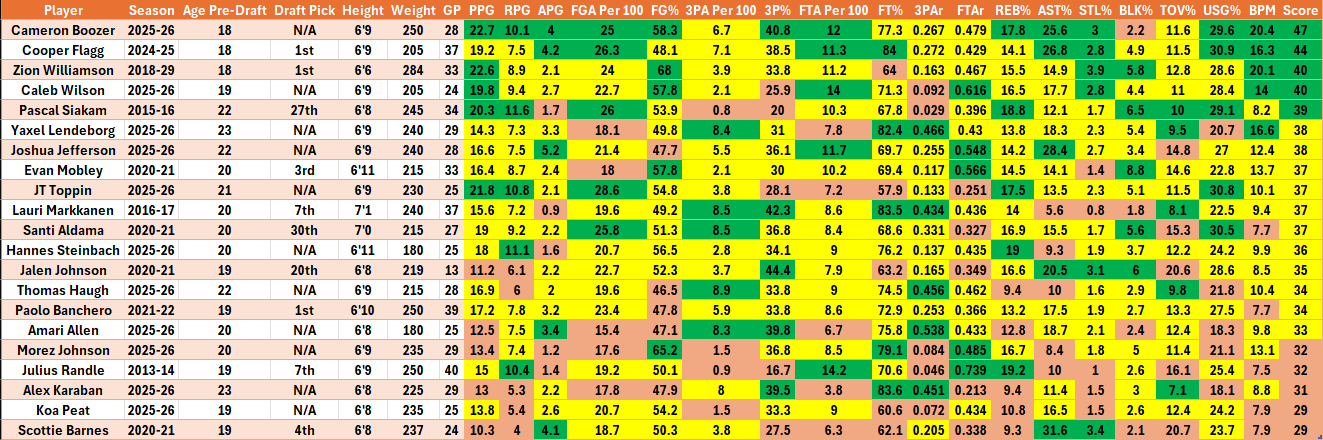
What I’ll be charting below is simple: I took both box score and Synergy metrics that showcase Boozer’s versatility as a forward, accounting for both offense and defense, and ran them up against his 2026 peers and current NBA power forwards that are inside the Top 100 in Box Plus/Minus as a catch-all to best determine who is currently producing at a high level.
I decided to add a “score” at the end to try to simplify things and create a statistical ranking for how this group is currently performing, and who is standing out the most. “Green” would stand for three points (top third in the group in the statistical category), “Yellow” stands for two points, and “Red” stands for just one point for being in the bottom third of the category.
First, we have Boozer against his 2026 peers both in terms of box-score metrics AND Synergy ratings/percentiles:


There’s a diverse group of forwards present in this comparison. Some, like Yaxel Lendeborg and Amari Allen, are playing multiple positions for their respective college teams due to the diversity in their offensive skill sets. Others are playing “up” in position and even playing some center for their squads.
But when running all of the numbers together, there just isn’t another player at his position close to doing what Boozer is across the board. The only red-flag area for Boozer against other forwards, both on these charts and the ones to come, is block rating, meaning he isn’t accounting for a significant enough percentage of his team’s blocked shots while he’s on the floor in relation to his peers. I’ve already dove into why that’s the case with my defensive concerns above, but nevertheless, it’s still a red flag that lends to the questions surrounding Boozer’s translation on that end of the floor.
Still, when factoring in his usage and effectiveness across the board in nearly every tracked play type imaginable, it statistically backs up everything I outlined about how excellent his offensive skill set is. It’s one thing to look at the numbers and be in awe, but having the context around just how good Boozer is on tape makes those numbers pop off the page in a completely different way.
Now, pretty much every evaluator has had some sort of gap between Boozer and the other forwards in the class (although Caleb Wilson’s freshman season needs to be appreciated quite a bit more). But what about Boozer against the best forwards the NBA has to offer who have played college basketball over the last 15 years?


In the 2019 NBA Draft, Zion Williamson was a runaway selection at number one overall for the New Orleans Pelicans. No other executive would’ve dreamed of taking another player at the top than the one who had arguably the most electric and productive college season since Anthony Davis did as a freshman at Kentucky.
Yet look at how Boozer’s production is clearing both Williamson AND last year’s top pick Cooper Flagg. This doesn’t outright mean that Boozer is worth being taken ahead of those players in a group drafting exercise where they’re all in the same draft pool (though it could), BUT it’s just mind-blowing that Boozer is lapping the field in its entirety, and the metrics aren’t even close when trying to put everything together.
So for the full contextual picture, here’s how Boozer fares overall against ALL of these forwards scored against each other in the same pool:

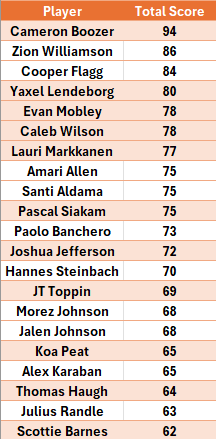
Again, the overall production is just staggering. Between pedigree, versatility, and production, there just hasn’t been a player like Boozer to enter the NBA in a long, long time. You really would have to go back to some all-time greats to put together resumes that compare to or exceed what Boozer is doing up to this point in his career.
Conclusion
At the end of the day, everyone is allowed to rank players as they see fit. Everyone’s draft philosophies are different. I can just share with those reading this how I best evaluate talent. I am looking for players who can dribble, pass, shoot, and don’t kill me on defense. Those players need to be physically ready and adaptable to the pro game in order to earn continuous minutes to develop.
Cameron Boozer is producing at levels far beyond that baseline that I look for in prospects, regardless of position—not to mention that he’s only 18, so his runway for development extends as long as any of these other freshmen that are entering the draft this season.
And now we come back to the premise of this piece: that Boozer is the “false ceiling” superstar of this draft. His run/jump athleticism won’t wow you. He’s not putting players on posters every trip down the floor. He may even get beaten on defense and let up some baskets that drive you nuts.
The “superstar” label is given out to NBA players who are perceived as “box office” and dominant on both ends of the floor. Dominance, to me, is consistently winning at every level and impacting the game in ways beyond just scoring points or putting the clamps on an opposing player. Without Boozer, Duke wouldn’t be arguably the best team in college basketball this season. Without Boozer, his HS, AAU, and FIBA teams wouldn’t have been nearly as successful. In turn, Boozer wouldn’t be able to do what he does without capable support systems that play off of his strengths. That’s completely fair. But Boozer is such a unique player that he stirs the drink without actually moving the stirrer around.
There are physical comparisons that we can try and throw out to Cam, such as his father, Carlos Boozer, Kevin Love, David Lee, and some others out there that I’ve seen, like Detroit Pistons Blake Griffin.
I just haven’t seen those other players dominate basketball in the way Boozer has before they got to the NBA, and had all of the requisite skills that he does at such a young age.
What we’re watching with Boozer isn’t normal by any stretch of the imagination. This guy is as special and unique as it gets.
So you can rank him third, fourth, fifth, etc., on your personal draft board. NBA teams can take him at those same spots. But don’t be surprised when Boozer keeps kicking ass and winning games in the NBA. Don’t be stopped in your tracks if he’s competing for an NBA Rookie of the Year award along with the other players near the top of the 2026 NBA Draft.
Cameron Boozer is a false ceiling superstar prospect if I’ve ever seen one.
This is very aligned with how I’ve been thinking about Booz lately. I have a hard time seeing how he can be any lower than 2 on anyone’s board.
The one question I’ve asked myself and hung myself up on a bit gets at some of your defensive questions. Basically if we knew it were true that Cam was a really bad defender in space, particularly in rotation on the perimeter, and that Scheyer was trying to implement a defensive system that covered for that, how much different would it look? Overall I think most of the defensive issues are likely to avoid fouling because Boozer foul trouble is one of the only ways Duke loses but that question does give me pause. Curious if you have thoughts.
TELL EM NATE TELL EM