


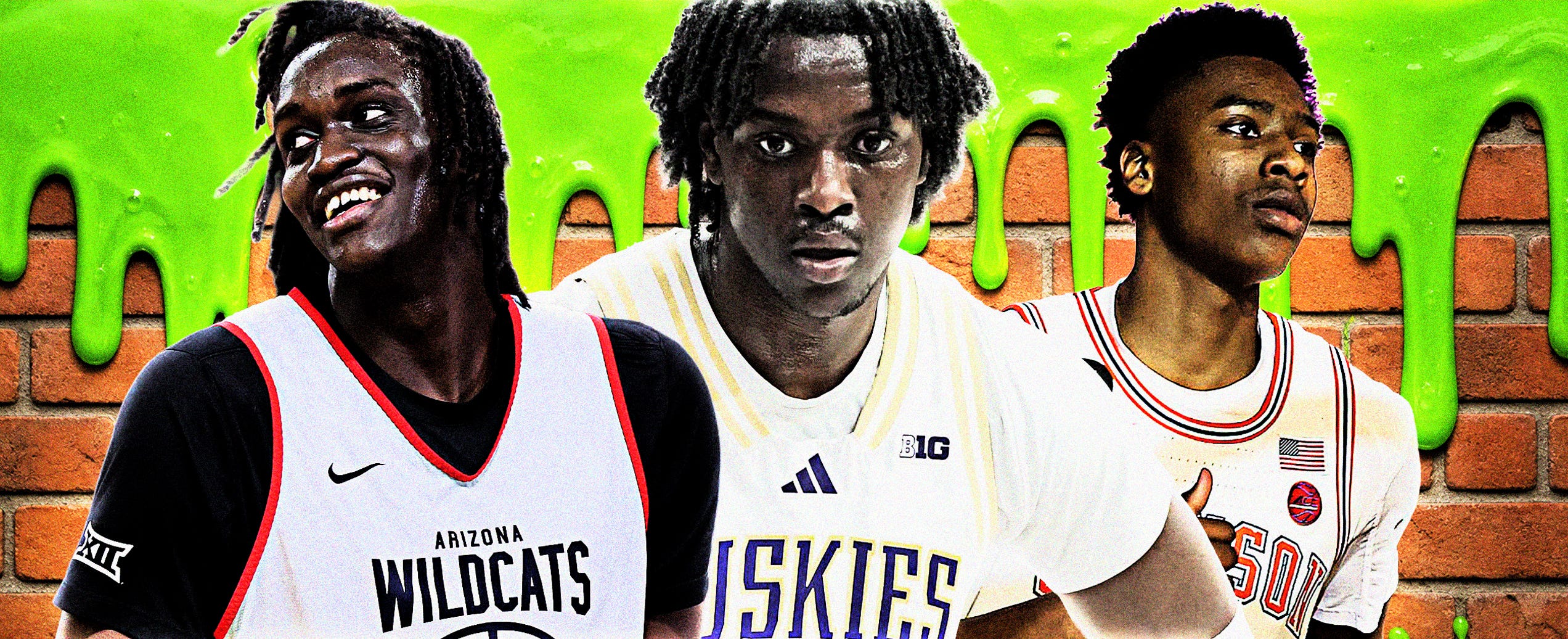
The coming 2026-2027 season has drawn some skepticism from both draft fans and analysts alike. You’ll hear things along the lines of “I mean, sure, there will be NBA players come out of this class, but it’s not very good.”
When I hear sentiments such as that, it makes me feel some sort of amalgam of frustrated and sad, but—mostly—motivated. Comments like that gas me up—gas me up to find players who can shine and thrive. Not to say that I’m right and everyone else is wrong, but it’s worth remembering that thousands of basketball players are about to play a full season of basketball.
I get what people mean when they call a class “weak” or “not very good.” They mean there’s no Cooper Flagg or Victor Wembanyama standing at the top of it, already announcing himself as a generational talent.
Fair enough.
But in 2024, I—along with the rest of you—was told that class wasn’t any good either. And I’m pretty sure I just watched Stephon Castle play a significant role on a team that went to the NBA Finals. Which isn’t to say there weren’t good players in that class all along—just that they hadn’t been found yet.
So, what’s my point here?
What we’re going to do here and in the following piece is highlight 15 players I’m leaning on to help shape the depth and quality of the 2027 NBA Draft. What I’m not going to do is pick at the top of the board. Top freshmen prospects will be covered elsewhere within No Ceilings—whether that’s here on the website or across our podcasts. Even the top returning prospects in this class won’t be covered here. To show there are plenty of prospects worth getting excited about, I want to focus on players who are primed to make “The Leap” into the consciousness of the greater basketball community (maybe not for all of you Sickos out there).
Five prospects were covered in Part One, five will be covered here in the second part, and five in the finale.
Let’s dive in!
Nolan Minessale | Guard/Wing | Junior | Marquette
Nolan Minessale tops the fictional list of “Low Major Prospect that People Can’t Wait to See Move Up a Level.”From Wisconsin, Nolan played his high school ball for Marquette University High School (I know), where he was named to multiple All-Conference Teams and a State Championship. Despite some success, Minessale wasn’t really recognized as an anything-star recruit by many reputable grassroots outlets. This led to him committing to play for St. Thomas. As a freshman, Nolan led the Summit League in blocks as a full-time starter. He returned for his sophomore season, where he averaged almost 20 PPG, 4.6 RPG, 4.3 APG, 1.6 SPG, and 0.6 BPG. This came on splits of 51/31/75. Minessale led the Tommies to their second consecutive 24-10 season, and then hit the transfer portal. Nolan opted to return to Wisconsin to play for Marquette University proper, for a team that is full of interesting and unique players.
What’s Working
Defensive Playmaking
One of the best parts of Minessale’s game is his defense. When you look at the defensive metrics, he checks a lot of boxes. He recorded a Steal Percentage of 3.1 and a Block Percentage of 2.0 as a 6’5” player. His length and strength allow him to stand out as a defender, as he is listed at around 200 pounds. Nolan has smart, quick hands that allow him to put his hands in the cookie jar to force turnovers on digs and poke-outs. He’s also vertically gifted, and he uses his lift and length to be a bother as a help-side rim protector. He can contest with either hand, and slides his feet very well for a backcourt player. Nolan’s anticipation and ability to toggle between his man, the ball, and the hoop is something you just can’t find every day at his position. For a guard/wing listed at 6’5” to lead any conference in college in blocks is quite an accomplishment, and that is something Minessale has done.
At-Rim Finishing
Because Nolan Minessale is such a tough and rugged athlete, he has proven to be a creative and resourceful finisher at the basket. Nolan’s squared-off upper body lets him absorb a high degree of contact. This is exemplified in the 27 And-Ones he recorded last season. While the physicality of his game stands out, Minessale also plays with a tremendous amount of patience. Despite being a backcourt player, Nolan plays well off two feet and has some slick counters to poke and prod at his defender. When you think about it, how many guards and wings are accustomed to being bludgeoned on the block? Of course, Nolan can make his way to the rim off of the bounce. When you look at how he ranked in the 88th percentile as the pick-and-roll ball-handler, and in the 88th percentile in scoring in isolation, Minessale can get to and score in a number of ways.
Decision-Making
For as much as Minessale is involved in the offense, he is very good at taking care of the ball. On his 31.6 Usage Percentage, Nolan had a 25.9 Assist Percentage to just a 13.7 Turnover Percentage. What makes his connectivity so impressive is that Nolan is utilized in so many areas on the court. When he’s backing other backcourt players down, Minessale can find open teammates for kickouts and on cuts. When he is handling the ball, he does a good job of finding guys out on the perimeter. He does a very good job of surveying the court when he is involved in the second action within the offense too, and does a solid job of making those next-level passes. While he isn’t likely to be the sort of player who shoulders the burden of the offense moving forward, Nolan is going to be additive as a processor and decision-maker for Marquette.
What Needs Work
Shooting
I covered this in Part One of this series, but pointing out that a player could improve as a shooter here isn’t meant to take an easy way out or to just go for the low-hanging fruit. But, especially for his position, Nolan Minessale really needs to make strides on his outside shot. Nolan shot 30% from deep on over eight attempts per 100 possessions. When looking at the shot on film, there isn’t a lot that looks out of place—speaking to just the body motion. The shot grouping is sporadic; it’s almost as if the strength or energy on the ball isn’t consistent. He does get a lot of lift on his jumper too, which makes him hard to block. The shot is high-arcing, which is sometimes a tell on a player’s touch—a high arc gives the ball a larger surface area to fall through for the shooter. His shot does take time to get off, which is likely the reason why he hasn’t found a way to hit it on the move. Nolan is one of those players who shot better when guarded as opposed to left open—which is always a tricky proposition to take a bet on.
Rebounding
For a player who is as tough as Nolan is—and as close as he likes to get to operate around the basket—he isn’t as high-level of a rebounder as one might think. His 13.8 Defensive Rebounding Percentage is fine, but his 2.9 Offensive Rebounding Percentage is slightly below average relative to players who have gone before him. With him playing at Marquette this season, there is a strong probability that there could be other areas of the game where he can expend his energy. Being able to be an impactful rebounder for his position would give Minessale the chance to separate himself from other guard/wing combo prospects.
What to Expect
As I touched on earlier, this season with the Golden Eagles is going to be the highest level of basketball that Nolan Minessale has ever played. With that in mind, knowing exactly what to expect is almost an impossibility. His strength and basketball IQ open a door to incredible possibilities. The way that he commits on the defensive end of the floor should endear him to the coaching staff and to his teammates. Combining that with his at-rim finishing and decision-making, there are ways that he can prove to be valuable on both ends of the floor. In Part One, I spoke to the fact that the players I’m highlighting are prospects who have drawn parallels to NBA players.
Minessale is interesting in a way because, analytically, his sophomore season had some similarities with Dylan Harper and Nickeil Alexander-Walker. His free-throw percentage, assists, and efficiency were close to what Harper did with Rutgers—he even showed a stronger free-throw rate and was better on his two-pointers. Harper did clear him on his threes and overall offensive contribution, though. For “NAW,” both had similar outputs in assists and steals. Nolan did have a stronger free-throw rate, but Alexander-Walker did generate more defensive events and was a better shooter. Those ceilings are very high for Minessale to clear, but he also put up a season similar to that of Tristen Newton when he was playing for ECU. Perhaps the journey for Nolan could be similar—or better! That said, it’s worth having him in second round territory to kick off the year considering the level of talent he’s come close to reaching, as well as what the film has shown.
Jackson Holcombe | Wing/Forward | Junior (RS) | Utah
Jackson Holcombe is a player who has punched his way up into being a new addition to the Utah Utes. As a high school player, he led Timpanogos High School to back-to-back 5A Championships. He was also named to the All-State First Team in his senior season. Following a successful high school stint, Jackson went on a two-year mission for The Church of Jesus Christ of Latter-day Saints. After completing the mission, Holcombe went to play for Utah Valley. He redshirted during the 2023-2024 season, then debuted in the 2024-2025 season with the Wolverines. Jackson played 31 games—starting once—and played under 15 MPG. Last year, he became a full-time starter, averaging 16.0 PPG, 7.0 RPG, 3.6 APG, 2.2 SPG, and 1.3 BPG on 30.1 MPG. After a breakout season, Jackson transferred but stayed in-state, committing to Utah.
What’s Working
Defensive Impact
For pretty obvious reasons, Jackson Holcombe is a player whose defensive film sneaks up on you—he appears unassuming upon first glance. However, it doesn’t take long when watching the tape to see how impactful he is. His footwork is remarkably sound and is what allows him to make such great plays on the ball. He does an awesome job of using his chest to wall off drives, and he can get vertical quickly—avoiding fouls and being a difficult obstacle to score over. He makes timely swipes and digs at the ball that result in steals and poke-outs. Not only can he block and contest shots, but Jackson is also adept at making clean rotations away from the ball to jump passing lanes and tip passes. Statistically, Holcombe was one of only three players (Allen Graves and Miles Byrd) who had a Steal Percentage and a Block Percentage of at least 4.0 among all players with a Minutes Percentage of at least 40.
Connectivity
For a player who spends a significant amount of time with the ball in his hands, Jackson Holcombe makes smart decisions as a passer. He is a great rebounder at his position, which he uses well in grab-and-go opportunities. Once he turns the corner after securing the ball, Holcombe keeps his head up to sling hit-ahead passes for easy transition points. Once the offense slows down, he can still find his teammates at a high level. He can make drives at the basket with his head up, and deliver kickouts into the shooting pocket of the open man. Utah Valley would also get the ball to Jackson on the elbow or on the block, and let him survey the court to spray the ball out to an open shooter from deep. He posted an Assist Percentage of 23.5 on 27.3 Usage, as well as a 1.5 Assist-to-Turnover Ratio. This level of decision-making is another wrinkle to his profile that makes him a fun sleeper to monitor.
Finishing
Jackson Holcombe is a consistent and dependable finisher. He is not one to shy away from contact, ranking in the 80th percentile in the percentage of his shots taken at the rim—66.5% of his shots, in fact, were at the rim. Holcombe shot 59.4% at the rim, which graded out as “Good,” per Synergy. Jackson’s strength that he shows on the defensive end also appears within his at-rim finishing. His squared-off upper body allows him to maintain his line of attack when he is driving to the basket. He does a great job of shielding the ball away from the defense while still being able to finish with contact. In fact, Jackson led his team by recording 11 more And-Ones than anyone else on his team last season, with 29. Holcombe’s finishing goes beyond being just a crafty finisher; he can finish above the rim. He makes timely cuts to the basket, as well as working his way around defenders, and uses his lift to dunk the ball. Jackson dunked the ball nine times on nine attempts in the half court—which is a great indicator of his finishing ability, even in a congested environment.
What Needs Work
Shooting
What happens to be Jackson Holcombe’s biggest area for improvement is his shooting ability. Last year, Jackson shot just over 15% from deep on just two attempts per 100 possessions. Both of those metrics are severely below average. Once you look at all of Holcombe’s shots from a season ago (it won’t take long; there are only 38), his mechanics don’t appear to be all that bad. The base is a skosh too skinny—but nothing alarming. Sometimes his feet are one in front of the other. HOWEVER, it’s not a horrendous shot at all. It’s a higher-arcing shot, which does present a larger area for the ball to drop through. There isn’t a funky hitch, there isn’t a knee-knock, the hands don’t flare out. It just hasn’t gone in. Honestly, there could be some small-sample-theory in play here, as Holcombe shot 33% the year before on just nine attempts. Maybe we just need to see Jackson shoot a little more to get a feel for how poor (or good) of a shooter he really is.
What to Expect
Jackson transferring from Utah Valley to the University of Utah is yet another example of a bigger fish in a bigger pond. He has a great opportunity to prove how scalable his skills are. Typically, rebounding and the ability to read the game travel well—which is great news for a player like Holcombe. His rebounding score for his position grades out well for my tracking—where he ranks in the 95th percentile in his position group. His size and effort should endear him to his coaches and his teammates. He is selfless and is more than willing to make the best play for the team—not just himself. I would expect Jackson to take more looks from beyond the arc in order to maintain spacing for others and to help the interest level from NBA teams.
When looking at how Holcombe produced last season in comparison to players who have come before him, he’s gotten close to some interesting names. Kenneth Lofton Jr. may not be the name you want to look to for comparisons in terms of body composition, but he was remarkably productive for Louisiana Tech. Both were very good in terms of assists and were similarly efficient inside the three-point line. Jackson Holcombe showed better consistency as a decision-maker. He was also stronger on the offensive glass. Cody Martin is another player who isn’t going to be at the front of the casual basketball fan’s mind, but he has enjoyed a seven-year NBA career. Identifying a player who blocked shots, moved the ball, and scored as efficiently as Cody did—while showing more aggressiveness on his drives and rebounding is how NBA teams win on the margin. Holcombe also drew the closest comparison to what David Punch did at TCU last season, and Punch is a player many like as a potential NBA prospect. With all of these factors, Jackson should be in mid-to-late second round range with another year of eligibility remaining.
Zoom Diallo | Guard/Wing | Junior | Kentucky
It’s interesting that a player who was once the top recruit out of the state of Washington—earning Gatorade Player of the Year honors in that state—has fallen out of the greater consciousness of the basketball community. It’s not unique to Zoom Diallo, but it has happened. Zoom came out in the 2024 class as a Top 50 recruit among the majority of grassroots scouting outlets. A McDonald’s All-American and multiple-time state champion, Diallo was recruited by some high-level programs such as Arizona, Kansas, Alabama, Gonzaga, UCLA, and USC. Zoom opted to stay home and play for Washington. He started 22 of 31 games as a freshman for the Huskies. He returned for his sophomore season and averaged 15.7 PPG, 4.5 APG, and 3.9 RPG on splits of 49/32/83. After the 16-17 finish to the season, Diallo entered the transfer portal and committed to play for the Kentucky Wildcats for the 2026-2027 season.
What’s Working
Advantage Creation
Zoom Diallo is a talented shot-maker and has an ability to work his way into advantageous positions. Diallo is more than capable as a ball-handler—a player who works his way to his favorite places by keeping the ball on the string and manipulating defenders around his teammates. He spent over 37% of his offensive possessions operating as a pick-and-roll ball-handler. On those possessions, Zoom ranked in the 87th percentile on points-per-possession out of that play type. His length at his size helps him keep the ball low to the ground. Diallo loves to work his way into the midrange, where he has been quite efficient. On his long two-pointers, Zoom shot just under 49% on 195 attempts. This shot is often looked at as a look that “unlocks” other aspects of scoring and passing. With his strength and ability to stop on a dime, Diallo forces his man—and the rest of the defense—to stay ready for a shot to go up at any time.
Passing
On top of being capable of snaking his way to his favorite spots, Zoom Diallo has shown a true knack for making sound plays as a passer. Zoom’s decision-making goes far beyond making safe “east-to-west” passes to string a play along. He does a good job of advancing the ball toward the basket. I touched on it earlier, but Diallo’s tendency and desire to operate in that midrange area of the floor opens up easier passing lanes. A collapsing defense can give openings for entry passes to bigs, lobs to cutting teammates, or even those escape-route passes to open people for a three-point opportunity. Zoom’s 30.3 Assist Percentage came on a Usage Rate of 28.5. This sort of decision-making capability provides much-needed relief within various lineups and gives more offensive pathways for Diallo to be of use.
What Needs Work
Floor Spacing
Zoom’s shooting isn’t a consistent weapon as of today. He shot under 32% from deep (which is below average) on 4.4 attempts per 100 possessions. The fact that Diallo hasn’t put up significant volume does signal that he isn’t the most confident in his three-ball. Looking at his shot, Diallo’s shooting form is pretty skinny from top to bottom. His base is narrow, and the release and supporting hand feel sort of rigid. On top of having a skinny base, Zoom does have a little twist at his waist—so what little balance he has as the shot is coming up is essentially zapped in unnecessary motion—not to mention that the mechanics look substantially different from when he is shooting from deep as opposed to a pull-up at the elbow. Something that stands out on the film is that, when he knows he is going to shoot the ball upon catch, the motion looks more natural and feels like it goes in at a higher clip than when he stops, surveys, and then puts up the shot.
Defensive Playmaking
On the other side of the floor, Zoom really has to find a way to make a somewhat consistent impact. It’s pretty surprising that Diallo put up such a small number of Stocks (steals + blocks) considering how strong and athletically gifted he is. For the season, he put up just 21 Stocks while having committed 87 fouls on defense. It feels like the majority of Zoom’s issues on this end come from fundamentals. When he is off the ball, he has a tendency to assume switch responsibilities—meaning that he’s willing to hand off his man without there being some overt communication with another teammate to switch assignments. He also overcommits in recovery. This leads to fouling on closeouts, biting on pump fakes to the point of granting wide-open driving lanes. There are also those frustrating fouls where he will reach out with his arms while remaining in his stance—no urgency in moving his feet to contest. To put it bluntly, these are fundamental blunders. When he’s on the ball, he competes. That’s good. But he is going to get backdoored to death if he doesn’t fix how he toggles between his man, the ball, and the basket more efficiently—and keep himself in a position to help without losing his assignment.
What to Expect
For Zoom Diallo, he’ll be in a new place this season, and he’ll be at a school to play for a coach who should be incredibly motivated to prove that he can get the most out of his players. This could be the perfect marriage, as Diallo figures to prove that he is the type of prospect many believed he would be out of high school. Kentucky will likely rely on the scoring acumen of Diallo. For the warts he has shown, Zoom is an efficient and savvy scorer. Coach Pope did a good job of coaching a team that scored well on their two-pointers. Inserting Zoom Diallo into an offense that wants to be efficient closer to the basket could be the thing that helps shape his scoring profile to be more NBA-esque. On top of the scoring punch he can provide the Wildcats, Diallo can definitely be additive as a passer and playmaker. His knack at finding teammates as a result of his scoring gravity is desirable and makes him an interesting offensive talent.
When looking at how his season went last year, Diallo drew some interesting and intriguing parallels to others. He produced similarly to that of Ryan Rollins when he was at Toledo in 2022. Rollins was better as a rebounder and a defender, but both had similar usage and shot similarly inside the three-point arc and out. Another fun name Zoom paralleled was Zyon Pullin in his 2021 UC Riverside season. Zyon was a better shooter from deep and a better defensive rebounder, but Zoom was better on the offensive glass, and his scoring usage was higher last year. Both also made plays for others at a similar clip.
These names aren’t thought of at the highest levels of NBA success, but Rollins has wedged his way into becoming a reliable and consistent NBA player, and Pullin feels as if he is right on the cusp of doing the same thing. Their archetype is a tough one to project—as evidenced by the aforementioned examples of success—but it’s still possible. Because of that, Diallo should still be respected and considered favorably as a legitimate NBA Draft prospect.
Zac Foster | Guard | Sophomore | Clemson
Zac Foster is a bit of a risky proposition in terms of projecting him to be a sleeper prospect in the 2026-2027 NBA Draft Cycle. Zac only played in 12 games last season—coming off the bench in all of them—due to a torn ACL in a game against South Carolina. In the games that he played, Foster averaged 6.9 PPG, 2.8 RPG, 2.5 APG, 0.4 SPG, and 0.3 BPG—on splits of 31/28/82. So, not only was he injured, but he was inefficient in his 18.7 MPG. Prior to playing for Clemson, Zac played for Woodward Academy in Georgia. In his junior year of high school, he was named to the All-Region team and was an All-State honorable mention in Georgia. In his senior season, Foster was named the Class AAAAA Player of the Year and was named to the All-State First Team in Georgia. He was considered a Top 75 player in his class and was recruited heavily by Georgia, Cincinnati, Virginia Tech, Mississippi State, and USF, but he ultimately committed to Clemson.
What’s Working
Decision-Making
Though we didn’t get to see much of him in multiple areas, Zac Foster has shown a propensity to make very good decisions as a decision-maker. Foster recorded an Assist-to-Turnover Ratio of 2.0. When he was on the court, he had an Assist Percentage of 26.2 on a Usage Rate of 26.3. Compare that to his 15.6 Turnover Percentage, and Foster has shown the ability to read and react to a defense at a solid level. One of the larger aspects of his passing that stands out is his patience. Sure, he can drive and attack a defense to an extent, but Zac has a level of maturity to recognize a collapsing defense and pivot out of the drive and find an open teammate. In his small sample of passing on film, there are glimmers of dropping slick bounce passes on the move to a rim-running big man—as well as one-handed whip-passes to teammates on the run. In the open court, when he can really show off his speed on the ball, he loves to look off cutters, too. It’ll be interesting to see how another year of experience and familiarity will help him show off more of his passing skill.
Athleticism
Typically, I try to steer away from using a player’s athleticism in pieces like this. When pointing to certain metrics that serve as athletic indicators of sorts, there are conflicting philosophies as to which ones are the best to use. The easiest thing to do is turn on the tape. Foster is a fun athlete—capable of really pushing the ball with his handle, speed, coordination, and balance. Once he turns the corner on the initial defender, the defense must be ready to rotate to slow Zac down. If not, Foster can bend and lean and contort his way around defenders and finish with flair. When looking at his total rebounding effort, he ranks in the 86th percentile among all guards.
What Needs Work
Shooting Volume
This is another tricky aspect of Zac’s game to project moving forward—largely because we just haven’t seen enough of him shooting the deep ball at a big enough sample size. On just 47 attempts, Foster shot under 28% from deep. His shot is a little sloppy upon analysis. There are times when the ball travels from his left pocket, up and around his right shoulder, and then he shoots. The upper parts of his mechanics are a bit rigid in the support arm, as well as the shooting arm. The entire motion feels a bit flicky—to the point where it feels like there is more of a lunge as the ball is coming off of his hands. It isn’t a soft landing for the ball, so the misses come high and far off of the rim. Now, he did take nearly 13 attempts from deep per 100 possessions, so maybe “volume” isn’t the most correct terminology, but Foster needs to rep out his shot for there to be any substantial confidence in him being able to shoot at a high level.
Strength and Frame
Zac Foster is going to have to make some strides in the strength department. Though he is listed at favorable dimensions, he does look more slight of frame on the tape. That strength component shows on the film and in the numbers; 36.9% of Foster’s shots came at the rim—which ranked in the 41st percentile. In terms of converting those shots, Zac ranked in just the 4th percentile in at-rim efficiency. In the halfcourt, he only converted 33.3% of his shots at the rim. This resulted in him having a free-throw rate of just 26.2. Some of this may just be comfort level. The film on Foster did, sometimes, show a player who would stop and survey—which allows the defense time to reset and brace themselves for any would-be angles of attack from the ball-handler. But what would cause this comfort level: processing and reacting, or lack of confidence in his strength? Something else entirely? It’s hard to know definitively, but the circumstantial evidence suggests it has something to do with Zac’s strength.
What to Expect
This is a bit of me “calling my shot,” so to speak, with Zac Foster. The biggest thing to factor into whatever calculus you choose is the ACL injury he suffered about eight months ago. There is no way to really know what level of play Foster will be able to display, but reports state that he hasn’t had any setbacks—and that he is “doing well.” Zac being well will make him an interesting Sophomore guard to monitor throughout the season. His athletic—almost instinct-driven—skillset should serve him well as he works on his body and the game slows down for him.
One interesting player who produced to a similar level as Zac Foster did last season was Caleb Love during his freshman season at UNC. Both had similar levels of efficiency from inside and outside the three-point line. Caleb Love had better turnover numbers and forced more turnovers from steals at a better rate. Foster, on the other hand, showed to be stronger on the glass and had a better Assist-to-Turnover Ratio. What’s interesting about Zac drawing close to Caleb Love is that Caleb was a slow build to becoming an intriguing NBA talent. Foster has an opportunity to do the same thing at the same rate—if not sooner. For this alone, Zac Foster has to be close to being listed as a second round talent.
Sidi Gueye | Big | Sophomore | Santa Clara
Closing out this piece is a prospect who may be an even bigger “calling my shot” play than Zac Foster: the now-Santa Clara Bronco Sidi Gueye. Gueye—from Senegal—came to Santa Clara after spending his freshman season with the Arizona Wildcats. A cool fact about Sidi is that he’s only played basketball since age 12, so less than seven years. Coming from Senegal, he played for Real Madrid prior to playing in the States. In perhaps Gueye’s biggest moment of exposure before college, he averaged 17.3 PPG, 8.7 RPG, and 1.7 BPG in the Adidas Next Gen U18 EuroLeague Finals. This led to him being selected to the All-Tournament team. This led Sidi to do something that many prominent international prospects do: commit to Arizona. In his lone season with the team, he played in 26 games. Though he played in a good number of games, it came while averaging 3.5 MPG—90 total minutes. In that time, Gueye averaged 1.3 PPG, 0.8 RPG, and 0.3 BPG.
What’s Working
Shot Blocking
In those 90 minutes Sidi Gueye played, he logged 10 blocks, per Synergy. For you math wizards out there—back me up here—that comes out to one block every nine minutes on the floor. Per 40 lovers, eat your heart out. Gueye’s tape shows a player who has awesome anticipatory skills and good fluidity. Having a reported 7’4” (+6) wingspan helps Sidi provide intriguing rim-protection ability, as he can high-point the ball or flip his hips in recovery and send shots off of the backboard. Even when you have the volume turned down on your film study, you can see Sidi directing traffic on the backline of the defense—showing awesome drop coverage instincts. Perhaps one of my favorite things that I’ve seen in his shot-blocking is that he can do it with either hand. Gueye’'s Block Percentage of 9.1 puts him in the same territory of players such as Flory Bidunga and above Tarris Reed Jr.—players who are considered prominent defensive-minded college big men.
Rim Running
I feel like I’ve pointed this out a couple of times at this point, but I want to (again) acknowledge that all of these projections and metrics are coming on a very small sample. That said, it’s still encouraging to see how natural Sidi Gueye looked as a rim-running play finisher in his limited playing time. Of all his shots, 77.8% were at the rim. This ranked in the 90th percentile in at-rim frequency. He converted 78.6% of those shots, which placed him in the 98th percentile in at-rim efficiency. Gueye has shown a couple of flashes of finishing around the rim with craft and touch, but he gets off the floor quickly. He looks to have good catching ability, which helps Sidi to be a credible lob threat. He has a motor that shows up on drives, as well as rebounding. His stride on cuts gives him advantages to establish position against the defense—which marries nicely with his quick, vertical ability.
What Needs Work
Decision-Making
There is certainly going to be opportunity to showcase more and better decision-making for Sidi Gueye, but the early flashes do show that he could stand to make strides in this area. Big men are asked to do more than ever with the ball and, if bigs cannot be trusted to have the offense extend through them, then their role will be restricted. To be fair to Sidi, he did post an Assist-to-Turnover Ratio of 1.0. That said, he did have an Assist Percentage of just 9.2, to a Turnover Percentage of just 20.1. The tape does show flashes of decent passes but, even on some credited assists, Gueye does show some potential struggles to find his teammates in stride and on target. For passes that are directly in front of him, or on some scripted reads, Gueye can do well. But there weren’t many times when he passed out of pressure, which obviously can alter the production for him. Some of that could be credited to inconsistent minutes and volatile lineups that he was rolled out with. If he takes on a larger role with Santa Clara, those tolerable takes could dwindle.
What to Expect
This season for Sidi Gueye is going to be interesting on a few levels. For one, the Broncos have another opportunity to bring in another former Wildcat prospect to see how good they can be. It’s also interesting because Gueye was a clear international prospect who just didn’t get a lot of runway due to playing on a team with championship aspirations. Santa Clara had some success with a player in Bukky Oboye, who has since transferred, so can they find a way to reshape their big man rotation with a completely new player? The Broncos are always a team that finds a way to be captivating.
When looking at how Gueye produced last season, he drew a strong parallel with a very fun name that makes Sidi a player to monitor: the 2022 season version of DaRon Holmes II. Both players had a similar Assist-to-Turnover Ratio, shot-blocking production, and offensive rebounding. DaRon was obviously a much more utilized scoring option in a significant role, but Gueye did show a high level of efficiency on his two-pointers and took better care of the ball. The biggest explanation for Sidi getting so close to a player like Holmes II is limited minutes, but it’s worth stating that his limited minutes could have gone in the other direction. With it being a possibility that Sidi Gueye could be on the level of DaRon Holmes II, he has to be in second round territory to start the season…at a minimum. The start of the season is the time to be bold and call your shots—so why not do it for a player like Gueye?
Follow me on Twitter: StephenGHoops
Catch me on BlueSky: StephenGHoops
Catch the Draft Sickos show LIVE on the No Ceilings NBA channel: