


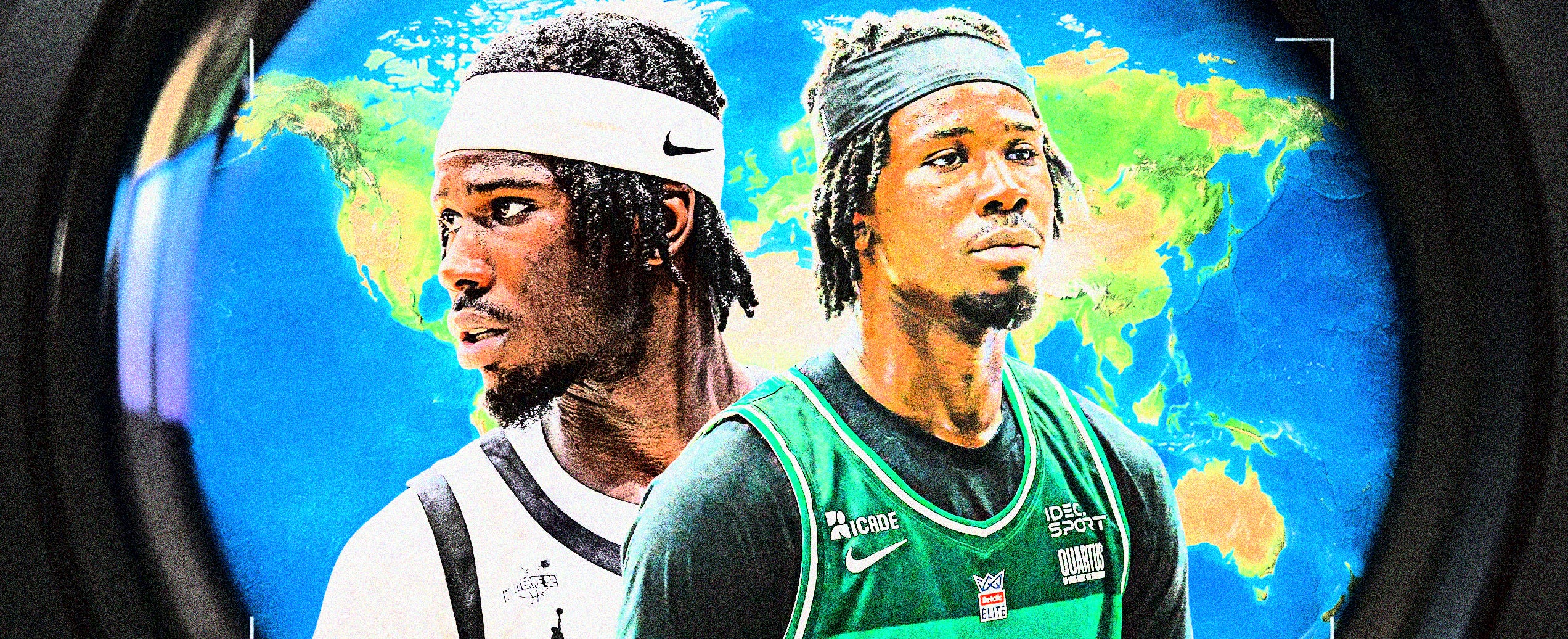
The 2027 NBA Draft cycle has so much going on this season that each subsection of prospects has its own fascinating storylines. The top of the class is where most of the heavy discussion will be had, and rightfully so. That is the most important part of scouting the draft: identifying the top talent. The returning class will have its own niche arguments: Who is the best returner? Who can be this class’s so-and-so? Can one of these returners make a push for the Top 3? Top 5? And so on.
You may have read my Five Offseason Findings piece from October 1st, where I mentioned that this crop of traditional international prospects could be the best group in quite some time. With that said, I thought it would be prudent to share my offseason findings on this particular group of prospects before the college basketball season (officially) kicks off on November 1st. While this was the goal, some of these will come out in the early onset of the college basketball season.
Keep in mind that when I say traditional international prospects, I mean those who were born outside of the States and are playing outside of the States—so Luigi Suigo won’t be in this series. Also, those who aren’t eligible for the 2027 NBA Draft won’t be included, so Joaquim Boumtje-Boumtje, Nikola Kusturica, and others won’t be mentioned.
Originally, this was going to be a two-part piece with five prospects per article, but there was simply too much to say about each of these guys to cram them together. Now, every prospect is getting his own installment of International Snapshot (yes, this group is kind of deep this year, folks).
Let’s dive in!
Hugo Yimga-Moukouri | JSF Nanterre | Wing/Forward | 6’8” | ~220
Most of the international prospects who will be covered in this Snapshot series have been returners—players we’re familiar with. Hugo Yimga-Moukouri is relatively “new” to the mainstream draft scene, despite having some international success. “HYM” earned a bronze medal at the 2023 FIBA U16 European Championship, silver at the 2025 FIBA U18 EuroBasket, and another bronze at the 2026 FIBA U18 EuroBasket.
At his size and at his age, it can be very easy to imagine how high his ceiling can be, and how NBA teams could value a player like Yimga-Moukouri.
Offense
Cerebro Sports has tracked more than 130 games played by Hugo and credits him with a usage percentage of 22.9%. In seven games logged through Synergy Sports, Hugo ranks in the 61st percentile, scoring 0.973 points per possession. These are encouraging metrics for a player who won’t turn 19 until July.
Physical Separation
Those who read my work know how much I value and prioritize physicality. At 18 years of age, the readiness or evidence of strength isn’t always there. When that is the case, the evaluation of a player’s psyche is the next best thing an evaluator can do.
Hugo (#1 in white) has great length, but he doesn’t have that Cameron Boozer or Caleb Wilson type of mass. However, that does not stop him from attacking the basket. Synergy shows that Yimga-Moukouri has spent about 30% of his possessions at the basket, and he’s finished 54.5% of those looks.
This clip shows exactly how Hugo is effective at the rim.
The ball gets to the right wing and works its way to the right corner. Hugo immediately gets into a pick-and-roll look and gets to work. While he isn’t the greatest ball-handler, HYM takes his man off the bounce and forces the defender off his spot with sheer force. Hugo’s shoulder work creates the requisite separation that gives him the space to get a floater off, which he finishes.
Drawing Contact
Part of the importance of initiating contact and creating separation is that it leads to drawing fouls.
Again, you can see in this clip that Hugo is a capable offensive threat in a straight line. We start out with the ball being driven to the left block, Nash-dribbled along the baseline, and kicked out to the right wing. The ball-handler then attacks the second side of the court off the bounce, which leaves Yimga-Moukouri open toward the top of the key.
One could argue that Hugo should have shot given the amount of space he had on the catch, but what happens next is pretty promising. He drives with his left, spins center, and extends past the reach of his man.
Now, Hugo doesn’t make the shot, but the pressure he puts on the compromised defense leads to a trip to the free-throw line. His aggressiveness and willingness to mix it up in the paint pay off.
Post Polish
What’s nice is that Yimga-Moukouri can attack the paint in a halfcourt setting, even when the defense is set. At his size, if he gets switched onto by a smaller guy, he has no problem taking advantage of that matchup on the block.
In this SLOB (sideline out-of-bounds) set, Hugo runs off a double screen to the right side of the floor and flashes across the paint to the left block. The ball is inbounded to HYM there, and he is manned up by a (slightly) smaller defender.
Hugo immediately gets after it, driving his left shoulder into his man and creating separation again. Simultaneously, as he is creating that space, Yimga-Moukouri hops to his right and gets off a right-handed push shot.
Savvy two points from Hugo, who finds an easy way to score.
Floor Spacing Potential
We’ve seen this story before: tall dude with tools who could be awesome…if he could be a consistent deep threat. Hugo figures to be such a prospect in this class.
We’ll start with him getting the ball at the top of the key. He gets into a pick-and-roll set, running his man off the screen set to his right. Hugo picks up the ball at the right elbow due to the double team. He finds his teammate at the free-throw line and backpedals out to the right wing. The ball is kicked back out to the top of the key for a potential pick-and-roll set.
This set opens a straight-line passing window to Hugo on the right wing. As soon as he catches the ball, Yimga-Moukouri steps into his shot and lets the three-pointer rip.
You’ll notice that the shooting base is a little skinny, and the shot is released over the shooting shoulder. There is a decent trajectory on the shot, and the motion isn’t super rigid, but it isn’t the most fluid, either.
When it goes in (Synergy has him at 31.3% on the season), it’s easy to see why people could be “in” on him.
What Misses Look Like
At his age, playing in a pro league, and with solid touch indicators (75.9% at the free-throw line), it’s easy to be high on the shot getting there for Hugo. Then again, the misses sort of show why there is reason to be a little skeptical.
We’ve already seen how quickly Yimga-Moukouri can opt out of shooting open shots. This clip starts with the ball on the left wing. Hugo is on the opposite end of the floor and runs off an elevator look. Now, the pass isn’t completely on target, but it gets there decently enough.
Hugo gathers the pass at the top of the key, steps into an open shot, and lets it fly.
The ball misses off the back-right portion of the rim. Notice how different the trajectory of the shot is in this clip compared to the prior one. It’s quite flat, relatively speaking. Also, the skinny base stepping into the shot gives him far less balance, which gives way to a wider shot grouping. This is likely the culprit as to why Hugo is a better shooter off the catch (32.1%) than off the bounce (25.0%).
That discrepancy really gives me the feeling that he is going to be more of a complementary player than an on-ball threat, but bigger wings and forwards develop in interesting ways; that’s why we take snapshots.
Connectivity
To get out in front of things, there aren’t a ton of examples of Hugo zipping the ball around all over the court. In fact, it’s safe to say that Yimga-Moukouri is settling into the “play finisher” category, with a need to grow as a playmaker for others. But there are traces—faint hints of promise—that could serve as a foundation for growth and development. This clip shows just that.
We’ll begin with the ball at the top of the key, and Hugo staged in the left corner. His team is running a pick-and-roll set, which leads to the ball being advanced into the restricted area. This causes the defense to converge on the ball and protect the rim. Yimga-Moukouri is wide open in the corner and presents himself to his teammate.
Notice how the defense is set before the pass is thrown: two men on the ball and one man playing between Hugo in the corner and his teammate on the wing. Hugo recognizes that if he gets the ball, his teammate on the wing will have either an open shot or an open driving lane.
As soon as Hugo gets the ball, he swings it to the wing—while in mid-air, mind you. The ball is driven to the paint, and the basket is made. Heads-up play by Hugo.
Connection Lost
Unfortunately, those looks are few and far between at the moment. In the nine games Synergy credits Hugo with (97 total possessions), he has only four assists to 10 turnovers.
Finding examples of passing decisions gone wrong was pretty tough. Simply put: Hugo isn’t doing a ton of playmaking. His passes come mainly through the natural flow of the offense and aren’t something being leveraged to create open looks for teammates. Of his 10 turnovers, only two could be credited to his passing, and one was him diving on the floor to save the ball and throwing it while lying on his back.
This clip is the other.
We’ll start with the opposing team shooting the ball, which leads to Hugo getting the rebound off the miss. Hugo looks to attack off the bounce and is met by a defender. It’s quick, but we can see that he isn’t comfortable here. He takes an awkward step and throws an errant pass that goes out of bounds.
Through the film dive, it appears that making plays out of a live dribble is still a work in progress.
Defense
For young wings and forwards, it can take time to become impactful defenders. In fact, sometimes half of the battle is having the tools to be solid on that end of the court. Yimga-Moukouri has the tools to be just that.
Role Encapsulated
For Hugo, this clip encapsulates what teams should expect from him, at least in the short term. The opposing team begins this play with the ball at the top of the key, getting into a pick-and-roll look. Hugo’s man is in the right corner, opposite of where this play is designed to go. This places Hugo in help.
As the play develops, the ball is doubled quickly, which results in the dive man rolling to the rim. Hugo places himself between his man and the roller in order to contest a potential shot at the basket.
But the ball isn’t advanced into the paint. Instead, it’s swung to the right wing and then to the corner—to Hugo’s man. Hugo is able to quickly rotate back to his man in the corner, chopping his feet on the closeout and contesting the attempted three-pointer without fouling.
This play is a great snapshot (if you will) of how Yimga-Moukouri could be utilized: as a long and capable team defender.
Walling Off
The previous play shows how active Hugo can be off the ball and how much ground he can cover. What we will see here is an example of how well he can defend on the ball.
The offense kicks off this clip with a high screen set well outside the three-point line. Hugo’s man is in the strong-side corner, as the offense is running a pick-and-roll to the right side of the floor. The ball-handler tries to pass the ball over the top of the defense, but the pass is tipped. The roll man recovers the ball for the offense and passes it to Yimga-Moukouri’s man on the perimeter.
The roll man comes out and sets a screen to the ball handler’s right, looking to free his teammate from Hugo’s pressure. Hugo does a fantastic job of getting skinny over the top of the screen and staying in step with his man. The ball handler even tries to create separation from Hugo with his shoulder, but Hugo maintains his spot, gets vertical, and tracks the ball with his left hand—blocking the shot.
Unsatisfactory Footwork
The previous plays are examples of how Yimga-Moukouri could be a more impactful defender long term, but unfortunately, those possessions aren’t as consistent as you’d like to see. This clip shows a bit of that.
The ball is toward the top of the key to kick this play off, with Hugo defending his man in the left corner. The offense sets a screen on the wing for a cut to the middle of the paint. This causes the defense to collapse to the middle of the floor, which opens up the next screen, set on Yimga-Moukouri.
The down screen allows Hugo’s man to catch the pass clean on the right wing, but Hugo does a solid job of recovering to get back into position. The screener from the down screen comes back and sets a screen to the ball handler’s right. This causes Hugo to think ahead a bit too much.
Likely because he’s a bit slim, Hugo looks as if he is bracing to fight over the screen, almost thinking ahead to what may come. The slight weight shift to his left immediately takes him out of the play, as Hugo’s man drives left, establishing and maintaining position as he gets to a lefty layup.
The fundamentals and even the frame aren’t where they need to be for Yimga-Moukouri to be a positive defender right now. Cleaner footwork and added strength will be necessary for him to reach his higher-end outcome.
Initial Thoughts
Hugo Yimga-Moukouri is a prospect whom a lot of people have fancied as the best or second-best international prospect who could be available in the 2027 NBA Draft class, and I have been in that grouping as well. A lot of this is due to his age, his size, and the fact that he’s playing professional basketball. There is also a bit of a scarcity tax factored in; there are only so many players his size who can move and be as effective on offense as he can.
But he isn’t a perfect prospect. In fact, he’s not close. BUT, there are encouraging signs. His ability to finish on straight-line drives is promising. There is also a promising shooting outcome with him. What must improve is the handle; even making it more functional on stampede actions and tight closeouts would be a huge step in his development. I don’t feel confident saying that he is a poor passer or decision-maker, mainly because the sample size isn’t there this year. It’s great that his passes aren’t leading to turnovers, but he is essentially a play finisher exclusively because he isn’t really moving the ball. Sometimes you can live with a quarterback throwing 10 interceptions if he’s throwing 50 touchdowns…you know what I mean?
Defensively, there is a lot of work to do in the fundamentals and strength departments. But we shouldn’t throw out the fact that he is competing in a professional league. Traits are equally important on defense, and it’s hard to know what sort of coaching is taking place. Most of the time he is getting scored on, it’s because he is coming out of deep help and is constantly fighting out of a recovery state. While he is responsible for his development, part of me wonders how much of it is him simply doing what is being asked of him.
All in all, there is enough to be excited about. Based on what I have seen, should he come out, I would bet that he is drafted predominantly out of intrigue. A team could fantasize about “getting their hands on him” and teaching him its scheme and philosophy. While many people wrote Zaccharie Risacher off because Atlanta moved on from him, he has shown some improvement on defense, rebounding, and playmaking with his new team in Dallas. He was drafted at 19 years of age, while still having a lot of his game to improve.
Teams will give Hugo real looks whenever he decides to come out, so it’s worth remembering that when scouting him this season.
Let’s pencil him into the bottom part of the first round, shall we?
Questions for the Podcast?: thedraftsickos@gmail.com
Follow me on Twitter: StephenGHoops
Catch me on BlueSky: StephenGHoops
Catch the Draft Sickos show LIVE on the No Ceilings NBA channel: