


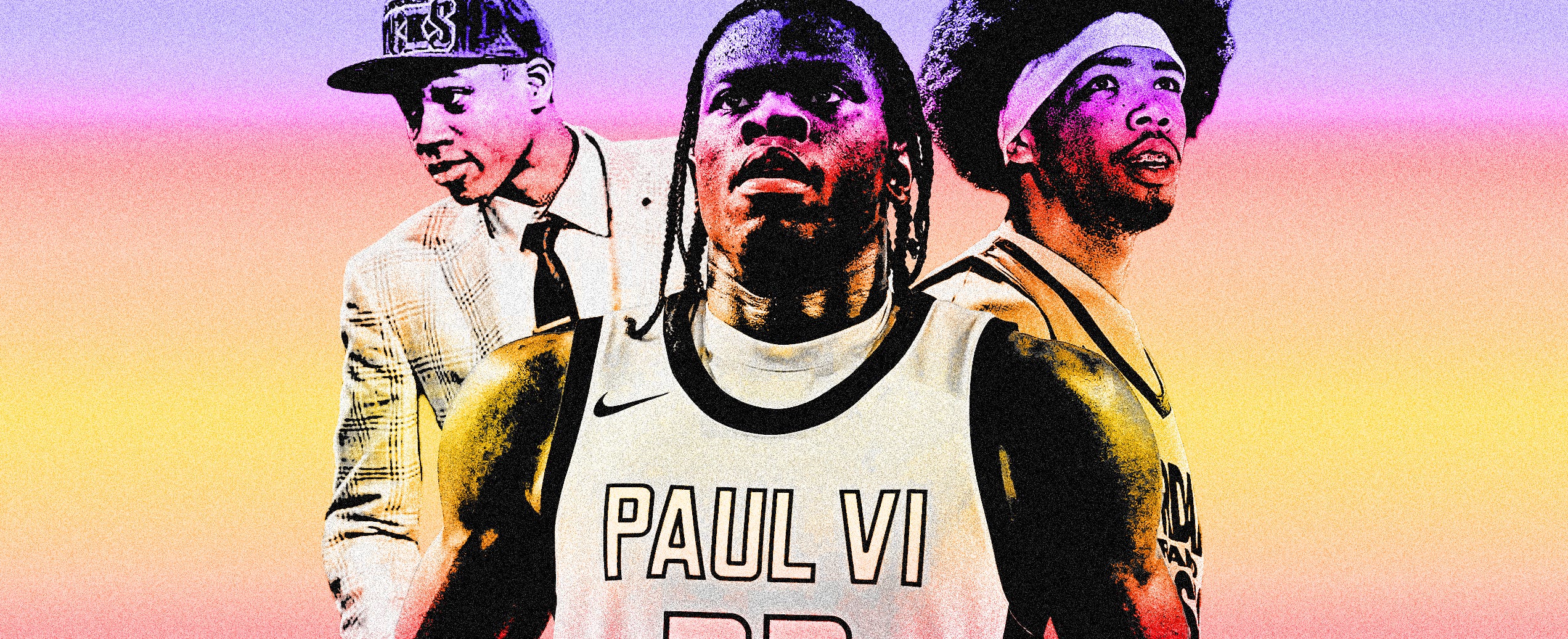
Last season, I shared some of my major offseason findings while preparing for the 2026 NBA Draft class. While some of the names I included didn’t pan out the way I anticipated, I was pretty satisfied with my overarching “findings.” Feel free to go back and read the article from last October, but below is the TL;DR listing for last season:
Is This Class Barren on Big Men?
The Guards WILL Heavily Impact the Quality of this Draft Class!
Is This the Year of the Returners?
Who Are the International Men of Mystery?
There Are Parallels to the 2023 NBA Draft Class!
There may be some who argue with the classification of some players but, by my count, four big men were drafted in the first round of the 2026 NBA Draft. Only one of them (Aday Mara) was taken in the lottery, at 12th overall. The guards did, in fact, heavily influence the draft, with five of the first ten picks being guards. As far as returning prospects, the first multi-year college prospect wasn’t taken until the ninth pick, and they made up only 13 of the first 30 picks. So, the answer to the “Year of the Returner” question was not as much of a “yes” as I anticipated.
For the international class, just two “traditional” international prospects were taken in the first round, the first not coming until pick 21 (Karim Lopez). The next was Sergio De Larrea at pick 25. As far as the 2026 class resembling the 2023 class, it’s too early to say whether it will age the same way. But the premise I built the comparison on (a clear “Big Three” at the top) didn’t hold. Caleb Wilson quickly jumped not only to the top tier on my board, but he was valued highly by consensus by year’s end.
All in all, tracking from October to June, several of my findings held up, and a couple of them missed. So, I am excited to completely whiff on this year! Just kidding; this article is going to have a strong run as well. Let’s get into it!
Here are the FIVE things you need to know about the 2027 NBA Draft Class!
1. The Top Spot is WIDE Open!
The same thing could have been said about last season’s draft class, but there is a reason why I want to emphasize this point this season. For one, this class has already been tagged as “weak” or “not very good.” I don’t know why that offends me, but it does. That said, I do want to acknowledge that this class is different from the two classes that came before it. I’ve spoken about this on pods, but there just isn’t a “mountain top” player. There’s no one who is the obvious “Hey! Look over here! I’m a generational prospect” type of guy. Think Cooper Flagg or Victor Wembanyama as prospects who fit that billing. This class doesn’t have that type of player, but someone (or someone-s) is going to rise above perception.
Tyran Stokes leads many boards within this class, and he currently sits at the top of mine. Stokes has a lot of the things people look for in a top pick. He has good size, listed at 6’8” and 230 pounds. He is a smooth operator with the ball in his hands, he likes to pressure the rim, and he uses his body well to create separation. He also shows a ton of potential as a facilitator. The biggest questions for me are going to come on the defensive end, as well as how much his supporting cast at Kansas will let him show.
Outside of Stokes, there are a number of players vying to throw their hats into the ring. Jordan Smith Jr. is one such player. Smith Jr. will be playing at Arkansas this season, joining JJ Andrews, Miikka Muurinen, and Abdou Toure, who have all garnered a significant amount of interest in their own right. With Smith Jr., his frame, athleticism, at-rim finishing, and defense at his position stand out in a unique way. On the other side of things, Smith doesn’t come in with the most reliable jumper. Nor has he shown himself to be a true setup guard. Given his size (6’2” and 200 pounds) at the guard position, those areas of his game present interesting challenges.
Caleb Holt is almost the polar opposite of Jordan Smith Jr. as a guard prospect. Holt’s jumper is going to be one of the most anticipated aspects of any prospect in the class. It’s smooth and repeatable, and he can shoot off-platform. On top of that, he has a handle that allows him to get to his favorite areas of the court. While Smith Jr. is a bit undersized for his position, Holt offers more in the height department (listed at 6’5”). As a passer, Caleb is more of a connective guy, and he will have to flash more at Arizona to be the top guy in this class. He also gives a lot of effort on the defensive end, even if that effort yields defense that is a tier below Smith Jr.’s.
Those three players are generally viewed as the Top 3 within this class, give or take a name. BUT, the next group is wide open. While you may see names like Cameron Williams, Bruce Branch III, Anthony Thompson, Quentin Coleman, Colben Landrew, or Christian Collins prominently featured in that next group, I’ll drop a dark horse candidate I have already written about for the site: Arafan Diane.
Diane will play for Houston, and he has reportedly gone from weighing over 300 pounds to being in the mid-280s. Even at that 300-plus listing, Diane showed off good footwork, shooting touch, budding playmaking, and rim protection. If there was ever a class to come into the cycle high on a young-to-the-game, high-upside bet, it would be this one. Arafan Diane offers something you won’t be able to duplicate with anyone else in this class.
2. The Wings/Forwards WILL Define this Draft Class!
Last season, I expertly predicted how the guards in the 2026 NBA Draft class would heavily influence its quality. And that was before anyone knew Kingston Flemings, Keaton Wagler, or Ebuka Okorie were ready to contribute to that premonition. This year, I’m anticipating that the wings and forwards will make up the identity of this class, and I’m not trying to pick two positions to “sweeten my odds.” It’s more about how people may define certain prospects.
Much like last year, I’m going to avoid “double tapping” prospects in these position sections, meaning writing about them in multiple sections. So, Tyran Stokes won’t get an additional breakdown here.
We’ll kick things off with Bruce Branch III. So long as BYU has a competent offense (and there’s no reason to doubt them), Bruce should have a good season. His game comes easy to him. The jumper is fluid, and the shot falls softly. His handle is good enough for him to get where he wants to go. His passing and vision are better than expected, and he has good size (around 6’7” and 195 pounds). His game has already been compared to bucket-getters who aren’t quite stars: Devin Vassell, Andrew Wiggins, Brandon Miller, etc. He’ll need to show more aggression in the paint and fill out his frame to become the sort of defender who can be a hands-down starter.
Colben Landrew’s high school ranking differs significantly from where many scouts have him. Landrew had incredible seasons playing in the state of Georgia, and found his way into the Top 25 of most recruiting outlets. He plays with a fun and unique blend of finesse and strength thanks to his frame (listed at 6’6” and 236 pounds). He does a great job of using his body to create separation, and he can finish with, through, and around contact. He has a knack for breaking his defender down off the bounce and prodding his way into the paint. While he was a natural and forceful scorer, Colben also showed some fun playmaking chops. Unique to this position group, his conditioning and slimming down are among the more interesting things to monitor. Should he be able to do that, Colben should be better on the defensive end, and perhaps even more dynamic on offense.
The next prospect is a player I am a bit higher on than where I have seen him ranked this offseason. And, look, he’s not a secret, but he is often ranked lower than one of his new teammates. It’s Abdou Toure. Toure is listed at 6’5” and 215 pounds, and he plays with a ton of go. He’s always working toward the rim, using physicality to finish. Abdou has a jumper that looks pretty reliable, with a nice high release and good lift. He is an awesome athlete, and it shows on defense. He takes away his man’s airspace. He rotates well. There is good anticipation and a knack for making his matchups uncomfortable. He’ll need to show some trustworthiness as a handler, but he has some fun dribble-drive stuff on his film, as well as some connective passing.
Anthony Thompson, JJ Andrews, Cameron Williams, Christian Collins, Austin Goosby, Josh Irving, Maximo Adams, and Chase Foster are among the other freshmen worth dog-earing as prospects who could play above expectations within this position group.
3. Are Traditional International Prospects Back?
For those who may be confused, what I mean by “Traditional International Prospects” is players born outside the United States who will play for an international team during their draft year. An example from last season was Karim Lopez, the Mexican-born prospect who played in the NBL before being drafted 21st. So, while Hannes Steinbach and Aday Mara were born outside the States, they played college ball last season, so they wouldn’t be considered for this category.
Last season’s crop of traditional international players wasn’t that deep. Lopez was the first such prospect drafted, and Sergio De Larrea joined him as the only two traditional international prospects taken in the first round. Beyond them, just four more were taken in the draft altogether, with three of those taken within the last five picks of the Second Round.
But this year figures to feature more prominent talent that could be taken earlier than the 21st pick in the 2027 NBA Draft.
The headliner for this group of prospects is Stefan Joksimovic. Most boards have the young Slovenian (he turns 18 in November) somewhere in their Top 10, and many have him in their Top 5. Playing for Baskonia, Joksimovic plays with a ton of poise for his age. A lefty, he is comfortable operating with the ball in his hands. His pacing and handling suggest that his pick-and-roll ability is going to translate at a high level. As a passer, Joksimovic shows some very fun flashes. His pass placement is encouraging. His ability to pass off the bounce, or as soon as he receives a pass, is rare within the ‘27 class. Even on defense, should he clean up some teachable things (footwork and rotational ideals), Stefan could be a positive on that end. His role and minutes share are going to be under a magnifying glass, as is often the case with young, budding stars playing international hoops. Also, the jumper isn’t where it should be. If the shot is going to be inconsistent, à la Luka Doncic, he’ll have to be excellent across pretty much every other aspect of the game.
A player who was thought to be a major part of the ‘26 class but opted to run it back this season is Dash Daniels. Dash’s decision not to declare last season impacted the depth and quality of last year’s traditional international prospects. But he looks primed to be a factor this season. He has gotten off to a solid start, looking more filled out and NBA-ready in terms of his frame. Dash is a frenetic defender who is adept at forcing events. He has great recovery tools and anticipates where the ball is going better than most. Players looking to pass cannot just assume the ball will find its way to their teammates, as Daniels will jump lanes, make digs, or even poke the ball out of a live dribble. On offense, Dash is better as a catch-and-go driver and decision-maker. When he has to create against a set defense, his processing can stagnate, and his reads aren’t as crisp. He’s working to improve his jumper, relying on a high-arching shot, which helps players without natural shooting touch since the ball has a greater surface area to fall through. That jumper and his decision-making are going to be the keys to fortifying his draft stock.
There are some interesting returning traditional international prospects worth monitoring this season. Pavle Backo, Marc-Owen Fodzo Dada, and Adam Atamna were popular names at various points of the ‘26 cycle, and they are back for another crack at things. There are also some newer names to keep an eye on this year, headlined by Cameron Houindo, Cheickh Niang, and Klark Riethauser. Someone who played in the States last season and opted to go back to Europe is former Gonzaga guard Mario Saint-Supery. There is a possibility that returning overseas helps him quietly rebuild his draft stock.
The impact of NIL has brought some of the more premier names from overseas stateside. Joaquim Boumtje-Boumtje, who committed to the Duke Blue Devils, is a bit of a wunderkind and will not be eligible for the 2027 NBA Draft. The NBA requires prospects to turn 19 during the calendar year of the draft, and Boumtje Boumtje won’t turn 19 until May 30, 2028. Despite not being able to declare, the young big is certainly going to be worth monitoring. One big who is eligible this season and came stateside is Luigi Suigo. After a year with Mega, Suigo will play at Villanova this season. At his size, Luigi is an intriguing prospect because he can finish at the rim, space the floor, and pass. He’ll need to answer questions about his mobility and defense to quell his critics.
The final international prospect who chose college and is worth keeping an eye on this season is Sayon Keita. Keita, a 7’1”, 205-pound big from Mali, will play for UNC and coach Michael Malone after spending a season with FC Barcelona. Sayon offers a ton of energy on both sides of the floor. Defensively, Keita moves his feet well and forces a ton of defensive events despite not being overly aggressive. On offense, he’s a scary lob threat who gives multiple efforts on the offensive glass. He lacks some natural touch at the rim, which can limit him as a play finisher in the dunker spot. He also isn’t the best decision-maker or dribbler, both of which have become increasingly important for big men. Given the experience Coach Malone brings from coaching one of the best NBA big men of all time in Nikola Jokic, perhaps we can see Keita grow in some of his areas of weakness.
4. Another Year of Returners Taking a Back Seat?
Given the flatness of this class, there will be some who think the 2027 NBA Draft could open the door for a returning prospect to become a high draft pick.
Braylon Mullins is back at UConn this season, and plenty of people are still “in” on him for his sophomore run. Mullins was billed as one of the better shooting prospects last season, and went on to shoot just under 34% from deep on 14 attempts per 100 possessions. Mullins showed some interesting defensive flashes, but he needed to get better at attacking the rim and making better, more consistent decisions with the ball. UConn is loaded this season with other notable returners in Nik Khamenia, Silas Demary Jr., and Najai Hines, so it will be interesting to see how Braylon is able to shine with other mouths to feed.
Thomas Haugh is perhaps the most accomplished returner in all of college basketball, and there is a high probability he would have been a first round pick had he stayed in the draft. Instead, Haugh will be back in Gainesville alongside fellow prominent returners Rueben Chinyelu and Alex Condon. Haugh spent a significant amount of time at the 3 last season, and that may be the case again this season. We saw him shoot more from deep, even off the bounce, where he shot nearly 33%. His defense, rebounding, and at-rim finishing continued to be mainstays of his arsenal, while his passing took a nice step in the right direction. Haugh’s biggest focus area is going to be the three-point shot. If he can polish that while Florida continues to win, we could see him be this year’s Yaxel Lendeborg.
Perhaps the prospect who can answer the most questions about his game this season is USC’s Alijah Arenas. Alijah was a top prospect but missed the majority of last season due to an unfortunate car accident. When he did play, it was clear he was working his way back into being comfortable and confident in his body on the floor. Arenas, the son of Gilbert Arenas, has an awesome handle and plays with good bend and lean. Like his father, Alijah can take and make tough shots, and he can leverage his shot-making into some fun passing plays. Along with showing that his athleticism is close to back (if not all the way back), Arenas needs to show a reliable jumper and prove that he can be trusted on the defensive end.
Beyond those three names, there is a slew of players people are excited to watch this season, and to see if they can capitalize on the flatness of this class.
Nik Khamenia, Motiejus Krivas, Ivan Kharchenkov, Billy Richmond III, Tyler Tanner, Milan Momcilovic, Matas Vokietaitis, Juke Harris, Amari Allen, Pat Ngongba, Shelton Henderson, Pryce Sandfort, Cruz Davis, Eric Reibe, David Mirkovic, JT Toppin: there are so many names who could legitimately push for a strong year. So, why might they take a back seat during the ‘27 cycle?
There are a couple of reasons. For one, none of these players are projected to be primary options. And that makes sense; otherwise, they would have been promised the world last year and been drafted accordingly. They all have prominent areas of concern. Khamenia very much played like a role player at Duke. Maybe he was just mishandled, but will Coach Hurley feature him as a top guy at UConn? Hard to say. Krivas has a strong game, but there are concerns about his consistency and whether he can be more than a complementary big. Can Ivan Kharchenkov, Billy Richmond III, or Shelton Henderson shoot it reliably? Can Tyler Tanner overcome height concerns and be a dynamic off-the-dribble shooter? I could go on, but you get my point: there are major areas of their games that need refinement. Did these guys refine their games?
The other major point worth mentioning is that returners naturally take more of a back seat; it’s just the way it goes. We saw it last June, when the first multi-year player in the 2026 class wasn’t taken until the ninth pick. Look back at the last notable class that was perceived to be “weak,” and the first multi-year player in the ‘24 class (Donovan Clingan) wasn’t taken until the seventh pick. You would have to go back to the 2013 class to find two multi-year players in the Top 3: Victor Oladipo went second, and Otto Porter went third. It may be hard for some of us to come to grips with this (I’ll put myself at the front of that line), but that was 13 years ago! Drafting strategies, and even the way basketball is played in the NBA, have changed so much in that time. In fact, most classes have been fairly strong ever since. Even the 2024 Draft, the “weak” class I just mentioned, produced a player who played a vital role in the Spurs reaching the NBA Finals. Shout out to Stephon Castle.
With that said, that brings me to my final point.
5. There Are Some Parallels to the 2013 NBA Draft Class
Last year, I drew parallels to the 2023 class. This year, I’m going back a full decade further. That’s not to say I believe two returning prospects are good enough to crack the Top 3 of this class, although I am already anticipating Pat Ngongba and Tyler Tanner being prominently featured on the personal boards of many draft fans based on their analytical cases. But I do feel like this class could produce some surprising selections based on preference. Tyran Stokes will come into this cycle as my #1 prospect, but I know some of my No Ceilings compatriots have a different player in that top slot. Jordan Smith Jr., Caleb Holt, and Stefan Joksimovic are other popular names you’ll see atop boards. But I would have Arafan Diane over anyone not named Tyran Stokes.
And the reason I would have Arafan Diane over all but one player is similar to the way so many scouts were allegedly “in” on Giannis Antetokounmpo in the 2013 NBA Draft class. Arafan brings traits that aren’t replicated by any other prospect in this class. I’m not anticipating an unexpected growth spurt, but his evaluation draws an interesting parallel to Giannis’s in that there isn’t as much film on him compared to his draft class peers.
But that sort of scarcity isn’t something I would typically lean into. So, why now?
I simply answer: Why not?
For one, it’s early. For the same reasons people were high on Justin Edwards and Cam Whitmore and were incorrect, I am going to lean on the work I have done this offseason. As my co-host, Jam, says on our pod: projection is the name of the game. Seeing what is and projecting what could be has been put on the back burner in the name of production. Don’t get me wrong: you have to be able to produce, but at this point of the cycle, it’s all projection. Some will call other projections more substantiated than mine on Diane, citing sample size.
But I would argue that even one year of college or high-level international hoops is also a small sample size, which is exactly why so many prospects don’t work out.
The other major reason I am leaning into scarcity is that the “scarcity bet” normally works out in these perceived “weaker” classes. And it makes sense. If consensus already thinks the class is weak and isn’t sold on the propped-up names, why not bet on the outlier?
The second-best player in the 2013 class was not taken until the 27th pick. I don’t anticipate that happening this year, for the reasons I laid out earlier (13 years later, strategies have improved, etc.), but I do think some of the best players in this class could be taken later than expected. Part of the reason is that the international class could be sneaky-good this year. Seven international prospects were taken in the first round of the 2013 NBA Draft. We could see a handful of them taken in the first round this season, and they could surprise the scouting world with how well they translate.
We also touched on how returning prospects were taken very high in that draft. Again, I’m not expecting multi-year college players to go in the Top 3, but they could make up a major part of this class’s identity.
This class will be the ideal one to test one’s craft and eye for talent. Different philosophies and takes will be perpetuated as the season goes on, and so many of them could be right! That’s what is going to make this cycle so fun. The uncertainty, the wide-openness, and the matchups will surely shake things up. And that’s without the surefire “out of nowhere” prospects who always pop up!
So, while this class may not have the “mountain top” prospect of prior seasons, scouts and evaluators will still be chasing that “mountain top” feeling. And that is what makes it all worthwhile.
Follow me on Twitter: StephenGHoops
Catch me on BlueSky: StephenGHoops
Catch the Draft Sickos show LIVE on the No Ceilings NBA channel: