


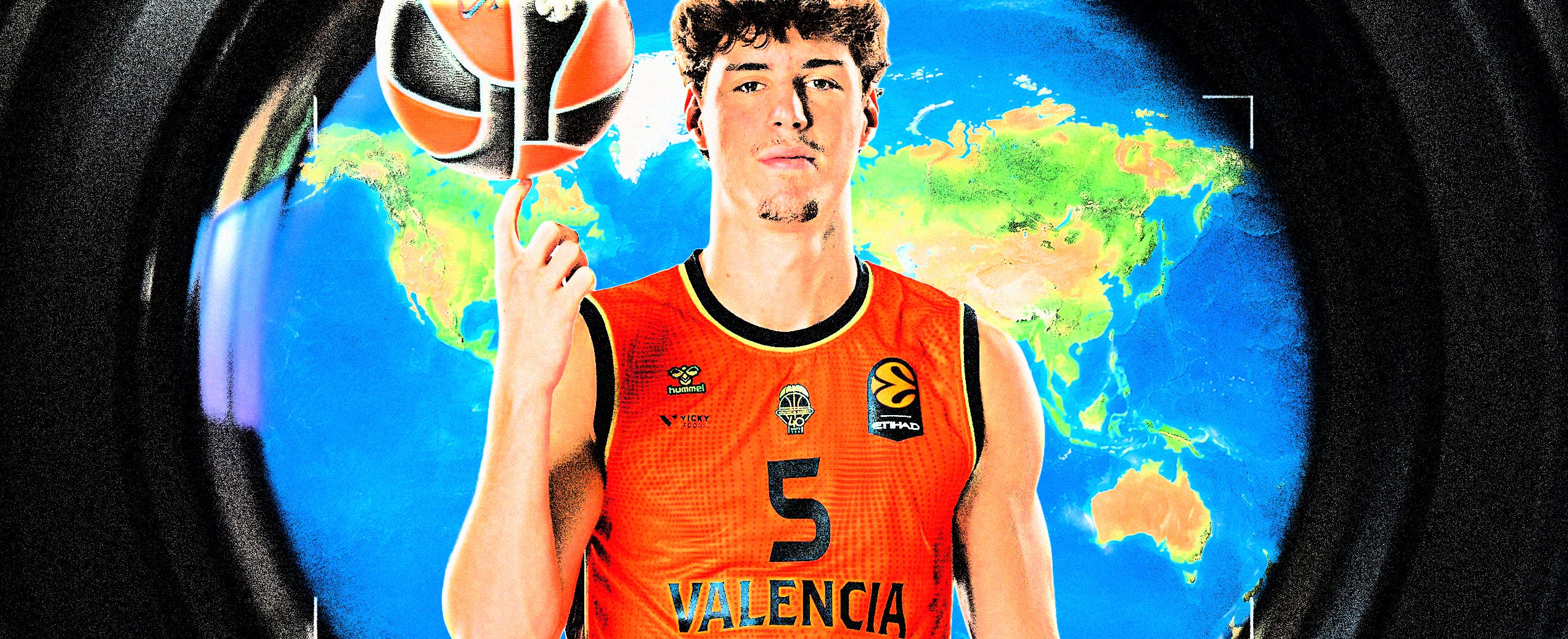
The 2027 NBA Draft cycle has so much going on this season that each subsection of prospects has its own fascinating storylines. The top of the class is where most of the heavy discussion will be had—and rightfully so. That is the most important part of scouting the draft: identifying the top talent. The returning class will have its own niche arguments: Who is the best returner? Who can be this class’s so-and-so? Can one of these returners make a push for the Top 3? Top 5? And so on.
You may have read my Five Offseason Findings piece from October 1st, where I mentioned that this crop of traditional international prospects could be the best group in quite some time. With that said, I thought it would be prudent to share my offseason findings on this particular group of prospects before the college basketball season (officially) kicks off on November 1st.
Keep in mind that when I say traditional international prospects, I mean those who were born outside of the States and are playing outside of the States. So Luigi Suigo won’t be in this series. Also, those who aren’t eligible for the 2027 NBA Draft won’t be included. So Joaquim Boumtje-Boumtje, Nikola Kusturica, and others won’t be mentioned.
Originally, this was going to be a two-part piece with five prospects per article. But there was simply too much to say about each of these guys to cram them together, so every prospect is getting his own installment of International Snapshot (yes, this group is kind of deep this year, folks).
Let’s dive in!
Mario Saint-Supery | Valencia Basket | Guard | 6’4” | 199
After spending a season with the Gonzaga Bulldogs, Mario Saint-Supery—one of the more intriguing returning prospects—opted to go back to Europe and play for Valencia Basket this season. On top of being named to the WCC All-Freshman Team last year, Saint-Supery was named to the All-Liga ACB Young Players team in 2025 and named MVP of the FIBA U16 European Championship in 2022, where Spain earned the silver medal. Spain also earned the silver medal at the U18 Championship in 2023 with Saint-Supery. Mario has earned such recognition due to the command he has on the ball, as well as the reads he can make.
Offense
The offensive side of the ball is where Mario butters his bread. With good size at the age of 20 (he turns 21 in April), there is a high level of feel to his game.
Organization
Mario Saint-Supery (#5 in white) feels comfortable operating with the ball, particularly with the assistance of a ball screen. We’ll start this clip off with Saint-Supery running up the middle of the paint, coming off a down screen. He then gets the pass at the top of the key, where he waits for the screen to be set to his right. Once the screen is established, Mario sets his man up to go square into the center of the screen—drawing the down defender to step out to the right wing.
From there, instincts take over. Mario takes the math that the defense is presenting him: two defenders on him and an open teammate gunning to the basket. It’s not just that Mario decides to pass the ball to the dive man, but how he elects to pass to him. Saint-Supery picks the ball up off a live dribble and passes it overhead—over the top of the down man and into the hands of the big man. The ball is then dunked for an easy bucket.
Great find.
Creative Passing Angles
It’s Mario’s creativity that sparks the interest of those who have watched him over the past few seasons. The way that he can make plays from essentially anywhere keeps defenses on their heels. Even in broken plays—such as the one below—Saint-Supery is a player who forces his teammates to play with their hands up at all times.
On this possession, we see Saint-Supery wrangle a missed shot for an offensive rebound. Once he gets the ball, Mario turns and attacks the baseline. His drive attracts the attention of the defensive big man. As he sees this, Saint-Supery gets into a layup motion, which forces the big to leave his feet and contest the potential shot. Mario is able to see that his big man is all alone with no defender between him and the basket. Mario slips a pass out of the shot to his big man, who is able to flip in the righty hook.
Synergistic Timing
Saint-Supery does a great job of understanding where his teammates are on the court, seemingly at all times. This play illuminates that notion. We start with a loose ball being corralled by the offense, then the ball finding its way into Mario’s hands on the right wing.
As he has a tendency to do, Mario takes a beat to see the defense and how his teammates are responding to it. It doesn’t take more than a moment for him to recognize he has an open man in the opposite corner. Saint-Supery’s hands are over his head while his guy is still in the opposite corner, which freezes the defense temporarily. His teammate sees this and then cuts baseline for a lob finish. The touch that Mario puts on this lob is telling, as it falls right where his cutter needs it to flush the dunk.
Too Much Sauce
As is the case for most players, Mario’s greatest strengths can translate into some frustrating results. We’ll take a look at an example of that here.
The ball starts off on the left side of the floor to kick off this clip, but then it works its way into Saint-Supery’s hands on the right side. Mario gets into a dribble combo as he waits for a screen to be set to his left. Once the screener is close (but not set), Mario rejects the screen and bursts to the rim.
The down man in the pick-and-roll coverage does a good job of cutting off Saint-Supery’s driving lane, which results in him having to make a play for someone else. Mario doesn’t go for just a run-of-the-mill pass. Oh no, he has too much sauce to simply dump the rock off. Instead, he goes for a behind-the-back pass. The lack of eye communication appears to cause the intended recipient to bobble the catch, leading to a turnover.
Tricky Finishing
The same sort of dichotomy that exists in Saint-Supery’s passing can rear its head in his at-rim finishing. In this clip, we’ll see Mario get the ball on the left wing off of a handoff. Once his big steps up into a screen stance, Saint-Supery darts to his right as the big slips. Mario is able to round the corner on his man and make his way to the paint.
Notice how Mario is able to initiate contact while he attacks the paint. His 6’4”, near-200-pound frame is able to hold up well in this professional league. After establishing his feet in the paint, Mario is able to stop, pivot, and fade over the top of the defense from the mid-post.
Making Things More Difficult Than Needed
The previous play exemplified how Mario Saint-Supery can use craft and feel to score in the paint. This play shows the opposite.
We’ll start this clip with Saint-Supery pushing the ball into a semi-transition look. As he gets past halfcourt, Mario draws the attention of both defenders coming off of the screen that was set. As he gets past one defender, another looks to make a play on the ball. Recognizing this, Saint-Supery elects to pick up the ball, swing it behind his back to his left hand, gather, and try to bank it in off a floater. This is an incredibly difficult look for Mario, and the ball rims out into the defense’s hands.
Floor Spacing
Last season with Gonzaga, Mario Saint-Supery shot over 40% from deep on over 115 attempts. He also shot nearly 82% from the free-throw line. This season in the ACB, Cerebro Sports has Saint-Supery shooting under 25% from three. Synergy shows him shooting 19% on 21 attempts. This disparity may speak to the level of competition, or simply that Mario is more of a streaky shooting prospect.
This clip shows that Saint-Supery is confident enough to take open looks. Not a lot to break down here: the ball is passed to Mario on the right wing, and he takes a three. The one takeaway I have here is that Mario felt the need to dribble before he shot. That could be because he didn’t bring in the pass cleanly. It could be because he feels more comfortable getting to the shot off of the dribble. This will be something to pay attention to as this season continues.
Dribble-Jumper Three
While we wait for that time to pass, let’s take a look at how this clip showcases Mario’s shot off the bounce. We’ll kick it off with Mario bringing the ball past halfcourt along the left side of the court. He then gets into his two-man game and follows it up by looking to drive to the middle of the lane. He’s then met by the defense and kicks the ball out to the right wing.
After a couple of passes, Saint-Supery gets the ball back at the top of the key and sets up for another pick-and-roll. The screener slips out before making contact, ghosting the play. Mario backpedals out of the play and notices that he is open for a three-pointer. He takes a dribble to square up and get his feet underneath him, and he lets the shot fly.
The motion looks clean for the most part. If there is a concern within the mechanics, it’s that there is a bit of an exchange at the top—a handoff from the support hand to the shooting hand.
What Missing Looks Like
The choppiness at the top of the release may be why the efficiency of Saint-Supery’s shot has taken a dip.
We’ll kick this clip off with the ball being taken inside the three-point line on the right side of the court, with Mario set up well behind the left wing. After a quick shot fake, Saint-Supery gets the ball. Again, we see Mario stop and survey, taking a moment to direct his teammate to set a ball screen. Before his teammate is set, Mario dribbles to his left and sets up for a pull-up three-pointer.
You can clearly see the hitch at the top as the shot comes off. The release trails off to the right, which is the direction the ball misses: short and to the right.
Defense
When looking at how he plays on offense, it would be easy to suspect that Saint-Supery would be a poor defender—perhaps one who takes plays off due to the energy he expends on offense. That is not the case with Mario.
Tight Contest
Saint-Supery does a pretty decent job of using effort and energy to keep himself in the play. This clip begins with Mario picking up his man on the right wing. While his man is holding the ball, Mario steps up to take away the space to drive. The ball handler tries to drive to his right with just a couple of seconds on the clock. He is denied the opportunity and is forced to take a tough, contested shot well beyond the three-point line.
What stands out here is how Saint-Supery is able to stay out in front of his man. He’s also able to contest the shot and come down while allowing his man the appropriate amount of landing space without fouling.
Limited Tools
While Saint-Supery will fight to stay in plays, there is only so much he can do with the tools he has. What’s cool about this clip is that Mario actually tips the cross-court pass that kicks off this play. Unfortunately, the ball still finds its target. After trying to make a play on the skip, Saint-Supery is able to get back to his man and get into his deny position.
The ball comes out of the strong-side corner and back to Mario’s man well beyond the left wing. Mario is then screened off and stays behind the play the rest of the way. He tries to make a dig on the ball, but he cannot get back in time to contest the floater that falls through the net.
Initial Thoughts
There was a small swell of support for Mario Saint-Supery across the draft community last season due to his vision and his potential to shoot from deep. After he left college for Europe, questions about where he would go and how much he would play soon followed. Synergy credits Mario with 45 possessions across six games with Valencia thus far. At this point in their young season, it doesn’t feel like there is much tangible growth or improvement in his game.
The playmaking is fun, but there are real concerns regarding Saint-Supery’s tendency to go for home-run plays. He’s also shown consistently that he will stop and survey, slowing down the pace of the offense so he can set things up to his liking. How often can he make those 0.5 decisions? The same questions exist for his floor spacing: Will he be able to shoot off the catch? Does he have to dribble in order to feel comfortable letting it fly?
Defensively, I do like the activity. There seems to be a real awareness of his physical limitations, which means Mario will have to do his work early on defense: position himself to hamper a dribble, guard his yard, and contest shots without fouling. He won’t recover against most guards, so he will have to be proactive in screen navigation. While this likely means he won’t be a great defender, he can still be an irritant.
I’m not confident that we will see Mario declare outright with the way things are looking for him right now, before we have even seen regular-season college hoops. The season is young, though, so let’s see where we stand at the halfway point.
Follow me on Twitter: StephenGHoops
Catch me on BlueSky: StephenGHoops
Catch the Draft Sickos show LIVE on the No Ceilings NBA channel: