Jam’s Journal: Recapping Virginia-Maryland and Harvard-American
Jam recaps his in-person scouts of Maryland and Harvard-American filled with must-know prospects and standout performances.

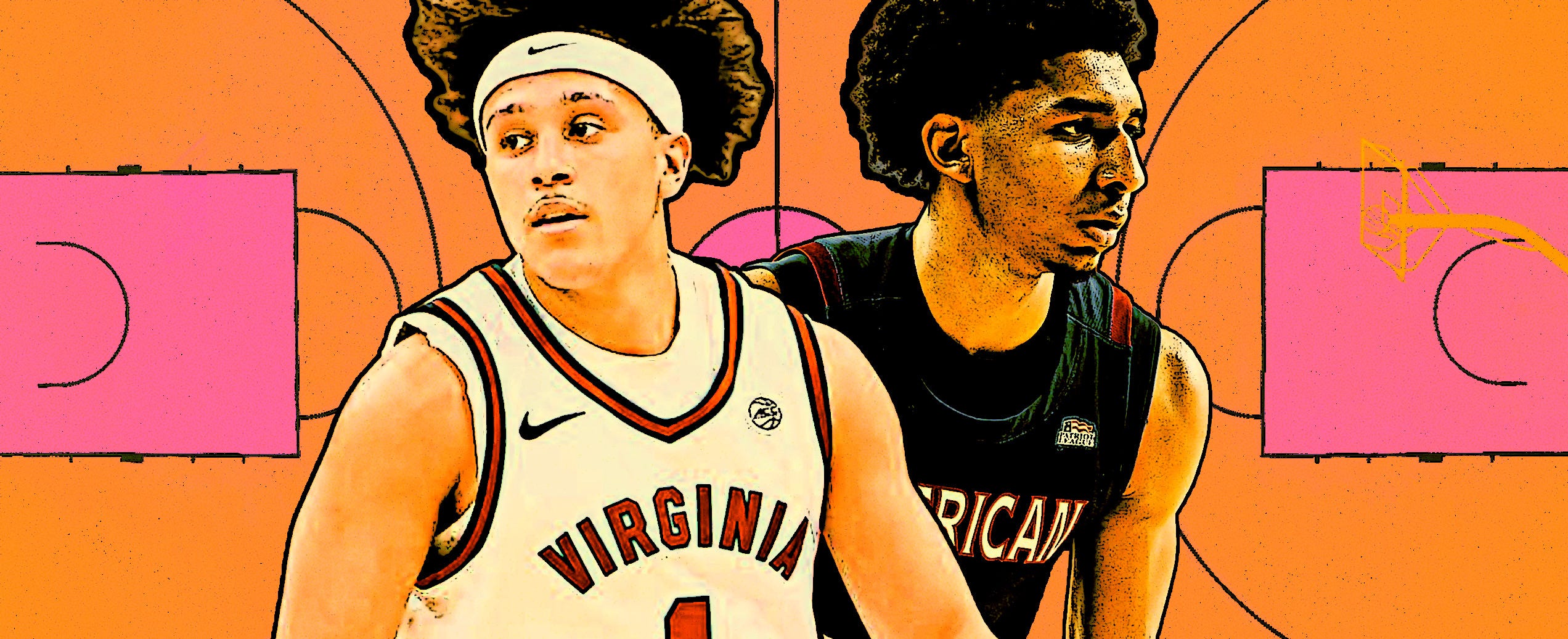
It feels incredible to be back in collegiate gyms and doing what I love! I had the pleasure of scouting Virginia-Maryland and Harvard-American last week in two very exciting environments.
There aren’t too many fanbases that can get an arena rocking the way Terps fans can at the Xfinity Center. That place was loud and buzzing throughout the red-out game, creating a fantastic atmosphere against Virginia.
American’s home opener saw the fans unite to unexpectedly sing the national anthem and welcomed Harvard alum and fellow basketball sicko, the 44th President of the United States, Barack Obama, to Bender Arena!
Both games across two unique environments brought out several standouts and stellar performances led by Virginia’s Sam Lewis, Maryland’s Pharrel Payne, and American’s Madden Collins. Let’s get into it!
Virginia-Maryland
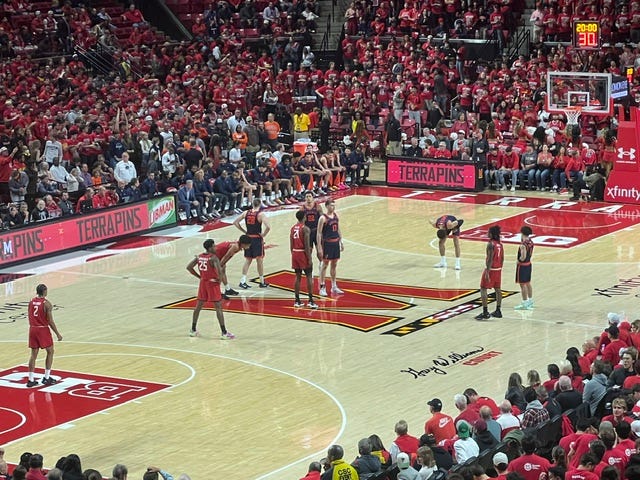
This was absolutely a resume game for Sam Lewis to lead Virginia over Maryland 87-83: 28 points and seven rebounds on an efficient 12-of-16 shooting.
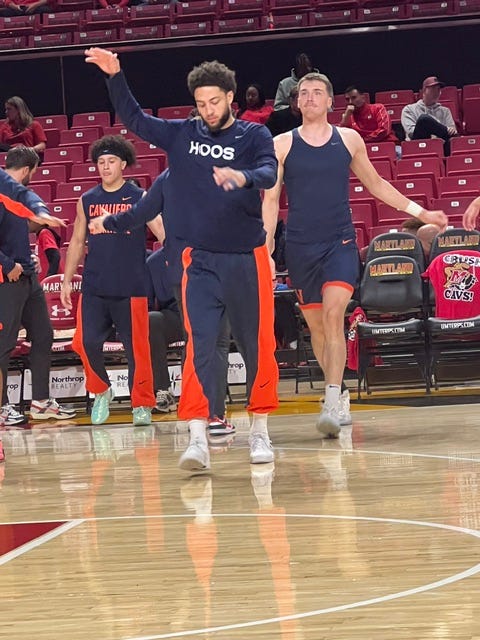
The biggest surprise was that Lewis, a 41% career three-point shooter, did not connect on a single three (0-of-2 3PA) and still was able to produce a high-scoring effort amidst a close game on the road. He fought back a big smile as Maryland fans booed him and his teammates during UVA’s pre-game stretching routine, as if he knew what was about to unfold and they didn’t.
Coach Odom relied upon Lewis all game, especially down the stretch, where he had actions and sets spammed for him. The 6’7” wing was especially adept at working off Iverson cuts that either freed him up to attack or flowed into a ball screen to operate (Iverson cut: off-ball cut across the floor via two stagger screens usually at the elbows).
I was impressed by his rim finishing versatility. With nearly every basket there, I thought: that’s an NBA-caliber finish.
Lewis finished through contact (counted at least three and ones), utilized craft on a spin finish and multiple backhand finishes, converted a tough hanging attempt over Payne, as well as finishing above the rim with a thunderous one-hand slam off two feet after initiating the contact on Boswell. The dunk drew gasps from the media section and was a real deal reminder of his athleticism.
The defense remains both a valuable and projectable part of his game. He fought through screens and played with effort. Two notable plays: an on-ball recovery block on Mills at the rim after closing out, and fighting through a ball screen for a block that led to a De Ridder three.
I certainly can’t gloss over the whopping seven turnovers. It wasn’t really a result of poor decision-making; it was more about bad execution on passing, including two post entries that were stolen. It’s not something I’m worried about long term.
Lewis is solidifying himself as a top 60 prospect, but how high can he climb in a translatable 3-and-D role with some on-ball upside?
Thijs De Ridder showed why he was named the Preseason ACC Player of the Year. Tallying 20 points and seven rebounds, his physical inside-out scoring presence and commitment on the glass were critical to UVA’s win.
I’m becoming more and more of a believer in both his functional handle and shooting being reliable NBA weapons for him. De Ridder pushed the ball the length of the floor for an and-one finish and later comfortably attacked a closeout after a shot fake into a dunk.
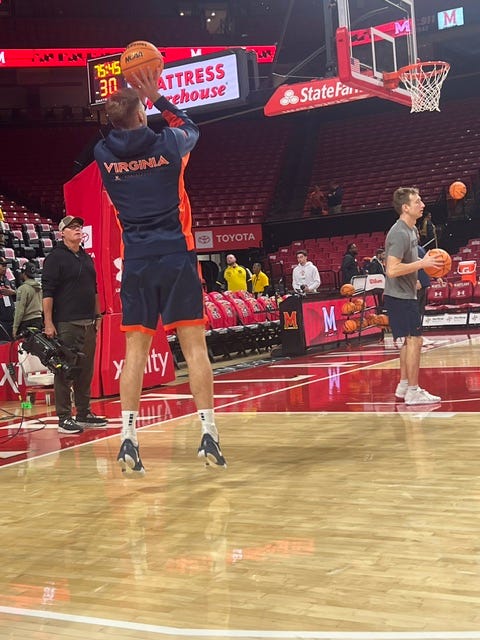
De Ridder went 2-of-3 from deep and spent a good bit of time during warmups working on his touch and range. He shot 35% from three last season (3.1 3PA) and is off to a hot start this season (58% on 4 3PA). For me, being a reliable floor spacer is critical to his NBA staying power.
Even when it can feel like a quiet game for him, Chance Mallory just finds a way to leave his imprint on winning and make timely plays (12 points, five rebounds, four assists, and one steal). He helped spark UVA’s second-half run with several standout plays: a pick-and-roll hesitation scoop finish, dig strip into a Lewis layup, and a pick-and-roll pull-up three to go up one with about six minutes left.
Every time I see Mallory in person, the frame stands out. He’s a shorter guard, but not necessarily small. Mallory has a stout frame with mature muscle and a strong lower body. Height has always been the NBA concern, but not physicality or functional strength.
Although we didn’t get the full stretch five version of Johann Grünloh (0-of-1 3PA), we still saw him be a legitimate vertical spacer by leveraging his 7’0” frame to throw down a dunker spot lob with one hand and a pick-and-roll lob from Mallory.
Grünloh swatted three shots at the rim, including two big help blocks. I loved that he battled against Pharrel Payne’s physicality and strength on both ends. He did tell the ref to watch for Payne’s elbows, but never backed down as he won some possessions against Payne and lost some too. Nearly finished with a double-double (15 points and seven rebounds).
It’s awesome to see Elijah Gertrude healthy and playing real minutes as a key reserve (19 minutes). Scored on a backdoor cut and a direct line slash from a handoff. He’ll be a factor for UVA all season and is someone that I would not be surprised to see breakout on draft radars next cycle because of his athleticism, length, and defensive tools.
Baba Oladotun’s slow start continues. The five-star freshman only logged six minutes, and his play was up and down. He had the ball stolen on a couple of drives and committed three fouls, including one after Sam Lewis went right through his chest, but credit to Oladotun for staying in the play before hitting Lewis on the arm.
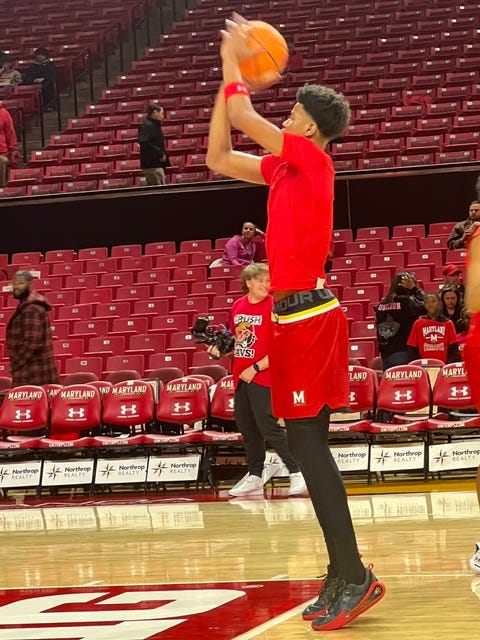
I did like the aggressiveness on Oladotun’s first shot attempt and hoped to see more. He attacked De Ridder with a crossover, then nailed a fadeaway jumper after being cut off in the lane.
Maryland is having a tough time right now getting him good looks and helping him find a rhythm. There is still plenty of time for Oladotun to find his footing. Let’s keep in mind that he reclassified up and is also adjusting to the physicality of the Big Ten.
At 6’10”, there is still a budding dribble-pass-shoot foundation to be patient with and let develop. After all, development isn’t linear.
Pharell Payne is clearly Maryland’s best player and most NBA-ready prospect. He led Maryland in scoring with 20 points and did it with his usual blend of physicality, athleticism, motor, and evolving skill around the rim.
Looked to seek contact on a couple of face-up attacks into scores on both Grunloh and De Ridder, alongside a seal finish on De Ridder. Defensively, had a big help block on De Ridder and let out a big scream at his teammates on the Maryland bench. Every NBA team needs an athletic, physical, and high-motor big like Payne off the bench.
It was a rough shooting night for Andre Mills (2-of-13 FGA). When you’re a slasher and shotmaker, there are going to be some nights like this. Mills did find a way to impact the game defensively with his length and quick hands to swipe three steals. One came after a brave weakside rotation and contest to force De Ridder’s miss on a dunk attempt, then Mills immediately stole the ball from Grunloh’s offensive rebound. Better days are ahead for one of the better guards in the Big Ten.
Four-star freshman guard Kaden House remains a long-term NBA prospect that appears poised to play a significant role for Maryland all season. I can absolutely envision him getting some starts as soon as conference play begins. His 17 points off the bench primarily came from his hustle (slipped in for several offensive rebounds that led to shooting fouls) and getting to the line (9-10 FTA). House missed some favorable attempts at the rim and from the perimeter, but flashed his dynamic scoring upside with a vicious in-and-out to lose Anya for an and-one finish.
Michael McNair Jr. is a name to know for the G League and potential E-10 contracts. He’s a standout shooter with a mature frame. He connected on 3-of-6 shots from beyond the arc and is a career 42% shooter. A transfer from Boston, McNair was a smart find by the UMD staff.
Harvard-American
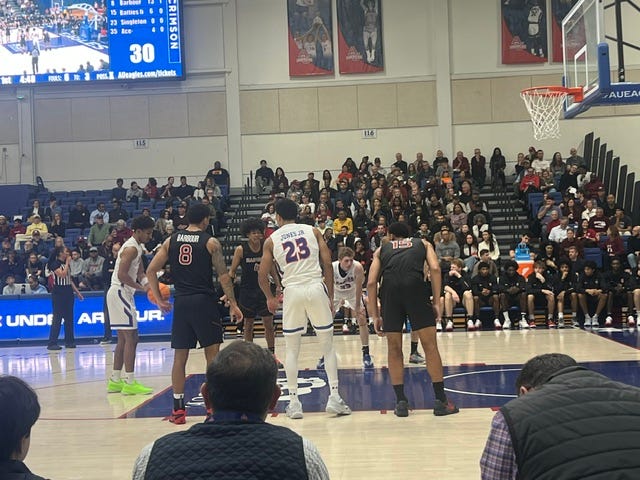
I can’t start anywhere else than with Madden Collins, who has been on a tear to start the season (22.8 PPG) after a tremendous freshman campaign.
Fresh off drilling the game winner against Drexel and vibing to “Gasolina” by Daddy Yankee during pre game warm-ups, I should have known that it was going to be all gas and no breaks against Harvard. Collins efficiently dropped a game-high and season-high 25 points on 8-of-12 FGA, 1-of-2 3PA, and 8-of-9 FTA.
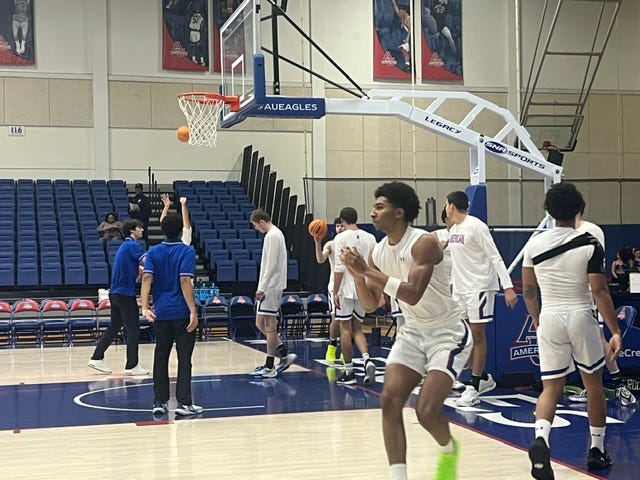
Collins got to whenever he wanted on the floor via his creative handle and strength. He converted multiple attempts through contact and aggressively posted up defenders, both smaller and like-sized, featuring a spin finish on Batties and a step-through late in the second half. I’m all for guards posting up again, and this is a go-to weapon for Collins that can get him going.
My favorite score came on a tween pullback and one middy that stumbled and nearly dropped the defender during American’s second-half run. The gym erupted while Collins had a look on his face like “that’s what I do.” He got into a little back and forth with Robert Hinton, but I’m all for the competitive chippiness.
Poised, skilled, and filled with unlimited confidence, Collins carried the American offense all game and through the stretch. He calmly sealed the game with two free throws that put American up four points with about 15 seconds left.
It wasn’t all offense for him, though. There are real defensive tools and abilities there. Collins came up with multiple on-ball stops, highlighted by a crucial post strip on Batties II in the second half. Rightfully so, Collins was fired up and gave the seatbelt celebration.
If you haven’t been watching Madden Collins, I highly encourage you to add him to your watch list and NBA draft radar. You won’t be disappointed.
Senior Greg Jones, the reigning Patriot League Defensive Player of the Year, put up eight points in this one. He should garner some E-10 and G-League interest. He must find consistency as a shooter and shotmaker this season to make a move on the draft radar. Jones got a big one-on-one stop to close the game.
Robert Hinton, one of the top players in the Ivy League, couldn’t find his rhythm (4-of-13 FGA), but it felt like a timely score or tough basketball whenever he hit. Hinton converted a smooth spin finish in transition, knocked down an elbow fading jumper to beat the shot clock, and got out in the passing lane for a BLOB steal finish. There were a couple of smart passing reads on spray outs and another with a pick-and-roll pocket pass that left me encouraged by his connective passing upside.
Thomas Batties II and Tey Barbour are two DMV locals who returned home and gave American all that they could handle. The 6’7” Batties II (18 points, 2-of-4 3PA) and the 6’4” Barbour (team-high 22 points, 5-of-7 3PA) both bring impact shooting to the floor and were not shy at all—especially Barbour.
Barbour has such a smooth, effortless, and repeatable shooting stroke. Really shoots a soft ball. He drained deep threes off the catch, and it felt like the ball was going in every time it left his hands. He had the Harvard fans behind me yelling shooter all game, even before he touched it.
Freshmen Jason Singleton Jr. and Julian Adigun are two long-term prospects to monitor for Harvard.
Singleton Jr. is a four-star recruit whose father played at Ohio State. He had some difficulty finishing at the rim after getting there, but did play with confidence and has defensive tools thanks to long arms and broad shoulders at 6’4”.
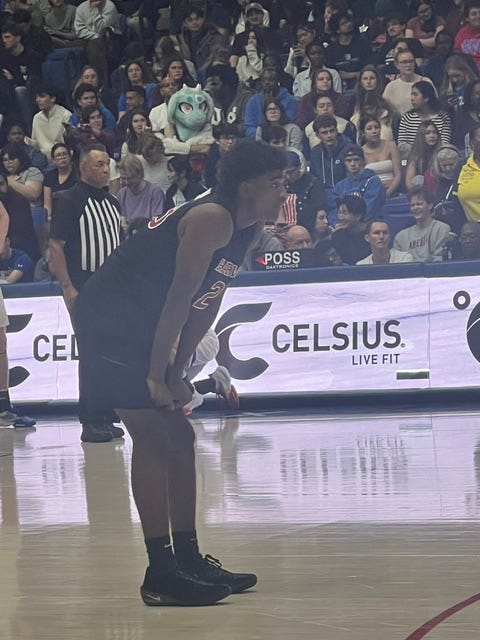
Adigun is a 7’0” big with mobility and length, but lacks ideal vertical pop. He did put down a big dunk in the lane from a drop-off (ruled a goaltend) and hustled back in transition for a block. Julian’s father, Abayomi, played collegiate basketball at Cornell.
Discussion about this post