



Buzzwords in the draft community are often overused. Evaluators lean on unique language that’s developed every year to quantify a prospect’s skillset and long-term projection. Podcasts, scouting reports, and big boards use these buzzwords as placeholders, repeating them constantly without actually explaining what a player does on the court—motor, versatility, scalability, and the one I believe gets thrown around way more than the rest: feel.
Feel implies a player displays proper instincts on the floor or the ability to process the game at a high rate. However, when used to describe players, it’s mostly vague. What about their game says they feel? Is it their passing instincts? Timely defensive rotations? Shot selection? Feel is deeply layered within a player’s profile, meaning it must be present across several facets of their game. Joshua Jefferson is one of the few players in the upcoming 2026 NBA Draft who truly represent feel.
Joshua Jefferson’s journey to prominence has been an unlikely one. Coming out of Liberty High School in Henderson, Nevada, Jefferson was ranked 182nd in 247’s 2022 high school class rankings. The forward would commit to Saint Mary’s early in the recruiting cycle. In his freshman campaign, he barely saw the court, only playing eight minutes a match. However, Jefferson saw a massive promotion in his sophomore season, starting in all 26 games he played and averaging 10.2 PPG, 2.3 APG, and 6.5 RPG on 47/27/73 shooting splits. Jefferson’s production would catch the eye of Iowa State coach TJ Otzelberger, where he would transfer to for his remaining two seasons of eligibility.
Jefferson’s Iowa State tenure has been nothing short of successful. In his junior and senior seasons for the Cylones, Jefferson averaged 14.8 PPG, 4.0 APG, and 7.6 RPG off 49/32/71 splits while making noticeable improvements in several aspects of his game. He has racked up two All-Big12 awards, helping Iowa State secure the #3 seed in 2025’s March Madness and #2 seed this season. An All-American honor this season is inevitable for Jefferson. His feel for the game has helped him dominate the collegiate level, and I believe it’ll be the biggest factor in his game translating to the next level.
Playmaking
Feel is most commonly used to describe smart passers, and Joshua Jefferson is no exception. His playmaking has made drastic strides since his days at Saint Mary’s, evolving into one of the best passers in the country. What makes the skill even more unique is Jefferson’s stature. At 6’9” and 240 pounds, he pairs brute force with high processing speed and vision, allowing him to be a translatable connective piece at the next level. This season, Jefferson has averaged 6.2 assists/40 minutes with a 27.7% assist rate, both of which rank in the 99th percentile (CBBanalytics.com). He’s constantly creating advantages for his teammates.
Jefferson can pass from virtually anywhere on the court in a variety of situations. Jefferson can initiate on the perimeter, at the elbows, and off closeouts. He’s patient with his passes, allowing defenses to rotate before he decides what to do. The off-the-bounce playmaking has been an incredible development in Jefferson’s game, blossoming into a proficient pick-and-roll handler. According to hoop-explorer.com, as the primary passer in the pick-and-roll, Jefferson has averaged 1.34 PPP (100th percentile). Compared to his time at Saint Mary’s, Jefferson only averaged 0.94 PPP. A significant reason for his development is his ability to recognize when defenders hedge too hard, leveraging his rim gravity (more on that later) to punish collapses and find either the roll man or other cutters. He generates 1.24 PPP (95th percentile), hitting backdoor cutters. This ability to read defensive rotations with ease has translated to other passing situations as well, such as dribble-drive-kicks and doubles (both 1.21 PPP, 99th percentile). It’d be naive not to acknowledge the role Jefferson’s handle plays in this. For a forward, Jefferson is a reliable ball handler. It’s allowed him to attack closeouts with confidence and maintain the ball long enough to capitalize on defensive mishaps. The handle may not be the flashiest, but it’s functional.
The passing versatility pops in the film, as he truly does make some incredible passes from all areas of the court in all sorts of actions, whether it’s in the high post or DHOs. Jefferson is comfortable making passes with either hand, displaying rare coordination. He routinely fires off skip passes to shooters positioned in the opposite corner and wing that exploit overhelp. They’re often advanced reads that most prospects can’t make at the collegiate level. They’re sharp and calculated, parlaying intense defensive pressure into an open three.
Jefferson does a terrific job of leveraging his body to create playmaking opportunities, especially in tight passing windows. Combining his sleek footwork, coordination, and strength, Jefferson steps through defenders with ease, thus creating new angles and passing lanes. He’s comfortable threading the ball through defenses with both bounce and wraparound passes to cutting teammates. That same touch is present in transition. After snagging a defensive rebound, Jefferson scans the court at a quick rate for scrambling teammates. It’s almost quarterback-like the way he delivers long outlet passes in the open floor, hitting cutters in stride. He generates 1.31 PPP in transition, turning halfcourt possessions into fastbreak opportunities.
This versatility will ultimately allow Jefferson to function in a variety of roles within an NBA offense. Several times a game, Jefferson will bring the ball up and initiate the Iowa State offense, organizing actions. Other times, he’ll function as a short-roll creator, catching the ball after setting the screen and initiating offense. In this play, after setting the pick for Tamin Lipsey, Jefferson has an easy foul line jumper. However, Jefferson sees Zuby Ejiofor committing to him, with Bryce Hopkins positioning himself towards Eric Mulder on the porch, leaving Jefferson to hit a wide-open Jamarion Bateman for a corner three.
The one gripe I have with Jefferson’s playmaking is that he’s too aggressive on some passes. He searches for high-value passes, which lead to forces in congested areas. The turnover numbers aren’t pretty, averaging 3.3 TOV/40 (seventh percentile). His handle can also be exploited by quick perimeter defenders who can turn Jefferson with ease. I’m choosing to believe the turnovers are a byproduct of heavy usage (currently at 27.7%, or 97th percentile), as he’s been asked to make tough decisions with the ball. Players who operate as offensive hubs are likely to turn the ball over more. In a professional context, most of Jefferson’s decisions will be made within the rhythm of the offense, which he’s proven to thrive within.
Your Next Read

Scoring
Similar to his passing game, a lot of Joshua Jefferson’s scoring comes from within the flow of the offense. He’s not a heliocentric scorer who relies on difficult isolation attempts or a self-created shot diet, but rather one who leverages his physicality and awareness to find openings created by offensive structure.
Most of Jefferson’s scoring prowess is derived from his ability to overwhelm in the paint. As previously mentioned, he has an imposing stature at 6’9” and 240 pounds. That frame helps create an advantageous positioning, both on and off the ball. When cutting, he’ll dig his shoulders into defenders before slipping towards the basket. If Jefferson is slashing towards the rim, he’ll initiate contact before using a smooth pivot or drop step to create adequate space around the hoop. He’s comfortable finishing through contact as he’ll often convert with a defender or two on his back. Jefferson is currently averaging 10.6 paint points/40 min (81st percentile) while drawing 7.9 FTA/40 (96th percentile).
Jefferson possesses a polished post-up game. His physical style forces defenders into uncomfortable positions and decisions, which often lead to fouls. I’m fond of his savvy ball fakes, which also contribute to his excellent foul-drawing numbers, as these moves either freeze defenders long enough to get them on his back or generate clean looks as defenders slip past him. He backs down defenders at both the block and the high post, using his raw strength to establish position. After getting to his spot, Jefferson reads his defender’s body and powers towards the rim. He doesn’t have the verticality to pop above defenders in these situations, but he’ll be able to leverage his strong core and footwork to create the interior opportunities he wants.
Many questions about Jefferson’s scoring game center on his shooting consistency, but he has made significant improvements. During his first two seasons at Saint Mary’s, Jefferson attempted 1.5 threes a game on 28% shooting. At Iowa State, those numbers have jumped to 2.4 a game on 33% shooting. This season, he’s shooting a career high 34% from three. The majority of Jefferson’s long-range jumpers come from above-the-break, where he’s shooting 34.7%, nearly 2% higher than the D-I average. These are often in catch-and-shoot situations, as 92% of his threes are assisted. Jefferson is capable of punishing defenses that leave him open, generating 1.07 PPP on perimeter jumpers. These marks may not represent a knockdown shooter, but they show development.
Jefferson still has clear limitations as an overall scorer, which may limit his impact at the next level. As mentioned, Jefferson is reliant on the offensive structure. The shot creation off the bounce is still lacking, generating only 0.95 PPP on dribble jumpers, with midrange scoring even worse at 0.73 PPP. Additionally, he’s struggled to be an efficient scorer, especially this year. The following is Jefferson’s shot chart as of 3/15/26:
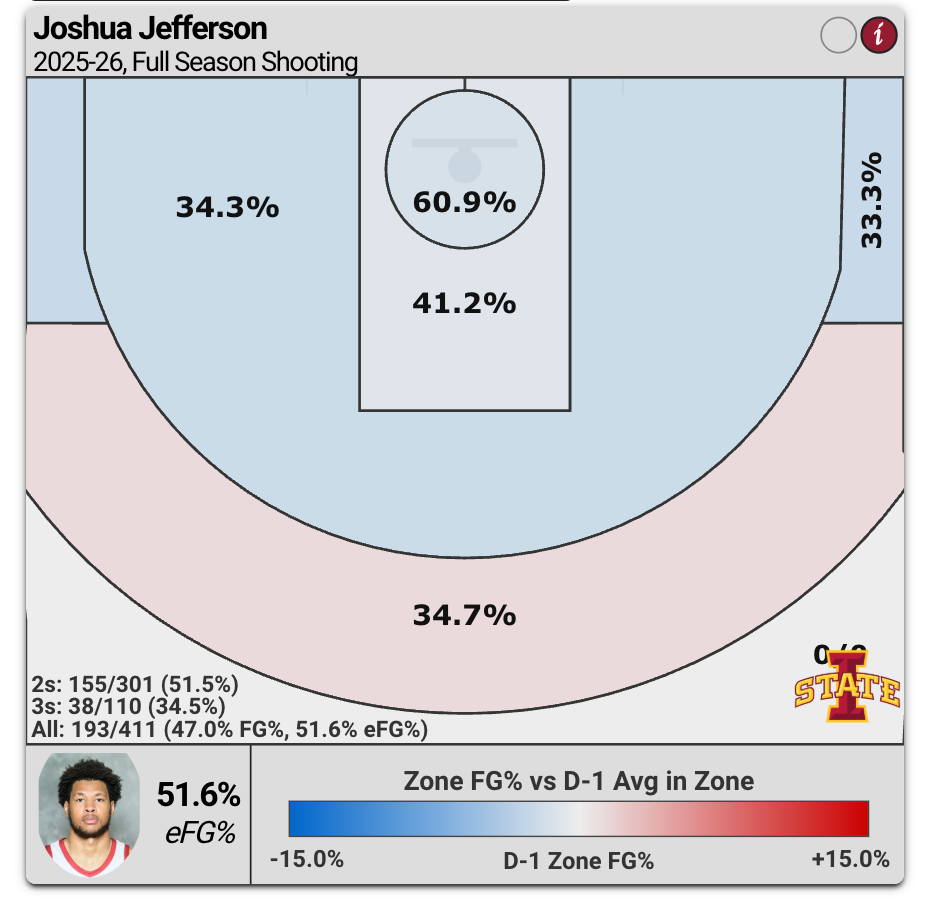
Clearly, he’s struggled to be an efficient scorer from all areas of the court except the top of the key. His 51.6% eFG and 56.8% True Shooting marks are mediocre at best. His finishing inside the paint is surprisingly low for a forward who relies on rim pressure to score. The scoring flaws are likely derived from his lack of explosive athleticism. He may be strong, but he doesn’t possess vertical burst or fast straight-line speed. This allows defenders to stay glued to him in tight situations. His shot mechanics are inconsistent as well, especially at the base, where his feet often are unbalanced, especially off hard closeouts.
Despite his limitations, Jefferson won’t ever be asked to be a primary scoring option. His strong ability to cut, screen, and get to the basket will create a natural gravity around him, opening up the offense. His passing prowess will also create scoring opportunities for him. The same instincts that allow him to find open teammates will help him produce open looks for himself, especially when defenses aren’t keyed in on stopping him.
Defense
Throughout his four years, defense has been one of Joshua Jefferson’s calling cards. He’s been widely regarded as a pesky, physical defender who consistently uses his size and instincts to disrupt offensive possessions. However, given the athletic limitations, it’s reasonable to question the defensive translation.
For me, it’s simple: Jefferson has given way more reasons to be more positive about his defensive projection than negative.
I feel as if I’ve said it a million times already, but Jefferson’s hands are quite impressive. He constantly uses his coordination to disrupt ball-handlers, clog passing lanes, and deflect passes. The 3.1% steal rate sits in the 97th percentile, meaning he’s frequently creating turnovers. What makes it even more impressive is that his steal rate this season is the lowest it’s been in the past four years! Jefferson has a knack for recognizing the exact time to grab a loose ball. His strength also aids him in that facet, as he rips the ball away like a bully stealing lunch money. These swipes are also calculated, as he rarely fouls, with a Steal-to-PF ratio of 0.70x.
The raw strength enables Jefferson to be comfortable switching against bigger defenders. He possesses the base and balance to absorb contact without getting pushed off his spots. He stays connected through his coordination and footwork rather than vertical explosion. Jefferson stays low, digs his chest into defenders, and maintains positioning. This will not only allow him to match up with wings and forwards, but small-ball fives as well.
To no surprise, Jefferson’s high IQ translates to his off-ball defense. He remains active and aware, constantly rotating into gaps. When teammates get beat, he does a good job of stunting the ball handler, disrupting plays before they fully materialize. Jefferson won’t make the high-flying recovery blocks, but he’ll know when to shade cutters and to clog passing lanes.
The limited vertical and horizontal speed is a cause for concern, as it naturally lowers his ceiling. From a switchability standpoint, quicker guards will give him trouble. There have been a few times the flashy guards of the Big 12, and even quicker wings turn the corner on Jefferson before he can even slide into position. It’s the unfortunate reality of Jefferson’s frame. Regaining angles against fast players will be a struggle for him.
Concluding Thoughts
Joshua Jefferson will likely never be the most athletic or explosive player on the floor; his value lies in a true feel for the game. It shows up in a connective way, facilitating offense, applying pressure to the rim, properly spacing, and timing out every aspect of his game to a tee. There’s a clear pathway for Jefferson to be a high-level role player at the NBA level, with traits built on making winning plays.
Strengths:
Playmaking
Off-Ball Scoring
Physicality
High IQ
Weaknesses
Shooting Consistency and Efficiency
Athletic Burst
Ambitious Passing