



The 2027 NBA Draft has been touted as weak by many draft “experts.” Although I concur that this class may not provide the Victor Wembanyama, Cooper Flagg, Dylan Harper, or any pick of the “Big 3” from the 2026 class level of prospect, I also feel as if it goes without saying that even this class will have diamonds in the rough. Sure, it may be some time before we as a draft collective know who will be the crown jewel of the 2027 crop. For now, though, we can take a look down the board at some less-discussed names and shine some light on those players. A name that I have found myself consistently drawn to when examining this less-discussed group is St. Louis guard-forward hybrid Kellen Thames.
The incoming fifth-year senior is a player I have had my eyes on for a while, as growing up in the same area as him has allowed me to track his progress from the player he was in his early days to the guy he is now. Thames is a name that many of even college basketball’s biggest fans may not be very accustomed to; during his college tenure prior to last season, Thames had spent a fair amount of time off the court, with an odd set of injuries hindering his ability to find the floor. Last season, however, Thames finally got his chance to play a healthy season and proved himself to the umpteenth degree, despite coming off the bench in 31 of his 33 games. Now entering his final year of college, Thames has a real chance to build on the ridiculously impactful season he had last year and shoot his name into real draft talks. I know that it may seem a bit out of place to have a guy who is by all accounts a role player on an A-10 team firmly in NBA draft talks, as that is typically a title reserved for college basketball’s best talents. But with Thames, he’s one of those guys where once you have all the information laid out in front of you, it’s hard to deny that he’s a player who deserves a chance at the next level. So let’s dive in.
Physicals
To the handful of people who are familiar with me and my evaluation process, you likely know that I don’t set a high bar for baseline physical and athletic attributes that a prospect has to cross. There have been countless examples of players who have been considered poor athletes outperforming their draft slot, with their draft stock often tanking in large part due to their physical shortcomings. On the flip side, there have been countless players drafted too high because of physical attributes, placing an expectation on a player who was likely never going to reach the heights of their pre-draft billing. Obviously, there is nuance to this conversation, like all others; I’m not saying that every poor athlete is exempt from criticism and every great athlete with a less-developed skill set is incapable of succeeding. But all of this is beside the point—sorry, I love this discussion.
For Thames—the player this article is about—it doesn’t take a sagacious basketball savant to figure out that he is a special, special athlete. The raw measurements aren’t groundbreaking, as he comes in at 6’6” and 210 pounds. There is no official measurement for wingspan to my knowledge, but it is evident that he has solid tonnage in that regard, likely hanging in that 6’8” to 6’11” range. We’ll call it 6’10”. All of those marks are adequate for a player in his archetype, but not exactly groundbreaking. Luckily, any ounce of impact that Thames loses size-wise, he makes up for tenfold in his athletic prowess. Much like his wingspan, there are no official testing numbers for Thames’s vertical, lane agility, sprint, etc., but all of that doesn’t matter when given the product we have been shown on tape. I’d personally estimate that his vertical is around 40 inches, a crazy mark to throw around, but not one that isn’t backed by merit. Thames is not afraid to dunk on anyone in his way, including 7’3” Aday Mara, something he won’t hesitate to show you. It isn’t just vertical prowess either, as Thames is just a great all-around athlete. His lateral movement patterns are insane and benefit every ounce of his game on both ends of the floor, along with his top-end speed and quickness, allowing him to either separate or recover lost ground.
Athleticism is the backbone of all Thames does on the floor, and it’s a superpower that he doesn’t take for granted. That said, there is a fair reason to be concerned as to whether that can translate up to the next level, and it has nothing to do with how it translates to the floor. Rather, Thames has had a fairly hearty history of injury. It isn’t exactly clear what caused his injury-riddled past and if it’s something that will continue to bug him as the years go on. Throughout the entirety of his college tenure, though, Thames has dealt with major cramping, which has occasionally built all the way up to full-body cramps—much like we saw last season from Darryn Peterson. This cramping issue kept him out for the majority of his freshman season, and he received a medical hardship waiver after appearing in just seven games. The issue also stunted his junior season, which saw him appear in just 17 games. These issues do seem to be a problem of the past for Thames, as last season he appeared in 33 of SLU’s 35 games, playing a pivotal role in each and every one. With all this in mind, I would also like to state that I am not a doctor — I have no way of knowing if these issues will continue to plague him for the rest of his career. This leaves me with no other option but to trust that he can battle through this and become the player I believe he can be—something I will hold onto until and hopefully through medicals in the pre-draft process.
Kellen by the Numbers
I’ve known the name “Kellen Thames” for a while now; he grew up in the same area I did, and the fact that we are roughly in the same age group led to us crossing paths a handful of times. With that said, I never really thought of Thames as an actual NBA prospect. For a little bit of background, he was a pure point guard in his high school days, playing a bit more of an off-ball role in the summer as a part of Brad Beal Elite. His claim to fame—at least on offense—has always been size-relative playmaking ability. With that said, the whole point guard schtick was always going to wear out, at least in a high-volume role once he got to the collegiate level, in large part due to his consistent shooting struggles. However, over his four-year, now going into five-year, college tenure, Thames has adapted his game to perfectly fit both what SLU needs him to do, along with maximizing his own ability. The results: breathtaking.
At face value, Thames’s numbers aren’t exactly world-beating. Last season he averaged just 9.7 points, 4.7 rebounds, 1.8 assists, and 1.3 steals per game, which is more than fine for a solid college player, but not numbers that scream NBA draft pick. On top of that, he has basically turned into a non-shooter, making just 25% of his three-pointers last season on just 1.2 three-point attempts per 100. For those who are optimistic about shooting development and use free-throw percentage as an indicator, I’m guessing you, too, won’t be very bullish as to who he can be. Thames shot 62.8% from the charity stripe last season, and he sits at 61.5% for his career. Free-throw shooting has been an issue for Thames dating all the way back to his high school days as well, where he shot 66.2% in his senior year.
Now, I know that all of this talk makes it seem as if Thames is just the typical “jump shot away” prospect, but what if I told you, even with him having all of these “touch flaws,” Thames still posted a 65.8% True Shooting Percentage last season? The mark is so good that it almost seems unrealistic given that his three-point shot is as shaky as it is, on top of his free-throw numbers being meh—and he gets to the line relatively often (42.5% FTR). The answer is derived from two areas: One, he finishes everything at the rim. Last season, Thames converted 70.9% of his shots at the rim, 21 of which were dunks, a number I don’t feel I have to explain as to why it’s impressive. The other thing he does well is the in-between game, converting 40% of his midrange attempts and ranking in the 97th percentile in midrange scoring efficiency. The way in which he does both is something I’ll dive into later on, but nonetheless, you see what I’m getting at here. Thames understands what he has to do to maximize his impact on the court and does it to the highest degree.
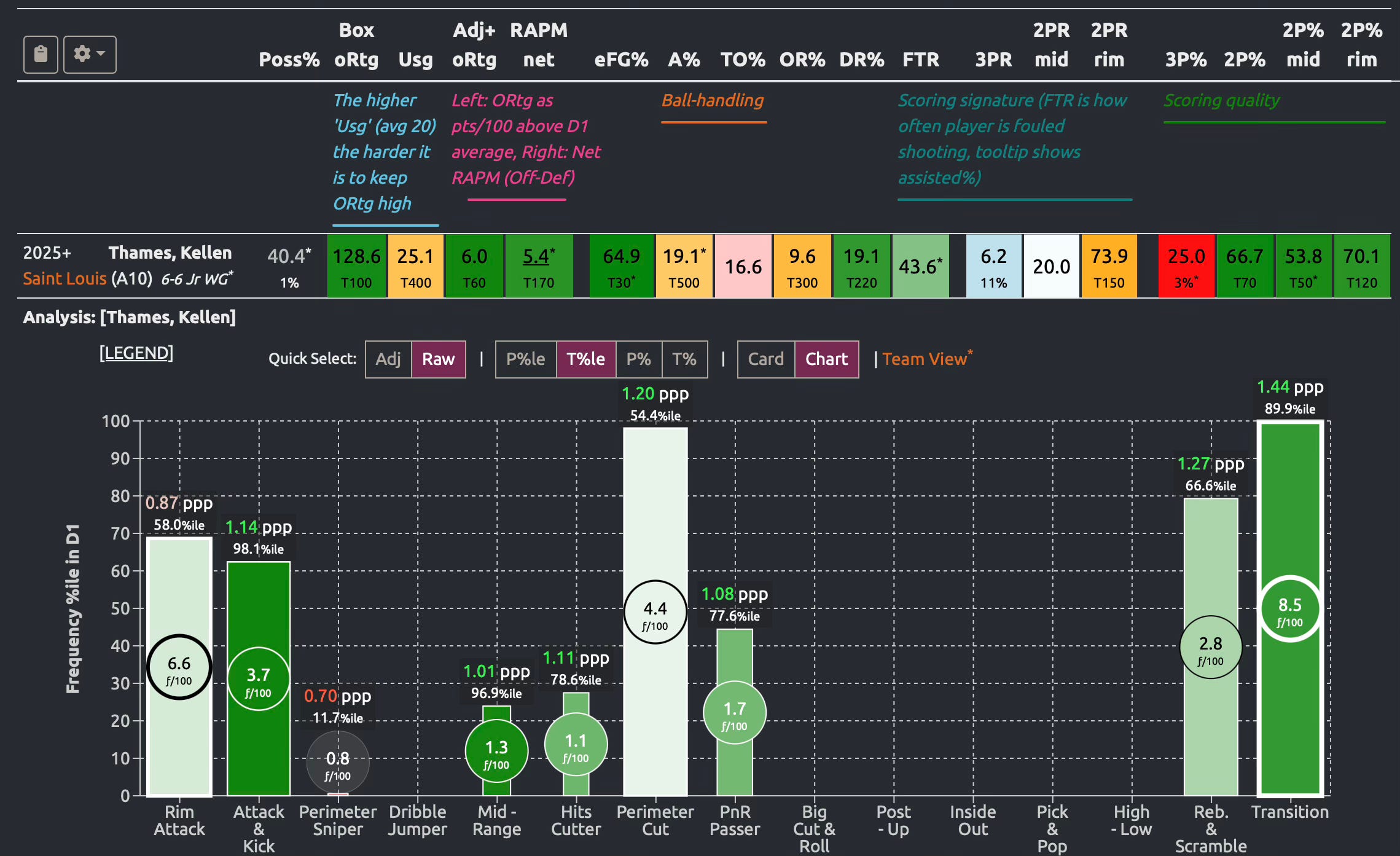
However, given his shooting limitations, Thames has to find other ways besides scoring to make an impact. One of those ways his passing prowess. Even back in his high school days, Thames was never considered an excellent passer or playmaker, but it’s hard to deny that the reps he got playing that role back in the day have benefited his play style today. Thames is someone I would consider to be a high-end connective passer, more capable of protecting the ball and making the right reads. Last season he posted a 19.8% assist rate and a 14.7% turnover rate, both of which are adequate for a tertiary initiator. Along with that, he posted a 1.4 assist-to-turnover ratio and a 24.6% usage rate, highlighting that he can be functional in most roles. Again, later on I’ll explore the nuances of what makes him a solid playmaker, but I hope for now you can latch onto the point I’m trying to make.
Even with the offense being as fun as it is, easily the sexiest aspect of Thames’s analytical profile is the defensive side of the basketball. He causes havoc, logging a 4.2% steal rate. He hits the glass, evident by his 18.9% defensive rebound rate—something that translates to the offensive side, too, where he posts a 10.6% rebound rate.
Overall, he does what he can to make a heavy impact on this side of the floor. The best way I can sum it all up is with the “all-encompassing” numbers—things like the 5.8 OBPM and 4.6 DBPM he posted, which, when combined, makes for the fourth-highest BPM total among all mid-major players last season. He also had a 127.5 offensive rating to just a 92.4 defensive rating for SLU in minutes that he was on the floor. Also, he logged a Net RAPM of 5.4 last season. All of these numbers are complex in their own right, but help paint the picture of just how good SLU was on both ends of the floor in the minutes that Thames played.

However, it’s one thing to dump numbers and force you to feel some kind of way about a player. It’s another thing to back it all up with things that he showed on the court, so let’s get into the fun stuff.
Unique Skill Set
With the analytics put to the side, it’s time to dive into the meat and potatoes of what makes Thames the player he is. As great as the numbers are, it isn’t exactly out of place for a prospect to have an outlier season in a certain micro-skill that boosts their numbers to heights they can’t sustain—hence why it’s important to watch games, to understand how the environment around a player both positively and negatively affects them. Along with getting a grasp of what things a certain player does and scaling it to a greater sample to see if it’s sustainable. In Thames’s case, I would be shocked if what he does offensively takes a major hit next season, as his impact on a game-to-game basis is almost entirely removed from how often and efficiently he can put the ball in the basket.
What he does do is complex and unique, making him a somewhat difficult prospect to evaluate, given that there have not been many players who do the things he does at the scale he does. On the ball, Thames taps into his point guard background a lot. Having the kind of handle he does is an amazing micro-skill to have given the fact he isn’t asked to do it on every rep. Most of his scoring production comes in the full court, with Thames ranking in the 92nd percentile in transition scoring efficiency. He does a great job at leveraging his speed with some slick change of pace, making it easy for him to put defenders on their heels before snatching a cross and blowing past them to the basket. Thames is pretty crafty with the ball as well, using everything from push crosses to in-and-outs, cross jabs, and hesitations—basically any move that requires a sudden change of pace, he excels at.
In the halfcourt, most of his scoring production is derived from cutting or out of structured sets. Thames ranks in just the 54th percentile as a cutter per Hoop Explorer, but that’s one of those numbers that I can’t back in good faith, given what I’ve seen from him on film. Thames does a great job at silently communicating with ball-handlers, finding the right time to dive to the basket for what is, most of the time, an easy two. On the occasions where he and the ball handler aren’t on the same page, or if the ball is reset for whatever reason, Thames does a great job at finding open space and staying in it, waiting for an angle to be created for him to find an easy two. The best way I can describe that ability is a receiver sitting in open space against zone coverage, waiting for the quarterback to find the passing angle to rifle said player the ball. Obviously, it’s at a much smaller scale on a basketball court; most of the time, ball-handlers don’t have four to five 260-plus-pound men trying to find any way to get to them and take their head off, but crazy things do happen on a basketball court. Nonetheless, cutting is an important skill to have, and it’s one that Thames has; he also understands when to clear out when his time in a certain spot has expired. This cutting prowess also allows SLU to play him in the dunker’s spot a fair amount, something you see NBA teams do with guys like the Thompson twins—players who have similar skill sets to Thames in many ways.
Cutting isn’t the only way he can make an impact in the halfcourt either, as once again, his rare blend of ball-handling, positional size, and athleticism makes him a somewhat versatile piece to use in ball-screen sets. SLU used him as both the screener and the ball handler in the pick-and-roll, allowing him to create scoring opportunities for himself or others in a variety of ways. As a screener, SLU gave him plenty of chances in the short roll, giving him a somewhat clean look at the basket with some room to operate. The Billikens also got a bit frisky at times, letting Thames get some looks in Spain ball-screen sets, which sadly rarely worked given his size limitations relative to what was asked of him in that scenario. As for him as a ball-screen ball-handler, it was pretty basic stuff. SLU would often set the screens high for him, giving him a running start well beyond the three-point line, which in turn often dragged multiple defenders with him en route to the basket. Because of this, Robbie Avila—the man who goes by many aliases—got plenty of easy pick-and-pop looks on the perimeter, created by Thames’s downhill pressure in ball-screen sets. SLU also allowed Thames to initiate a lot of its baseline and sideline out-of-bounds sets, giving him the first look out of the inbounds and letting him make the decision for the action around him. Creativity kills, and that creativity is exactly how Josh Schertz and the rest of the Billikens staff were able to maximize him in the halfcourt.
That said, process is one thing, results are another—and although the two often correlate a fair amount, circumstances make situations. In Thames’s case, the analytics certainly point to him both having great process and the results to back it up. So, continuing on the repetition here, let’s dive into the process of how he achieves his results—stick with me now. Let’s start with scoring, which as I mentioned earlier is complex in its own right. Thames has a lot of craft to work with when it comes to putting the ball in the basket. I previously mentioned how he gets to his spots; when it comes to actually completing plays once he gets where he wants, though, Thames is arguably just as advanced—if not more. The rim finishing in particular is just spectacular; it’s truly chef’s kiss stuff. Multiple things go into making a great finisher, with a few of the most important factors being control or craft on the gather, taking proper finishing angles, stability in the air, and touch around the basket. Thames checks all of those boxes. On his gathers, Thames has an innate ability to stop on a dime or continue to accelerate through, making it easy for him to use Euro steps and spin moves at full speed to set up Pinoy or slow-step gathers later in the game. Along with that, Thames is no stranger to exploring all kinds of pickups either, using low and high gathers to his advantage depending on what is taking place around him.
Once he’s ready for takeoff is where the gears really start turning, as Thames is a truly intelligent finisher. It’s commonplace for great athletes to struggle finishing at the rim in their college and early NBA days. For the majority of those players, they have been able to get away with out-jumping whoever is in front of them en route to the rim. However, at a certain point, athletes become too good, and bigs become too—big— forcing young players to add nuance to their takeoff points and in-air finishing angles. In Thames’s case, none of this is an issue. In seemingly every rep, he knows how high to jump, he knows where to jump, and he keeps the ball in a controlled enough manner so that he can react to any in-air craziness that takes place. He isn’t afraid of contact, consistently showing the ability to play through it, and does a great job finishing almost every shot right at the rim. Thames knows when to rise up and finish over a defender, and he knows when to duck under and finish below the rim. He does miss the occasional bunny, most of the time as a result of a difficult finishing angle—which is something that will happen from time to time. But in his case, the 70% conversion rate at the rim absolutely speaks for itself.
As for some other aspects of his scoring, I really like Thames’s willingness to take and make floaters. Because he gets so creative with his paths to the basket, on occasion he will have to rise up and push a shot over the rim. Per Hoop Explorer, Thames hung around 58.8% on shots in floater range, which checks out with what the eye test tells me. He will also shoot catch-and-shoot midrange shots on occasion, as he does get a fair amount of looks in the intermediate area given his use as a mini hub and as a short-roll guy. Those shots don’t drop at nearly the same clip, making just two of his nine attempts in that area. But, given his lackluster outside touch and inconsistency at the charity stripe, that mark comes as no surprise.
In terms of the passing, I really do love what Thames does. I’ll once again reiterate that most of his value as a passer comes as a connector, but that’s not to say he doesn’t do some fun stuff. I mentioned earlier the value he brought in pick-and-pop sets as a ball-handler, with a large part of that value coming from the fact that he could read the floor in front of him. Thames does a great job at playing off two feet and pivoting through space to find the open guy, along with swinging overhead passes to the pop man and creating an easy shot. The same control that Thames displays on drives as a scorer reflects on his downhill passing creation as well. He does a great job of skipping quick passes into tight spaces, reading the low man to make easy dump-offs.
The only real gripes I have with him as a playmaker are the lack of ability to make high-end reads and the sometimes silly turnovers that he creates. High-end passing feel is not something I expect out of everyone, and Thames is no different, but it is no secret that he struggles to read the weak side at times. There were a couple of instances in his film where it looked as if he flat-out didn’t see a weak-side rotation coming in, leading him to throw a pass that was easily tipped. Working hand in hand with that is his love for jump passes, which, when they work, look great, but when they don’t, he can get caught in the air, panicking for an easy out. Besides that, there isn’t much to nitpick at here. On occasion, he will get a bit too ambitious in grab-and-go, pulling a rebound down and instantly turning into a defender, resulting in a turnover. But on the flip side, that same ambition often gives him a leg up, as he is able to instantly transfer his momentum heading in the other direction, pulling him ahead of the pack.
Overall, Thames has a really fun offensive profile. We could sit here all day and point out the fact that he doesn’t have this or that, nitpicking at him not having star qualities. But the sell for him isn’t that he’s walking into your franchise and taking it over. In an ideal world, he can figure out the shooting and turn into at least a willing perimeter threat, which in turn gives him a bit more lineup flexibility. However, odds are he won’t ever reach that height, and what we are left with on offense is this jumble of fun skills that requires a creative, offensive-minded coach to put together. A daunting task, sure — but one worth the risk given the upside.
Defensive Stalwart
I hate to say this, but it couldn’t be more true: I will think less of you as a person if you don’t chronically yearn for upscale, elite defensive tape. I’m sorry, I can’t help feeling this way, but it’s true. It’s a pinnacle part of my love for the sport, and I am left with no choice but to feel these sorts of things. All jokes aside, who doesn’t love an elite defender? Unless it’s coming at the expense of your own team, it’s hard not to enjoy the process of watching one player cut the water off from another team’s offense, purely because they take the other team’s offensive engine out of the game. It’s poetry. Luckily, for those of you who also enjoy this brand of basketball, Thames provides just that—and adds a bit of flair in the process.
For his defensive tape specifically, I would love to start off the ball, because Thames is a textbook weakside defender. He keeps the proper amount of space between his man and the ball, dependent on the matchup, of course. He stays flat to the baseline with his weakside rotations, not helping up on drives or tagging in places he’s not supposed to be. The best part of it all is his ability to find his man once the shot goes up, hit him, and crash the glass to secure a board. Not to mention, if the ball does get swung his way, Thames takes a very disciplined approach to his closeout technique. You won’t find him jumping for joy at a simple pump fake or closing out on a bad line. Rather, he keeps his balance and closes out with intent in order to stay engaged with the action at hand. This near-perfect weakside approach does break down from a technical perspective when he is positioned in gaps, but it by no means diminishes the positive value he has. Thames has the classic inverted footwork when guarding gaps, positioning his chest to the ball and his near-side shoulder to his man. Now, for the vast majority of basketball players and human beings in general, this approach will get you burned, as it takes both schematic congruity with the rest of the team, along with the instincts and athleticism necessary from the player in order to recover for lost ground in technique. In Thames’s case, the perfect storm crashes together, allowing him to play as ambitiously as his heart desires.
The result of this approach is a lot of positive activity. Thames can consistently predict passes, jumping lanes, which, paired with his transition shot-creation ability, makes him an easy bet to turn defense into offense. Along with the event creation, Thames is able to remain within the structure of the defense, properly handling gap coverage when drives are funneled to him, along with rarely ever getting backcut or blindsided by a screen. The only times he really ever gets burned is when he does get a bit too aggressive, something opposing teams can scheme for, drawing up offensive sets to combat it. Thames is still a good enough defender to adapt on the fly, but it’s not uncommon to see him get beat on something silly early in the game. Nonetheless, he functions as an elite defender away from the ball.
As for his on-ball defense, it’s hard to pick out many flaws. In fact, his approach to guarding the ball is so pure and just a joy to watch. Look at me, fanboying over defensive technique. Thames is truly special, however. He gets low in his stance, sliding his feet and gliding across lanes to catch guys with his chest. He takes proper angles to cut off drives; he knows how to recover when he’s beat, doing things like punching hips, winding his stride, cross-stepping—doing all of this while staying in proper position. So many times when watching guys try and attack him, you’ll think, “Oh, he got a step on him,” or, “Oh, he found a bit of space.” Then you take a moment and realize that the step he gained and the space he found all funneled the ball handler into either a crowded area or the short corner, neither of which provides great scoring angles. Along with that, Thames knows when to take his risks. His sturdy base allows him to hold his ground when engaged on drives, meaning that his hands can poke at the ball to keep pressure on ball handlers. Thames does a great job at timing downward dribbles and close-to-body gathers, both of which are easy targets for quick deflections. And much like what he does away from the ball, Thames can turn these deflections into offense moving the other direction, as once that ball is free, he knows whether to attack it to start his own offense or run the floor and hope an outlet passer finds him.
Anyway you cut it, Thames can really guard. Whether an NBA team chooses to rewire some details of his approach in order to better fit their specific scheme is obviously a preference to monitor on a team-by-team basis, but I have no doubts that no matter what spot he lands in, if given the opportunity, Thames will provide very positive defensive value.
What’s Next?
Projecting forward is a difficult thing to do, as even though SLU’s roster is filled to the brim with all 15 roster spots being occupied, it’s still unclear as to how anything will shake out. Last season, coach Schertz headed what was a by-committee system, relying on eight guys to carry the team’s load. Now, looking ahead to next season, the Billikens will likely have to do the same, as unless someone takes a huge leap forward as a creator, SLU lacks a true go-to guy. Guys like Trey Green, Amari McCourty, Ishan Sharma, and Quinten Jones are all returners who played more minutes than Thames last season and will likely play similar roles to the ones they did last season. Along with that, Elijah Strong and Alon Michalei are incoming transfers who will also be competing for playing time, further proving the point that this will likely be a by-committee system.
With that said, Thames is just one of those guys you can’t keep off the floor. More than likely, with a healthy offseason under his belt, Thames will be competing with the likes of Sharma, McCourty, and Strong for a starting spot, one that likely only two of them can occupy. Nonetheless, Thames should be given starter-level minutes as long as he stays on the same track he was on last year. Who knows how high he could fly if some other things started clicking?
For example, if for whatever reason the shot comes around and he’s shooting even a respectable amount of threes, Thames could really be cooking as both a prospect and college basketball talent. Say that improves on top of an improved pace as a halfcourt ball-handler—which in turn should open up more scoring opportunities for himself and others—and we could be looking at Thames being a first round pick. Now, of course, this whole dialogue centered around “ifs” is incredibly wishful thinking, and odds are we don’t see him improve drastically in all these given areas. However, as long as Thames continues to progress along the path he has been on and stays healthy, he should be an easy bet as a second round sleeper in what could be a talent-depleted 2027 NBA Draft.
What is his major? He should pursue that aggressively.