


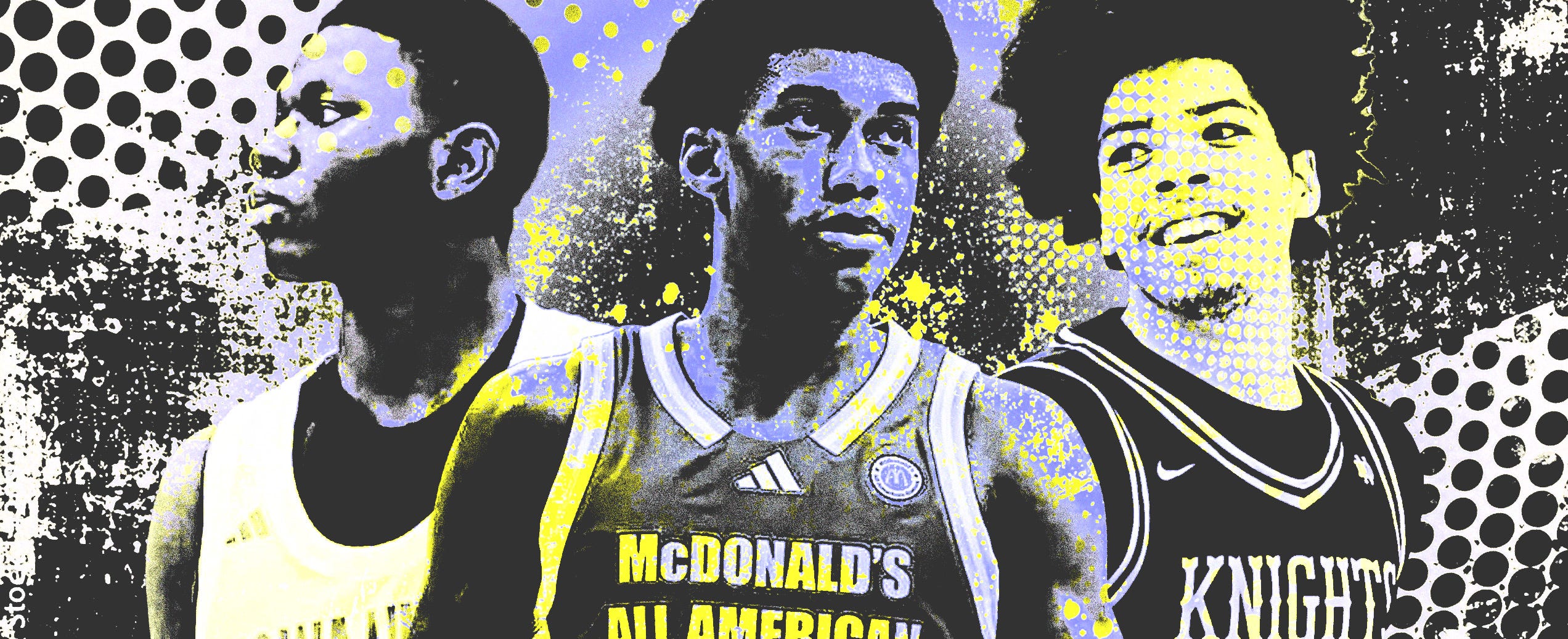
All Rise!
Court is now in session for the matter of who should be charged with being the #1 pick in the 2027 NBA Draft. Several names have been brought to the court’s attention, and while the evidence so far is largely circumstantial, each case will be heard in full. These proceedings can take time, potentially an entire draft cycle. As new evidence comes to light, the court will recess, reconvene, and reexamine each case. Charges will be dropped only when the evidence no longer supports a prospect’s claim to being the best player in his class. The names on today’s docket:
Tyran Stokes, University of Kansas
Arafan Diane, University of Houston
Christian Collins, University of Southern California
Caleb Holt, University of Arizona
Jordan Smith Jr., University of Arkansas
Stefan Joksimovic, Saski Baskonia
Bruce Branch III, Brigham Young University
The parties are ready to proceed. Let the opening statements commence!
Tyran Stokes | Kansas | Freshman | Forward | 6’8” | 230
Mr. Stokes checks many of the boxes this court looks for in a top prospect. He has the age, size, and position NBA teams tend to be most patient with, and he arrives at Kansas with no shortage of hardware: FIBA gold medals, State Championships at Rainier Beach, Jordan Brand Classic MVP honors, a McDonald’s All-American selection, and a spot on the preseason Naismith All-American First Team.
Evidence from Cerebro Sports shows Stokes posting a 23.0% Usage Rate across more than 100 games while regularly scoring 20 or more. His game resembles that of the NBA’s primary scoring options because of how much balance he plays with as a scoring threat. He can absorb contact and initiate it with a strong shoulder game, and his balance, strength, and length let him finish through it. Beyond the scoring, Stokes shows real promise as a playmaker. At 6’8”, he sees over defenses in a way that is rare and valuable at the next level. He drives with either hand, keeps his dribble low, and makes unselfish plays while attacking the teeth of the defense. His vision lets him find teammates on the weak side, so his scoring and passing feed off each other.
There are concerns, which is why the top of this class remains wide open. Stokes isn’t a knockdown shooter from deep. He has made strides, but his shot trajectory is low, which can magnify the touch issues he showed in high school. Cerebro has him as a career 27.9% three-point shooter across 106 tracked games. As a playmaker, he has been turnover-prone, with a tendency to gamble on passes, force the ball into closed lanes, and telegraph his reads by leaving his feet or putting too little on the pass. Defensively, the tools are there, but he has to lock in. Too often his technique slips: hands down, feet crossing, and footwork that isn’t fundamentally sound.
The case for Stokes at #1: Size, scoring acumen, playmaking feel
The case against: Shot inconsistency, defensive technique and fundamentals
The Court’s preliminary ruling: Mr. Stokes will open the season as the #1 prospect on my board, but there will be room for movement.
Arafan Diane | Houston | Freshman | Big | 7’0” | 280
Consensus may view the Houston big man, Mr. Arafan Diane, as the biggest dark horse of the 2027 cycle, but this court sees more than that. Born in Guinea and developed partly in Canada, Diane committed to Houston after a stint at Iowa Prep. He was terrific in FIBA play, propelling Guinea to its first-ever African championship gold medal and leading the FIBA U17 Basketball World Cup in rebounding. He also earned invitations to the McDonald’s All-American Game, Jordan Brand Classic, and Nike Hoop Summit.
Though a visa issue cost him some competitive time, Cerebro still logs nearly 70 games for Diane, with a 22.5% usage rate. He has been a dominant rebounder at every level he has played, a skill that typically translates. Diane grew up playing soccer, and it shows in his footwork. He can face up, sell a pump fake, and attack off the bounce, and that fake has to be respected because he has shown some ability to shoot. His screening is effective, creating dives to the rim and timely flares to the perimeter for open jumpers. Defensively, he’s a tough obstacle to shoot over.
The biggest concern for a big with his measurements is conditioning, and Houston’s program is well built to address it. The film shows some slow-footedness, particularly on defense. Mr. Diane holds up when tested at the rim, but in space he has shown recovery concerns. Offensively, he’ll need to show consistency. Since he came to the game late (reportedly picking it up at 12 and moving to Canada at 14 to train), there are fair questions about how refined his game is. There’s plenty to be excited about, including a reported drop from 300-plus pounds to 280 and the chance to learn under Kelvin Sampson, but it’s balanced by a steep learning curve. Still, a high-upside big who handles the traditional big-man duties while growing as a passer and shooter could very well challenge the consensus in the ‘27 class.
The case for Diane at #1: Size, rebounding, flashes of passing and shooting
The case against: Conditioning, experience, defensive mobility
The Court’s preliminary ruling: This court recognizes the unique skills Mr. Diane brings to his position and preliminarily awards him the #2 spot on its early-season big board.
Christian Collins | USC | Freshman | Forward | 6’9” | 200
It is unusual for this court to hear cases for prospects who may miss time with an injury, but exceptions can be made based on circumstantial evidence. Mr. Collins enters the season at USC with an uncertain timeline. He also brings the measurables NBA teams crave and a strong résumé, with invitations to the McDonald’s All-American Game and Nike Hoop Summit and a spot on the MaxPreps All-American team.
The special circumstances behind this unusual hearing are simple: Mr. Collins is a tantalizing prospect. At 6’9”, he can attack the defense, space the floor, and do plenty of fun things in between. Cerebro credits him with a career 26.3% usage rate across more than 40 high school games. His low, controlled dribble lets him weasel into his favorite spots, including stopping on a dime and rising over the defense. His three-point numbers aren’t great (26.7%), but there’s a confidence and natural touch from deep that should project well. He has also grown comfortable operating in the post, even making some advanced passes when he senses pressure. There’s a high floor to his offense as is, and the kind of ceiling that gets NBA teams dreaming.
The concerns start with his audacity as a scorer and passer. He wants the “star shots,” so teams will need patience while he learns to make them a reliable part of his game. The same goes for his passing. At his size, the movement and handle are exciting, and the vision is there. The passes just need to be on target more consistently. Defensively, there are encouraging tools, but they are nowhere near as developed as his offense. The USC commitment raises some questions as well, since the program hasn’t yet established a track record of developing NBA talent under its current staff.
The case for Collins at #1: Unique movement at size, three-level scoring potential, budding playmaking
The case against: Injury, defensive consistency, shot consistency
The Court’s preliminary ruling: This court recognizes Mr. Collins’s special abilities and grants him a hardship exception to contend for the top pick in this class. He starts at #3 on the board.
Caleb Holt | Arizona | Freshman | Wing | 6’5” | 215
Scoring wings without ridiculous size are among the toughest archetypes to translate to the NBA, but Mr. Holt may be the right player in the right class to buck that trend. He joins Arizona as the top-ranked freshman on a team with foundational returning pieces, and the accolades follow him: Alabama Gatorade Player of the Year, McDonald’s All-American, and MVP honors at the Nike Hoop Summit, Adidas Eurocamp, and McDonald’s All-American Game (co-MVP).
Cerebro credits Holt with a career 26.0% usage rate across more than 60 logged high school games. His frame projects well, built to add mass as he matures. His work off the ball is superb. He moves constantly, runs the floor in transition, and attacks in a straight line with short-area quickness. His in-between game could become a real strength. Because defenses have to respect his shot from deep, he can drive hard, stop on a dime, and rise over the defense. Though he’s a score-first wing, Holt can advance the ball into the next level of the defense with timely passes. His decision-making is intermediate. He makes plays on the move but doesn’t bend the floor as a passer. Defensively, he’s more impactful than most score-first wings, able to stunt off his man to make plays and to play tough and vertical.
Shot diet will be worth monitoring with Mr. Holt. Despite a decent frame, he tends to stop short of the restricted area and finish around contact, not with or through it, when he isn’t settling for tough pull-ups and side-steps. As a facilitator, he has shown interesting flashes of live-dribble kickouts and whip passes, but those need to translate to the next level. Defensively, the effort is there, but at 6’5” he’ll have to prove he can handle both tall wings and quick guards, or risk being hidden on lower-priority assignments. The path to the top is pure, unadulterated scoring, backed by solid playmaking and impactful defense. This court has heard cases like Tre Johnson’s and Bennedict Mathurin’s before. What’s the separator with Mr. Holt? Or is this the class where a player like him finally rises to the top?
The case for Holt at #1: Three-level scoring, off-ball movement, defensive activity
The case against: Finishing through contact, shot selection, defensive versatility
The Court’s preliminary ruling: Mr. Holt has entered this cycle with the reputation of a top prospect, and this court has received no substantial evidence to the contrary. #4 on the board for now.
Jordan Smith Jr. | Arkansas | Freshman | Guard | 6’2” | 210
Among NBA guards, there is a growing demand for players who can do two things at a high level: apply pressure the full length of the floor and make good decisions with the ball. Mr. Smith Jr. exemplifies both, perhaps better than anyone in this class. He swept the National Player of the Year honors (Gatorade, Naismith, MaxPreps, Sporting News, and USA Today) and now brings his NBA-ready frame and intensity to an Arkansas team undergoing a drastic identity shift from last season.
Cerebro shows Smith Jr. posting a career 20.6% usage rate across more than 100 high school games, and over the past year he scored 20-plus with real consistency. His length and power more than make up for any “small guard” knock. As a ball handler, he has some interesting moves to get downhill, and he can stop, pivot, and rise over the defense for a midrange jumper. Off the ball, he never stays put for long. He cuts, flies off down screens into a stampede dribble, and even crashes the glass for second-chance opportunities. Defensively, it doesn’t get much better than Smith Jr.’s film. He covers a ton of ground, makes plays on the ball from help or deny positions, and his stout frame makes him nearly impossible to move off his spot. His length lets him defend vertically, contest shots, and generate events (steals, blocks, and deflections).
The concerns start with the jumper. Cerebro credits Smith Jr. with a 26.9% career three-point mark across 108 high school games. What’s odd is that the evidence shows a quick, high release, so the mechanics aren’t the issue. The touch is, and that’s the harder fix. His handle is solid but doesn’t yet project to lead-guard duties in the NBA. He looks more like a switchblade guard in the mold of Alex Caruso or Derrick White. Those guards grew into reliable shooters, though, and that’s the real proposition here: if Smith Jr.’s shot follows the same path, a guard with his defense and strength becomes a legitimate #1 candidate within this class.
The case for Smith Jr. at #1: Athleticism, motor, defensive intensity
The case against: Shot inconsistency, lead guard handle, go-to offensive skill
The Court’s preliminary ruling: Mr. Smith Jr. will begin the year at #5 for this institution, but the door will remain open for movement in either direction.
Stefan Joksimovic | Saski Baskonia | International | Perimeter | 6’7” | ~190
Leading the charge among this class’s traditional international prospects, Mr. Joksimovic has an early case to be charged with the #1 pick in the ‘27 Draft. A native of Serbia, he has already begun playing with Saski Baskonia in Spain’s ACB. His mature game has earned him U18 EuroBasket MVP and Basketball Without Borders Europe MVP honors, along with time on Serbia’s senior national team.
Cerebro credits Joksimovic with a career 20.7% usage rate across more than 70 games, and how he uses those possessions is the sell. He thrives as both a scoring threat and a playmaker for others. At about 6’7”, he projects as a jumbo initiator, a highly desirable archetype in the NBA. He has a tight handle, a propensity for getting into the paint, and real craft with his finishing angles. Mr. Joksimovic handles the pressure of operating in pick-and-roll well, delivering timely passes with precision. Simply put, he makes the difficult things on offense look routine.
The concerns? For one, his playing time is lower than it would have been had he chosen to play in the States. In his few ACB games for Baskonia, he has hovered around 10 minutes per outing. That’s nothing new for traditional international prospects, since European clubs weigh development against winning differently than American programs do, and NBA scouts know it. So, what else? The flip side of making the difficult look routine is that teams will have to live with moments of ugly, forced basketball. Some of his shots would bench 99% of prospects in America, which may help explain those 10 minutes a night. His jumper also needs some work, as Cerebro credits Stefan with a career 31.5% shooter from deep across 73 games. Beyond the shot diet, Joksimovic doesn’t defend well. It isn’t a lack of effort, because the activity is there. But he gets caught on screens too easily and is manipulated off the bounce. His supporters will take comfort in the activity and size and bet on him becoming a neutral-to-slightly-above-average defender at his peak. If he becomes a premier scorer, shot-maker, and playmaker, those defensive concerns will matter far less.
The case for Joksimovic at #1: Jumbo initiation, scintillating passing, above-average processing
The case against: Bold shot diet, shot consistency, defensive impact
The Court’s preliminary ruling: This institution has monitored the current sample of games as new evidence, and will allow for Mr. Joksimovic to present more. He has been awarded the #6 spot on the board for now.
Bruce Branch III | BYU | Freshman | Wing/Forward | 6’7” | 195
From one scoring prospect to another, the court now hears the opening case for Mr. Branch III. He’s the latest in BYU’s pipeline of NBA prospects, following Egor Demin and AJ Dybantsa. A five-star recruit out of Prolific Prep, Branch III has represented his country in FIBA play and earned spots at Eurocamp and the McDonald’s All-American Game.
Branch III profiles as an easy bucket-getter who doesn’t need to dominate the ball to be effective. Cerebro credits him with a career 19.0% usage rate in a smaller sample of nearly 40 high school games. His jumper is aesthetically pleasing, smooth with a high release. In the paint, he can contort his body in the air and finish with either hand, working through Euro-steps and rip-overs or decelerating into mid-post fades. As smooth as his scoring is, Branch III can also deliver live-dribble dimes, and his ability to pass out of shots and push the ball up the floor complements his breezy scoring. He also attacks the offensive glass, provides solid help-side pressure, and shows moments of defending with his chest.
The concerns arise when that chest can’t provide resistance. In other words, Mr. Branch III needs to get stronger. The lack of strength could show up most on defense, and it’s likely why he settles for push shots and floaters rather than finishing through contact. His playmaking flashes are enjoyable, but his handle isn’t the most reliable, and his wide, loose dribble could easily lead to turnovers. On a team featuring Robert Wright III and Collin Chandler, will Branch III get enough on-ball reps to show the decision-making of a #1 pick?
The case for Branch III at #1: Three-level scoring, ancillary playmaking, defensive flashes
The case against: Strength, finishing through contact, ball security
The Court’s preliminary ruling: Mr. Branch III has opened with an intriguing case as a potential riser and enters as this court’s 11th-ranked prospect. There will be ample leniency for a climb.
Honorable Mentions
For those keeping track: yes, this court has ranked some prospects ahead of names heard today. Those prospects are:
#7 Colben Landrew, University of Connecticut
#8 Dylan Mingo, Baylor University
#9 Alijah Arenas, University of Southern California
#10 Abdou Toure, University of Arkansas
All four rank ahead of Mr. Branch III. While this court is lower on Branch III, multiple credible sources have spoken highly enough of him that he was granted special consideration in today’s session. As more evidence comes before this court, we will proceed to cross-examination and see how these cases hold up.
Court is now in recess. We will reconvene at approximately the halfway point of the season.
Dismissed.
Follow me on Twitter: StephenGHoops
Catch me on BlueSky: StephenGHoops
Catch the Draft Sickos show LIVE on the No Ceilings NBA channel: