


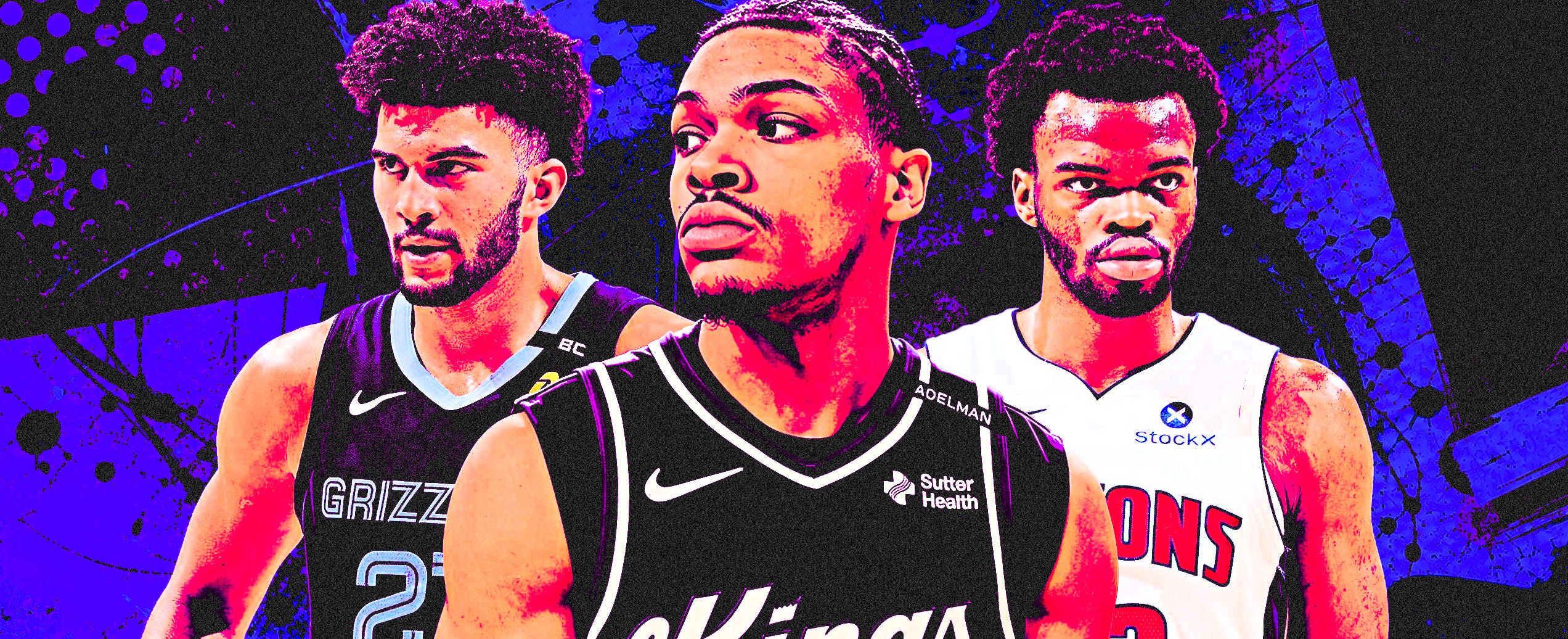
I’ve been waiting all summer for the 2026-27 NBA season.
To be clear, I take some time away from basketball to relax, reflect, and strategize how I want to talk about it over the next year. What do I need to learn and improve upon? What are my strengths as an analyst, writer, scout, and what are my weaknesses?
I’ve had an entire summer to ponder all of that, and what I want to deliver most this year is engaging, fun discourse about the game I love most: basketball.
You see, basketball brings me joy every day. I love keeping up with the league’s young talent and watching them develop, as much as I do scouting the next crop of talent in college and abroad. There’s always something to watch, learn, and discuss in basketball, and I hope to share that love and curiosity through my writing and podcasting this year for No Ceilings.
Before we get into the season’s first edition of The Morning Dunk, I want to stir up that excitement by sharing the top NBA rookies I’m most fascinated by as we head into a new season. Who do I actually want to watch the most? What storylines should fans know and keep up with?
I’ve selected a total of 10 players for this exercise. If your favorite rookie isn’t on this list, my apologies. This isn’t a class ranking either. These are just the players I’m most excited to watch film on and discuss right out of the gate.
So without further ado, let’s get into it!
Rookies
Darius Acuff, Sacramento Kings
There isn’t another rookie point guard in the NBA who is walking into as much opportunity right away as Darius Acuff Jr is with the Sacramento Kings.
It was no secret that before the 2026 NBA Draft, this franchise was searching for an heir replacement to De’Aaron Fox after a trade landed him in San Antonio with the Spurs. Now that the Kings had the chance to take Acuff in the lottery, eyes are on what this team can accomplish with bare minimum expectations, even in a depleted Western Conference compared to years past.
Acuff had one of the best seasons of any guard in the SEC this century, let alone the last decade. Under John Calipari at Arkansas, Acuff posted volume scoring and assist marks at excellent efficiency from all levels of the floor. He operated in the pick-and-roll, made defenses pay in transition if they didn’t get back to contain him, and put on the cape for the Razorbacks more than a handful of times, keeping that team in some games they had no business being that competitive.
Even though Sacramento hasn’t replicated its most recent “Light the Beam” success story lately, it still has real talent on this roster until it’s traded away in what could be a fire sale at this year’s trade deadline.
Domantas Sabonis already looks like he’s developed some two-man game chemistry with Acuff, serving as a screener and a great handoff partner who can put Acuff in position to attack off the bounce without Darius having to create that advantage himself. Zach LaVine remains one of the NBA’s premier shooting talents, capable of relocating and knocking down shots off balance with a second’s notice. Keegan Murray still has room to flex his offensive muscle, even though he’s taken on an enforcer role at the forward position in recent seasons. And young talent like Maxime Raynaud, Dylan Cardwell, and Nique Clifford should all take steps forward in second seasons.
What I want to watch most is how Acuff can make those other players better, and, in turn, how they make him “better” by helping insulate him a bit on the defensive end of the floor.
To address the offense first, Acuff has better passing chops than given credit for before his first collegiate season. His touch and timing on lob passes is excellent, and he made some great reads out of the pick-and-roll for Arkansas last year. How will he operate at the NBA level in those same actions? We’ve already gotten some glimpses of him using pace, getting defenders on his hip, and knocking down jumpers in the preseason. I want to see more of him using that gravity to create windows for his teammates. On defense, there’s no question Acuff’s effort on that end of the floor left a lot to be desired last year. He’s already shown more in that department in the preseason in Sacramento, but this team will need to find ways to limit how opposing offenses can attack him on that end of the floor.
I have ZERO doubts there will be nights Acuff goes for 25 and pours in buckets. He’s a natural-born scorer. But how else can he help win games on the margins early in his career, and what does that look like for the Kings?
Nate Ament, Milwaukee Bucks
Bet you expected to see Brayden Burries’ name here after his excellent preseason run in Las Vegas.
Well, I could’ve absolutely written a blurb here about Burries and what I’m excited to see from him in Milwaukee’s backcourt.
But I went in a different direction after seeing Nate Ament take the court for Milwaukee in the preseason.
Call me crazy, but I think there’s a real role player in there who can end up proving his lottery selection in time as a 6’10” forward who can stretch the floor, score in transition, and add support on the glass.
Ament doesn’t have a calling card of scoring the basketball out of the gate in the NBA, despite being billed before last year started as a three-level forward who could manufacture points from anywhere on the floor. He showed flashes of hitting mid-range and deep shots, and excelled at getting to the free-throw line off contact initiated around the basket.
Unfortunately, that strength needs to be paired with an improved handle and the instinct to pass out of a situation when that driving lane isn't there, given how the defense chose to rotate or play Ament’s angle to the rim. I’m not entirely convinced that Ament, given how much depth is on this team in the frontcourt that this front office will have to evaluate and work through in Milwaukee, will get those same chances he got at Tennessee when he looked the part of a player who could go somewhere in the Top 10 in the 2026 draft.
However, that doesn’t mean there won’t be positives we can take away from Ament's rookie year. How well will he move without the ball? Can he make the easy reads when they’re there off a second-side attack? What will his defensive effort look like, and can he at least end possessions by securing rebounds on the defensive glass?
The masses will judge Ament by his shooting percentages and counting stats. I’m looking past both. How comfortable does he look in an NBA offense, and what types of lineups can he succeed in early in his career? Milwaukee invested a lottery pick in Ament after trading away Giannis Antetokounmpo. So I expect both Ament and Burries to get plenty of run with the major league team and not spend much time with the Wisconsin Herd in the G League. So how does Ament take advantage of those minutes, and what does the coaching staff ask of him? I’ll be watching closely for answers.
Cameron Boozer, Memphis Grizzlies
Is it a Nathan Grubel piece about NBA rookies if I don’t mention Cameron Boozer?
Already in the preseason, Boozer is putting up per-36 averages and efficiency that eerily resemble his run at Duke last season, and performances at prior levels of competition before he set foot on the court in college. Bottom line, Boozer just dominates no matter where he goes, and he does it through winning decisions and habits.
Boozer doesn’t force offense, and he hasn’t in a Memphis Grizzlies uniform either, from what we’ve seen in the preseason. Boozer dissects the defense and reacts accordingly. Whether it’s slipping to the basket for an easy finish, sealing his man in the post after setting a pick up top, popping out beyond the arc, or even making those highlight-reel transition hit-ahead passes, Boozer knows the best decision at every moment.
Does that mean he’s perfect? Of course not. Boozer still has moments when he turns the ball over or tries to muscle an opponent in the post who has a true size advantage. But those mistakes are rare for a player his age.
I’ve been very impressed by his defensive effort so far for the Grizzlies in preseason. It’s clear the weight he’s lost since his days at Duke has benefitted him massively on the defensive end of the floor. He can now slide his feet and keep up with opposing wing matchups while retaining the strength to box out and bang with opponents in the post at times as a small-ball center. Boozer’s ball-handling and lateral mobility give Memphis options to play him as a small forward at times, while choosing other opportunities to roll him out there at center.
That level of versatility isn’t common in the NBA, even in an age of positionless basketball. Boozer can do everything that’s asked of him and more, even at a young age. There will be matchups where he struggles to adapt early on. Everyone has bad games and stretches during their rookie campaigns. But there’s also a world where Boozer can be a true floor raiser for a team with limited expectations (though all of a sudden the Grizzlies are a hot team to pick to hit on their “Over” win total).
Boozer can legitimately score from all three levels, pass his teammates open, and help command the glass alongside one or multiple bigs on this Grizzlies roster. He does everything I want a modern basketball player to do, which is why I can’t wait to see how he performs in his first few regular-season games in the NBA.
Mikel Brown Jr., Brooklyn Nets
We didn’t get to see much of Mikel Brown Jr. for the Brooklyn Nets in the preseason, or in Las Vegas during Summer League. In fact, he also suffered injuries at Louisville during his freshman campaign, so we didn’t get a full season with him there either.
Despite those concerns, Brown is absolutely on my list for top rookies to watch because of his exciting blend of scoring and playmaking.
Few players step into the NBA with Brown’s level of confidence as a star-caliber guard. He just has that “it” factor as a highlight machine. Before the 2026 draft, my best “comp” for Brown was LaMelo Ball before he entered the NBA. Yes, there were concerns about Ball’s style of play and whether it would lead to winning, but there was no denying that Ball could do things on the court that not many other guards could. And I feel the same way about Brown, except I have zero questions about his attitude and demeanor towards playing a winning brand of basketball.
His shots and passes off the dribble are mesmerizing at times. He uses his handle and eyes to create separation and catch defenses off guard with a darting pass into the middle of the floor for an easy scoring chance for a teammate. His three-point range is insane for a player his age; he can pull up from the parking lot with ease and hit jumpers when he’s feeling it. And when he gets a full head of steam downhill, he can jam dunks over defenders who try to meet him at the rim.
At 6’5”, that’s a great combination of traits offensively to kickstart a player’s career in a positive way. Not to mention, he’s shown competitiveness on defense at lower levels, using his length and lateral agility to pressure opposing ball handlers and force steals.
Brown’s path to helping the Nets post a better-than-expected record this year comes down to a few things. How does he hold up defensively in the backcourt? Can he guard both backcourt positions, navigate screens/communicate well away from the ball? Can he be as effective without the ball as an athletic movement shooter who can create space and provide a scoring outlet for players like Egor Demin, Michael Porter Jr., and Julius Randle?
I know Brown will have highlights where he dazzles with the ball in his hands. But I’m interested in seeing how he can affect the game without the ball. What types of advantages can he create for his teammates through his movement and ability to play passing lanes on the other end of the floor? That's what I want to see from Brown out of the gate.
AJ Dybantsa, Washington Wizards
Who doesn’t want to watch the top pick from the 2026 NBA Draft go to work?
AJ Dybantsa is going to put on a show for the Washington Wizards at times, given how polished he already is with the ball in his hands. Last year at BYU, Dybantsa took on a massive pick-and-roll workload as a jumbo initiator who could do some serious damage attacking downhill and getting to the free-throw line.
There were flashes when Dybantsa’s entire offensive game came together, and he made as many great passing reads as he did shots from his patented midrange spots. Yes, Dybantsa is a much better passer than he gets credit for, and he really found his groove as the season went on, even if it didn’t directly raise his assist rate (remember, the other player has to make the shot for the pass to count as an assist).
I want to see what that passing ability will look like in a very team-friendly Wizards offense built around one of the best assist guards in the NBA in Trae Young. Many will point to Young as nothing but a small, heliocentric guard given how teams were built around him in Atlanta. But I think Washington has more opportunity to embrace a more free-flowing offense than just spamming the same high pick-and-roll sets every time up the floor.
Dybantsa can handle the ball and create shots in the halfcourt, Anthony Davis is a real hub in the middle, Kyshawn George looks poised for yet another leap on the wing, and Alex Sarr has passing chops of his own in handoff and short-roll situations. I want to see AJ drive to set up an action for someone else, then relocate to get the ball back in a better position. Washington’s offense shouldn’t be built on one main action. This team has the personnel to create monstrous secondary reads for easier scores, if everyone is as invested in moving without the ball as they are in making highlight-level plays with the ball in their hands.
And Dybantsa can help set that tone alongside Young and Davis. He can lift from the corners and move into a secondary handoff with Davis, set a screen for Young, or even cut from the wings and pick apart a lazy defense, either to score or kick to the corner depending on where the help is coming from (if it even comes at all).
Dybantsa is arguably the best isolation scoring threat we’ve seen enter the NBA in quite some time. We know he can dribble and maneuver into one-on-one buckets, and he will during his rookie season. But Washington has the opportunity to see him grow past that on offense and really buy into being a well-rounded wing who can create or exploit advantages from anywhere on the floor. That continued growth is what I’m watching most from Dybantsa, especially as he gets further acclimated to his new team.
Yaxel Lendeborg, Golden State Warriors
What can’t Yaxel Lendeborg do on a basketball court?
The Golden State Warriors have already given Lendeborg massive freedom during the preseason, and he’s fit in no matter who he's shared the floor with.
He’s brought the ball up the court, distributed off secondary actions/rolls in the halfcourt, scored in transition, and made open jump shots when given the opportunity. Not to mention, he’s already matched up against several positions defensively and has done a great job communicating on and off the ball. He’s looked the part of a veteran player who's been in the league for five-plus seasons, and I’m sure someone out there is reading this and thinking I’m an idiot because, of course, the 24-year-old rookie should look like he belongs.
There’s a difference, though, between fitting in and standing out. Most older rookies aren’t drafted in the same position as Lendeborg and are viewed more as one-job role players you hope can hold up on defense.
The Warriors clearly view Yaxel as the exact opposite. They see how critical he could be during this upcoming season, where the Warriors don’t have a lot of depth around Stephen Curry and Draymond Green, especially with Jimmy Butler and Kristaps Porzingis sidelined.
They’re giving him the keys to the castle already, and seeing how much he can handle out of the gate. And honestly, I’m here for it!
That’s what I want to see this season. Put Lendeborg in inverted screening actions with Curry. Let him play a bit of jumbo two-man game with Draymond. Use Lendeborg as a screening partner with someone like Brandin Podziemski, and let him go work as a short-roll playmaker or DHO partner. Lendeborg’s utility should extend far beyond sitting in the corner and occasionally cutting to the baseline. Yaxel deserves as many touches as he can handle, and he’s proving that the offense benefits when he’s heavily involved.
So long as the defensive effort doesn’t suffer, of course. Golden State has no other forwards like Yaxel outside of Draymond who can cover multiple positions and clean the glass on both ends of the floor. Lendeborg isn’t a shutdown defender, but he can guard well enough on the perimeter and is an awesome help defender who can slide his feet, rotate to block shots, and play passing lanes. His length is also a weapon should the Warriors look to use him as a blitzer to force turnovers in the halfcourt.
I’m just beyond excited to see Lendeborg in an NBA uniform playing in a movement-heavy system that benefits smart, skilled talents. He’s built to play alongside guys like Curry and Green, and this Golden State team will benefit from his talent and two-way ability at that coveted PF position, a player who can dribble, pass, shoot, and defend with real size and length.
Aday Mara, Oklahoma City Thunder
Aday Mara has been the most impressive rookie this preseason, in my view, compared with my expectations for others in the class.
I could’ve told you Cameron Boozer and Yaxel Lendeborg would absolutely crush the preseason. They already did that in Summer League when they competed for the championship in Las Vegas! AJ Dybantsa, Darryn Peterson, and Caleb Wilson all having highlight-reel moments in the preseason doesn’t shock me either.
What surprised me a bit was how ready Mara was to play competitive, sound, two-way basketball right out of the gate.
Yes, he was a championship rim protector and play finisher in college at Michigan. But Mara has done things this preseason that have really caught my eye.
I don’t think he’s been a complete disaster in different coverages away from the basket. And when he’s been in position to challenge shots at the rim? I mean, he’s an imposing presence at over 7’3” tall with a crazy wingspan and standing reach combo. He’s built to play around the basket. But he moves better than he gets credit for away from it, too, even if he’s not playing a boatload of minutes!
But on offense… holy smokes, has Mara put on a show. When Ryan Kalkbrenner stepped into the NBA last season and stood out for his sky-high field goal percentage, he did it all on lobs and garbage finishes. Kalkbrenner was on cleanup duty, while Mara has had a real opportunity to work within the offense out of the post and in handoff situations. As he did at Michigan, Mara has already made some SLICK dimes for the Thunder, and his post scoring, even mixing in some fading jumpers, has been a sight to see. It makes his efficiency even more impressive, not to mention he’s kept up his work on the glass.
Mara could very well get a triple-double in his rookie season, and I wouldn’t be surprised. He’s already in position to rebound and finish plays, given his size and touch. The passing ability is clearly translating already. Even if he only averages around 15-20 minutes a night, those might be the most impactful minutes played in this entire rookie class every night! It’s not out of the question, even though I would heavily favor Boozer, Lendeborg, and the other top picks for the NBA’s Rookie of the Year Award over Mara.
But Mara is further along offensively than I anticipated at an NBA level. I know the flashes were there on tape last year, and even at lower levels of competition. But now we’re seeing him operate with a level of comfort in the preseason that I just wasn’t expecting this soon. I only wanted to pick one Thunder rookie, and despite how electric Bennett Stirtz has looked in preseason action, I’m putting Mara on my early All-Rookie Second Team predictions.
Ebuka Okorie, Detroit Pistons
All summer long, the Detroit Pistons were in headlines for the wrong reasons. Jalen Duren dominated the offseason conversation because of his restricted free-agent saga, to the point that much of the talk wasn’t about how Detroit’s roster is built to compete for yet another Eastern Conference regular-season crown.
Cade Cunningham, Ausar Thompson, and the aforementioned Duren are one of the league’s best young trios to contend and rack up wins. But what does this supporting cast look like around those three players? Is there enough ball-handling and shooting to complement Cade? Who will be the long-term secondary scorer who can take pressure off Cunningham, Duren, and Thompson?
For many, myself included, the answer is for the Pistons to trade for that player at this year’s deadline or in the offseason. But when I spoke to some Pistons fans and those who cover the team this summer, there’s a wave of confidence that player is already on the roster: Ebuka Okorie.
Now Okorie is a small-ish guard out of Stanford who put on a scoring barrage night after night for a team that, quite frankly, wasn’t very competitive outside of his efforts. How that team won games, knowing the opposing squad could gameplan against Okorie, is beyond me. That’s how gifted an engine Okorie was at the collegiate level.
His efficiency, given how he manufactured buckets, was special. He wasn’t an overly impressive finisher at the basket, nor was he a lights-out three-point shooter. But his elite handles and side-to-side shift let him shake defenders at the top of the floor routinely, and dance into floaters, runners, or pull-up shots that left defenses shaking their heads.
Okorie is an absolute blur in the open court, and a freaking mirage in the halfcourt. One minute, you think you have him contained, and then the next he vanishes. It’s uncanny how often Okorie has defenders just looking silly trying to cover him.
That ability to separate and create something out of nothing left media scouts rising up the boards in a frenzy last cycle, and for good reason. Those types of guards, especially those who measure with a 6’8” wingspan, tend to outperform their draft slots should they be taken outside the lottery. The Pistons found Okorie outside the lotto and hope he’ll be a key piece alongside Detroit’s other perimeter options, Cade, Daniss Jenkins, and Isaiah Joe, as a dynamic scorer who can create offense when plays break down or ideal spacing isn’t there.
He’s not guaranteed heavy minutes out of the gate, like a lot of the other rookies I’ve written about here. But even more than someone like Yaxel Lendeborg or Aday Mara, Okorie could be a key piece in swinging a championship contender's offensive balance in his rookie season if he gets the opportunity. I’ll be watching closely what responsibility Okorie gets out of the gate, and how Detroit looks to use him both in lineups without Cade and when the two share the floor. Okorie is a dynamic, exciting young guard who has my full attention this season.
Darryn Peterson, Utah Jazz
The Utah Jazz have EVERY NBA fan’s attention heading into this season as the sexiest pick from bottom-feeder to actual playoff contender.
And that belief is well-founded. Lauri Markkanen has been one of the league’s best scoring forwards for years now. The Jaren Jackson Jr. acquisition is meaningful, as he supports the team’s defensive infrastructure while maintaining coveted spacing within Will Hardy’s offensive scheme.
Keyonte George took an All-Star-level leap at point guard last year, and there’s more scoring talent on the wing waiting to be unlocked in Ace Bailey and Brice Sensabaugh. Yes, there’s a hole at center without Jusuf Nurkic (Kyle Filipowski, please stand up). But this team has so much firepower, and the addition of franchise shooting guard Darryn Peterson only amplifies it.
Peterson is as good a pure scorer as I’ve evaluated in 16 years working the NBA Draft. He’s a pure bucket getter of the highest order, able to separate and convert on the most difficult jump shots imaginable. His balance and focus on those shots are incredibly unusual for a player his age, and he pairs it with the athletic pop to finish a dunk at the rim or step into threes off real movement.
I have zero concerns about Peterson putting the ball in the basket as a rookie. What I want to see is continued development behind Peterson’s ball-screen game as an initiator from the top of the floor.
After George, there’s Isaiah Collier, and then not many other options the Jazz would want running the offense. Peterson will have chances to work as the de facto “point guard” and could even get some of those touches alongside George, giving him more freedom to operate as a movement shooter away from the ball.
How much damage can Peterson do as Utah's pick-and-roll ball handler? What advantages can he create by turning the corner and forcing defenses to react to his downhill moves? Those drives produced mixed results at Kansas, but we did get good glimpses of Will Hardy drawing up better ways to get Peterson moving into those actions rather than running a ball screen from a standstill. How Hardy chooses to deploy Peterson in secondary actions is key, but even more important for his overall development are the moments when he’s tasked with bringing the ball up the floor and getting this team into real offense.
There’s evidence of Peterson passing and making excellent reads both in high school and in college. But the speed of the NBA game is a completely different animal. What will he do if those simple reads are taken away, and it becomes a matter of playing against the second and third levels of the defense?
More than how he looks on defense alongside George, and how both of them can handle that end of the floor in the backcourt, THAT is what I want to see from Peterson. How does he evolve in making others around him better at the NBA level?
Caleb Wilson, Chicago Bulls
Did I save the best for last with Caleb Wilson?
His Summer League debut was about as opposite as I could’ve expected for the 6’9” forward out of North Carolina.
Wilson went from barely attempting any threes in college to coming out of the gates and nailing triples like he’s been doing it at a high level his entire career. That, along with all the usual eye-popping athletic feats he is prone to during a game.
It’s no hyperbole to say Wilson is the best athlete in the 2026 draft class, even though AJ Dybantsa and Morez Johnson would like a word.
He’s just so explosive off two feet, and in driving to the basket. His long strides, coupled with his spring and pop, let him get to angles and shots other forwards can’t. Then add his ability to knock down the occasional face-up jumper or turnaround shot, plus how he’s evolved as a standstill passer and playmaker, and you can start to see why Wilson ends up going so high in the draft.
Where I feel Wilson is lacking the most right now, even more than finding regularity within his three-point diet, is in his halfcourt handle. In my humble opinion, the key to unlocking Wilson is putting him in position to become one of the league’s most dangerous inside-the-arc scoring threats. That means being able to break down his opponent from the top of the floor, get into the teeth of the defense without turning it over, and either find an open man on the move or finish a play himself.
Wilson can do those things on occasion, but not consistently without making mistakes. The Bulls need balance to put Wilson in position as a finisher as often (or more often) as they ask him to develop as a creator. Putting too much on Wilson’s plate too soon can stunt his growth, even if he’s just as eager to prove he should’ve been the top pick in the draft and take over games with the ball in his hands.
Gradually feed Wilson more on-ball reps, work on his mid-range touch and polish, guide him to make better reads on the move, and then worry about gunning six-plus threes a game. Chicago has guys who can knock down catch-and-shoot shots. That team doesn’t have enough players right now who can actually break a defense and create a real advantage. Wilson forces defenses to pay attention to him because of how he can drive, cut, and separate as a vertical finisher. The sooner he can break defenses from the top in transition or off movement, the better the Bulls will be on offense.
I’m going to leave words on his defense for another point in the season. He had some really bad moments on that end of the floor in the preseason, but there are clear communication and responsibility gaps with the team, and Wilson just isn't quite there from a decision-making standpoint on defense. His effort and motor are top-notch, so he’ll make plays on defense for sure. But I want to see how the TEAM progresses there before I start picking nits with his individual defensive miscues both on and off the ball.
Honorable Mentions
Brayden Burries, Milwaukee Bucks
Christian Anderson, Charlotte Hornets
Bennett Stirtz, Oklahoma City Thunder
Kingston Flemings, Atlanta Hawks
Allen Graves, Toronto Raptors
Keaton Wagler, LA Clippers