


The 2026 Portsmouth Invitational Tournament (PIT) marked my ninth trip to Portsmouth, VA, for the illustrious pre-draft all-senior event. A huge thank you to the city, Churchland High School, and the entire PIT team for organizing another tremendous hoops summit.
For evaluators like myself who are obsessed with scouting on the margins and finding impact value there, the PIT is truly paradise. To wrap up my in-person coverage that includes some fun nights producing the PIT Diaries with Stephen and supporting podcasts, here are my 2026 Portsmouth Invitational Superlatives.
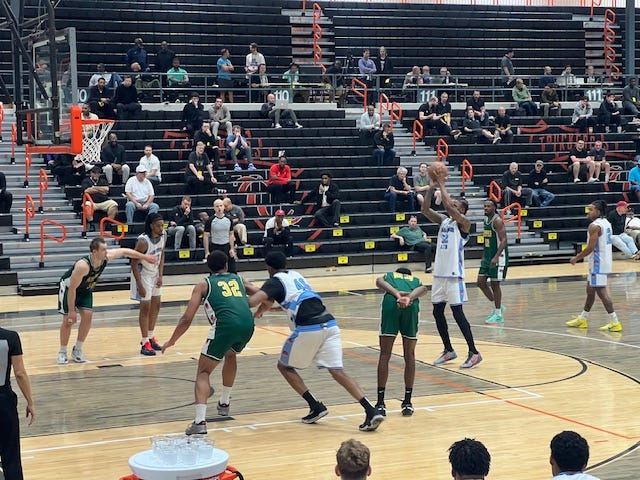
Most NBA Ready: Quadir Copeland/Rafael Castro
As mentioned in the PIT Diaries with Stephen that covered our boots on the ground perspectives, Quadir Copeland entered the event as my top-rated prospect, with his standing remaining unchanged. His intersection of size (6’6, 6’11” wingspan), ball skills, feel, and competitiveness shined in a setting that made for the versatile and shifty floor general.
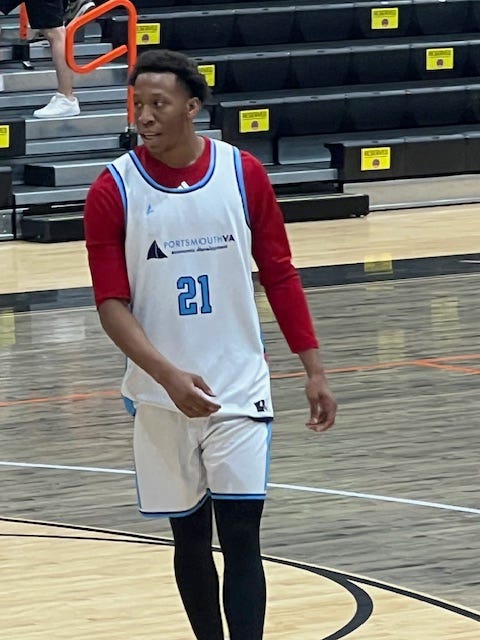
Copeland generated a ton of paint touches for quality scoring and playmaking opportunities. He routinely made plays for others in the open floor, from drives and kicks, and out of ball screens en route to dishing out 23 assists across three games. He was relentless in encouraging his teammates, including countless low and high gives and several moments of verbal praise after both makes and misses.
Defensively, Copeland leveraged his length and instincts for steals in passing lanes and on digs. His defensive playmaking and physical tools give him the versatility to defend 1-3.
Copeland’s biggest knock remains his three-point shooting (career 28.5% shooter on 137 total 3PA). However, I’m probably a bit more optimistic than most on Copeland developing into a respectable long-range shooter. On top of consistent, fluid mechanics, Copeland connected on a career-best 39.7% of his threes (1.7 3PA; I understand the low volume) and 77.5% of his free throws (5.4 3PA). Copeland is a firm and rising top-60 prospect for me. For a fuller scouting report, I wrote about Quadir Copeland earlier in the cycle:

I’ve long been a Rafael Castro fan and have had the pleasure of scouting him in person at George Washington over the past two seasons. Castro excelled in his usual playfinishing-shotblocking role, highlighted by above-the-rim finishes, gazelle-like floor runs, and weakside blocks/contests at the rim.
While it wasn’t an overly productive tournament, Castro showcased a translatable skill set and performed much better than expected. As a big with a slimmer frame, I was worried he would measure much below his 6’11” and 220-pound listing on the GW site. However, Castro measured at 6’10” and 226 pounds alongside a 7’2” wingspan. That’s a major win!
Top Performer: Kowacie Reeves Jr.
The athletic and energetic wing out of Georgia Tech averaged 23 PPG and grabbed 5.3 RPG, while shooting 42.8% from beyond the arc (21 3PA) and earning all PIT honors. Kowacie Reeves shot with confidence, finished at the rim with authority, and played with tenacity on defense.
194 pounds is concerning, given the wiry frame. Yet, Reeves doesn’t shy away from physicality on either end of the floor. Officially measuring at 6’7” with a 6’10.5” wingspan, there is a legit 3-an-D path for NBA teams to explore on a two-way contract.
The Instant Film Dive Award: Jaden Henley/Peter Suder
One of the many reasons why I love the PIT is that it forces immediate deep dives on standout players. Whether it’s someone that you hadn’t seen much of, needed to see in person, or were intrigued with coming in, the PIT always seems to produce those “Yup, I need an instant deep dive” prospects. Grand Canyon’s Jaden Henley and Miami (OH)’s Peter Suder are my Instant Film Dive winners.
Henley popped in on the few Grand Canyon games that I watched in real time this cycle, and the intrigue grew during my PIT prep. After the first game and a half, it was clear Henley should be headed to Chicago. He blended physicality and creativity to get downhill for scores at the rim and in the midrange, initiated and finished through contact. He seemed to be everywhere defensively, leading the tournament, swiping ten steals in three games.
There was a sense of confidence and purpose from Henley that was evident, and it no doubt translated to his All-PIT team performance. Don’t be surprised to see Henley rise throughout the draft process thanks to his mix of ball skills, physicality, shotmaking, feel, and defensive playmaking. A legit case can be made for Henley as the wing with the post upside down from the PIT.
Like Henley, Suder earned All-PIT team honors. Not bad for a late invite! Suder played with toughness and confidence; he didn’t look out of place amongst the numerous Power Four names in the event. Against Mike Duman, Suder took over in the second half. He buried shots at multiple levels, including a soft floater, flashed his passing feel on a tight pocket bounce pass, and hustled to save a ball from going out of bounds that led to points for his team.
Despite some of the ups and downs in shooting throughout his career and athletic limitations, there is a pass-dribble-shooting vision here with Suder that should draw G-League and Ex. 10 interest.
The Trust the Film Award: Cade Tyson/Tamin Lipsey
It’s fair to say that both Cade Tyson and Tamin Lipsey didn’t perform up to the All-PIT expectations that many other evaluators and I had of them, but don’t let that sway any evaluations of them. Trust the film. There is a larger sample size on both sides to support, and I don’t feel like this setting exposed or exacerbated any concerns.
Tyson is still a knockdown shooter with NBA size, and Lipsey still is an experienced floor general and disruptive defender. Even amid some struggles, Tyson and Lipsey offered glimpses of their NBA appeal at the PIT.
Best Playfinisher: Tobi Lawal
Tobi Lawal is an easy plus athlete with effortless pop and explosion. Seeing his functional athleticism affect games on both ends, while exciting fans and evaluators, was a treat. He finished several passes for slams from drop-offs to lobs, including in transition and halfcourt. Many times, Lawal was peering down at the rim and literally throwing the ball in.
Lawal was another big measurement winner. Adding to his plus athleticism, he’s 6’8.75” with a 6’11” wingspan. There was real concern Lawal could end up being much closer to 6’7”, which would hinder some of his undersized big appeal despite his athleticism.
Furthering his playfinishing profile, Lawal knocked down 41.7% of his threes (13 3P) at the PIT. He has long flashed shooting touch (32% career three-point mark). Seeing it at this stage is very encouraging, especially coming off the heels of a 25% three-point shooting clip season (48 attempts).
Best Defender: Rafael Castro/Izaiyah Nelson/ Seth Trimble
Rafael Castro, Izaiyah Nelson, and Seth Trimble all share the award. Castro and Nelson bring many of the same defensive qualities. Long, athletic, and rangy bigs who can defend in space, affect shots at the rim, be active in passing lanes, and generate defensive events all over the floor. Both did just that throughout the PIT. I was particularly drawn in by Nelson’s outward passion and playful trash talk.
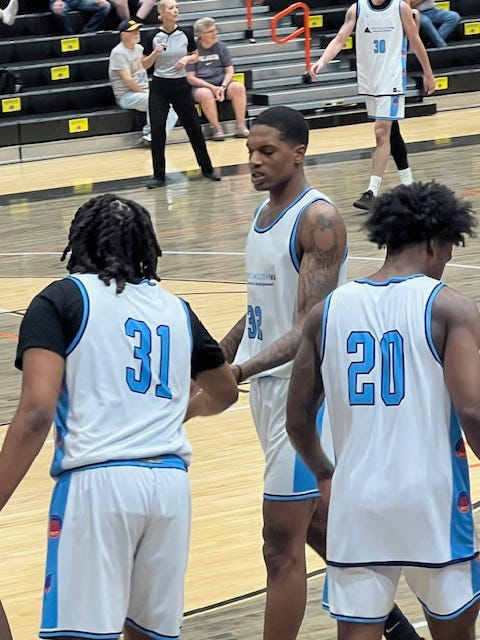
Trimble is a known defensive ace, and both his play and measurements (6’3”, 6’8.5” wingspan) continue to fuel it. Trimble was active and disruptive on and off the ball, featuring a pick-six steal into a big dunk where that PIT leading 40.5” vertical popped tremendously. My favorite Trimble defensive possession saw him pressure the ball full-court, forcing the ball-handler to work and the opposing team to get into their set later in the shot clock. Then, Trimble ended the possession with an on-ball stop. He’s clearly a valuable defensive weapon, but he’ll need to convince teams that he can be a respectable three-point shooter.
Best of the Rest (no order):
Closing Reflections
This year’s PIT did not disappoint. Many of the participants are well on their way to becoming margin monsters for an NBA franchise. In terms of draftable prospects, I walked away with five at this point in the cycle: Quadir Copeland, Rafael Castro, Izaiyah Nelson, Tobi Lawal, and Cade Tyson, with Jaden Henley right there on the cusp.