The Oklahoma City Thunder and Their Potent Stack of Ball-Handlers
The Oklahoma City Thunder have a key feature in their system by deploying these guard-centric lineups, and it’s yielded success in low- and high-leverage situations.

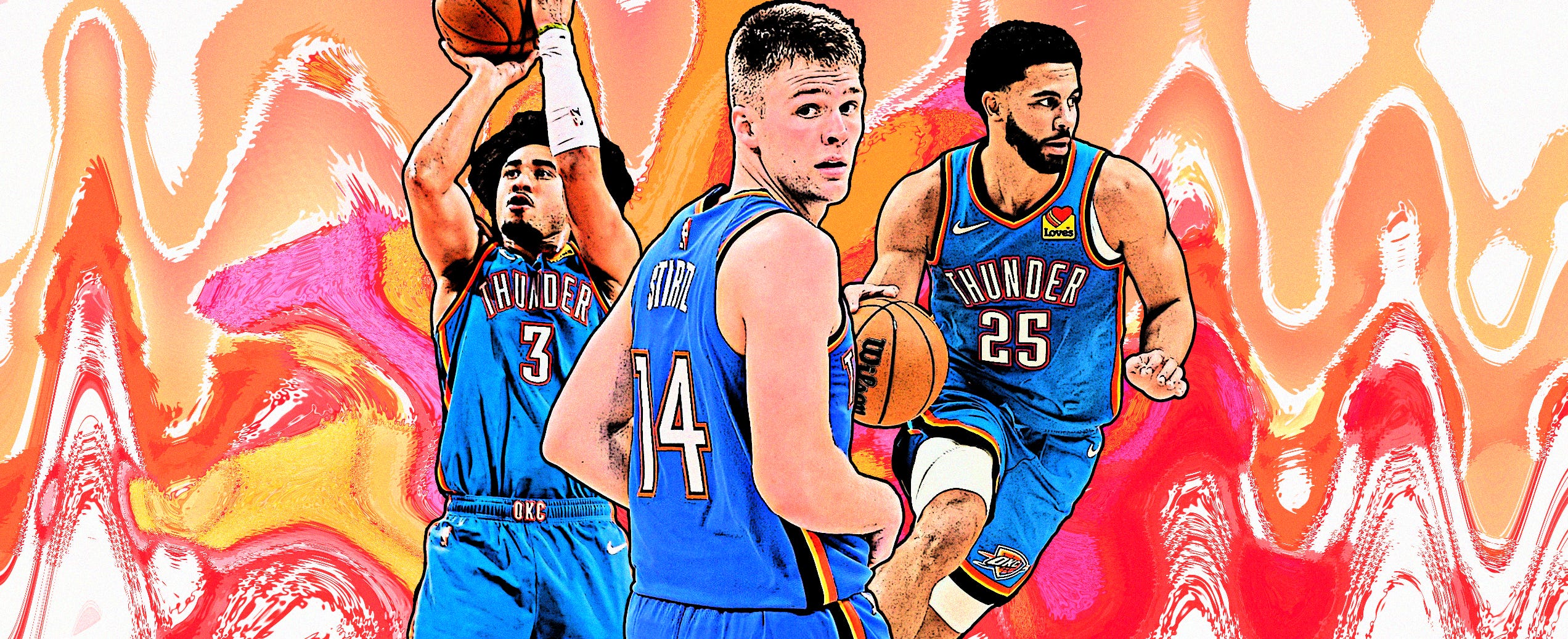
Over the summer, the Oklahoma City Thunder made a series of moves to step underneath the second apron. They traded away Lu Dort, Aaron Wiggins, and Isaiah Joe for second-round picks. Two things stood out within their offseason moves that create more layers than just financial flexibility.
First off, they didn’t replenish their wing depth. In the draft, they fortified their center depth with Aday Mara—a move that not-so-coincidentally aligned with the Victor Wembanyama-related issue they faced through the regular season and Western Conference Finals. In addition, they added another ball-handler in Bennett Stirtz.
Secondly, because of their offseason moves around it, it’s clear that Sam Presti and the Thunder are going all in on ball-handling and size around Shai Gilgeous-Alexander, a formula that has worked in the playoffs. The lineups typically trend towards having Gilgeous-Alexander with two 6’5” or under guards masquerading as wings, a forward (typically Jalen Williams), and then a big man. Other configurations could remove a guard or a forward to go two-big with Chet Holmgren and a center.
Through this team-building construct, a vision that’s been crafted for quite some time, Presti was an early adopter of the necessity to deploy as much ball-handling as possible. Skeptics may scream that there’s only one basketball. While the argument can be true for some teams, it’s important to note that different roles can be formulated in this construct—in fact, that take feels more reserved for scoring-dominant players without much ancillary skill to scale.
Ajay Mitchell, Jared McCain, and Bennett Stirtz are the players in these roles right now for the Thunder. In the absence of Jalen Williams and Cason Wallace, their responsibilities have heightened as the Thunder progresses in their team-building philosophy.
But First… The Two Years of Lineup Data for a Successful Formula for the Oklahoma City Thunder
The Thunder really tapped into this formula when they traded Josh Giddey for Alex Caruso in the 2025 offseason, a move that served as a catalyst for their 2025 championship. The trade fortified their stingy defense with an All-Defensive ace that could fit into multiple roles offensively—primarily as a spacer, attacker, or screener.
These roles spread across its roster, primarily through prospects off their bench. Cason Wallace fits as a point-of-attack defender who’s a spacer offensively. Ajay Mitchell is an attacker. Jared McCain is a spacer.
While on paper, it’s three—at times, four—guards together. These roles enable it to work quite well together.
It’s important to illustrate the why with this data. Despite the difference in positional size—at least relative to the average—they offset it in various capacities. Most notably, the defensive tenacity and versatility are the key enablers, particularly with Alex Caruso and Cason Wallace—those two players can defend bigger than their size. Shai Gilgeous-Alexander is the size of a small forward. However, the key skill here is the advantage it creates having multiple ball-handlers on the floor, even if it comes with a slight size disadvantage.
It’s not to discredit Dort, Joe, or Wiggins; this trio provided real value to their championship run. In fact, the SGA lineups with this combination still yielded tremendous success. However, the sample built within these guard-centric lineups shone as a pathway to continue investing in, particularly because of the defensive excellence.
It’s not an all-or-nothing formula for the Thunder coaching staff. The best teams typically have multiple looks to throw at their opposition. Two components fall into this approach. First is availability. The Thunder have had to experiment based on injuries. Since the above time period, Jalen Williams has dealt with recurring injuries last year and in the postseason, then suffered a gruesome leg injury at the beginning of this season. Alex Caruso has played fewer than 60 games a season since joining the Thunder. Isaiah Hartenstein and Chet Holmgren have had their share of injuries, and the latter is out after a knee procedure. Cason Wallace is now out with a torn labrum for an extended period.
Within this, Mark Daigneault looks to deploy these types of situations often—even without injuries—to prepare for circumstances where they’re not whole.
“Even proactively, when we’re whole, we try to be aggressive in those situations, so that when we’re not whole, we don’t fall off,” Daigneault said. “We’ve tried to have a mentality over the years with any adversities or any situations like this, where we try to be opportunistic and [we try to] figure out ways where we can build some momentum despite the circumstances.”
Secondly, Daigneault simply looks for ways to get his talent together on the floor as much as possible.
“When it’s Caruso, Jalen Williams, Shai, and Dort, you want them all playing and there are only 5 spots,” Daigneault said. “One way to do it is get them all together.”
With role elevation due to personnel changes and injuries, the Thunder will be relying on Ajay Mitchell, Jared McCain and Bennett Stirtz—deploying them in a fashion that’s made this Thunder team a well-oiled machine the past several years.
“Right now with Stirtz, McCain and Ajay, those are smaller guards, but you don’t want them shuffling in and out for each other,” Daigneault said. “You got to figure out ways to get them out there together. Then tactically, what do you need to do to make that be successful and get their strength to rise to the surface?”
The Thunder are tasked with pushing through the season without key pieces from their 2025 championship season. However, the developmental runway given to this specific trio can yield long-term success when the sum of parts return whole.
Ajay Mitchell: The Co-Pilot
No Thunder player has been tasked with this level of responsibility on both sides of the ball quite like Ajay Mitchell. In the process, he’s continued illuminating these flashes of stardom that brightened over the 2026 playoffs.
Starting with his offense, Mitchell is an elite pick-and-roll creator who carves defenses up in a unique way. This season, he has scored 1.208 points per possession (PPP) as the pick-and-roll ball-handler—per Synergy Sports. However, he has accomplished this without a single made three. This sort of efficiency without the reliance on the outside jumper is absurd. In fact, among players with at least 5 or more possessions in the pick-and-roll, he leads the league in efficiency.
The company of players with his level of pick-and-roll efficiency and three-point volume is typically reserved for star creators.
He has a wonderful stack of traits that enable his star-level efficiency as a creator. He has plus size at either guard spot—leveraging his physicality to generate separation off slight shoulder bumps once he touches the paint. When doing so, he demonstrates a sweet blend of balance and shooting touch off contact and when creating separation. His movement patterns and handle are silky smooth. His pace off screens is tremendous—as he can change directions, snake his way downhill, and turn corners effectively.
When sharing the floor with multiple guards, pick-and-rolls with Mitchell as the handler open up different advantages, particularly with where they’re being initiated. Typically from one of the wings, Mitchell can leverage the space from the empty corner to explode downhill via the screen or the reject.
Mitchell’s assist numbers don’t quite pop. He ranks in the 43rd percentile among combo guards in assist percentage (19.6), per Cleaning the Glass. In addition, he falls in the 14th percentile in rim assists (1.6) and in the 22nd percentile in potential assists per 100 possessions (11.1). The Thunder, as a whole, rely on self-creation and exploiting defenses off drives—as they are last in the NBA in assist percentage (55.5).
For what it’s worth, his assists per 100 possessions increase by 4.1 when he’s not sharing the floor with Gilgeous-Alexander, per Databallr. This trend leads to a belief that it’s tied to his role—with SGA, he’s more of a second-side attacker, while he’s a pilot of the offense with him off the floor. Nonetheless, I want to highlight the assists here, because he demonstrates great cadence and creativity as a passer off drives—opening up the passing map when he has a secured advantage. In addition, the Thunder bigs make for helpful lob targets due to their size and catch radius, exploiting defenses for the attention Mitchell and Gilgeous-Alexander garner.
Likewise with the pick-and-roll, Mitchell slices defenses with his driving ability. When playing off the other guards, he can identify mismatches and exploit open space to get downhill. The balance, body control, and touch all blend together to make him one of the league’s more potent drivers. Among players who have played at least 5 or more games, Mitchell ranks 7th in field goal percentage (59.1) and 5th in field goals made per game (5.0) off drives.
Pairing Gilgeous-Alexander with another guard that can frequently touch the paint with his driving puts tons of pressure on the defense.
“He’s always been a paint hitter as a player, and it’s one of his elite skills,” Daignault said.
Finally, the defense is something Mitchell has been tasked with a bit more, especially in the absences of Williams and Wallace. Most players see a defensive slippage when the offense scales up to a significant degree, at least when their earlier roles were more heavily tied to defense. However, even with increases in usage, he’s maintained a steal rate of at least 2.0 or higher and a defensive box plus/minus (DBPM) of 1.6.
“It starts with defense,” Mitchell said. “Even when I got here as a rookie, I knew that in order for me to be on the court, I had to play great defense — and really bought into that. I like the challenge of being able to guard the best players every night. It’s hard, obviously, but it just makes it challenging and fun, and I love to compete on both ends. I’m really enjoying that.”
While his size is additive to individual defense, Mitchell’s value is more so tied to his event creation and off-ball defense. Per Databallr, he’s in the 85th percentile in stop percentage (3.8) and in the 90th percentile in forced turnovers per 100 possessions relative to league average (1.5). He combines aggressiveness and anticipation in passing lanes to stir up activity and force turnovers.
When assessing Mitchell coming into the 2024 Draft out of UC Santa Barbara, I was too fixated on his scalability out of an environment where he was the system. While I highlighted his pick-and-roll and driving prowess in his scouting report, I oversold the offensive freedom while undermining his superpower, especially accounting for his size at the guard spot.
He’s a legitimate star-level offensive weapon. His excellence as a driver—particularly in the pick-and-roll—is why he’s a trendy pick to be a breakout All-Star down the road, or to be a popular candidate to make a “Jalen Brunson leap.” While that may be in the cards down the road, right now he’s an awesome co-pilot to Shai Gilgeous-Alexander—dissecting defenses as a secondary creator, and holding down the fort when the star sits.
Jared McCain: The Spacer
When assessing pre-draft evaluations, on the other side of the aforementioned spectrum, Jared McCain’s profile is one that felt obvious to translate seamlessly to the league. He’s a guard who can toggle off the ball, hunts threes and hits them at a high rate, and has a good frame to withstand physicality in the paint and defensively. Through his three seasons in the league, McCain has translated to a role where he can impact winning, particularly by weaponizing his outside jumper.
Upon the trade to Oklahoma City, it was a hand-in-glove fit. Accounting for the skill sets and shot diets of its All-Star trio, they needed to surround their roster with shooters that let it fly on volume in order to open up the floor for the driving. McCain carries that responsibility perfectly.
Since joining the Thunder, McCain has shown that he’s not shy when it comes to shooting the three-ball—attempting 12.2 threes per 100 possessions. Last postseason, that number rose up to 13.6 while making them at a 37.1% clip. Only Isaiah Joe has attempted double-digit threes per 100 possessions since the beginning of the Thunder’s rise to the NBA’s elite.
The percentages aren’t pretty right now, only making 35.3% of his threes, but he’s trended around 38-41% dating back to college. Nonetheless, his shooting accuracy and volume give the Thunder a marksman defenses have to pay mind to, which in turn amplifies its spacing.
McCain told No Ceilings that he looks “to space the floor when they’re sending doubles to our ball-handlers, or in our certain offenses where we put 2 on the ball—just being able to move off of it and hit open shots.”
McCain’s process as a shooter is textbook. He keeps his hands ready to receive the ball right in the shooting pocket. He chases open space in order to let it fly before the defense can offer a formidable contest. He hunts threes in transition. Everything with McCain’s shooting process feels fluid and repeatable.
A key component of deploying these multi-guard lineups is the ability to string actions together. The Thunder lean on Isaiah Hartenstein as a hub, more now than ever due to their injuries. Aday Mara will be developed into this role as well. McCain is deft coming off handoffs, as he comes around the action to chase space for threes or to turn corners to get downhill and touch the paint. Per Synergy Sports, he scores 1.216 PPP off handoffs (84th percentile in efficiency), and they take up 20 percent of his shooting possessions (98th percentile in frequency).
McCain isn’t the most explosive athlete. However, he leverages his craftiness to get downhill and finish effectively in the paint, often shielding his body on drives. Whether it’s coming off actions or in spot-up situations, he utilizes the threat of his shooting to attack closeouts and probe his way to the paint. One fascinating component of this comes within his synergy with Hartenstein, where he can take advantage of defenses looking to top-lock or blow up handoffs to cut towards the basket.
He’s not the most reliable driving engine, as he’s susceptible to getting his shot blocked. However, he’s a shooter who adds value when he’s run off the line, a valuable trait for high-level marksmen in today’s NBA. So far this season, he’s converting on 63% of his half-court attempts at the rim.
“Since I was a kid, [I was] always using the three-point as a threat to create an advantage,” McCain said. “Offense is pretty much about just creating an advantage, and being able to read closeouts is something I’ve done since I was a kid. Being able to translate that to these games is pretty elite.”
Back to pre-NBA trends, this sort of lineup structure isn’t foreign to McCain. Duke operated with a lot of three-guard lineups with him, Tyrese Proctor, and Caleb Foster. In the same role, he weaponized his jumper to open up the offense for himself and others. Most importantly, when assessing scalability, it showed NBA teams McCain’s adaptability.
“Just being adaptive to any environment,” McCain said. “In high school, I was more on the ball and then going to college, I played a little bit of both. Just being able to read whatever’s going on out there and be able to go into the game and play off the ball [or] on the ball — whatever I need to do from the guard position, I can do.”
In closing, with his ancillary skills, McCain isn’t a volume passer, operating more as a connector that can create out of the second-side actions. He’s a sound positional rebounder as well. Defensively, he’s not a stopper or event creator, but his stout frame allows him to play with the necessary physicality to avoid being the weak link.
Nonetheless, Jared McCain provides the necessary shooting and offensive pop needed alongside a drive-centric Thunder team.
Bennett Stirtz: The Intersection of the 2?
Bennett Stirtz checks a ton of boxes for the Thunder with his positional size, quick processing, and shooting touch. While the pick may have felt like adding a logjam to ball-handling, it all makes sense looking at the team Sam Presti has built around his stars.
Stirtz’s usage has led to quite a shift. At Drake and Iowa, he was the system. Last season with Iowa, he played in 94% of his team’s minutes; at Drake, it was at 98.8. The minutes dip was always going to be noticeable. However, his playtype portfolio has warped—transforming from a heliocentric guard to a spot-up shooter.
In this role as a spacer, Stirtz has shone. He’s made 42.9% of his catch-and-shoot threes. He’s also run the floor quite well, as he’s made 71.4% (5/7) of his transition triples. He has a quick release with good balance and shot prep with his jumper. He didn’t have the chance to really operate in this capacity in college, but it’s a perfect situation for him to get his feet wet in the league.
“Hopefully just make it tougher for the defense to send 2 to Shai or 3 to Shai,” Stirtz told No Ceilings. “He’s usually getting a lot of double teams. So if he gets those, then I can be a knockdown shooter.”
Don’t get it twisted. Stirtz’s creation is still dazzling. He’s scoring 1.333 PPP as a pick-and-roll ball-handler. He’s converting on 47.4% of his dribble jumper threes. In addition, he’s making 62.5% (5/8) of his shots at the rim in the half-court. He possesses great burst after lulling defenders to sleep, but he’s also never really sped up. His balance on his jumper translates off the dribble as well, as his mechanics don’t drastically change.
A likely byproduct of the usage shift, Stirtz’s playmaking numbers don’t pop, boasting a 7.4 assist percentage. I likely tie it to his playtype portfolio, though. Stirtz thrives playing in interactions due to his quick processing. Often showcased with the big man, he keeps his options open out of ball screens and handoffs, possessing a nifty slip pass to the big man for the roll. Within these, he utilizes it to reset actions as well.
As he gains more comfort in the NBA and in the system, I’d expect an uptick here.
I use “intersection” with Bennett Stirtz, because he provides a stack of traits not really in the supporting cast among guards right now. He’s a high-volume shooter with real pull-up shooting equity, which opens up a different dynamic in the pick-and-roll or in next-actions. The processing should shine more in this role as well. Over time, he should really warp defenses with his pull-up shooting equity, processing, and poise out of the pick-and-roll.
Stirtz’s development within these multi-guard lineup constructs is worth monitoring, as it can pay big dividends for the Thunder.
How it blends together
I want to run through several plays to illustrate how it blends together.
Gilgeous-Alexander starts off the ball after the screen from Mara. McCain comes over for a subtle screen, and Mitchell toggles over to the corner in the meantime. SGA drives and kicks to Mitchell, who attacks the closeout from the low man to touch the paint and get a bucket.
McCain and Mitchell initiate a handoff that ultimately generates a switch to create the desired matchup. From there, Hartenstein sets the screen to allow for Mitchell to get his man in a hostage dribble. From there, Mitchell leverages his footwork to get the bucket he wants.
First play of the game — similar concept. Gilgeous-Alexander moves off the ball, and in the meantime, he shifts Amen Thompson over to the weak side out of the action. McCain and Mitchell run a handoff to get the switch. Mitchell explodes turning the corner to draw Sengun’s attention, as Hartenstein slips the screen for the lob attempt.
In transition, Mitchell finds Mara to get some offense at the top of the key. Mara fakes the handoff with McCain and flows into one with Stirtz. From there, Stirtz rejects the handoff into a screen from Mara. He draws the nail help to find McCain, who attacks that closeout and gets to the bucket.
The Thunder create a guard-to-guard pick-and-roll with Mitchell and McCain. As Mitchell turns the corner, Hartenstein’s roll gravity creates a pick-your-poison predicament with the big in drop—opening a pathway for Mitchell to get to the runner.
A key component of this trend is to allow Gilgeous-Alexander to get to his spots in different actions, as opposed to a high ball screen. Off the Zoom action, Mitchell drives and occupies the nail help. In the meantime, Williams re-spaces to the corner. He steps into the closeout and swings it back to Mitchell. He makes one more pass to Gilgeous-Alexander, who’s now driving into an easy mid-range jumper against the closeout defender’s top foot. This action ultimately created a rare look where Gilgeous-Alexander can attack a tilted defense.
I wanted to show these plays because they highlight the integral component of today’s NBA of stacking together as much ball-handling as possible. Sure, people can point to the “there’s only one ball” argument. However, that designation belongs to teams that stack with scorers without additive ancillary skills, or with drivers that are good but not elite.
The Thunder have arguably the best driver of the basketball in the world in Shai Gilgeous-Alexander. Ajay Mitchell drives the ball at a high level. Jared McCain and Bennett Stirtz are potent shooters who can leverage it to create out of side pick-and-roll or handoff actions. Cason Wallace and Alex Caruso are hounds defensively that can spot up, set screens, and handle the ball.
Stacking this team with guards around Gilgeous-Alexander is vital because of the looks the defenses typically throw and the system the Thunder run. Defenses typically send two or three defenders at SGA, so you have to surround him with quick decision-makers capable of creating off the bounce, shooting, or finding teammates. In addition, when they’re not running pick-and-rolls with SGA, they like to run offense through Hartenstein—and in future years, Mara will likely take this role. Therefore, you need complementary players who are comfortable making decisions out of handoffs or screens—on or off the ball. Surrounding SGA with these types of players takes immense pressure off him, while also punishing defenses for coverages they throw at him.
In today’s NBA, it’s imperative to deploy multiple ball-handlers in order to string together actions and to create advantages. It creates unpredictability against the defense. Look at successful teams in recent years:
Spurs: Dylan Harper, Stephon Castle, De’Aaron Fox
Celtics: in their championship year, they paired the Jays with Derrick White and Jrue Holiday
Knicks: although not guards, they surrounded Brunson with wings that can handle the ball
Despite the perceived size disadvantage, the Thunder have built a guard-wing rotation that accomplishes these things.
“It makes the game easier for all of us,” Mitchell said. “We have so many great players that can play on and off the ball. When you’re out there, it makes it a lot easier. So you just go out there, make a simple play, and that’s really what gets us going.”
While these guard-centric lineups don’t make up the whole system, it’s become a key feature that’s yielded high success in the Thunder’s rise to the league’s elite. Don’t be surprised if they continue leaning into these combo guards down the road—looking at the 2027 Draft littered with this archetype.
Even though the Thunder are hobbled with injuries right now, it’s an integral time for the development of Ajay Mitchell, Jared McCain, and Bennett Stirtz. Mitchell can continue tapping into his driving skill to level up his game as a potential star. McCain’s shooting willingness and accuracy will be counted on for a scoring pop—vital without Williams and Holmgren. Stirtz was likely facing heavier minutes with the Oklahoma City Blue this year but now can get development reps on the main roster next to these players.
This trio is getting valuable reps that should only pay off as the Thunder gear up for another championship within this era.
Discussion about this post