


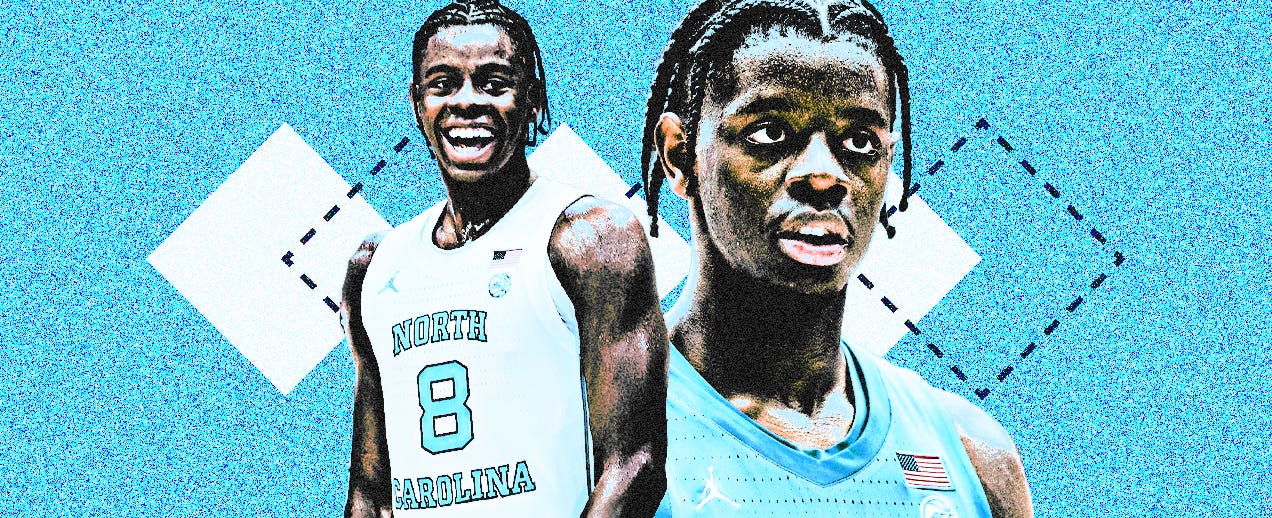
Cameron Boozer. Darryn Peterson. AJ Dybantsa.
Those are the names within the 2026 NBA Draft class you will hear they belong in their own tier, for a number of reasons. Cameron Boozer is the cyborg that will consistently pour out production over the course of a game. Darryn Peterson is the professional bucket-getter, who can provide an onslaught of scoring that can leave the defense in a state of confusion and fear. AJ Dybantsa is the player that has the highest ceiling in this class, possessing a rare combination of size and skill.
Every other player is just fighting for fourth place.
Once you get to the fourth spot among big boards, there are several players who are vying for that position. Kingston Flemings has been very effective all season long, but his 42 points, six assists, and two steals in his last game against Texas Tech has put him firmly within the #4 pick conversation.
But, simultaneously, there are conversations as to who is “PG1” within this class. Mikel Brown Jr. and Darius Acuff Jr. are also considered to be in contention for being the best at their position within this class. Inherently, that makes the conversation for the fourth overall pick all the more saturated.
Keaton Wagler has also played his way into consideration for the second tier in this class.
This is why you will hear Caleb Wilson’s name mentioned with multiple players within a tier…just not the top tier.
The reasons for this largely come down to a few points:
Shooting Concerns
Non-Dunk Finishing
Lack of Feel
How do those things translate? We’ll dive into that here.
Shooting Concerns
Reason to Doubt?
Let’s kick things off with the shooting concerns that some have with Caleb. There is some precedent for these concerns, to be fair. He is shooting only 25% from deep on 1.8 attempts per 100 possessions, and if you look at the current free-throw percentage of 69.3%, you may not feel confident with Caleb’s ability to be a consistent shooter from distance.
Let’s take a look at his three-point shot.
From this clip, there isn’t much to nitpick in terms of form, timing, or release. He looks confident right from the catch, going right into his shooting motion, and he’s able to knock down the shot.
Let’s take a look at a missed three.
Yeah, this is a missed three, but what’s the difference in this shot compared to the one above? After all, this shot came in the same game—just a little later. To start, there is a difference in the decisiveness on this three-pointer compared to the previous clip. Notice the hesitation Wilson has in attempting the shot. Shooting off the catch is a rhythm shot; any disturbance in that rhythm can decrease the likelihood of the shot falling. That’s what it looks like here.
Just want to drop this make from Caleb after the clip of the miss. Caleb getting into his jumper confidently looks much different.
Reason to Believe?
If you’re curious to know why there should be a patient approach to Caleb growing into becoming a reliable shooter, there are a few ways you could get there. Let’s start with getting into the sheets.
This BartTorvik query is used to show how Caleb Wilson compares to those players who have been drafted that meet specific criteria. To start, I filtered the entire “BT” database of lottery-drafted players who measure at least 82 inches—Caleb’s height on the website. That shows that, since 2008, there have been just 73 players at Caleb’s height drafted in the NBA Draft Lottery. From there, I applied the following:
Far Two Pointers Attempted: At least 50
Three Point Percentage: No Greater than 30%
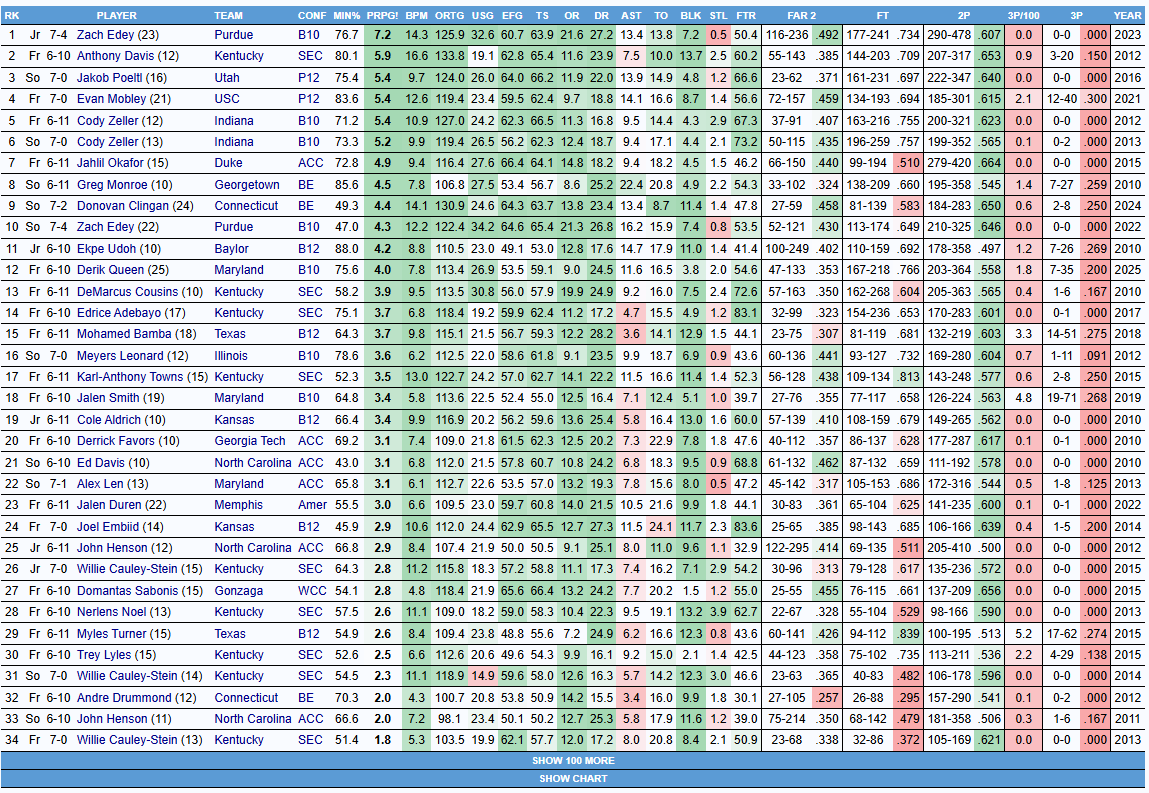
The objective was to show players who attempted a healthy number of “Long Twos” while also not being very efficient from deep. Wilson has attempted 50 Long Twos, and figures to attempt a good bit more, and we already touched on the fact that he hasn’t hit many of the few three-pointers he has attempted. The findings here are a bit interesting.
Only 30 players in the BartTorvik era have been drafted in the lottery who have shown the confidence to hit the more difficult two-pointers, but weren’t consistent from deep. Of the 34 seasons of play that popped in this query, only nine included seasons where the prospect shot 70% or more from the free-throw line—two of those seasons came from the same player, Cody Zeller. The players who didn’t hit this magical free-throw percentage threshold of 70% include Joel Embiid, Evan Mobley, DeMarcus Cousins, and Domantas Sabonis.
These players are interesting when measuring against Wilson. For one, they are all big men. Secondly, these four big men aren’t career three-point marksmen, but they have had multiple seasons of shooting at least 35% from deep in the NBA.
There are obviously some players who fell more toward a supporting cast role in the NBA who became reliable shooters, which could mean promising results for Wilson as well.
Shots like this provide a lot of promise as to why Caleb could become a credible threat from deep as he continues to develop. He gets the ball in the right corner and goes to work, looking to back his man down. Wilson is capable of firing off and making these high degree of difficulty shots—shots that require a considerable amount of touch. Let’s look at another.
This is almost an identical shot to the one above. Caleb is able to dribble his way to the right corner and then work to back his man down. Again, the amount of confidence Wilson has in spinning, fading, and releasing this tough shot over the top of the defense. Shots like this demonstrate fantastic touch.
Non-Dunk Finishing
Reason to Doubt?
According to our friends at Synergy, Caleb ranks just in the 33rd percentile on non-dunk finishes—grading out as “Average”. When you look at his percentages, Wilson is converting only 44.4% of his non-dunk attempts at the rim. Now, it’s worth noting that he ranks in just the second percentile in non-dunk shot attempts. This is because Wilson has 62 dunks on the season—which ranks in the 93rd percentile. In other words, Caleb is looking to put his armpits in the rim.
A lot of Wilson’s misses come down to moments like this. After a scramble, our guy gets the ball on the left wing and looks to attack the rim. As Virginia’s defenders get into position to try to wall him off, Caleb picks up his dribble and goes into a clutch layup. The ball hangs on the back of the rim and just rolls off the back-right side of the rim. Maybe you could question the necessity of the way he went about getting into this shot, but athletic players can get into situations like this, where they can take off a little bit further than they should. This isn’t a unique phenomenon to Caleb Wilson; this often happens to the best athletes that we see in the NBA.
Reason to Believe?
So, why isn’t this long, athletic forward able to convert at the rim?
Truth is, this isn’t that uncommon among athletic finishers. My colleague and former podcast partner, Maxwell Baumbach, and I have discussed this for years. Maxwell has even included this concept in prior written work—including the piece he did on V.J. Edgecombe.

In this piece, Maxwell dove into the numbers behind Edgecombe’s 45.3% layup finishing within the halfcourt.
Simply put, it’s not uncommon for high-wire athletes to struggle with their touch at the basket when they’re younger. Bruce Brown, Dejounte Murray, Lu Dort, and Josh Green were all poor finishers during their pre-draft seasons.
-Maxwell Baumbach “The Value of V.J. Edgecombe | The Prospect Overview”
As a matter of fact, the following players were within the bottom 20th percentile compared to long-term NBA players within their position group as finishers.
This is during their final college season, by the way—and there are more players that I could list. But, you kind of get the point here. Other players—such as Amen and Ausar Thompson—also had surprisingly lower at-rim finishing, despite being supremely athletic. So, one could say that Caleb’s finishing numbers could be alarming because they are simply not good.
That’s fair.
But...
…the precedent for a long and athletic player like Wilson becoming a better finisher at the next level isn’t all that unrealistic.
Lack of Feel
Reason to Doubt?
Maybe the narrative that is associated with Caleb Wilson isn’t explicitly “Caleb Wilson has a lack of feel” but it is certainly implied. Many evaluators have stated that Wilson’s game is based on his athleticism. Now, we just looked at how Wilson’s athleticism should play a part in the reason to believe in his long-term projection as an NBA player. Don’t get it twisted, he’s a fantastic athlete with the sort of coordination and measurements that NBA front offices drool over.
Take a look at this play. Caleb posts up his man on the left block after setting a screen. After putting his left side into the post defender, he spins off to his right to avoid the impending double team. Wilson now has a runway to rise over the rotating help and slam the ball down over him. Nasty business.
Wilson has had 35 of his 62 dunks come from the halfcourt, which has given the “just an athlete” narrative a bit of footing.
Reason to Believe?
However, it’s an irresponsible oversimplification to say that Wilson’s game is “just” his athleticism. The clips that we’ve looked at so far have served as a small sample—little pieces of evidence—that Caleb has more to his game than running, jumping, and moving people.
Even the dunk clip above shows great feel for where to go with the ball in his hands to convert the dunk. But, we will look at more feel indicators.
I’ve tried to broaden my evaluation perspective a bit more this season than in years past. I’ve never been “closed off” to analytics, but I will say that I’ve tried to get into the headspace of analytically-driven evaluators more than I ever have. I’ve come away a little more enlightened, believe it or not.
“Cognition” is a fun buzzword that has been a splinter in my brain over the past couple of weeks, and there are some stats that can serve as potential indicators of a prospect’s cognition and how they can translate. For those of you who already knew this, forgive the “no kidding” nature of this prelude. For those who have no idea what I am talking about, it’s okay—I was you just a few weeks ago.
One way to recognize the cognition of a prospect is by looking at a few metrics. Assist-to-Turnover Ratio (ATO) is one such metric. Caleb has an ATO of 1.4. That may not be the top of his class, but let’s consider where that would rank among the players that we compared him to earlier.
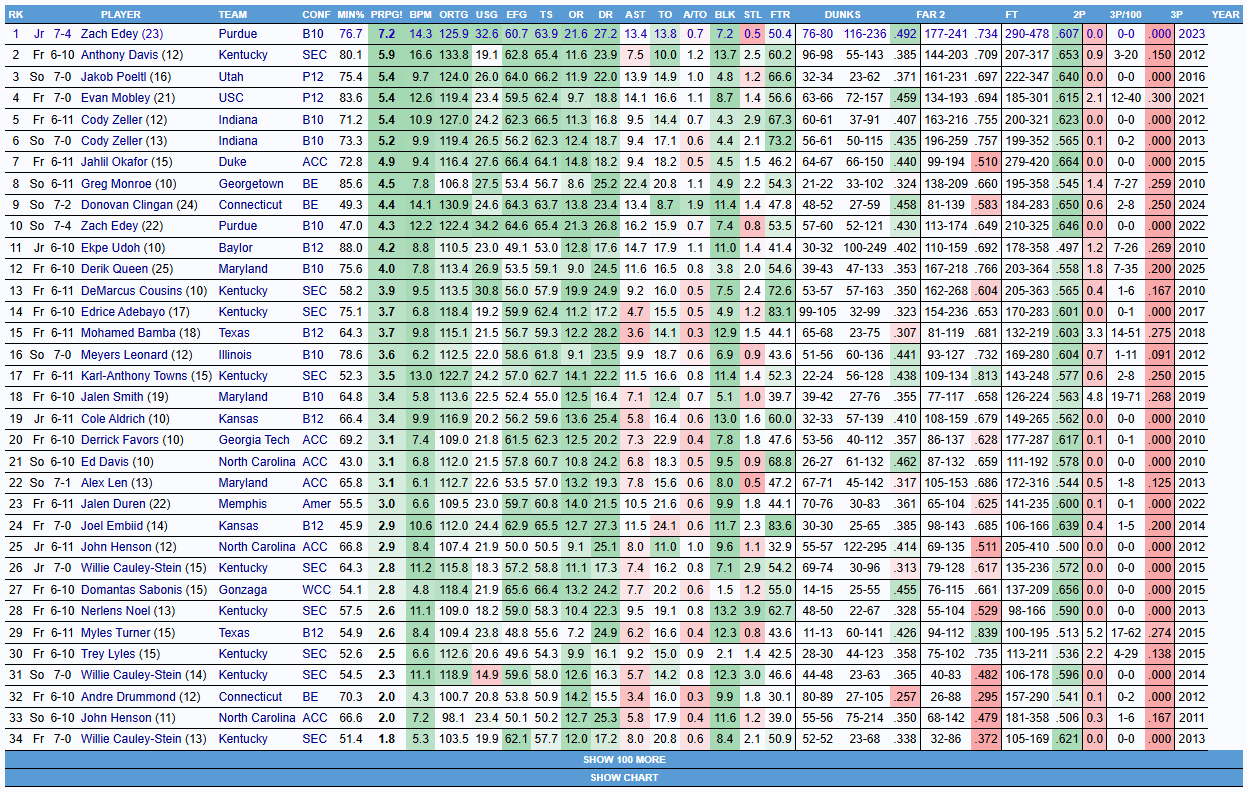
This is the same BartTorvik group we looked at earlier, but I allowed some additional fields to be viewed. Wilson’s ATO compared to the rest of the field would rank #1—which is quite impressive considering some of the names on this list. Even just in this season, he has the best ATO of any freshman at his size—over Nate Ament, Hannes Steinbach, and fan favorite, Massamba Diop.
There is a clear separation of size and skill with Caleb Wilson.
But this cognition isn’t limited to just the offensive end of the court. Defensively, Caleb has shown some ability to be impactful. This is where the skeptics and the believers will most likely come to some sort of understanding and agreement.
This clip highlights how well Caleb’s marriage of his tools and his mind can take away possessions from opponents. As his man catches the ball in the left corner, Wilson is able to rip the ball away mid-crossover. This takes ridiculous hand-eye coordination and processing.
This clip highlights Caleb’s mind, tools, and athleticism. As Malik Thomas catches the ball on the right wing in transition, he looks to attack the rim. Caleb recognizes that there isn’t anyone who can realistically challenge the shot at the rim, and makes a sprint to rotate. Caleb takes two steps after turning around and is able to swat the ball off the backboard with ferociousness.
If you want to know how the holistic game of Caleb compares to others who have come before him…
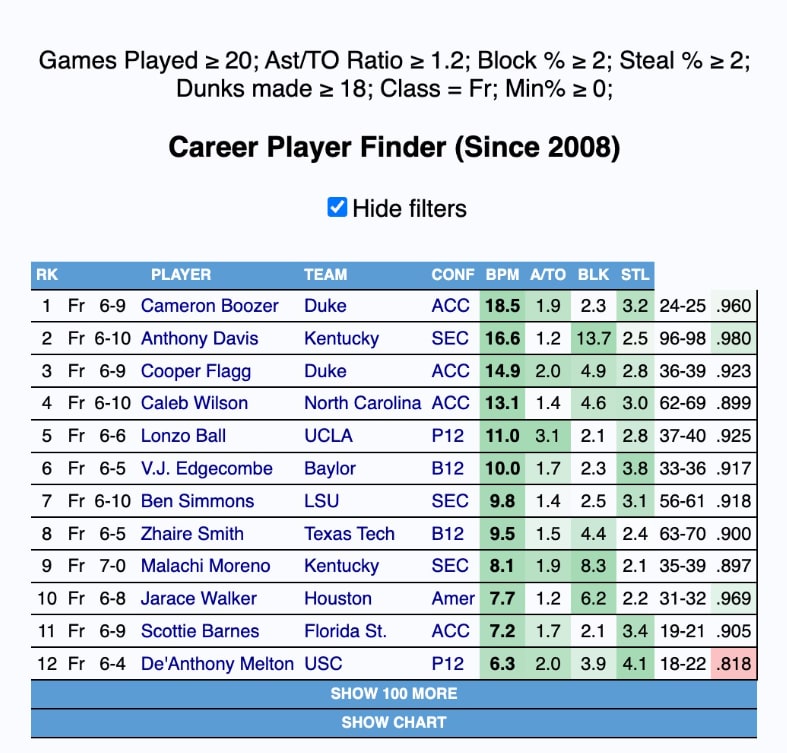
Again, this query (courtesy of the incredibly bright Finn Vandergriff) is another example of the cognition that Caleb has. When freshmen are able to perform at this level on both sides of the floor, it tends to yield positive results. Everyone on this list has made it (or will make it) to the NBA to some degree. The size of Caleb would indicate that he has a real chance to be an impactful NBA player at the very least.
Curtains
The 2026 NBA Draft Class is at an interesting moment in its season. Earlier in the season, there were concerns with Cameron Boozer’s finishing numbers and—even now—there are some (however, maybe minuscule) concerns as to his defensive role in contrast with his offensive role. Darryn Peterson hasn’t been able to play a significant stretch of basketball during the season. AJ Dybantsa has shown some sort of trouble scoring efficiently against the higher levels of competition—particularly the recent game against Arizona. They are outstanding NBA Draft prospects, and are considerably elite in many (maybe most) areas of their games.
As amazing as they are, and as much as consensus has already dubbed them as immovable at the top of the draft, there is still so much of the season ahead of us. Would it be the craziest thing in NBA Draft history for Caleb Wilson to push one of the aforementioned “Big Three” all the way down to the fourth spot on some Big Boards? I truly don’t think so. Caleb Wilson could be the prospect who could break into that top tier.
It’s not because any of those three aren’t good enough—or aren’t deserving—but because Caleb is that good.
Shoutout to Maxwell and Finn for their help in contributing to the metrics and points made in this piece.
Follow me on Twitter: StephenGHoops
Catch me on BlueSky: StephenGHoops
Catch the Draft Sickos show LIVE on the No Ceilings NBA channel:
He processes fast on the offensive end.
Not on the defensive end.
im a huge believer in his game
I have him higher than Peterson and Dybantsa
outlier(top 1%) athleticism is so valuable and will help cover up flaws. Has an elite motor and plus feel as well. He generates a TON of stocks and draws LOTS of fouls
His FT rate and midrange aren't terrible, which indicate potential shooting
His ceiling is better than Boozer depending on how everything develops
Two way play is key to me and he seems like a huge positive on both ends.