Five Rookies Standing Out in the G League So Far This Season
These first-year pros are flashing some fun stuff in the minors to start the season.

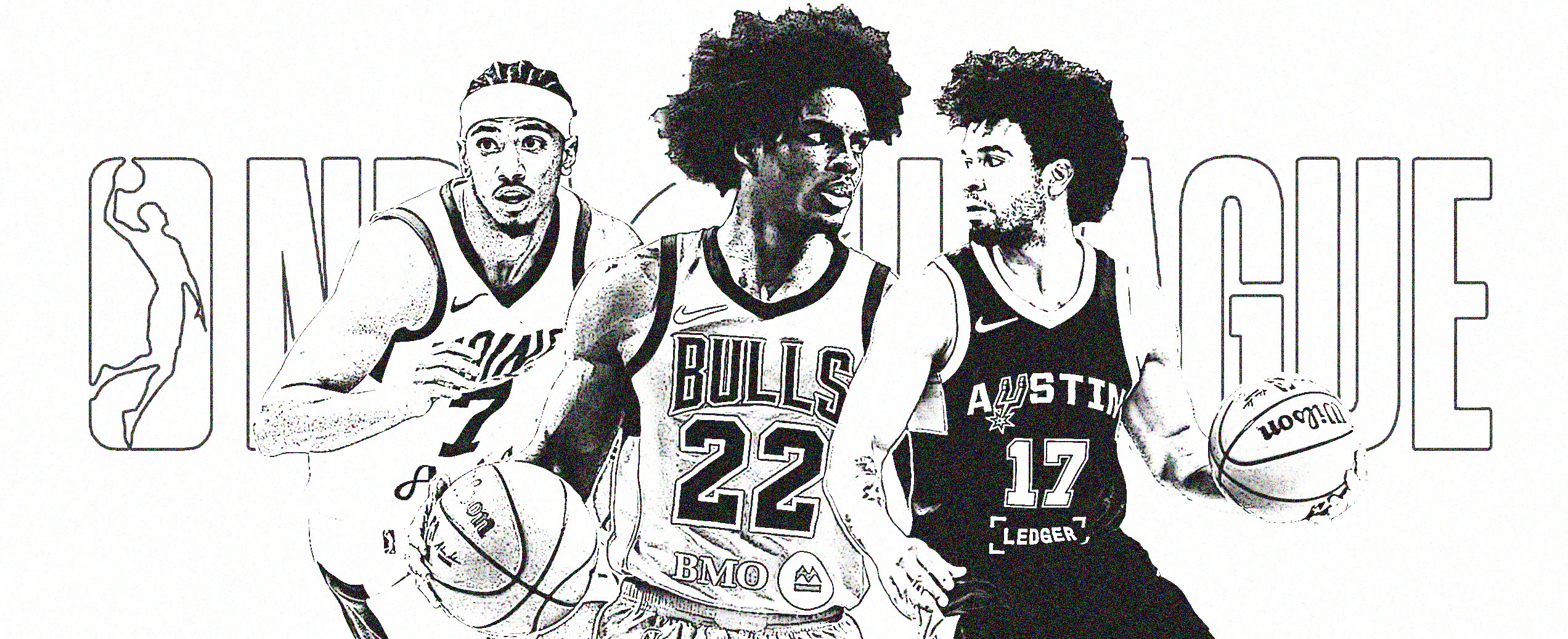
It’s always fun to see how prospects transition from college to the pros. After all, scouting doesn’t end when guys get drafted—continuing to evaluate their growth is crucial for understanding what works and what doesn’t at the highest level.
No Ceilings’s very own Nathan Grubel has done some phenomenal work covering the NBA’s top rookies so far this season, but what about the G League? Today we’ll be talking about five freshmen who have stood out in the minors and how they’re already improving as players. Let’s get right to it!
(All stats are accurate as of 11/24/26)
Jaylin Sellers
Jaylin Sellers, who’s on a two-way contract with the Chicago Bulls, has been tearing it up for the Windy City Bulls. He’s already shown he’s one of the most dynamic scorers in the G League, becoming the first Player of the Week winner of the season after averaging 26.6 points per game and 5.0 assists per game through his first five outings. With each electric performance he delivers, his case to get a real rotation opportunity in the big league grows stronger.
Coming out of Providence, we knew Sellers could get buckets in bunches. The 6’4” guard put up 18.3 PPG as a fifth-year senior in 2025-26, using his blazing speed and fiery shot-making to give defenders across the Big East headaches. It’s been the same story for him in the pros thus far, as he continues to bomb pull-up jumpers from three and in the mid-range while also aggressively attacking the rim. He has to get better at converting once he gets in the paint (0.94 PPS on layups, 23rd percentile, per Synergy), but how easily he’s creating looks for himself inside against pro athletes this early in his career is still quite encouraging.
The unexpectedly impressive part of Sellers’s play in the G has been his playmaking. He was focused on putting the ball in the hoop with the Friars last season, posting just 1.6 APG while coughing up 1.8 turnovers per game. However, with Windy City, he’s dishing out 4.8 APG while still keeping turnovers down. He’s getting all his teammates involved, making sharp kickout passes to shooters and pocket passes to his roll men out of the pick-and-roll. The more he can leverage the threat of his scoring to make plays for others, the scarier he’ll be offensively.
Tiago Splitter has already begun experimenting with Sellers, and the early returns have been overwhelmingly positive. The rookie notched 14 points in 14 minutes against the New York Knicks on November 4th, and on the 23rd, he had a nine-point, four-assist night against the Cleveland Cavaliers that had everyone in Chicago’s locker room praising him. Splitter said in an interview after that game that Sellers is “part of our future. We love him.” That’s a powerful endorsement for a kid whose stock is now surging through the roof.
Ja’Kobi Gillespie
Ja’Kobi Gillespie has established himself as an early G League MVP candidate as the Austin Spurs have gone 6-0 in the Showcase Cup. The 2026 42nd overall pick, who’s on a two-way deal with the San Antonio Spurs, has been the engine for Austin offensively, averaging 24.2 PPG and 6.7 APG.
For smaller guards to succeed in today’s NBA (especially as non-stars), it’s necessary for them to hit threes at a high rate and hold up defensively. Gillespie checks both boxes. It’s no secret the former Tennessee Volunteer can scorch nets from deep—that was one of his major selling points as a prospect. In the G, he’s shooting 47.8% from beyond the arc on 7.7 attempts per game, with many of his looks being tough pull-ups from parking lot range. As for the defense, while his 6’0” stature certainly limits him, he’s a serious disruptor who is constantly a threat to pick the pockets of unsuspecting handlers (2.2 SPG).
As a complement to his shooting, Gillespie has continued to develop as a floor general. His assist average increased each year he was in college, peaking at 5.4 in his senior campaign at Tennessee. He’s made a jump in that department once again this season, serving up 6.7 APG while acting as Austin’s lead creator. He’s also grabbing 5.7 rebounds per game, 5.2 of them coming on the defensive end, which pops given his lack of size.
It was always going to be difficult for Gillespie to get playing time as a rookie with the stacked San Antonio squad. But, as dominant as the Spurs are, they still have glaring holes on the perimeter. Whether it’s at some point during Dylan Harper’s absence, later in the spring, or in 2027-28, San Antonio should eventually give Gillespie a chance because they need more shooting. Based on how he’s looked in the G League, he would be up to that challenge.
Tre Donaldson
Tre Donaldson signed a two-way contract with the Miami Heat as an undrafted free agent this past summer, and he might just be their next undrafted gem. He’s looked the part of an NBA-caliber backup point guard at each level he’s played at—G League included.
Donaldson, who ended his college career with the Miami Hurricanes in 2025-26, has only appeared in two games so far for the Sioux Falls Skyforce, but they’ve been loud ones. He poured in 26.5 PPG, 7.0 APG, and 3.0 SPG in those contests, helping secure a win both nights.
While his scoring numbers definitely stand out, it’s Donaldson’s on-ball orchestration that headlines his value proposition from an NBA perspective. His pace control is excellent. He’s a slithery pick-and-roll operator who patiently probes and reads defenses but can speed up in an instant to beat his man or drop a dime.
Donaldson pressures the rim in transition and in the halfcourt with atypical bullishness for a 6’1” guy. His determination to seek out easier shots inside is a hallmark of his steadiness as a ball-handler. Don’t get it twisted, though: he can still knock down threes on volume. He’s a bit streaky on pull-ups, but he’s consistently efficient on catch-and-shoot tries, making him less usage-reliant than other players of his archetype.
Davion Mitchell has been unbelievable for the Heat this year, but he’s the sole true point guard in the team’s rotation right now. If he were to get hurt, or if Erik Spoelstra decides his bench needs an organizer, Tre Donaldson should hear his number called. He’s earned the opportunity.
Milos Uzan
Milos Uzan went to training camp with the Boston Celtics this fall, but he wasn’t able to beat out Devin Carter for the open two-way slot they had at the time. Now, he’s absolutely banging on the front doors of TD Garden, letting Boston know they maybe should have kept him around.
Uzan is averaging 17.0 PPG, 4.0 RPG, 6.3 APG, and 1.8 SPG while shooting 55.1% from the field and 40.0% from three for the Maine Celtics this season, a well-rounded stat line that underscores how compelling his profile is. He’s the exact type of smart role player that Joe Mazzulla loves.
During his days as a prospect at Oklahoma and Houston, Uzan proved himself as a capable secondary handler/creator who could score and playmake off the bounce while also being a solid off-ball shooter. With Maine, however, he’s growing into a primary initiator role. He’s logging fewer spot-up possessions per game (1.8) than he did in any of his collegiate seasons while scoring at an 88th percentile rate out of the pick-and-roll and setting his teammates up for plenty of easy ones.
It’s unlikely that Uzan would be used as a full-time point guard in the NBA, but the more experience he gets in a scaled-up role, the better he will look if he scales down again. There’s a world where Uzan becomes a rotational dribble-pass-shoot (and defend) off-guard at the highest level, especially if he stays in Boston’s system.
Drake Allen
Speaking of scaling up, Drake Allen has done as much of that as anybody in the G League so far this season. He was more of a role-playing connector at Utah State (although he was probably an overqualified one), but he’s become a featured piece for the Motor City Cruise and consequently a must-know sleeper on the two-way contract market.
In his final season at Utah State, Allen put up 7.9 PPG, 3.0 RPG, 4.7 APG, and 2.0 SPG while shooting 32.5% from three on low volume. For the Cruise, he’s currently notching 16.8 PPG, 4.8 RPG, 9.0 APG, and 1.4 SPG while hitting 40.0% of his shots from deep (still on low volume, though).
Allen isn’t necessarily doing anything he’s never done before from a skillset standpoint; he’s just doing more of it. Possessions as the pick-and-roll ball-handler were his top play type during his two years as an Aggie, and that’s still the case in Motor City, but his frequency has almost doubled from his senior campaign. The 6’5” guard has been fantastic as a driver and passer out of ball-screen actions while also killing it as a closeout attacker and fast-break finisher. The fact that he’s drilled 66.7% of his catch-and-shoot threes is extra intriguing—obviously that level of efficiency is unsustainable, but maintaining above-average shooting splits would go a long way for his career.
The best part of Allen’s game isn’t even his offense—it’s his perimeter defense. He can hound offensive players at the point of attack while being massively disruptive as a steals guy. He’s a good athlete with the lateral quickness and flexibility to stick to his man like glue.
From John Ukomadu, to Dawson Garcia, to Brice Williams, to Basheer Jihad and more, Motor City is loaded with interesting two-way prospects, but Drake Allen is quickly rising to the top of that bunch. The Detroit Pistons could lose him from their system soon if they don’t call him up.
Honorable Mentions:
Malik Dia, Nick Martinelli, Dillon Mitchell, Michael Ajayi, Nick Boyd, Rashaun Agee, Tucker DeVries, Dion Brown, Brendan Hausen, Houston Mallette
Finn’s Fast Findings
Here are some sleepers standing out in each league as of late:
NBA:
Jayson Kent has crept his way into the rotation for the Portland Trail Blazers recently. The sophomore out of Texas is now averaging 12.8 minutes per game across eight appearances, including two starts this past week. Kent, who first made the G League as a tryout player and earned his NBA call-up in 2025-26, is a competitive and athletic wing whose three-ball has rapidly improved since he turned pro. Last season, the Blazers found a legit two-way gem in Sidy Cissoko, and they might have done it again this year with Kent.
G League:
Cameron Hildreth of the Noblesville Boom is an early Most Improved Player candidate in the G. The British shooting guard is a sparky slasher with some P&R creation and POA defensive chops. He’s averaging 24.6 PPG right now and is a steady jumper away from being a clear two-way contract guy.
NCAA:
UCLA’s Trent Perry is enjoying a junior-year leap, putting up career highs in PPG (15.5), RPG (3.8), APG (5.7), and SPG (1.0) while shooting 43.5% from three and getting to the free-throw line 6.8 times per game. The Bruins have only faced one formidable opponent so far (Arizona), but Perry had 21 points and five dimes that night. If he can keep up this type of play throughout the conference schedule, he could sneak his way into second round pick conversations.
Discussion about this post