


When it comes to finding players who will eventually succeed in an NBA role, my train of thought is, “find guys who are capable of doing a lot, but can succeed doing less.” The data backs this up, as for the 9,304,586th time, I will link to Boris Beric’s research on two-way contracts.
Things are starting to change a little bit on this front. In the transfer portal era, we’ve seen teams load up their rosters more than ever before, increasing the likelihood that college role players will find NBA success. Guys like Sion James and Will Richard have quickly found their footing in the NBA after playing roles for premier college teams. In the olden days, they would’ve stayed at Tulane and Belmont, respectively, and put up video game numbers before entering the league, but that’s not the world we live in anymore.
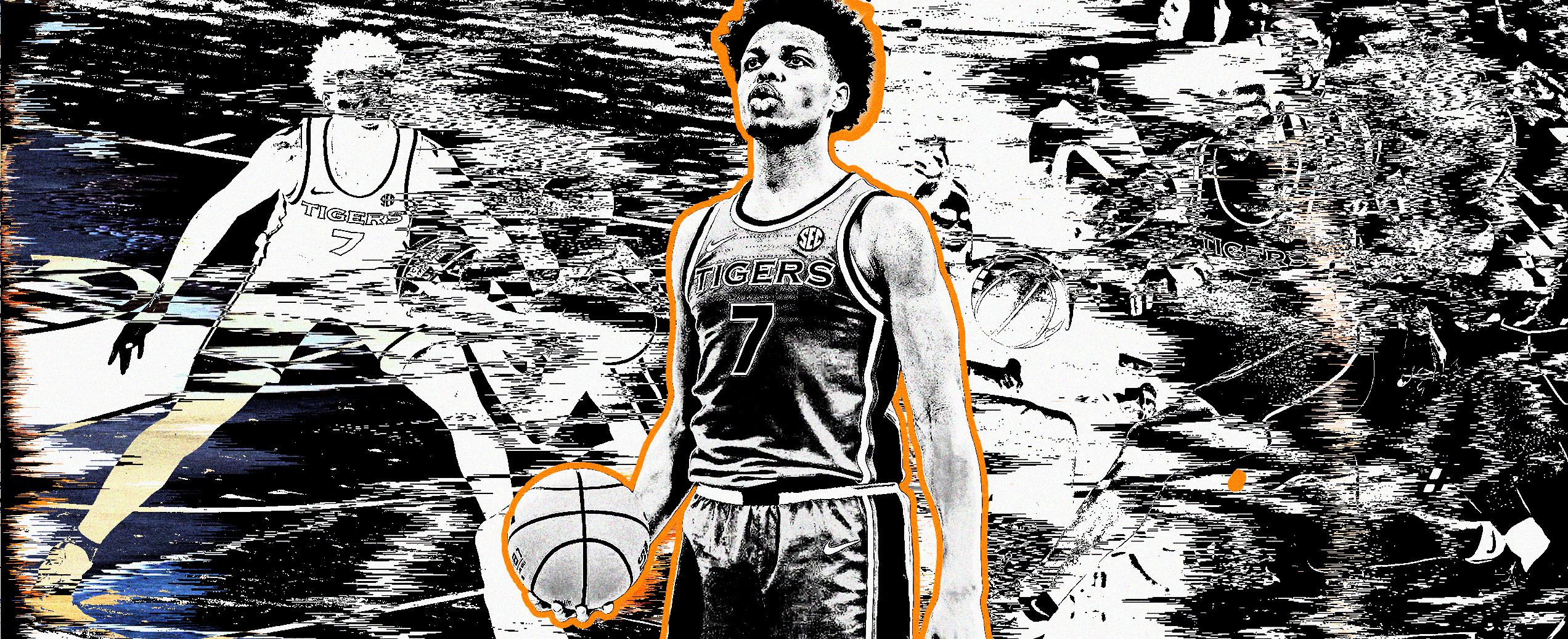
Still, I prefer to bet on guys with a wide range of talents that can be scaled down for a smaller role. A player who’s caught my eye on this front all season long is Auburn’s Keyshawn Hall. The 6’7”, 225-pound senior has been able to take on a large usage burden, but his ability to do the simple things well, paired with an NBA-ready frame, makes him an enticing prospect.
On-Ball Offense
Keyshawn Hall has thrived in a starring role this season. He’s averaging 20.4 PPG on 45.3/39.6/86.4 splits with a 27.6 USG%. Despite being the size of a big wing, Hall is a polished playmaker. He currently ranks in the 91st percentile on pick-and-roll possessions, including passes, this season, per Synergy. Hall is a diverse creator. If defenders give him too much space, he’s comfortable pulling up from deep, and he’s gone 34.2% on pull-up threes this season. That would be a solid number for any player, but again, for someone this big, it’s rather uncommon.
What I like most about Hall, though, is how he collapses the defense. For starters, he knows how to manipulate ball screens. Hall will reject or re-use ball screens to keep both his man and the screen defender off balance, which helps him get an edge early in the play. From there, he has the juice to string together multiple dribble moves, spinning and/or shifting directions to continue his advantage. Throughout that part of the process, his strength goes a long way toward helping him reach his spots. This blend of power and skill is so potent that it could be problematic even for NBA-level defenders. Plus, he relishes contact at the rim, as evident by his preposterous .684 Free Throw Rate on the season. Hall is pretty bouncy while still being coordinated enough to keep his touch when bumped inside. While Hall is ultimately an inefficient finisher (49.6% on half-court rim attempts), the fact that he applies heavy pressure to the rim, taking 42.9% of his half-court shots there per Synergy, and draws so many fouls goes a long way to compensate. Plus, he checks many of the boxes common among poor-finishing forwards who end up finding NBA success.
It’s not just about the scoring with Hall’s creation game, though. He’s a heads-up playmaker on the move, which has led to him tallying a 15.6 AST% on the year. His ability to collapse defenses, combined with his size and speed, gives him a ton of gravity. Off-ball defenders have no choice but to come help once he heads downhill, and Hall is able to exploit those openings. Whether he’s dumping it to a cutter, tossing it up to a big man, or finding a shooter, Hall can read the floor and execute well-timed deliveries.
Off-Ball + Secondary Offense
Here’s the thing, though—most NBA players don’t get to have the ball in their hands a majority of the time. As a result, I’m typically leery of players who “need the ball.” The good thing for Keyshawn Hall is that he’s not one of those players. Per Synergy, he ranks in the 97th percentile on Spot Up efficiency this year. The lefty has a high release and consistent mechanics off a quick one-two step base. Hall has sunk 41.2% of his catch-and-shoot threes on the year, and that type of floor spacing is always valuable.
It’s even more valuable given that Hall can attack hard closeouts or stampede to the rim. His first step, size, and freight-train-like driving style make him a scary player for defenses to deal with when he gets a running start. Plus, as we discussed in his on-ball section, he can sling the rock on the move, too. The fact that Hall will stretch the defense but also has the ability to scramble it as a secondary playmaker makes him all the more intriguing. The pieces of a great complementary player are all here.
That said, one thing Hall will want to work on in the lead-up to the draft is speeding up his process. Simply put, he takes his time too much of the time. Hall is prone to stopping the ball and surveying the floor before deciding which course of action he’s going to take. The NBA is a “.5” league, though. Decisiveness is of the utmost importance. This issue isn’t something that can’t be conquered, and a player like Jaylon Tyson is a great example of that. Still, it’s the type of little trait that isn’t a big deal in his current context but could really hinder him at the next level.

Defense
Keyshawn Hall’s defense is an area that will need work. Let’s start with the positives. At his best, he can be a chore to deal with. He’s a physical dude, and he’s not afraid to bang bodies on the block against big men. This works in his favor on the perimeter, too, where smaller players are uncomfortable having to wear the weight of his frame. Plus, his foot speed is pretty good, too. When he’s fully locked in and committed to his fundamentals, he does a good job of staying in front. Still, he’s not totally consistent. He has a bad habit of “hopping,” as you’ll see in the last two clips above. This tendency to take both feet off the floor before landing makes it hard to shift directions in a hurry, and it creates consistent openings for drivers to turn on the jets and blow past him. By sliding his feet rather than jumping, he’d be better able to contain the ball.
The off-ball stuff leaves a lot to be desired. Hall’s 1.4 STL% and 2.3 BLK% are both poor marks for a forward-sized player, especially given that he’s a senior. He can get caught watching the ball at times, and he doesn’t always move with a ton of intensity when he needs to rotate or close out. Again, this is stuff you can get away with as a lead option in college, but it will need to look different on a pro floor. That said, Hall has long thrived at ending possessions. He has a career 19.2 DRB%. He’s not afraid to fight for positioning on the glass, and he does a good job of tracking where the ball is going to go.
Conclusion
I think Keyshawn Hall has gone a bit underdiscussed this draft cycle, given his production. I can see why front offices may be skeptical: Auburn has been disappointing, his defensive production is poor, and he has a tendency to stop the ball. Still, it’s hard to be super-duper low on a 6’7”, 225-pound dude who’s putting up over 20 a game in the SEC with a 61.9 TS%. Throw in the fact that he’s a reliable catch-and-shoot target, a physical driver, and an impressive playmaker, and there’s a real path for him to shape his game into an NBA role player mold. He’s one of the more intriguing players currently projected to be in the two-way contract territory.
Quick Hits
-I keep finding myself coming back to Amari Allen. I’d had some skepticism about the 6’7” freshman forward from Alabama, as he doesn’t have a ton of burst downhill, and he’s a subpar vertical athlete. As a result, he can be more back-to-the-basket as a driver than I’d like, and he’s struggled at the rim. That said, he’s been better at the basket in conference play, and he might be a true, real-deal shooter. He’s hit 39.5% of his threes on 8.5 attempts per 100 possessions in conference play. Throw in solid defensive playmaking numbers, good rebounding numbers, and a high skill-level relative to his size, and there’s a lot of insulation to his game even if the half-court rim stuff is always an issue.
-Koa Peat confuses and terrifies me. His defense against Iowa State was absolutely outrageous. We’ve seen Joshua Jefferson terrorize physically overmatched opponents this year, so Peat turning the tables on him defensively was mesmerizing. Where I’m struggling is with his offensive projection. I love his blend of power and stop-start, which helps generate space before he finishes with touch inside. He always feels like he’s totally under control. Some of the passes he throws raise my eyebrows, too. Still, we’re dealing with an interior-oriented non-center who doesn’t have much in the way of positive shooting indicators. I don’t know what he does off the ball to provide offensive value, and I’m not sure he’s dynamic enough to command it early in his career. I feel like I always end up putting oddball archetypes either too high or too low, so I’m just praying I figure out whatever the hell “just right” looks like for him come June.
-I don’t know what to do with Tounde Yessoufou either. The highly touted 6’5” freshman from Baylor. He’s taken a lot of threes this year, which is a great indicator, but it takes him a while to get it off. He’s been awesome in the mid-range, but his subpar handle and lack of control over the ball limit his upside in that area of the floor. His driving game is a bit of a mess, as he always wants to go left but finish right. He also tends to force things at the rim and misses open teammates on his way to the basket. I love his athleticism in transition, and his 3.7 STL% helps him to get out on the run often. Everything feels a bit disjointed, but the tools and motor are still leading to production. Given the weakness of next year’s class, he could explode as a “go back” guy. But if he does enter the draft, it would be hard for me to fault a team for “buying low” on a former five-star recruit with this framework.
-It’s hard to think of a better “draft the guy you don’t want to play against” guy than Rueben Chinyelu. The 6’10” junior out of Florida has another year of eligibility if he wants it, which is terrifying. His 7’8” wingspan is a mark you don’t see too often. Throw in his defensive awareness and positioning, and it’s next to impossible for teams to get anything good going inside the arc when he’s on the floor. Plus, his motor enables him to grab every single rebound. The fact that he’s only shooting 58.3% from the field is rather confounding, and he blows more easy ones than I’d like to see (34-for-41 on dunks this season, per Synergy). Still, he’s made nearly 70% of his free throws, so I don’t want to come down too hard on his coordination, as he may still be piecing it all together. I’m very intrigued.
-When I fill out the back part of my Top 100, I always like to include a few “I know the numbers say no, but my heart says yes” type of guys. Truthfully, it’s tough to find a true, firm, numbers-oriented case for 100 players, but there are always outlier cases. Look at Gabe Vincent’s college stats, for instance. One guy my heart loves—Seth Trimble. I get it, he’s a 6’3” senior who’s never had a high assist rate, and he shoots under 33% from three on low volume. But he’s a guy you can go to war with. Trimble has brought the fight on defense to everybody from Cam Boozer to Darryn Peterson. He’s quick-footed, strong, and feisty. Plus, he’s a hard-nosed driver who draws a ton of fouls. I wouldn’t mind someone taking the undrafted E-10 flier on him and seeing if they can fix his shot, given the overall level of toughness and on-ball defensive acumen.
This column still isn’t over! No Ceilings+ subscribers get an additional bonus section every week! This week, I wrote about Bennett Stirtz! There is no better way to support the work that we do at No Ceilings than by subscribing to NC+. I believe our track record of consistent, thoughtful work over the past four years speaks for itself. It’s only $8/month or $80/year, so please consider supporting the work that we do. You’ll get our pre-season draft guide, access to our Discord, this extra section of my column each week, bonus columns from our entire team, live scouting reports, and MUCH MORE!