Utah Jazz: Darryn Peterson’s Offensive Explosion | The Morning Dunk
Darryn Peterson is in the midst of one of his best stretches of basketball across both college and the NBA.


Welcome back to another edition of The Morning Dunk!
It’s been a great week in basketball, with more college games tipping off filled with NBA Draft prospects AND young players in the league finding their way to producing at levels we were expecting from a star-studded rookie class.
One of those players in particular is Darryn Peterson, whose week for the Utah Jazz was arguably the best of any rookie, including other frontrunners for NBA Rookie of the Year such as Yaxel Lendeborg, Darius Acuff, and Cameron Boozer.
What’s clicked for Peterson, where can he still improve, and what does it mean for the Jazz? Let’s dig in and find out!
All stats are as of Sunday 11/15/26 and are courtesy of Synergy Sports and Basketball-Reference
The Slam Dunk: Darryn Peterson’s Offensive Explosion
If you were to sum up the last stretch of five games for Darryn Peterson, the biggest takeaway is that he’s producing in ways that are beyond just getting hot from certain spots or shot types.
Peterson is reading the game at a higher level and playing with pace in possessions such as pick-and-roll in ways he wasn’t during the first few weeks of this season, and even last year at Kansas.
To set the scene on just how good Peterson has been over the last week, in five games, Peterson has averaged 24.4 PPG vs. 12.6 over the prior eight games. Per Synergy Sports, he’s operating at a much more efficient 1.07 points per possession in those five games compared to 0.86 overall in the prior eight. But perhaps the most important efficiency indicator at a 5,000-foot view: 1.09 PPP in the halfcourt compared to just 0.87 in those aforementioned eight prior games.
That jump in halfcourt efficiency is the largest reason why he’s found much more success on offense. Yes, he’s essentially increased shot volume across the board, and his effectiveness from three-point range has been excellent during this stretch (which I’ll touch on a bit later). But it’s what he’s doing in the paint that has me the most excited about where his game is going, both in pick-and-roll sets and even on other play types or drives.
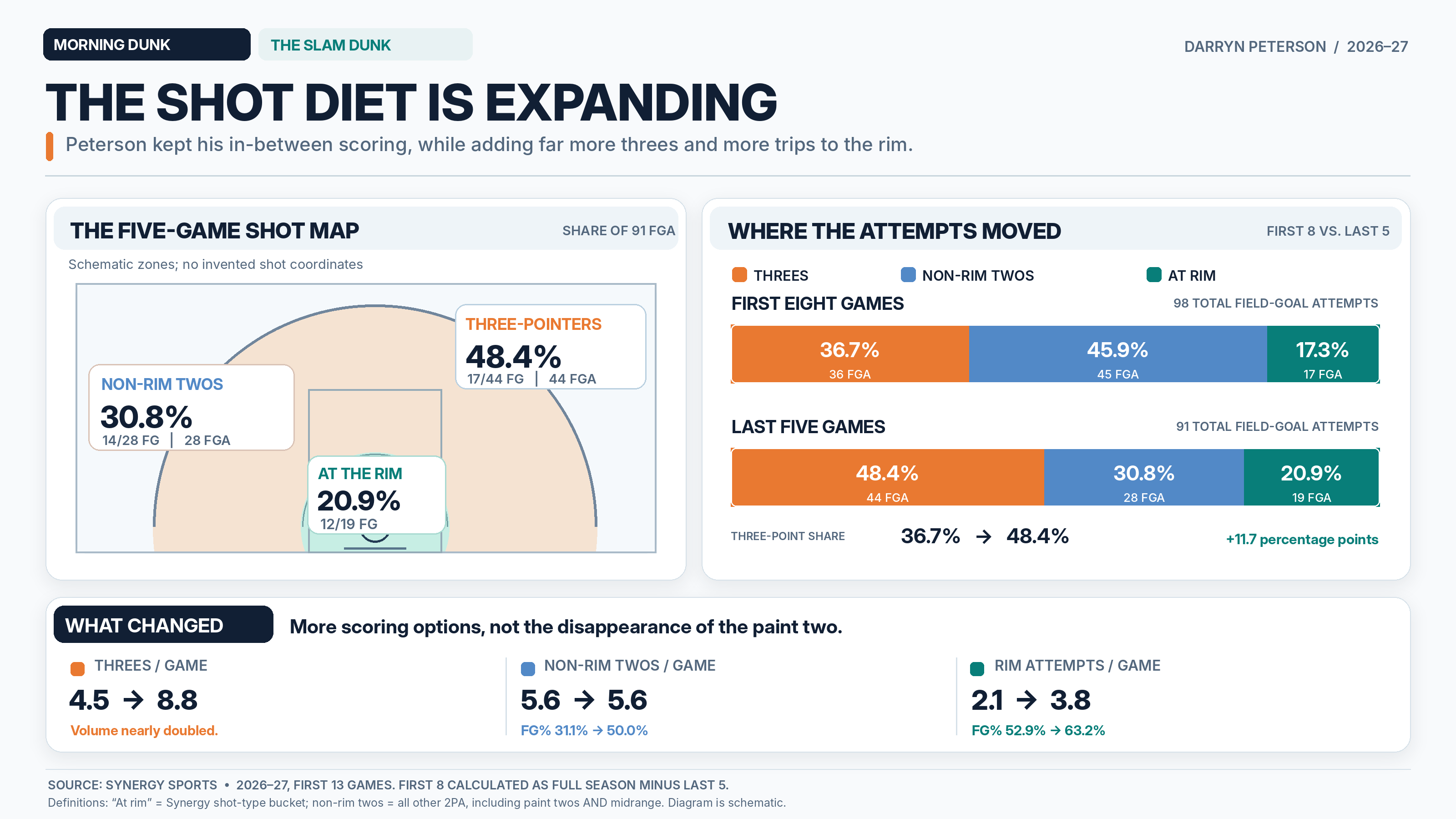
Peterson is showing a much better balance when it comes to changing gears and playing with pace on drives, especially when playing out of ball-screen offense. Peterson isn’t just showing occasional flashes of keeping defenders on his hip and playing better out of that in-between area in the paint. He’s finding success on floaters and runners on non-restricted paint twos, and it’s become as much of a go-to shot for him at this point in the season as his pull-up three.
All of Synergy’s data supports both things being connected: pick-and-roll efficiency coupled with his ability to connect on those one-handed push shots. Over these last five games, Peterson has increased his number of handler possessions in pick-and-roll, and has seen an efficiency increase of 1.27 PPP compared to 0.81. On runners specifically, he’s connecting on 52.9% of those shots.
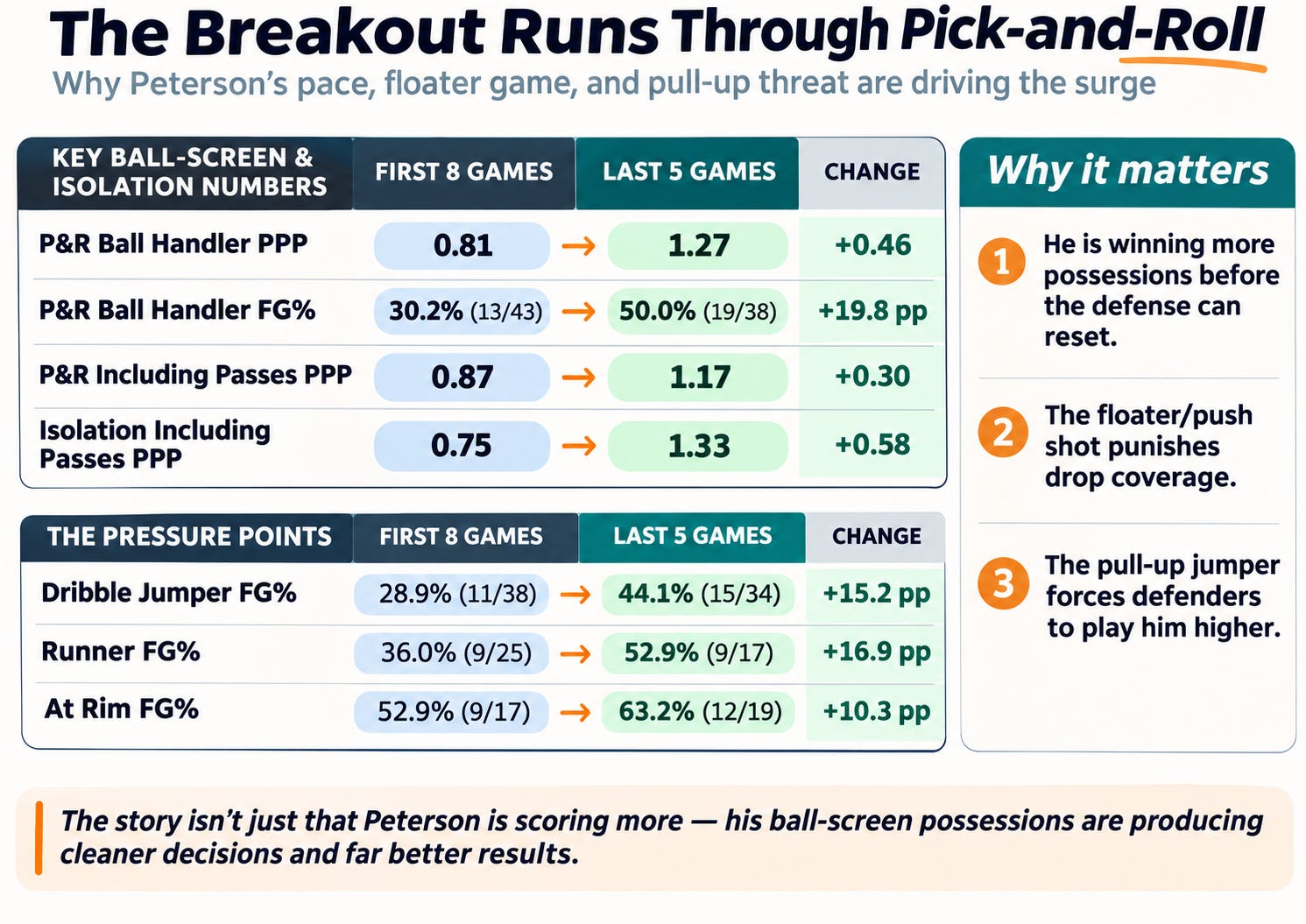
A lot was made last draft cycle (and rightfully so) about Peterson’s lack of at-rim attempts, regardless of his effectiveness on those shots. And this season, prior to this five-game hot stretch, that same concern was abundant. Before this past week, Peterson’s at-rim frequency was in the third percentile across the league per Synergy, which isn’t a number you want to see from a guard who is expected to share real ball-handling duties in the backcourt alongside Keyonte George.
So instead of forcing drives and taking contested shots at the basket to prove a point to defenses just how great of a scorer he can be when given opportunities, he’s instead pivoted to living in that intermediate window outside the restricted area.
That shot is doing so much more for his game than even the numbers could illustrate on paper. He’s forcing defenses to make decisions on the fly about how to play him, especially in ball-screen sets. Peterson is taking advantage of whatever space (or lack thereof) he has to work with, essentially neutralizing efforts to step out and defend him in several actions because of how he’s choosing to operate on offense. He’s not rushing drives to the basket, and has become much more deliberate about what the BEST shot is for him in any given situation.
When defenses have played over screens and tried to follow him from behind, he’s converted on those runners and killed drop coverages. When defenses have chosen to give him even a little space to better prepare for those middle-of-the-floor chances, Peterson has drilled jumpers off the dribble at a 44.1% frequency over these five games, even connecting on 38.6% of long threes off the bounce on even greater volume.
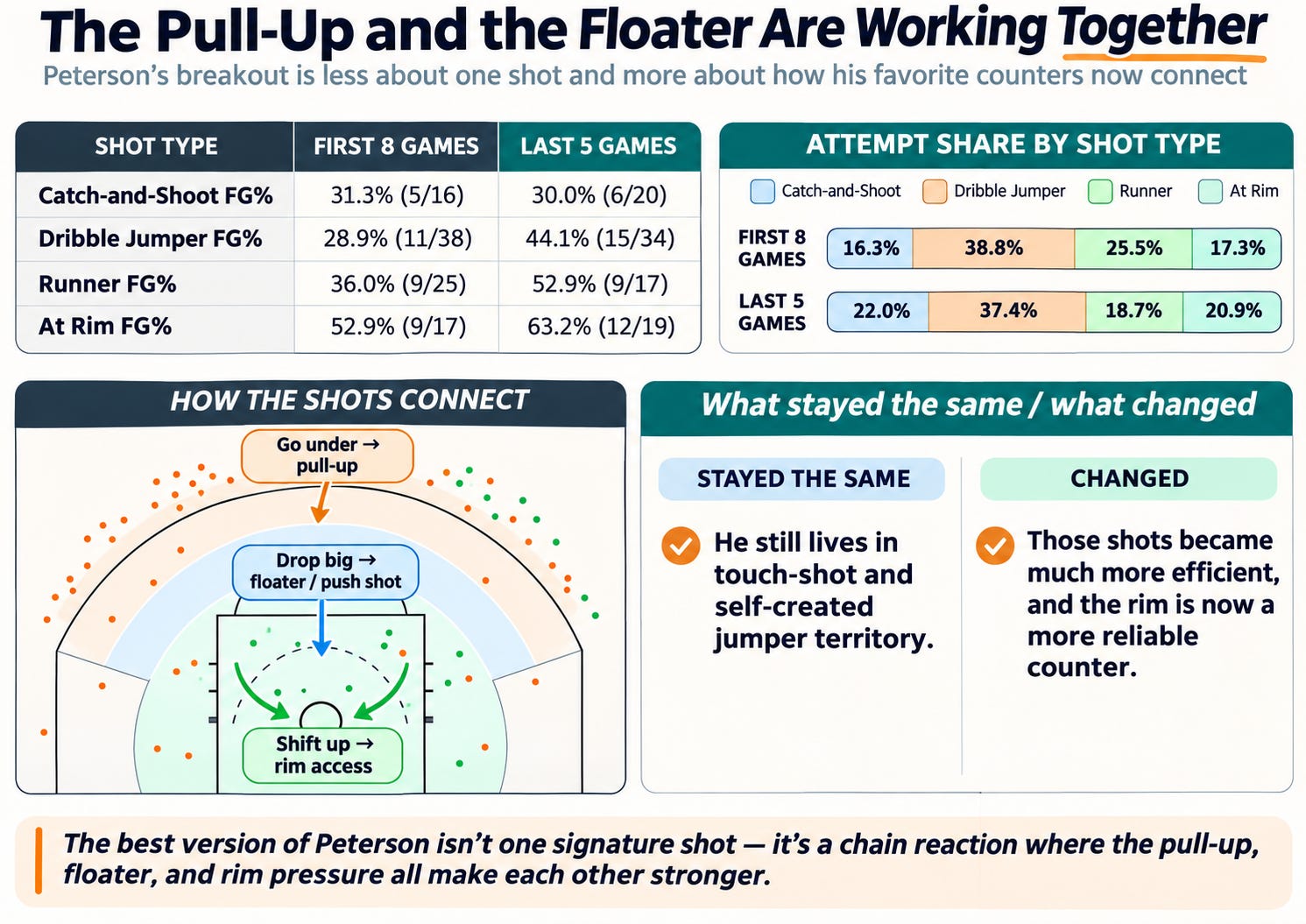
Putting all of these numbers together, you can start to paint a picture in your mind of what the heck is a defense supposed to do against this guy when he has it rolling? Even if he’s not quite finding the same level of efficiency off the catch as a three-point shooter as he did in college, we know those movement shots are in his arsenal given his shot prep and footwork stopping on a dime. His development on the ball in such a short amount of time to better mirror the type of overall scoring threat he was in high school is really punishing defenses no matter what decision they make.
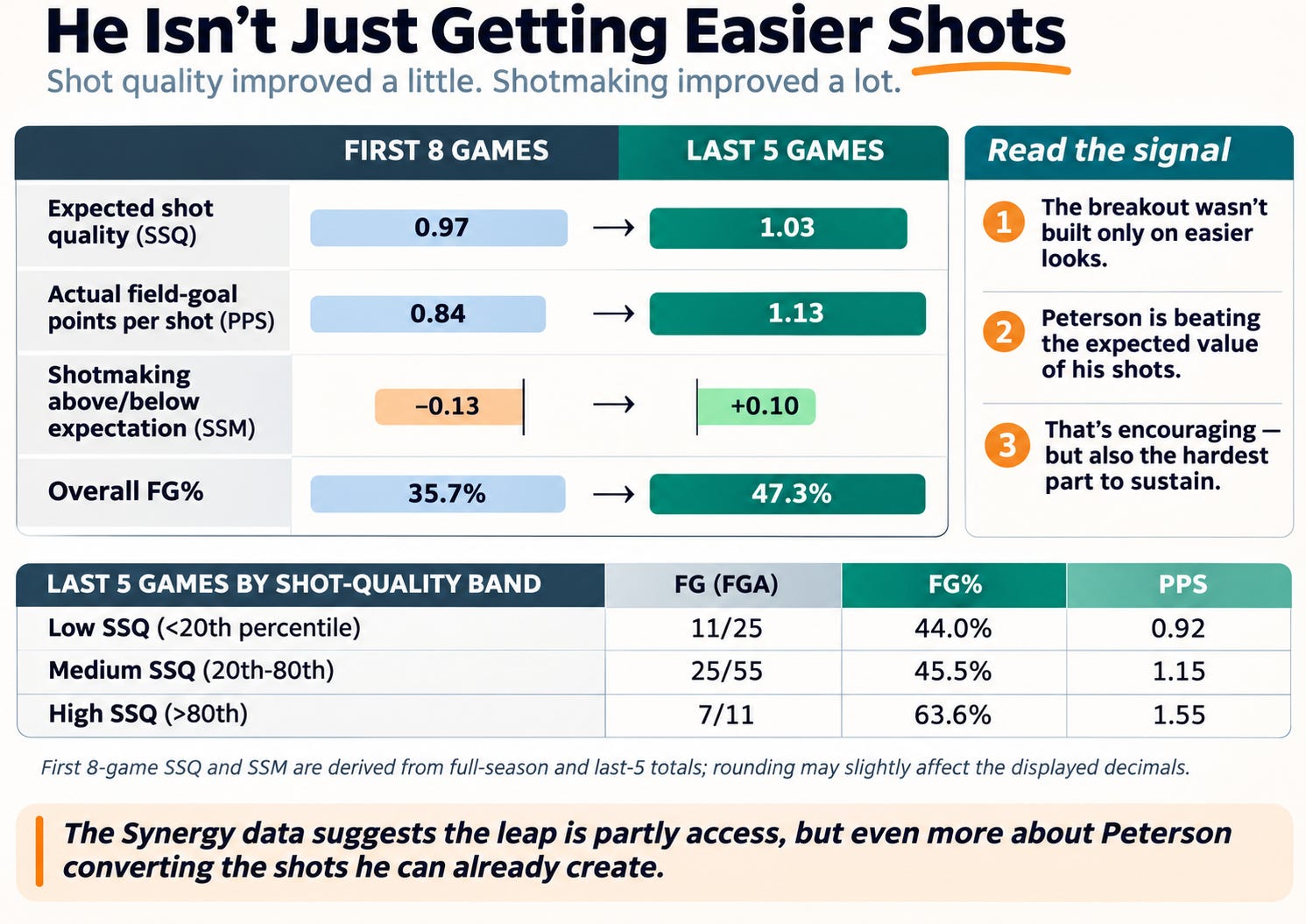
And now that Peterson is better recognizing how to play in certain situations without just forcing poor shots, his shot quality metrics have improved for the better, which obviously drives his overall efficiency across the board. Peterson is learning in real time what shots in the NBA are good or poor decisions.
Now Darryn isn’t without criticism on the offensive end of the floor, even during this excellent stretch. I’ve waxed poetic about how he’s improved as a paint scorer to better complement the level of shooter he had already proven to be before he even set foot on an NBA floor. What hasn’t changed during this run, though, is his passing.
When defenses have played coverages to show him a second defender and bring in help from the weak side, Peterson hasn’t made the most of those possessions at greater volume and efficiency. There are certainly examples over this five-game sample where he’s made higher quality passes, but the frequency and consistency of his passing game is still behind where he is as a shot maker.
Those developments will come in time, and that’s why his fit with the Jazz was perfect from the beginning. Peterson wasn’t an excellent PnR playmaker at Kansas, with poor ratings compared to where his reputation sat coming out of high school. Utah, however, ran one of the lowest frequency ball-screen offenses last year in the NBA, and has a player in George who’s much more comfortable in those types of actions to pass out of anyway, compared to Peterson.
Having a coach like Will Hardy design sets to bring Peterson into different handoffs and second-side PnR actions was always going to be a blessing for Darryn as he gets used to life in the NBA. I’ve very much loved how they’ve brought him along, and the ways in which he’s figuring out how to beat defenses even when they take away some of his best options. Punishing the help, not just the big in PnR action, is his next major step forward. I’m optimistic he’ll continue rounding out the rest of his game from a passing standpoint because, as I said earlier, he’s made some sharp decisions outside of PnR play already in the NBA. He’s far from an unwilling passer; he just needs to keep developing his vision and instincts with the ball in his hands.
I haven’t touched on his defense yet, but I’ve thoroughly enjoyed how he’s affected games both on and off the ball in the NBA so far. He hasn’t been PERFECT as a screen navigator at this level, but his reads playing passing lanes and rotating to block shots and offer support around the basket have been as good as advertised coming out of high school and college.
Peterson’s steal and block rates at lower levels were excellent for a guard prospect, and he’s continued that level of defensive playmaking with the Jazz AND he’s offered rebounding support on the glass for a team that desperately needs it due to decimating injuries in the frontcourt.
There’s been no shortage of motor and effort from Peterson on either end of the floor, and I just can’t help but speak positively about his overall development. Again, there are certainly elements we haven’t seen come together, like tighter on-ball defense, passing in certain situations, and that level of explosiveness taking angles on drives that he did at lower levels. But even with those deficiencies, Peterson has played at a level for the Jazz I didn’t expect THIS early in his career.
Could Utah have used a player like Cameron Boozer, especially without bringing back Walker Kessler given the cluster injuries that have popped up? Absolutely. But did this team also need a real scoring punch who could develop into a secondary handler in between George, Ace Bailey, and Lauri Markkanen? Also yes. And when you factor in the type of floor Peterson has as a three-point shooter with size and defensive activity, that’s a player who is so difficult to pass on in today’s NBA.
I can’t wait to keep tabs on Darryn as the season progresses, and I promise these are NOT the last words I’m going to write about Utah’s prized rookie guard.
Rookie Spotlight
Darius Acuff, Sacramento Kings
I continue to remain astounded by Darius Acuff’s comfort level in the NBA through his first month of action with the Sacramento Kings.
By no means is this a team that’s built to take advantage of everything that Acuff can do on the floor, yet he’s continued to get to every single spot he wants to on the court and knock down shots, making it look so easy.
There’s more work for him still to do as a three-point shooter, but his midrange pull-ups have continued to be one of the best weapons for any rookie in this class. At this point in the season, Acuff is hitting 43.9% of his midrange shots off the dribble, which is a great number to balance some of his shortcomings both off the dribble from three and at the rim.
Still, Acuff has taken on a preposterous amount of on-ball usage, and is essentially at “Average” marks across the board per Synergy in several key categories for a point guard.
When he starts hitting a higher volume of his threes to complement his inside-the-arc feel for getting to those pull-up jumpers, it’s going to be so difficult to guard a player who has seen the floor as well as he has from a passing standpoint to top it off. Acuff is as strong a contender for NBA Rookie of the Year as we have in the field.
Cameron Boozer, Memphis Grizzlies
Don’t look now, but Cameron Boozer is starting to figure out how to put the ball in the basket.
Over Boozer’s last four games with the Memphis Grizzlies, he’s hitting on 64.7% of his two-point field goals, compared to 45.1% on the entire season. That’s a sharp jump in efficiency inside the arc for a player who shared some of the exact same struggles during his first stretch of games last year at Duke.
What hasn’t tagged along in that regard is his three-point shot, as over those same four games he’s 3-of-17 from three-point range. If Boozer is going to take four-plus threes a game, that number certainly has to improve, but he’s shot north of 38% from deep his last few seasons as a basketball player, while also sitting at 87.3% from the free-throw line on the season overall.
Boozer’s touch on a lot of those runners and push shots was the exact same callout I had around this time last year. When he started using the backboard more last season, his two-point percentage immediately rectified itself, which is what’s happening now. He’s taking fewer of those contested runners outside of the restricted area, and doing a better job at setting himself up for looks down low off the ball against mismatches.
What hasn’t changed this entire season is Boozer’s impact as a rebounder, passer, and even defender in non-center matchups. His overall floor mapping and instincts have been as good as advertised, and he’s done a better job of sliding his feet and containing perimeter-based matchups than given credit for.
I wouldn’t have Boozer as my ROTY right now, but I do think he’s positioned himself quite well in the race, and I’d have him no lower than #3 on my ballot at this point in the year. Let’s see how he continues to navigate the waters scoring the rock, especially when given more opportunities to create shots on his own.
Sophomore Spotlight
Cedric Coward, Memphis Grizzlies
I continue to value everything Cedric Coward does as a complementary basketball player.
The Memphis Grizzlies aren’t winning because Coward is the best player on the floor. But this team IS winning because of what he provides every minute he’s out there.
Coward has become one of the best rebounding wings in the entire league, and when he’s defending his position and making shots on the other end, that’s a combination that adds up victories in a hurry.
He still hasn’t taken “the leap” as a creator, but he’s an awesome play finisher who has a nose for the ball and does the little things it takes to win. His play for Memphis to start this season is amongst some of the best you’ll see from a starting wing in the NBA in terms of impact and value.
Ace Bailey, Utah Jazz
Ace Bailey is providing production in ways very similar to what Cedric Coward is on a night-to-night basis; it just hasn’t translated to winning in the same way.
Now the Memphis Grizzlies have a frontcourt edge right now that Utah simply doesn’t, even when Zach Edey isn’t in the lineup. The Jazz are without several key frontcourt players, including Jaren Jackson Jr., so there are real issues on the margins that a player like Bailey can’t make up by himself.
But as I wrote a few weeks ago, his corner crashing for offensive rebounds hasn’t stopped, and now he’s really finding his groove as a reliable scorer off the dribble. Bailey’s shot selection is much improved this year compared to last year, and it’s led to a very repeatable shot diet and efficiency bump I expect to see from him for the rest of the year.
He’s even getting more comfortable putting the ball on the floor and getting past just pulling up for a tough jumper. Bailey is showing a much more well-rounded skill set this season for the Jazz, especially when factoring in his team defensive efforts and passing flashes.
Bailey has without a doubt been one of the top sophomore players I've watched in the league this year, even if Utah hasn’t been able to overcome a wave of injuries and frontcourt departures in the wins column.
Tyrese Proctor, Cleveland Cavaliers
Tyrese Proctor’s outing against the Dallas Mavericks deserves a mention all in itself. The sophomore guard put up a 20-point triple-double in a game where the key Cleveland Cavaliers players did not suit up. Despite not having the franchise’s best talent out there around him, Proctor looked as comfortable as I've seen him making plays with the ball in his hands.
Anyone who has watched Proctor going back to his last two years at Duke knows that he can shoot the cover off the ball, especially stepping into shots on the move. He’s a catch-and-shoot specialist with excellent size at the guard spot. He tried to do everything at Duke during his first season, but when the Blue Devils moved him into a secondary creator role and leaned more on his strengths as a shooter, Proctor’s game really came together, considering he’s always been a pest on the defensive end.
But as I said before the 2025 draft, Proctor’s experience he did get on the ball as a pick-and-roll playmaker would ultimately help him at the NBA level, even if that wasn’t his most successful role. Guys who come in as pure role players with little to no on-ball experience in college do not work out to the same degree in today’s NBA. The days of specialist role players who can’t be trusted to make decisions and put the ball on the floor are over. Proctor has experience he can lean on when it comes to making quick decisions and passing guys open for shots. You saw that passing ability on display against Dallas, on top of how he approached getting to shots in one-on-one situations, not just spotting up from deep.
This isn’t the only great game Proctor has had as a pro, and it won’t be his last. Cleveland quietly has some great perimeter talent ready to come off the bench and make an impact every night between Proctor and Jaylon Tyson. I’d expect Proctor to keep getting more opportunities as a backup point guard, not just as a spot-up shooting threat.
No Ceilings Standouts
2027 NBA Mock Draft V.2
Trusting the process with Bruce Branch III

Anthony Thompson: Connector or Correction?
The Most Intriguing Player on Each 2026-27 G League Roster
What I’m Watching Next Week
Tuesday 11/17, Illinois vs. Duke
Tuesday 11/17, Detroit Pistons vs. San Antonio Spurs
Tuesday 11/17, Michigan State vs. Tennessee
Tuesday 11/17, Utah Jazz vs. LA Clippers
Wednesday 11/18, Golden State Warriors vs. Dallas Mavericks
Wednesday 11/18, UConn vs. Arizona
Thursday 11/19, Golden State Warriors vs. Memphis Grizzlies
Thursday 11/19, LA Clippers vs. San Antonio Spurs
Friday 11/20, Kentucky vs. Indiana
Friday 11/20, Sacramento Kings vs. Los Angeles Lakers
Saturday 11/21, Milwaukee Bucks vs. Philadelphia 76ers
Saturday 11/21, Michigan vs. Villanova
Sunday 11/22, Dallas Mavericks vs. Utah Jazz
Discussion about this post